








Introduction
When security threats in Africa are discussed, attention is usually focused on terrorism, civil wars, insurgencies, military coups, piracy, and conflicts between states. This is understandable because the continent, especially Sub-Saharan Africa, has experienced decades of violent conflict and political instability. However another serious threat that is imperceptibly emerging on the continent is xenophobia. Xenophobia refers to hatred, fear, hostility, or discrimination against foreigners or people considered outsiders. In Africa, xenophobia often involves Africans attacking fellow Africans from other countries.
Although xenophobia is commonly discussed as a social or political issue, it has become an important non-traditional security threat in Africa. Unlike traditional security threats that involve military attacks or wars between states, non-traditional security threats include problems such as ethnic violence, pandemics, climate change, terrorism, migration crises, and social instability. Xenophobia falls into this category because it threatens peace, social stability, economic cooperation, regional integration, and human security.
The repeated xenophobic attacks in South Africa against African migrants from countries such as Nigeria, Zimbabwe, Somalia, Ethiopia, Mozambique, and Ghana have forced African leaders and scholars to pay greater attention to the problem. These attacks have led to deaths, destruction of property, displacement of people, diplomatic tensions, and fear among African migrants living in South Africa. Xenophobia, therefore, threatens not only individuals but also the broader vision of African unity promoted by the African Union (AU) and regional organisations such as the Economic Community of West African States (ECOWAS).
Africa’s history already shows how dangerous identity-based hatred can become when societies allow prejudice, exclusion, and fear to grow unchecked. Ethnic conflicts, religious violence, and discrimination have contributed to some of the continent’s bloodiest wars and humanitarian crises. Xenophobia is, therefore, part of a larger problem of identity politics and intolerance that continues to threaten peace and stability across Africa.
Africa’s History of Identity-Based Conflicts
Africa is one of the most culturally diverse continents in the world. It has thousands of ethnic groups, languages, cultures, and religions. While diversity should be a source of strength, politicians and elites have often manipulated ethnic and identity differences for political and economic purposes. This has contributed to violent conflicts in many African countries.
One of the darkest examples of identity-based violence in Africa was the Rwandan genocide of 1994. Between April and July 1994, more than 800,000 Tutsis and moderate Hutus were killed within about one hundred days. The genocide followed years of political propaganda, ethnic hatred, and colonial policies that deepened divisions between Hutus and Tutsis. Belgian colonial authorities had earlier reinforced ethnic identities by issuing identity cards and favouring one group over another. After independence, political tensions increased, and extremist politicians used radio broadcasts and propaganda to encourage violence against Tutsis (Mamdani, 2001).
The genocide demonstrated how dangerous identity politics can become when leaders promote hatred and dehumanisation. Neighbours turned against neighbours, families were destroyed, and the country collapsed into chaos. According to the United Nations, the genocide remains one of the worst humanitarian tragedies of the twentieth century (United Nations Outreach Programme on the Rwanda Genocide).
Another important example was the Nigerian Civil War, also known as the Biafran War, fought between 1967 and 1970. The conflict emerged after ethnic tensions, political instability, military coups, and fears of domination by the Hausa-Fulani-led federal government pushed the Igbo-dominated Eastern Region to declare independence as the Republic of Biafra. The war resulted in famine, displacement, and the deaths of between one and two million people, many of them civilians (Falola & Heaton, 2008).
The Nigerian Civil War revealed how ethnic distrust and competition for political power could threaten national unity. Although Nigeria remained united after the war, ethnic tensions have continued to shape politics and security in the country.
Sudan also experienced long periods of identity-based conflict. The Darfur conflict, which began in 2003, involved attacks by government-backed Arab militias known as the Janjaweed against non-Arab communities in western Sudan. Hundreds of thousands of people were killed, while millions were displaced. The conflict was driven by political exclusion, ethnic divisions, environmental pressures, and struggles over land and resources (Flint & de Waal, 2008).
Similarly, South Sudan experienced civil war after gaining independence in 2011. Political rivalry between President Salva Kiir and former Vice President Riek Machar quickly developed into ethnic violence between the Dinka and Nuer communities. Thousands were killed, and millions became refugees or internally displaced persons (Johnson, 2016).
Ethiopia has also witnessed ethnic tensions involving Oromo, Amhara, and Tigray groups. The Tigray conflict that erupted in 2020 caused large-scale destruction and humanitarian suffering. Reports from international organisations documented killings, displacement, and widespread human rights abuses (Human Rights Watch, 2021).
Even relatively peaceful countries such as Ghana have experienced ethnic conflicts. Northern Ghana has witnessed recurring clashes such as the Kokomba-Nanumba conflict of 1994 and the recurrent conflict among the Bimobas, Konkombas and Mamprusis. These conflicts often emerged from disputes over land, chieftaincy, and political representation (Tsikata & Seini, 2004).
These examples show that identity-based hostility remains one of Africa’s major security challenges. Xenophobia is closely linked to these broader patterns of exclusion and intolerance.
Religion and Conflict in Africa
Closely following ethnic-based conflicts is religious conflicts which also contribute to insecurity in Africa, especially when combined with poverty, political exclusion, unemployment, and weak governance. Religious identity has sometimes been manipulated by political actors and extremist groups to mobilize violence.
Nigeria provides one of the clearest examples. The country is divided roughly between a mainly Muslim north and a largely Christian south. Religious tensions have contributed to repeated outbreaks of violence since independence. One important example was the Maitatsine uprising in Kano in 1980. The extremist preacher Mohammed Marwa, popularly known as Maitatsine, led violent attacks that resulted in thousands of deaths (Isichei, 1987).
Religious violence later spread to other parts of northern Nigeria, including Kaduna and Jos. These conflicts often involved deeper political and economic grievances, including poverty, unemployment, corruption, and competition over political power.
The emergence of Boko Haram in northeastern Nigeria further worsened insecurity. Boko Haram, officially known as Jama’atu Ahlis Sunna Lidda’awati wal-Jihad, began as an Islamist movement rejecting Western education and state institutions. Over time, it evolved into one of Africa’s deadliest terrorist organizations. Boko Haram has attacked churches, mosques, schools, markets, military bases, and government institutions. According to the United Nations Development Programme (UNDP), the insurgency has killed tens of thousands of people and displaced millions across Nigeria, Niger, Chad, and Cameroon (UNDP Report on Journey to Extremism in Africa, 2017).
Religion has also played roles in conflicts in other African countries. In the Central African Republic, violence erupted between the Muslim Seleka rebels and Christian anti-Balaka militias after 2013. Although religion was not the sole cause, religious identity became a major factor in the conflict (International Crisis Group, 2015).
In Somalia, Al-Shabaab continues to wage insurgency against the government and African Union peacekeepers. In Mali and Burkina Faso, extremist groups linked to Al-Qaeda and the Islamic State have exploited weak governance and local grievances to expand their influence across the Sahel region.
Scholars argue that religion alone rarely causes violence. Instead, religious conflict is often connected to social inequality, political exclusion, poor governance, historical grievances, and economic hardship (Basedau, Pfeiffer & Vüllers, 2016). The same logic applies to xenophobia. Foreigners are often blamed for deeper economic and political problems that governments have failed to solve. This is why adding xenophobia to the already volatile and complex security mix of religious, ethnic and political conflicts in Africa, must be of great concern to every African.
Causes of Xenophobia in Africa
Xenophobia in Africa is driven by several political, economic, and social factors. One major cause is economic hardship. High unemployment, poverty, and inequality create frustration among citizens, especially young people. Foreign migrants are often accused of “stealing jobs,” controlling businesses, or increasing crime.
Political leaders sometimes worsen the situation by using foreigners as scapegoats. Instead of addressing corruption, poor governance, and economic mismanagement, politicians blame migrants for domestic problems. This shifts public anger away from governments and toward vulnerable foreign communities.
In South Africa, for example, some political groups claim that migrants are responsible for unemployment and criminal activity. However, studies have shown that migrants also contribute significantly to the economy by creating businesses, providing labour, and paying taxes (Crush & Ramachandran, 2017).
Another cause of xenophobia is competition over limited resources. In poor communities where housing, jobs, healthcare, and social services are inadequate, migrants are often viewed as competitors. This can easily lead to resentment and violence.
Misinformation and stereotypes also contribute to xenophobia. Social media, rumours, and inflammatory political rhetoric sometimes spread false claims about foreigners. Migrants are frequently portrayed as criminals or economic threats, even when evidence does not support such claims.
Weak law enforcement further encourages xenophobic violence. When perpetrators are not punished, attackers feel they can act without consequences. This creates a culture of impunity that allows violence to continue.
Xenophobia in South Africa
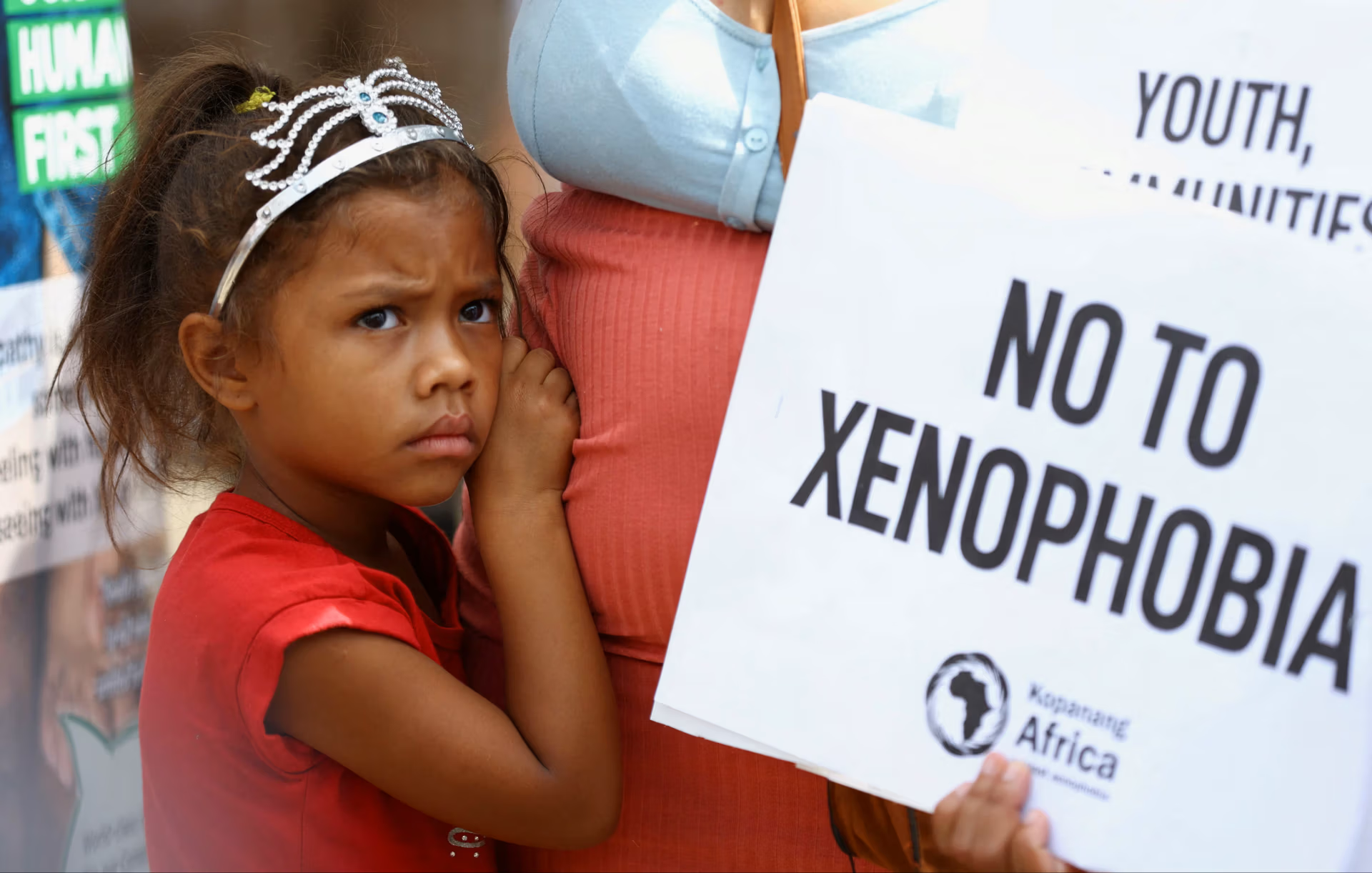
South Africa provides the most prominent example of xenophobia in contemporary Africa. Since the end of apartheid in 1994, the country has experienced repeated attacks against African migrants.
Large-scale xenophobic violence erupted in 2008 when attacks spread across Johannesburg and other townships. More than sixty people were killed, hundreds were injured, and thousands were displaced (Human Rights Watch, 2008). Foreign-owned businesses were looted and burned, while migrants were beaten and forced to flee their homes.
Further attacks occurred in 2015, 2019, and subsequent years. Migrants from Nigeria, Zimbabwe, Somalia, Ethiopia, Mozambique, and other African countries were targeted. Informal traders and shop owners were particularly vulnerable.
Groups such as Operation Dudula and Put South Africans First have openly campaigned against migrants, accusing them of taking jobs and contributing to crime. According to Xenowatch, a project hosted by the African Centre for Migration & Society at the University of the Witwatersrand, South Africa has recorded over 1,200 incidents of xenophobic violence since 1994.
The xenophobic attacks are especially painful because many African countries supported South Africa during the anti-apartheid struggle. Countries such as Ghana, Nigeria, Tanzania, Zambia, and others provided financial support, diplomatic backing, scholarships, and safe havens for South African liberation activists.
Nigeria, for instance, contributed millions of dollars to anti-apartheid efforts and established the Southern African Relief Fund. Tanzanian leader Julius Nyerere and Ghanaian leader Kwame Nkrumah strongly supported African liberation movements. Nelson Mandela himself acknowledged the role played by African countries in the struggle against apartheid.
Xenophobia, therefore, contradicts the principles of Pan-Africanism, which promote African solidarity, unity, and cooperation. Pan-African leaders such as Kwame Nkrumah, Julius Nyerere, Patrice Lumumba, and Nelson Mandela believed that Africans shared a common destiny and should support one another against oppression and underdevelopment.
Xenophobia as a Security Threat
Xenophobia is not only a humanitarian or social issue; it is also a major security threat. Persistent attacks on foreigners can create diplomatic tensions between African states. For example, xenophobic attacks in South Africa have repeatedly strained relations with Nigeria and other African countries.
Violence against migrants can also trigger retaliatory attacks, protests, and economic disputes. Such tensions weaken regional cooperation and undermine trust between states.
Xenophobia also creates instability that extremist groups and criminal networks can exploit. Divided societies become more vulnerable to manipulation by violent actors. Where communities distrust one another, it becomes easier for insurgent groups, militias, and organised criminals to recruit supporters.
In addition, xenophobia threatens economic growth and regional integration. The African Continental Free Trade Area (AfCFTA) depends on the movement of people, labour, goods, and services across borders. Fear and hostility toward foreigners discourage trade, migration, tourism, and investment.
The African Union’s Agenda 2063 promotes free movement and African unity. Regional organisations such as ECOWAS have also introduced protocols allowing citizens to move freely across borders within West Africa. Xenophobia directly undermines these goals.
Historical Lessons from Ghana and Nigeria
West Africa has experienced its own history of anti-foreigner policies. In 1969, the government of Ghana under Prime Minister Kofi Abrefa Busia introduced the Aliens Compliance Order. The policy required undocumented foreigners to leave the country within two weeks. Many Nigerians and other West African migrants were expelled (Aremu & Ajayi, 2014).
Years later, Nigeria carried out similar expulsions. During the economic crisis of the early 1980s, the Nigerian government expelled millions of undocumented migrants, including over one million Ghanaians.
The famous “Ghana Must Go” bags became symbols of forced migration and humiliation. These events damaged relations between the two countries and disrupted regional unity. Although Ghana and Nigeria later restored good relations, the incidents remain important reminders of the dangers of xenophobic policies.
Xenophobia as a Global Problem
Xenophobia is not unique to Africa. Across the world, migrants increasingly face hostility and discrimination.
In the United States, immigration remains one of the most divisive political issues. Debates over migrants from Latin America have intensified political polarisation.
In Europe, several countries have adopted stricter immigration policies amid rising anti-migrant sentiment. Far-right political parties in countries such as France, Italy, Germany, and the Netherlands have gained support partly by campaigning against immigration.
In Libya and Tunisia, Black African migrants have experienced violence, abuse, detention, and human trafficking. Reports by the International Organization for Migration (IOM) and Amnesty International have documented severe human rights violations against migrants attempting to cross the Mediterranean into Europe.
However, xenophobia poses special dangers for Africa because many African states already face challenges such as weak institutions, poverty, unemployment, corruption, terrorism, and political instability. Xenophobia can easily combine with these existing problems and produce wider insecurity.
Conclusion and Recommendations
Xenophobia has become one of Africa’s most dangerous non-traditional security threats. The repeated attacks against African migrants in South Africa show how hostility toward foreigners can threaten peace, security, diplomacy, and regional integration. Africa’s history of ethnic conflict, religious violence, and identity politics demonstrates that hatred and exclusion can easily escalate into wider instability when left unaddressed.
Xenophobia also undermines the ideals of Pan-Africanism and African unity promoted by the African Union and regional organisations such as ECOWAS. It threatens economic cooperation, weakens trust between states, and creates opportunities for extremist groups and criminal networks to exploit social divisions.
To address this growing threat, African governments must invest in education and public awareness campaigns that promote tolerance, peaceful coexistence, and Pan-African solidarity. Schools, universities, media organizations, and civil society groups should teach citizens about African history, shared humanity, and the importance of unity.
Governments must also address the root causes of xenophobia by tackling unemployment, poverty, corruption, inequality, and poor governance. Political leaders should avoid inflammatory rhetoric that blames foreigners for domestic problems.
Strong laws against hate crimes, mob violence, and discrimination should be enforced. Perpetrators of xenophobic violence must be prosecuted to discourage future attacks.
Regional organisations such as the African Union and ECOWAS should strengthen policies promoting free movement while improving migration management and border security. African states should cooperate more closely on migration policies and conflict prevention.
Religious leaders, traditional authorities, youth organisations, and community groups also have important roles to play in promoting dialogue and reconciliation. Media organisations should avoid spreading stereotypes and misinformation about migrants.
Africa’s diversity should be treated as a source of strength rather than division. For the continent to achieve lasting peace, stability, and economic development, Africans must reject xenophobia and embrace solidarity, cooperation, and shared humanity.
References
- Aremu, J. O., & Ajayi, A. T. (2014). Expulsion of West African Aliens and Nigeria-Ghana Relations.
- Basedau, M., Pfeiffer, B., & Vüllers, J. (2016). “Bad Religion? Religion, Collective Action, and the Onset of Armed Conflict in Developing Countries.” Journal of Conflict Resolution.
- Crush, J., & Ramachandran, S. (2017). South-South Migration and Urban Food Security: Zimbabwean Migrants in South African Cities.
- Falola, T., & Heaton, M. (2008). A History of Nigeria. Cambridge University Press.
- Flint, J., & de Waal, A. (2008). Darfur: A New History of a Long War.
- Human Rights Watch. (2008). “Neighbors from Hell”: Violence Against Foreigners in South Africa.
- Human Rights Watch. (2021). Ethiopia: Events of 2021.
- International Crisis Group. (2015). The Central African Republic: The Roots of Violence.
- Isichei, E. (1987). “The Maitatsine Risings in Nigeria 1980–1985.” Journal of Religion in Africa.
- Johnson, D. H. (2016). South Sudan: A New History for a New Nation.
- Mamdani, M. (2001). When Victims Become Killers: Colonialism, Nativism, and the Genocide in Rwanda.
- Tsikata, D., & Seini, W. (2004). Identities, Inequalities and Conflicts in Ghana.
- United Nations Development Programme (2017). Journey to Extremism in Africa.
- United Nations Outreach Programme on the Rwanda Genocide. The Rwanda Genocide and the United Nations.