








INTRODUCTION
There is a profound and growing contradiction at the heart of Africa’s twenty-first century project. On one hand, the continent is building its most ambitious integration architecture since independence: the African Continental Free Trade Area (AfCFTA), ratified by fifty of fifty-four African Union member states, promises to eliminate tariffs, liberalise services, and create a single market spanning over 1.5 billion people (African Union [AU], 2025). The African Union’s Agenda 2063 envisions a prosperous, peaceful, and integrated continent, united in its sense of purpose and identity. On the other hand, on the streets of Johannesburg, Pretoria, Durban, and Cape Town, African migrants are being harassed, assaulted, their businesses looted and destroyed. In April 2026, anti-migrant marches organised by vigilante movements swept across South Africa’s major cities, drawing international condemnation and triggering formal diplomatic protests from Ghana, Nigeria, and Mozambique (Daily Maverick, 2026a).
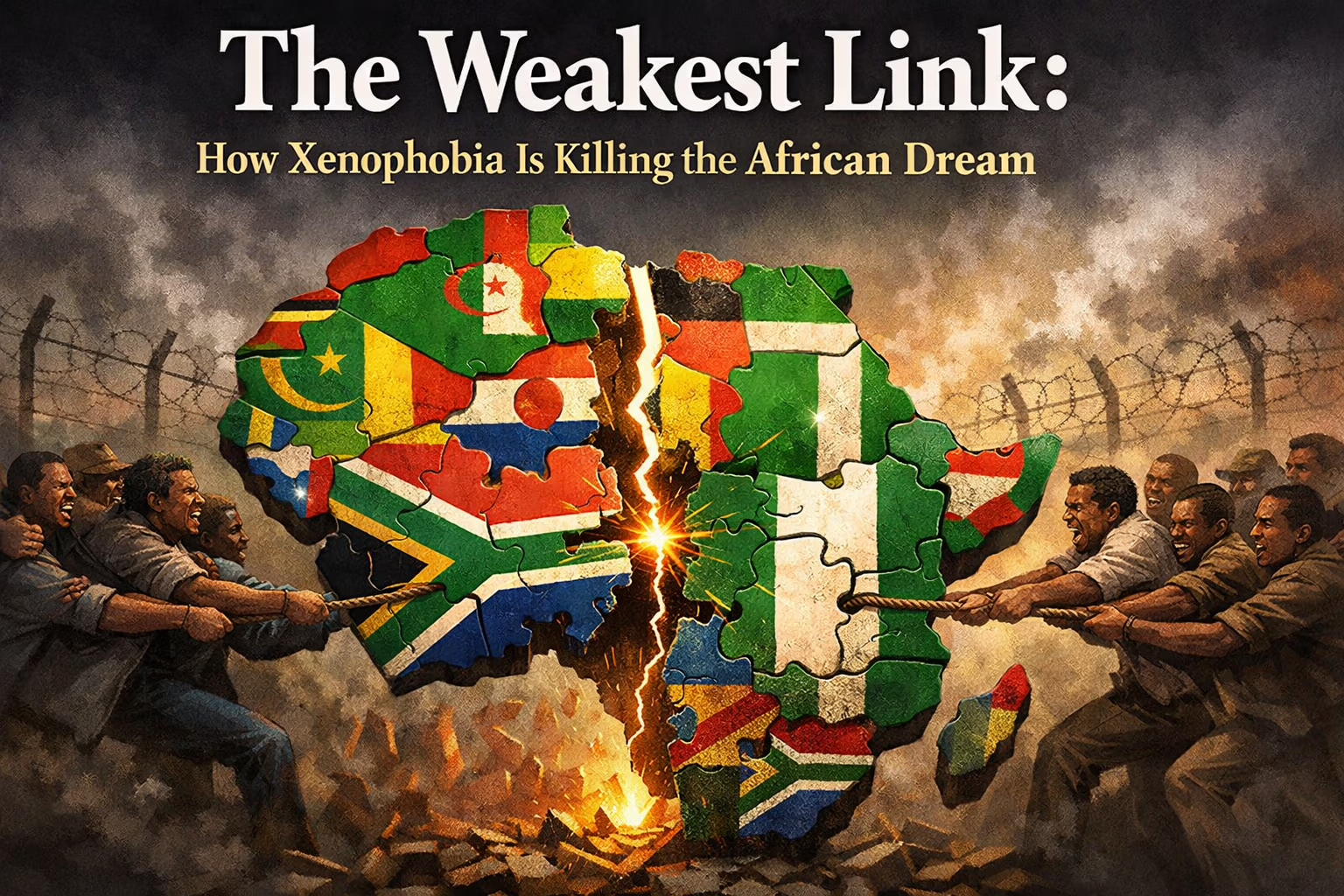
This article argues that what is unfolding in South Africa is not merely a domestic law-and-order problem, nor an isolated outbreak of social frustration. It is a structural indictment of a continental integration project that has been built from the top down, with treaties signed in capital cities while the foundational work of building solidarity among ordinary Africans has been neglected. Xenophobia, or more precisely what scholars have termed Afrophobia, the targeted hostility directed specifically at fellow Africans, is the continent’s weakest link: the point at which the African Dream is most likely to fracture (Unisa, 2024). It is a crisis with colonial roots, political architects, and media amplifiers. And it demands a response that goes beyond condemnation.
The Architecture of Integration and the Street-Level Fracture
Africa’s integration journey has registered genuine institutional milestones. The AfCFTA, which formally launched trade in January 2021, has seen twenty-five countries complete the process of gazetted tariff concessions, including the continent’s two largest economies, Nigeria and South Africa (U.S. Embassy Ghana, 2026). Intra-African trade now accounts for approximately sixteen percent of the continent’s total trade, doubling from less than ten percent two decades ago (AU, 2025). The Economic Commission for Africa projects that full AfCFTA implementation could increase continental GDP by up to $141 billion by 2045 and boost intra-African trade by as much as fifty-three percent (United Nations Economic Commission for Africa [UNECA], 2025).
Yet for all the progress at the institutional level, the AU’s own progress tracker for Agenda 2063 reveals a stark divergence between ambition and reality. While the framework for a unified Africa is recorded as one hundred percent established, progress on preserving peace and security stands at a mere one percent (AU, 2025). The AU Commissioner for Economic Development noted with candour that “too often, our implementation lags our ambition” and that protocols on free movement “remain under-ratified” (AU, 2025). The Protocol on Free Movement of Persons, adopted in 2018, has not yet reached the minimum threshold of ratifications required to enter into force, meaning that the AfCFTA is being asked to integrate economies whose people cannot legally move across borders without significant restriction.
This gap between institutional architecture and lived reality is nowhere more visible than in South Africa, the continent’s most industrialised economy and the largest host of African immigrants. South Africa is home to approximately three million migrants, ninety percent of whom are from other African countries (South African Department of International Relations and Cooperation [DIRCO], 2026). Between late April and early May 2026, anti-immigrant marches organised by movements including Operation Dudula and the newly emerged ‘March and March’ swept through Johannesburg, Pretoria, Tshwane, and Cape Town (Daily Maverick, 2026a). The Human Sciences Research Council had already documented a sharp escalation in anti-immigrant sentiment, with the share of South Africans expressing outright hostility toward immigrants rising from twenty-eight percent in 2020 to forty-two percent nationally by 2025, and reaching sixty percent in KwaZulu-Natal (HSRC, 2025). In response, the African Commission on Human and Peoples’ Rights issued a formal statement of grave concern, noting that the 2026 incidents formed part of a longstanding pattern of xenophobic violence stretching back to the 1998 killings in Johannesburg and the catastrophic May 2008 nationwide attacks that resulted in over sixty deaths, 1,700 injuries, and 100,000 displacements (African Commission on Human and Peoples’ Rights [ACHPR], 2026).
Afrophobia: The Colonial Blueprint and Its Post-Colonial Inheritance
To understand why Africans fear and attack each other, it is necessary to interrogate the historical architecture of that fear. Contemporary Afrophobia is not spontaneous; it is the product of deliberate colonial engineering that systematically dismantled the pre-colonial networks of solidarity and mobility that had connected African peoples across what would become artificial national borders (The Reporter Ethiopia, 2024).
European colonialism did not merely draw borders; it constructed what scholars have called ‘ethnographic states’, that is, administrative units designed to make diverse populations legible and controllable by institutionalising rigid communal identities (PMC, 2022). The implementation of Communalising Colonial Policies across British and French territories deliberately ensured that ‘distrust was stronger than trust’ among the colonised, using preferential treatment for selected ethnic or linguistic groups to generate ranked hierarchies of status and inter-communal resentment (PMC, 2022). In southern Africa, the apartheid homeland system took this architecture to its logical extreme, classifying Black Africans by ethnicity and geography, physically separating populations, and creating a system in which even Black South Africans were rendered ‘foreign’ in their own land (Science Open, 2023). The structural consequence of this history is that post-colonial African states inherited borders designed for extraction rather than for the cultivation of inclusive citizenship, and post-independence governments frequently embraced exclusionary nationalism as a tool of political consolidation rather than dismantling the colonial frameworks of belonging (The Reporter Ethiopia, 2024).
The psychological dimensions of this legacy are equally significant. Frantz Fanon and Jean-Paul Sartre described the ‘nervous condition’ of the colonised: a state in which the oppressed, having been subjected to centuries of colonial hegemony, internalise their oppressors’ hierarchies and project them onto one another (Unisa, 2024). This internalised racism explains a phenomenon that is otherwise deeply counterintuitive: why, in a country like South Africa, a white foreigner is often perceived as a potential employer or benefactor while a Black African migrant from Zimbabwe or Nigeria is seen as a threat who has come to ‘steal’ jobs and resources (Unisa, 2024). The ‘exceptionalism’ narrative, which conditions citizens in more economically developed African countries to believe they occupy a superior tier relative to their continental peers, functions as an ‘architectural illusion’ that obscures a shared vulnerability while directing popular anger downward at the most precarious rather than upward at the systems that produce precarity (The Reporter Ethiopia, 2024).
West Africa’s own history offers sobering precedent. In 1969, Ghana’s Aliens Compliance Order targeted over 200,000 migrants, many of them Yoruba traders from Nigeria who had been deeply integrated into Ghanaian society for generations (International Migration Institute, 2010). In 1983, Nigeria’s government ordered the deportation of an estimated two million undocumented migrants, primarily Ghanaians, in what became known as the ‘Ghana Must Go’ expulsions, triggered by an oil price collapse and used to divert public attention from economic failure and corruption (International Migration Institute, 2010). In Côte d’Ivoire, the ideology of Ivoirité , initially a cultural concept , was weaponised by political elites to disenfranchise millions of residents from the north and from neighbouring countries, eventually contributing to a civil war (Africa Files, 2003). These are not footnotes to history; they are templates that continue to be replicated.
The Political Economy of Manufactured Fear
Contemporary xenophobia in South Africa is not merely the spontaneous expression of economic grievance; it is manufactured, organised, and politically exploited. The critical analytical distinction here is between citizens experiencing genuine economic distress, which is real and should be addressed, and political actors who weaponise that distress by directing it toward migrants rather than toward the governance failures that produced it.
South Africa’s structural conditions are severe. Since 2021, unemployment has hovered around one-third of the working-age population, with youth unemployment significantly higher (Al Jazeera, 2023). Inequality remains among the highest in the world, with the post-apartheid transition having produced democratic political rights without commensurate economic transformation. These conditions create the social soil in which xenophobia can take root. But the harvest is cultivated by political actors. The uMkhonto weSizwe Party, led by Jacob Zuma, explicitly embraced xenophobic nationalism in its 2025 manifesto, pledging to prioritise South African workers over foreign nationals (IOL, 2026). The Zulu king’s use of the derogatory slur ‘kwerekwere’, a term implying sub-human status , in public discourse represented the normalisation of anti-African hatred at the highest levels of political and traditional authority (IOL, 2026). As one analyst observed, ‘xenophobia in South Africa is manufactured by elites who benefit when the poor fight each other instead of demanding accountability from their rulers’ (IOL, 2026).
Operation Dudula, whose name translates from Zulu as ‘to force out’, formalised this political machinery into a vigilante movement and subsequently a political party (Al Jazeera, 2023). Established in Soweto in 2021, the organisation developed office structures, social media accounts, and staged mass gatherings attended by members in branded uniforms (Daily Maverick, 2025). Operating under the rhetorical cover of targeting ‘only undocumented migrants’, the organisation in practice targeted all those perceived to be non-South African, documented refugees, legal residents, and citizens whose appearance or language marked them as ‘other’ (SIHMA, 2025). In November 2025, the Gauteng Division of the High Court issued an interdict against Operation Dudula, prohibiting its members from blocking foreign nationals from accessing schools, hospitals, and clinics, with the presiding judge finding that since 2021 the organisation had ’emerged as one of the most visible and violent proponents of xenophobia, targeting foreign nationals and those perceived to be foreign’ (Power Law Africa, 2025). Yet within months, the organisation had resumed its activities in coordination with new movements, marching through multiple South African cities in April 2026 (Daily Maverick, 2026a).
The role of digital platforms and media in amplifying this hostility deserves particular attention. The shift from sporadic street violence to organised digital xenophobia represents a qualitative escalation. Researchers at Africa’s a Country have noted the movement’s deliberate rebranding of anti-migrant sentiment into the legalese of ‘illegal aliens’ and ‘undocumented immigrants’: a linguistic strategy designed to disarm critics while preserving the essential hostility (Africa’s a Country, 2025). Social media platforms have enabled the rapid coordination of marches, the viral spread of anti-migrant content, and the construction of a narrative ecosystem in which the African migrant is rendered as the root cause of South Africa’s social ills. The Johannesburg High Court, in its 2025 ruling, explicitly recognised that social media cannot be used as a ‘shield for hate speech or vigilantism’ (Power Law Africa, 2025). Meanwhile, the UN Secretary-General António Guterres, speaking on South Africa’s Freedom Day on April 27, 2026, condemned the violence and reminded South Africa of the solidarity African nations had extended during the struggle against apartheid (Daily Maverick, 2026a).
The Continental Stakes: Xenophobia as a Security Threat
The framing of xenophobia as a domestic social problem systematically underestimates its continental security implications. Afrophobia is not merely a violation of individual rights; it is a structural threat to the collective security and economic architecture that African states are simultaneously trying to build. And history shows, with uncomfortable consistency, that the states which expel their African migrants tend to damage themselves in the process.
West Africa’s own past offers the clearest evidence of this pattern. When Ghana’s Prime Minister Kofi Busia issued the Aliens Compliance Order on November 18, 1969, requiring approximately 200,000 immigrants — predominantly Yoruba traders, farm labourers, and artisans from Nigeria — to leave within fourteen days, the government framed the measure as economic protection (Edward A. Ulzen Memorial Foundation, 2017). The immediate consequence was the opposite. Nigerian migrants had been deeply embedded in Ghana’s retail trade networks and cocoa farming economy since at least the 1930s; their abrupt removal created acute shortages in urban markets and disrupted agricultural labour chains that Ghana’s own workforce was not positioned to fill quickly (Addo, 1970; Academia, 2009). Far from arresting Ghana’s economic malaise, the expulsion deepened it, contributing to the deterioration that preceded Busia’s own overthrow in a military coup in January 1972. The lesson was stark: the economy that expelled its migrant labour force did not reclaim prosperity — it inherited the vacuum.
Nigeria’s expulsion of an estimated two million Ghanaians and other West Africans in 1983 produced a mirror image of the same logic. President Shehu Shagari’s government, facing collapsing oil revenues and an impending election, scapegoated migrants as the cause of Nigeria’s economic difficulties (LSE Africa at LSE, 2017). Yet Ghanaian migrants had been critical to Nigeria’s cocoa belt economy as merchants, traders, and farm workers; their expulsion hurt Nigeria’s own cocoa industry, reducing the merchants available and driving up prices at a moment when Nigeria could ill afford further agricultural disruption (Academia, 2022). Meanwhile, the 900,000 to 1.2 million Ghanaians forcibly returned — representing ten percent of Ghana’s total population at the time — overwhelmed an already fragile Ghanaian economy and worsened the 1983 famine (EBSCO, 2025). Both states absorbed damage neither had anticipated. In every instance of mass expulsion in West African history, the expelling state has paid an economic price it neither calculated nor recovered from quickly.
South Africa’s present crisis is reproducing this pattern in real time. Foreign African migrants, particularly from Zimbabwe, Mozambique, Nigeria, and Ghana, constitute the backbone of the informal spaza shop economy in South Africa’s townships — the retail networks through which millions of low-income South Africans access food and basic goods daily. Campaigns to remove them do not create jobs for South African nationals; they create food access crises in the very communities that supported the expulsions. South Africa received 10.5 million tourists in 2025, with African travellers accounting for four in every five arrivals; the current crisis has already triggered travel advisories from Kenya, Ghana, and others, directly threatening a tourism economy built on African solidarity (The East African, 2026). In 2019, retaliatory protests in Nigeria against South African businesses — forcing MTN and Shoprite to temporarily close their facilities — offered an early preview of the regional economic blowback that xenophobia generates (ACET for Africa, 2019). The AfCFTA’s projected gains are directly undermined when the states that anchor the agreement are simultaneously destroying the social fabric on which any meaningful integration must rest.
The diplomatic fallout from the 2026 crisis has been swift and multilateral. Nigeria’s Foreign Minister Bianca Odumegwu-Ojukwe formally contacted her South African counterpart Ronald Lamola following the deaths of two Nigerian nationals — one from injuries sustained after an assault by South African National Defence Force personnel, a second found dead at the Pretoria Central Mortuary following an interaction with the Tshwane Metro Police (Daily Maverick, 2026b). Ghana summoned South Africa’s acting High Commissioner and, in a letter signed by Foreign Minister Samuel Okudzeto Ablakwa on May 6, 2026, formally petitioned the African Union Commission to place the issue on the agenda of the Eighth AU Mid-Year Coordination Meeting scheduled for Cairo in June 2026, invoking the legacy of Kwame Nkrumah and arguing that Africa’s liberation and development depend on solidarity among African nations (Diplomatic Times Online, 2026). Mozambique’s President Daniel Chapo visited South Africa in early May to discuss the protection of Mozambican nationals (Daily Maverick, 2026b). The African Commission on Human and Peoples’ Rights issued a formal statement of grave concern, noting that the 2026 incidents formed part of a longstanding pattern of xenophobic violence and calling on Pretoria to take decisive measures to dismantle vigilante groups engaging in unlawful enforcement activities (ACHPR, 2026).
South Africa’s response to Ghana’s AU petition was revealing. Pretoria described the escalation as regrettable, insisted there was no credible evidence that nationals had been killed by law enforcement, and proposed that if the matter reached the AU agenda, South Africa would counter with a discussion on the push and pull factors of migration — effectively redirecting blame toward the governance failures of sending countries (DIRCO, 2026). The Africa Report captured the central contradiction with precision: Pretoria cannot claim the mantle of continental leadership while failing to protect African citizens within its own borders (The Africa Report, 2026).
Conclusion and Recommendations
The African Dream of integration, collective prosperity, and continental solidarity is being unmade one violent encounter at a time on the streets of South African cities. The continent is signing trade agreements while failing to secure the social compact that makes trade meaningful: the recognition that the African on the other side of the transaction, the other side of the border, or the other side of the street is a partner rather than a threat.
Addressing this crisis requires intervention at multiple levels simultaneously. First, the political exploitation of xenophobia must carry a real cost. African governments must move beyond rhetorical condemnation to concrete accountability by prosecuting political leaders and vigilante groups that incite anti-migrant violence
and ensuring that platforms enabling digital hate speech face enforceable consequences. The November 2025 Johannesburg High Court interdict against Operation Dudula is a model that must be reinforced, not circumvented.
Second, the Protocol on Free Movement of Persons must be prioritised for ratification. Continental integration that moves goods and capital without enabling the movement of people is integration that serves elites rather than citizens. Accelerating ratification and public education around the Protocol would begin to close the gap between institutional aspiration and street-level reality.
Third, the AfCFTA’s implementation must be accompanied by deliberate social investment in building pan-African solidarity at the community level. Trade frameworks reach communities through their effects , jobs, affordable goods, investment. If those effects are not felt, the treaties remain abstractions, and the African migrant remains a competitor rather than a fellow beneficiary of a shared project. Community-level dialogue initiatives, curriculum reform to include authentic pan-African history, and public awareness campaigns grounded in the Ubuntu philosophy of shared humanity are not soft complements to the hard work of integration , they are the preconditions for it.
Finally, as President Ramaphosa himself acknowledged on South Africa’s Freedom Day 2026: ‘We did not walk alone into freedom. We were carried by a tide of solidarity from the nations of Africa’ (DIRCO, 2026). That debt of solidarity is not merely rhetorical. It carries a concrete obligation to protect African lives within South Africa’s borders. The African Dream will not be realised by summit declarations alone. It will be realised, or it will fail, in the daily decision of whether to see the African standing before you as kin or as threat.
References
Africa Files. (2003). Côte d’Ivoire: The ‘Ivoirité’ crisis: Xenophobia as patriotism. https://www.africafiles.org/article_id-7157.html
Africa’s a Country. (2025, July 4). Afrophobic metamorphosis. https://www.africasacountry.com/2025/07/afrophobic-metamorphosis
Africa Center for Economic Transformation [ACET for Africa]. (2019). The African Continental Free Trade Area Agreement and xenophobia: Is Africa at a crossroads? https://acetforafrica.org/research-and-analysis/insights-ideas/commentary/the-african-continental-free-trade-area-agreement-and-xenophobia-is-africa-at-a-crossroads/
African Commission on Human and Peoples’ Rights [ACHPR]. (2026, April 27). The African Commission on Human and Peoples’ Rights deplores the xenophobic attacks and vigilante conduct perpetrated on nationals of other African countries in the Republic of South Africa. https://achpr.au.int/en/news/press-releases/2026-04-27/xenophobic-attacks-and-vigilante-conduct-perpetrated-nationals-other
African Union [AU]. (2025). AU launches the 2025 Africa Integration Report to accelerate Agenda 2063 implementation. https://au.int/en/pressreleases/20251003/au-launches-2025-africa-integration-report-accelerate-agenda-2063
Al Jazeera. (2023, September 26). South Africa’s Operation Dudula vigilantes usher in new wave of xenophobia. https://www.aljazeera.com/features/2023/9/26/south-africas-operation-dudula-vigilantes-usher-in-new-wave-of-xenophobia
Daily Maverick. (2025, November 25). How Dudula’s anti-migrant actions are reaching global attention in refugee applications. https://www.dailymaverick.co.za/article/2025-11-25-how-dudulas-antimigrant-actions-are-reacare-reaching-global-attention-in-refugee/
Daily Maverick. (2026a, April 29). Hate on parade: Xenophobic marches gather pace as UN warns South Africa. https://www.dailymaverick.co.za/article/2026-04-29-hate-on-parade-xenophobic-marches-gather-pace-as-un-warns-south-africa/
Daily Maverick. (2026b, May 4). Escalating xenophobia in SA sparks diplomatic protests by African nations. https://www.dailymaverick.co.za/article/2026-05-04-escalating-xenophobia-in-sa-sparks-diplomatic-protests-by-african-nations/
Diplomatic Times Online. (2026, May 7). Ghana petitions AU on xenophobia in South Africa, calls for fact-finding mission. https://www.diplomatictimesonline.com/ghana-petitions-au-on-xenophobia-in-south-africa-calls-for-fact-finding-mission/
Human Sciences Research Council [HSRC]. (2025). Going from bad to worse: A rise in anti-immigrant sentiment in South Africa. https://hsrc.ac.za/news/research-outputs/going-from-bad-to-worse-a-rise-in-anti-immigrant-sentiment-in-south-africa/
International Migration Institute. (2010). The 1969 Ghana exodus: Memory and reminiscences of Yoruba migrants. https://www.migrationinstitute.org/files/events/olaniyi.pdf
Edward A. Ulzen Memorial Foundation. (2017, November 18). November 18, 1969: Kofi Busia’s government announces the Aliens Compliance Order. https://www.eaumf.org/ejm-blog/2017/11/18/november-18-1969-kofi-busias-government-announces-the-aliens-compliance-order
LSE Africa at LSE. (2017, August 14). Ghana Must Go: Containing the mayhem of migration. https://blogs.lse.ac.uk/africaatlse/2017/08/14/ghana-must-go-containing-the-mayhem-of-migration/
EBSCO Research Starters. (2025). Nigeria expels West African migrant workers. https://www.ebsco.com/research-starters/anthropology/nigeria-expels-west-african-migrant-workers
Gravil, R. (1985). The Nigerian aliens expulsion order of 1983. African Affairs, 84(337), 523-537. https://doi.org/10.1093/oxfordjournals.afraf.a097752
IOL. (2026, May 8). Xenophobia in South Africa: A crisis of governance and unemployment. https://iol.co.za/sundayindependent/dispatch/2026-05-08-xenophobia-in-south-africa-a-crisis-of-governance-and-unemployment/
Power Law Africa. (2025, November 4). Kopanang Against Xenophobia & Others v Operation Dudula & Others. https://powerlaw.africa/2025/11/04/kopanang-against-xenophobia-others-v-operation-dudula-others/
Science Open. (2023). Xenophobia as racism: The colonial underside of nationalism. https://www.scienceopen.com/hosted-document?doi=10.13169/intecritdivestud.3.2.0033
South African Department of International Relations and Cooperation [DIRCO]. (2026, May 8). South Africa’s response to the request by the Republic of Ghana for a debate at the AU on the ‘Xenophobic attacks in the Republic of South Africa against African nationals’. https://dirco.gov.za/south-africas-response-to-the-request-by-the-republic-of-ghana-for-a-debate-at-the-au-on-the-xenophobic-attacks-in-the-republic-of-south-africa-against-african-nationals/
Socio-Economic Rights Institute of South Africa [SIHMA]. (2025). Xenophobic vigilantism and the struggle for migrant rights in South Africa. https://sihma.org.za/Blog-on-the-move/xenophobic-vigilantism-and-the-struggle-for-migrant-rights-in-south-afric
The Africa Report. (2026, May 9). Ghana drags South Africa’s xenophobia into the diplomatic light. https://www.theafricareport.com/416227/ghana-drags-south-africas-xenophobia-into-the-diplomatic-light/
The East African. (2026, May 6). Xenophobic violence in South Africa sparks tourism fears. https://www.theeastafrican.co.ke/tea/news/southern-africa/xenophobic-violence-in-south-africa-sparks-tourism-fears-5449694
The Reporter Ethiopia. (2024). Why calling it ‘xenophobia’ obscures the specificity of Afrophobic violence. https://www.thereporterethiopia.com/50588/
United Nations Economic Commission for Africa [UNECA]. (2025, April 25). ERA 2025: With effective implementation, the AfCFTA can open alternative markets to sectors affected by the global tariff wars. https://www.uneca.org/stories/era-2025-with-effective-implementation,-the-afcfta-can-open-alternative-markets-to-sectors
University of South Africa [Unisa]. (2024). Afrophobia versus xenophobia in South Africa. https://www.unisa.ac.za/sites/corporate/default/News-&-Media/Articles/Afrophobia-versus-xenophobia-in-South-Africa
U.S. Embassy Ghana. (2026, February). Ghana African Continental Free Trade Area (AfCFTA) December 2025 update. https://www.trade.gov/market-intelligence/ghana-african-continental-free-trade-area-afcfta-december-2025-update
PMC. (2022). The colonial origins of ethnic warfare: Re-examining the impact of communalizing colonial policies in the British and French Empires. https://pmc.ncbi.nlm.nih.gov/articles/PMC8874078/