








1. Introduction: The Prison as a Potential Threat Multiplier
Prisons, by their nature, concentrate risk. They bring together individuals with criminal histories, social grievances, disrupted relationships, and often significant psychological trauma, in environments of coercion and deprivation. When properly managed, prisons can interrupt criminal careers, facilitate rehabilitation, and reduce recidivism. When mismanaged (overcrowded, understaffed, and lacking programme resources and intelligence oversight), they can instead deepen criminal expertise and harden grievances; in cases documented elsewhere in the world, this combination of conditions has at times allowed prisons to become sites where violent extremist recruitment takes hold.
This is not merely a theoretical concern for Ghana, but it is also not yet a documented one, and the distinction matters. The spillover of Sahelian jihadist violence into West Africa’s coastal states has raised a genuine, if unconfirmed, possibility that individuals with some exposure to extremist networks could enter Ghana’s prison population through the ordinary channels of arrest and pre-trial detention. The UNODC has identified strengthened prison management as an important part of preventing radicalisation in detention settings across the region (UNODC, 2025). As the sections that follow set out, Ghana’s prison system currently lacks the classification and monitoring tools that would allow it to detect such cases were they to occur, a gap this brief argues is worth closing regardless of how the underlying risk is ultimately assessed.
2. The State of Ghana’s Prison System
2.1 Structural Overcrowding
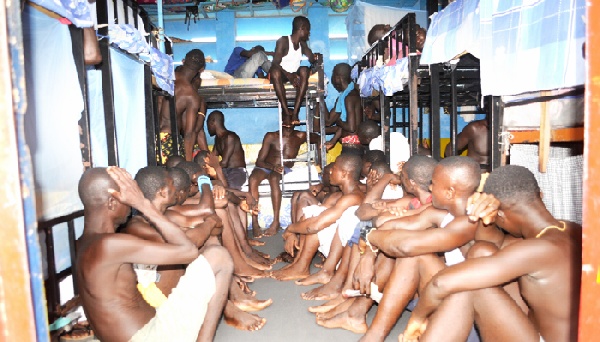
Ghana’s prison capacity and population figures vary slightly by source and reporting year, and it is worth being precise about which figure comes from where. A 2022 Ghana Prisons Service report, reviewed by Ghana Web in 2024, recorded 15,441 inmates against a designed capacity of approximately 9,000, an occupancy rate of 166 percent that the same report, citing World Prison Brief (2022), ranked 14th in Africa for overcrowding (Ghana Web, 2024). A separate, peer-reviewed study using 2023 Ghana Prisons Service data put official capacity at 10,265 against a population of 15,228 individuals, including remand prisoners and pre-trial detainees, an excess of 4,963 (Baffour et al., 2024). The two data points, drawn a year apart from the same institutional source, point in the same direction: a structural, multi-year pattern of severe overcrowding rather than a single anomalous reading. This structural overcrowding is not a recent development; rather, it represents a chronic failure of investment, political will, and sentencing reform that has persisted for decades.
The consequences documented in the research literature and human rights reporting are severe: extreme crowding in cells with insufficient beds, inadequate sanitation, food of poor nutritional quality with detainees relying on charitable donations and family support, limited medical care, and profound psychological stress for both inmates and prison officers (Baffour et al., 2024; U.S. Department of State, Human Rights Report, 2023). Ghana’s Interior Minister-Designate acknowledged the crisis at his vetting before Parliament’s Appointments Committee in January 2025, proposing public-private partnership models to address infrastructure deficits (News Ghana, 2025). Structural reform proposals, however, remain at the discussion stage relative to the urgency of the problem.
2.2 Inadequate Classification and Monitoring
International standards codified in the Nelson Mandela Rules require that prisoners be classified according to risk profile, criminal history, mental health status, and, crucially in the current threat environment, extremist exposure or affiliation. The UNODC’s 2025 training intervention for Ghana Prisons Service officers, covering detainee classification methods, intelligence collection in prison settings, and the evolving terrorist threat landscape in West Africa, revealed both the importance of these functions and the extent to which Ghana’s prison system has not yet systematically institutionalised them (UNODC, 2025).
Without robust classification systems, violent extremist prisoners, whether individuals recruited before incarceration or those susceptible to in-prison radicalisation, cannot be identified, managed, or separated from vulnerable populations. UNODC’s 2023 training workshop for 25 prison officers from the five northern regions explicitly prioritised these regions due to their proximity to the Sahel region and the factors making them susceptible to violent extremism and terrorism (UNODC, 2023a). The focus on northern regions is appropriate but insufficient; the threat does not respect administrative geography.
3. The Extremist Threat Convergence
3.1 The Sahelian Jihadist Threat at Ghana’s Borders
The security context within which Ghana’s prisons must be assessed has undergone a significant transformation since 2022. JNIM, the al-Qaeda-affiliated jihadist coalition led by Iyad Ag Ghali and operating primarily across Mali, Burkina Faso, and Niger, has extended its operational footprint toward West Africa’s coastal states. Between 2022 and 2024, JNIM increased its activities in Benin, Togo, and Ghana’s border areas, with attacks in these countries rising by more than 250 percent over the period, a figure reported independently by the Indian Council of World Affairs and, citing Africa Center for Strategic Studies data, by Africa Defense Forum (Ingale, 2025; Africa Defense Forum, 2024).
According to a 2024 report by the Clingendael Institute (Netherlands Institute of International Relations), cited in Citi Newsroom’s October 2025 investigation, Ghana’s northern frontier, spanning approximately 500 kilometres along Burkina Faso’s volatile south, has become a conduit for supplies, recruits, and safe havens sustaining jihadist insurgencies. The same report assesses that JNIM’s avoidance of direct attacks on Ghanaian soil is a calculated decision to protect these supply chains and avoid provoking Ghana’s relatively capable security forces, rather than evidence of strategic disinterest in Ghana (cited in Citi Newsroom, October 2025). The Soufan Centre separately assessed in November 2024 that militant groups from Burkina Faso have crossed into northern Ghana, using the area for logistical and medical purposes to sustain ongoing insurgencies (The Soufan Center, 2024).
3.2 Prison Entry Points for Extremist Networks
The expansion of JNIM’s operational presence in northern Ghana, combined with the documented use of the area for recruitment, logistics, and safe haven operations, creates a plausible entry point for extremist-affiliated individuals into the prison population, although the evidence for this specific pathway, as distinct from the underlying cross-border activity, remains indirect. Cross-border criminal networks engaged in cattle theft, arms smuggling, and narcotics trafficking, all documented JNIM revenue streams (The New Humanitarian, cited in Modern Ghana, 2025), intersect regularly with Ghana’s law enforcement operations in the Upper East and Upper West Regions. On at least one occasion, Ghanaian security forces conducting a cross-border operation arrested more than ten suspected terrorists, who were handed over to Burkinabe authorities rather than prosecuted or detained in Ghana (ACCORD, 2024); a senior Ghanaian security official corroborated this practice independently, telling Reuters that the country has “arrested a lot of terrorists in the past and handed them over to Burkina” (cited in Africa Defense Forum, 2024).
This pattern is informative: it suggests that, to date, the individuals most directly tied to confirmed extremist activity have generally not entered the Ghanaian prison system through the formal justice process. The more plausible risk, and the one this brief treats as primary, is the harder-to-screen population of individuals arrested for ordinary offences along the same smuggling and trafficking routes, whose links, if any, to extremist networks go unassessed at intake because Ghana’s prisons do not yet operate a systematic screening protocol.
The refugee crisis generated by Sahelian violence has also brought into northern Ghana populations who have themselves fled extremist violence rather than perpetrated it, a distinction that matters for how this risk should be framed. The Zini reception centre in the Sissala West District of the Upper West Region was officially opened in April 2024 with a stated capacity of 3,000 to 4,000 people (Ghana News Agency, 2024); on-the-ground reporting in 2025 recorded its actual population at 867, alongside continuing new arrivals fleeing attacks in Burkina Faso (Citi Newsroom, 2025). The Tarikom centre in the Upper East Region hosts several thousand more; together with smaller community-based sites, these formed part of a population of more than 17,000 registered refugees and asylum seekers in Ghana as of late 2024, the great majority from Burkina Faso (UNHCR, 2024).
It is important to be precise about what the available evidence does, and does not, show. No source reviewed for this brief documents a case of ideological transmission originating from Zini, Tarikom, or any other Ghanaian refugee site. Independent reporting on Burkinabe Fulani asylum seekers, several of whom describe fleeing both jihadist groups and the militias formed to fight them, points in the opposite direction: this population is at risk of extremist violence, not a demonstrated source of it (The New Humanitarian, 2024). The defensible concern is narrower than a generalised vector-of-transmission framing would suggest: protracted displacement, interrupted education, and constrained livelihoods are recognised vulnerability factors in the broader displacement and radicalisation literature, and some of these conditions are present in Ghana’s northern refugee-hosting districts. That is a reason for sustained humanitarian investment and monitoring, not a basis for treating refugee communities as a security threat in the absence of evidence. Where refugee-hosting districts intersect with this brief’s core argument, the connection is indirect: the same northern regions feed into the same court and remand systems discussed elsewhere in this brief, which makes regional classification capacity, rather than camp-specific surveillance, the more defensible policy response.
3.3 Conditions Associated with Radicalisation Inside Prisons
International radicalisation research has identified a recurring cluster of conditions associated with extremist recruitment in custodial settings: social isolation and alienation, a sense of injustice and grievance, exposure to ideological recruiters, the search for identity and belonging, and the perception that the state is an illegitimate adversary (Penal Reform International, 2016; Hannah, Clutterbuck and Rubin, 2008). Several of these conditions, including severe overcrowding, inadequate programming, and extended pre-trial detention without conviction, are well documented features of Ghana’s prison system (Baffour et al., 2024; U.S. Department of State, 2023).
The U.S. Department of State’s 2023 Human Rights Report on Ghana documented that prison conditions were generally harsh due to overcrowding, inadequate sanitary conditions, lack of medical care, and substandard food, with authorities not providing food to pre-trial detainees (U.S. Department of State, 2023). These conditions are humanitarian failures in their own right, and the international literature treats them as risk factors that can increase vulnerability to recruitment where an ideological entrepreneur, whether a senior extremist figure or a mid-level recruiter, is present and able to operate without effective monitoring.
3.4 What the Evidence Does and Does Not Show
It would overstate the available evidence to treat the association between prison conditions and radicalisation as a settled causal mechanism, and it is worth being precise about what the comparative literature actually shows. A detailed two-prison study of high-security custody in England compared two facilities of broadly similar size and population and found markedly different levels of the anger, alienation, and intergroup tension that the literature associates with radicalisation risk; the study did not test overcrowding or population density as a variable, since neither facility was unusually overcrowded, but it found that institutional culture, specifically the quality of staff-prisoner relationships and the degree to which prisoners experienced the regime as legitimate, explained most of the difference (Williams and Liebling, 2023). Applied cautiously to Ghana, this suggests that physical conditions such as overcrowding are not the only, or necessarily the primary, driver of the dynamics associated with radicalisation, and that institutional culture and classification capacity can move the same underlying risk factors in either direction, for better or worse.
No publicly documented case of an individual being radicalised inside a Ghanaian prison was identified for this article, and none of the sources cited here, whether from the UNODC, the Ghana Prisons Service, or independent reporting, claims otherwise. This absence is itself informative, though it is open to more than one interpretation. It may reflect a genuinely low level of realised risk to date. It may equally reflect the absence of any systematic monitoring capable of detecting radicalisation if it were occurring, a possibility reinforced by the classification gaps described in Section 2.2. Ghana’s prison system is not currently positioned to distinguish between these two explanations, and that, rather than a confirmed pattern of extremist recruitment, is the most defensible characterisation of the present evidence. It argues for investment in classification and monitoring capacity as a means of establishing the actual scale of the risk, not solely as a response to a risk that has already been confirmed to exist.
4. Assessing Current Countermeasures
Ghana’s counter-radicalisation efforts within the prison system are nascent and externally driven rather than institutionally embedded. The UNODC has conducted training workshops in 2023 and 2025 targeting prison officers in northern regions, building capacity in classification, intelligence collection, and violent extremist prisoner management. The Ghana Prisons Service lacks a dedicated counter-radicalisation unit, a standardised extremist risk assessment tool integrated into intake procedures, or a systematic programme for managing identified violent extremist prisoners (VEPs) that meets international standards.
Ghana’s National Framework for Preventing and Countering Violent Extremism and Terrorism (NAFPCVET), launched in 2019 and built around four pillars (prevent, pre-empt, protect, and respond), provides a strategic context but has not yet generated operationally specific guidance for the prison sector (a multi-stakeholder review of the framework was under way in early 2026) (UNDP Ghana, 2024; Ghana News Agency, 2026). The inadequacy of a comprehensive, resourced, and monitored Prison Deradicalisation Programme incorporating religious counselling, vocational training, psychosocial support, and post-release monitoring represents a critical gap in Ghana’s counter-terrorism architecture.
Direct interviews with serving Ghana Prisons Service officers on the radicalisation question specifically were not available in the preparation of this article, a limitation worth stating plainly rather than working around. The closest available proxy is the documented experience of officers who have participated in UNODC-led capacity-building. Assistant Director of Prisons Augustina Mensah Fiadzo, a Ghana Prisons Service officer involved in a 2023 training programme on the Nelson Mandela Rules, said the training had “broadened my mindset…on the classification of prisoners and their risks and needs” (UNODC, 2023b). Her comment is consistent with the diagnosis offered in Section 2.2: that classification capacity, rather than officer awareness or willingness, is the binding constraint on Ghana’s ability to manage this risk. A fuller account would benefit from structured interviews with serving officers across several regional commands, and this is flagged here as a priority for future research rather than a gap this article was able to close.
5. Policy Recommendations
First, the Ghana Prisons Service should establish a dedicated Counter-Radicalisation and Violent Extremist Prisoner Management Unit, staffed with trained intelligence officers, psychologists, and religious engagement specialists. Second, a standardised extremist risk screening tool should be integrated into prison intake procedures across Ghana’s prison estate (reported variously as 44 to 46 facilities depending on the source and year), with particular intensity in the five northern regional prisons and Nsawam. Third, NACOC, the Ghana Prisons Service, and Bureau of National Intelligence should establish a formal intelligence-sharing protocol covering extremist-affiliated individuals in the criminal justice pipeline; that agency’s statutory name has changed more than once in recent years (Bureau of National Investigations until 2020, the National Intelligence Bureau thereafter, with a 2025–2026 reform reverting the acronym BNI to mean Bureau of National Intelligence), and any inter-agency protocol should be drafted against its current legal designation rather than an earlier one. Fourth, the government should urgently develop and fund a Prison Decongestion Programme combining sentencing reform, alternative dispute resolution mechanisms, and infrastructure investment to reduce overcrowding below 100 percent of capacity, thereby reducing the structural conditions that can heighten vulnerability to radicalisation. Fifth, Ghana should engage with the UNODC’s Global Counter-Terrorism Programme for sustained, multi-year technical assistance rather than episodic training interventions. Sixth, and in direct response to the evidentiary gaps identified in this article, the Ghana Prisons Service should establish a standardised incident-reporting and risk-monitoring system, integrated with the proposed Counter-Radicalisation Unit, so that future assessments of this threat rest on Ghana-specific data rather than on inference from regional and international experience alone.
6. Conclusion
Ghana’s prison system represents a gap in the country’s counter-terrorism architecture, not because radicalisation has been documented occurring within it, but because the system currently has no reliable way of knowing whether it is. The convergence of severe overcrowding, inadequate classification, absent rehabilitation programming, and a deteriorating security situation on Ghana’s northern border creates conditions in which prison-based radicalisation could take hold if left unaddressed, and Ghana would have limited capacity to detect it if it did. Closing that gap, building classification systems, training officers, and gathering better evidence on what is actually happening inside Ghanaian prisons, would strengthen the country’s counter-terrorism architecture regardless of how the underlying risk is ultimately assessed. The UNODC’s view that strengthened prison management is an important part of preventing radicalisation in detention settings deserves to be treated as a near-term institutional priority, not a distant aspiration (UNODC, 2025).
References
ACCORD. (2024, April 25). Understanding armed violence in Bawku: Exploring links with terrorism and its drivers. Retrieved from https://www.accord.org.za/conflict-trends/understanding-armed-violence-in-bawku-exploring-links-with-terrorism-and-its-drivers/
Africa Defense Forum. (2024, November 25). Northern Ghana Emerges as Base for Sahelian Terrorist Organizations. Retrieved from https://adf-magazine.com/2024/11/northern-ghana-emerges-as-base-for-sahelian-terrorist-organizations/
Baffour, F. D., Francis, A. P., Chong, M. D., & Harris, N. (2024). Prison Overcrowding and Harsh Conditions: Health and Human Rights Concerns to Persons in Custody, Staff, and the Community. Criminal Justice and Behavior, 51(3), 375-400. https://doi.org/10.1177/00938548231219803
Citi Newsroom. (2025, October 6). Ghana’s quiet crisis: Bawku, smuggling, and the extremist war next door. Retrieved from https://citinewsroom.com/2025/10/ghanas-quiet-crisis-bawku-smuggling-and-the-extremist-war-next-door/
Ghana News Agency. (2024, April 15). Zini asylum seeker reception settlement centre opened. Retrieved from https://gna.org.gh/2024/04/zini-asylum-seeker-reception-settlement-centre-opened/
Ghana News Agency. (2026, March 25). Ghana reviews counter-terrorism framework amid regional extremism threats. Retrieved from https://gna.org.gh/2026/03/ghana-reviews-counter-terrorism-framework-amid-regional-extremism-threats/
Ghana Web. (2024, October 18). Decongesting Ghana’s Prisons: Addressing The Alarming Issue Of Overcrowding. Retrieved from https://www.ghanaweb.com/GhanaHomePage/features/Decongesting-Ghana-s-Prisons-Addressing-The-Alarming-Issue-Of-Overcrowding-1955952
Hannah, G., Clutterbuck, L., & Rubin, J. (2008). Radicalization or Rehabilitation: Understanding the Challenge of Extremist and Radicalized Prisoners. RAND Corporation. Retrieved from https://www.rand.org/pubs/technical_reports/TR571.html
Ingale, U. A. (2025). The Growing Influence of JNIM in West Africa: Threats to Benin, Togo and Ghana. Indian Council of World Affairs. Retrieved from https://www.icwa.in/show_content.php?lang=1&level=1&ls_id=12356&lid=7539
Modern Ghana. (2025, November 11). Jihadist Group JNIM in Burkina Faso: Ghana Must Not Sleep on the Enemy Within. Retrieved from https://www.modernghana.com/news/1447777/jihadist-group-jnim-in-burkina-faso-ghana-must.html
News Ghana. (2025, January 24). Ghana’s Interior Minister-Designate Proposes Public-Private Partnerships to Alleviate Prison Overcrowding. Retrieved from https://newsghana.com.gh/ghanas-interior-minister-designate-proposes-public-private-partnerships-to-alleviate-prison-overcrowding/
Penal Reform International. (2016). Preventing radicalisation in prisons: International expert roundtable. Retrieved from https://cdn.penalreform.org/wp-content/uploads/2016/02/PRI-Radicalisation-briefing-paper-V2.pdf
The New Humanitarian. (2024, April 18). Ghana accused of expelling Fulani asylum seekers from Burkina Faso. Retrieved from https://www.thenewhumanitarian.org/news-feature/2024/04/18/ghana-accused-expelling-fulani-asylum-seekers-burkina-faso
The Soufan Center. (2024, November 20). Jihadist Spillover Impact and Deteriorating Security in Coastal West Africa. IntelBrief. Retrieved from https://thesoufancenter.org/intelbrief-2024-november-20/
UNDP Ghana. (2024, March 19). UNDP and Partners review Ghana’s national framework to enhance response to violent extremism. Retrieved from https://www.undp.org/ghana/press-releases/undp-and-partners-review-ghanas-national-framework-enhance-response-violent-extremism
UNHCR. (2024). Ghana. Retrieved from https://www.unhcr.org/us/where-we-work/countries/ghana
United Nations Office on Drugs and Crime (UNODC). (2023a). Prisons in Ghana: Introductory training workshop on prison management and the prevention of radicalization to violence. Tamale, February 2023. Retrieved from https://www.unodc.org/unodc/en/justice-and-prison-reform/cpcj-prison-reform/news/prisons-in-ghana_-introductory-training-workshop-on-prison-management-and-the-prevention-of-radicalization-to-violence.html
United Nations Office on Drugs and Crime (UNODC). (2023b). Reaching prison officers across Ghana with the Nelson Mandela Rules. Retrieved from https://www.unodc.org/unodc/justice-and-prison-reform/cpcj-prison-reform/news/reaching-prison-officers-across-ghana-with-the-nelson-mandela-rules.html
United Nations Office on Drugs and Crime (UNODC). (2025). UNODC Supports Ghana Prisons Services on Preventing Radicalization and Violent Extremism in Prison Settings. Retrieved from https://www.unodc.org/unodc/en/terrorism/latest-news/2025-unodc-supports-ghana-prisons-services-on-preventing-radicalization-and-violent-extremism-in-prison-settings.html
United States Department of State. (2023). 2023 Country Reports on Human Rights Practices: Ghana. Washington, D.C.: Bureau of Democracy, Human Rights, and Labor. Retrieved from https://www.state.gov/reports/2023-country-reports-on-human-rights-practices/ghana/
Williams, R., & Liebling, A. (2023). Do prisons cause radicalization? Order, leadership, political charge and violence in two maximum security prisons. The British Journal of Criminology, 63(1), 97-114. https://doi.org/10.1093/bjc/azab122