








Introduction
On April 25, 2026, coordinated attacks by jihadist and separatist militants struck military installations and government buildings across Mali simultaneously, from the desert stronghold of Kidal in the far north to the capital, Bamako, and the garrison town of Kati 1,500 kilometres to the south. Mali’s Defence Minister, General Sadio Camara, who had been the principal architect of his country’s security pivot toward Russia, was killed in a suicide vehicle bombing at his home. An Africa Corps helicopter was shot down. Approximately 400 Russia-backed Africa Corps mercenaries were evacuated from Kidal under rebel escort; Malian soldiers were left behind as prisoners. By April 27, the Malian flag no longer flew over Kidal. The city had fallen (Chatham House, 2026; NPR, 2026).
The significance of these events extends far beyond Mali’s borders. They represent the most consequential stress test of the Eastern security pivot that has reshaped West African geopolitics since 2020, and the results are damning. For five years, a narrative has built steadily across West Africa: that Western security partnerships had failed the region, that sovereignty demanded a break from the neocolonial models of France and the United States, and that Russia, China, and the broader Global South offered an authentic alternative rooted in solidarity rather than conditionality. The juntas of Mali, Burkina Faso, and Niger expelled French and American forces, withdrew from ECOWAS, and handed their security to Wagner, now rebranded as Africa Corps. The Sahel was held up as the vanguard of West African self-determination.
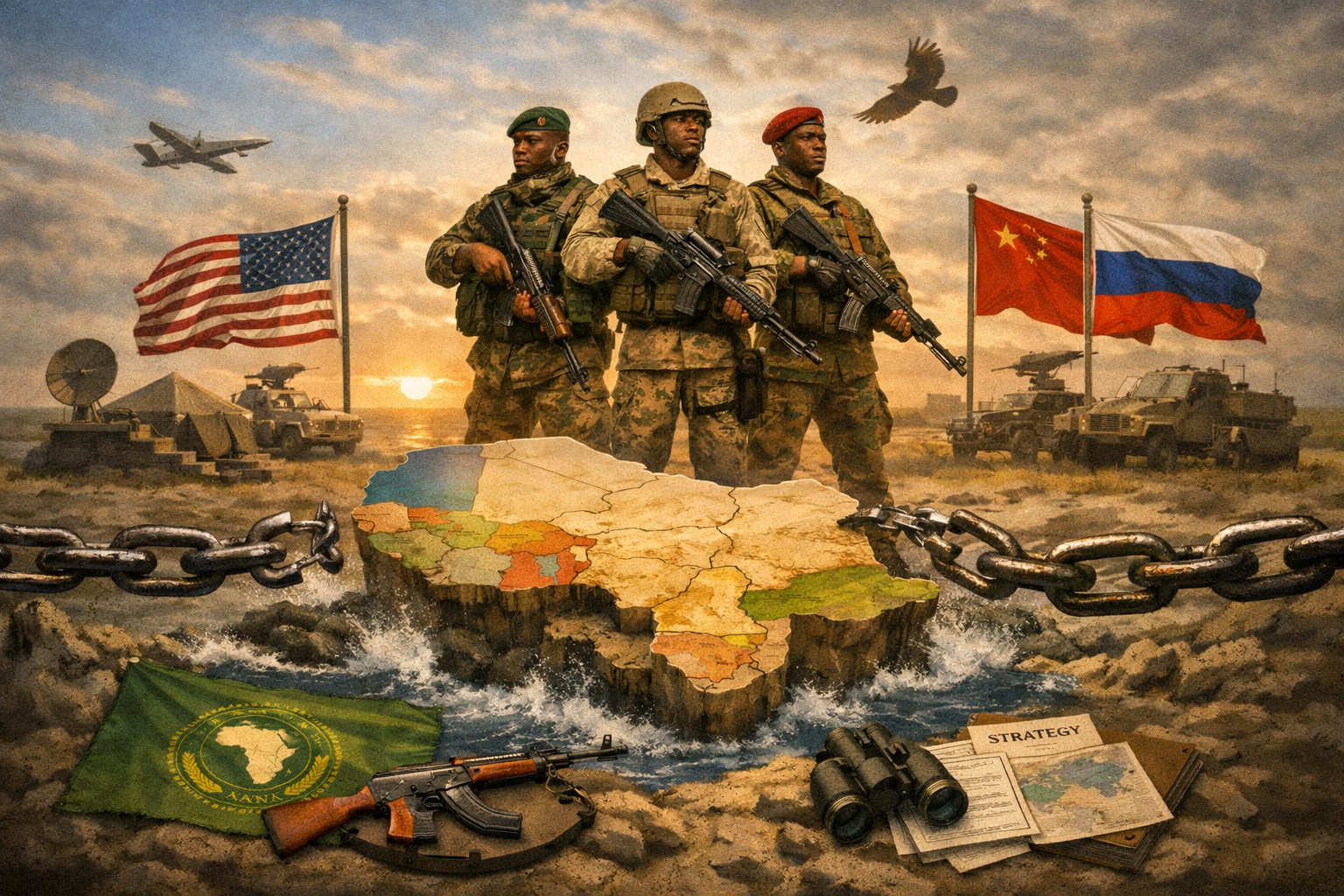
This essay argues that both the Western failure and the Eastern promise have been real, but that neither represents a solution to West Africa’s security crisis. The problem runs deeper than the identity of the patron. The region’s strategic vulnerability is structural, rooted in governance deficits, institutional fragility, and a decades-long habit of outsourcing sovereignty. Trading one external security framework for another does not break this cycle; it extends it under a different flag. The pendulum has swung from West to East, but the fundamental condition, dependency, has not changed. The only path toward genuine security autonomy runs through West African institutions, and the most viable of these, despite its profound current crisis, remains the Economic Community of West African States (ECOWAS).
The Western Security Model and Its Discontents in West Africa
The anger that drove Africa’s turn away from Western security partnerships was not manufactured but earned and any honest account of this moment must begin by acknowledging that fact. For decades, Western security engagement with West Africa was structured around the strategic interests of external powers rather than the security needs of West African populations. France’s Operation Barkhane, which deployed thousands of troops across the Sahel from 2014 to 2022, consumed billions of euros and achieved no durable reduction in jihadist violence. By the time French forces were expelled from Mali in August 2022, the country was objectively less secure than when they arrived (Foreign Policy, 2026). The United States maintained its second-largest military presence in Africa in Niger, operating drone bases and deploying over 1,000 troops, while terrorism deaths in the Sahel accelerated year after year (Congressional Research Service [CRS], 2026). The 2026 Global Terrorism Index confirmed that the Sahel remained the epicentre of terrorist activity worldwide, accounting for more than half of all terrorism-related deaths in 2025, a period in which Western forces were deeply embedded in the region (NPR, 2026).
Western security assistance also came with political conditionality that African governments experienced as an extension of colonial oversight. Human rights benchmarks, democratic governance requirements, and the threat of aid suspension were wielded selectively, protecting Western strategic interests while pressuring African governments in ways that were often perceived as illegitimate interference. When ECOWAS, backed by Western powers, threatened military intervention in Niger following the July 2023 coup, the AES states responded by characterising the organisation as a tool of French neocolonialism, and significant portions of West African public opinion agreed with that characterisation (Tricontinental, 2026). The sentiment was not irrational. France had intervened repeatedly to protect regimes that served its interests and failed to intervene when those interests were not at stake. The credibility of Western security partnerships in the region had been spent.
The withdrawal of French forces from Burkina Faso in February 2023, Niger in December 2023, Chad in January 2025, Ivory Coast in February 2025, and Senegal by July 2025 marked the end of sixty-five years of French permanent military presence in West and Central Africa (News24, 2025; The Defense Post, 2025). France now has no permanent bases anywhere in West or Central Africa, retaining only a presence in Djibouti. The United States withdrew its remaining troops from Niger under pressure from the junta in 2024 (CRS, 2026). The vacuum left by these departures was genuine, urgent, and largely self-inflicted by decades of partnership models that prioritised external interests over African security outcomes.
The Eastern Promise and Its Structural Illusion
During this vacuum across West Africa, Russia moved with considerable tactical sophistication. The Wagner Group’s entry into Mali in late 2021 was preceded by a deliberate and well-documented disinformation campaign that amplified anti-French sentiment, manufactured narratives of Western betrayal, and positioned Moscow as an anti-imperialist ally offering security without political conditions (Small Wars Journal, 2026). The appeal was real for the Sahelian juntas: a government seeking to insulate itself from external democratic pressure found in Russia a partner willing to provide combat forces, diplomatic cover in the UN Security Council, and access to weapons without accountability requirements. The Wagner model, later restructured as Africa Corps under direct Russian Ministry of Defence control following the death of Yevgeny Prigozhin in 2023, spread rapidly across the Sahel, establishing presences in Mali, Burkina Faso, Niger, the Central African Republic, Sudan, and Equatorial Guinea (CRS, 2026).
The language of this partnership was one of sovereignty and solidarity. The AES states framed their pivot as an act of decolonisation, a reclaiming of African agency from the grip of the former colonial powers. This framing resonated powerfully with constituencies that had legitimate grievances against Western models of engagement. But the structural logic of the arrangement was identical to what it claimed to replace. Russia did not offer security without conditions; it offered security without democratic conditions. The conditions it imposed were of a different kind: access to mineral resources, political alignment, and insulation for junta governments from the very accountability mechanisms, whether regional or international, that might hold them to their populations. In Mali, Wagner was deployed at a reported cost of ten million dollars per month to the Malian state while simultaneously gaining access to some of the country’s largest gold mines (Brown Political Review, 2026). The transaction was not solidarity but a commercial and strategic arrangement that prioritised Russian interests over Malian interests.
The evidence that the Eastern model has failed to deliver security is now overwhelming. Despite the presence of up to 2,500 Russian Africa Corps personnel in Mali as of early 2026, more than seventy percent of the country’s territory is either controlled or contested by jihadist and separatist armed groups (Africa Defense Forum, 2026). Nearly two million Malians are internally displaced. Secular schools have been shuttered across vast regions and girls’ education has effectively ceased outside urban centres. In September 2025, Jama-at Nursat al-Islam wal-Muslimin (JNIM) imposed a fuel blockade on Bamako itself, attacking supply convoys and strangling the capital’s economy. Insurgents had encircled the seat of government of a state that had traded Western security partnerships for Russian ones and found itself holding a collapsing country (The Gateway Pundit, 2026). The Carnegie Endowment for International Peace concluded in its March 2026 assessment that Russia was repeating France’s fundamental mistake, relying on a heavy military hand without any political strategy to address the governance failures and socio-economic marginalisation driving instability, and that even Russia’s battlefield successes had ultimately inflamed rather than reduced tensions (Carnegie Endowment, 2026).
The April 25 attacks brought this failure to a head. The death of Camara, the evacuation of Africa Corps from Kidal, and the coordinated offensive across multiple cities simultaneously exposed what the Carnegie assessment had warned: that external military presence, regardless of origin, cannot substitute for the political legitimacy, governance capacity, and community trust that produce durable security. Russia’s response to the attacks illustrated the self-serving nature of the partnership: Africa Corps released a statement, without basis, claiming that Ukrainian and European mercenaries had participated in the offensive, framing a catastrophic failure of its own security model as a Western imperialist conspiracy (Chatham House, 2026). The patron, when faced with accountability, deflected blame rather than providing answers.
West Africa’s Dependency as the Structural Condition
The Western and Eastern models of security engagement in Africa share a deeper structural logic that has nothing to do with their ideological framing. Both are forms of security rentierism: arrangements in which West African states trade sovereignty, resources, and political alignment for military capacity they cannot generate domestically. The question of which patron to rent from is secondary to the question of why the rental model persists at all. The answer lies in the conditions that make West African states vulnerable to external security dependence in the first place: governance deficits, weak state capacity, underdeveloped defence institutions, and the long-term neglect of the regional security architecture that might allow West African states to address their security challenges collectively.
The Sahel’s security crisis did not begin with French withdrawal or Russian arrival. It began with the collapse of Libyan state authority following the 2011 NATO intervention, which released a flood of weapons and fighters across the Sahel, and accelerated through a decade of governance failures that allowed jihadist groups to fill the vacuum left by states that could not deliver services, justice, or security to their own populations (Chatham House, 2026). Foreign partners, whether French, American, or Russian, arrived at the symptom rather than the cause. They suppressed insurgent activity in specific areas and at specific times without building the political legitimacy, institutional capacity, or community relationships that would allow states to sustain security autonomously. The Foreign Policy assessment of Africa Corps’ failure in Mali was precise on this point: its coercive counterinsurgency operations alienated civilians, undermined local intelligence collection, and fuelled jihadist recruitment (Foreign Policy, 2026). Russia had not brought a different strategy. It had brought the same strategy with a different accent.
The dependence on external security partners also produces a perverse institutional incentive: governments that can outsource their security needs to foreign partners face reduced domestic pressure to build the governance capacity, accountability mechanisms, and civil-military relations that generate organic security. A junta that can call in Russian mercenaries to suppress an insurgency has less incentive to address the marginalisation, corruption, and impunity that created the insurgency. Each cycle of external security dependence deepens the structural conditions that make the next cycle necessary.
ECOWAS: Imperfect, Fractured, but Irreplaceable
The most significant institutional casualty of the Eastern pivot has been ECOWAS, the Economic Community of West African States. On January 29, 2025, Mali, Burkina Faso, and Niger formally withdrew from the regional bloc, marking what Colonel Festus Aboagye (Ret.) at Amani Africa described as the most significant crisis in West African regional integration since ECOWAS was founded in 1975 (CISA, 2026; Amani Africa, 2025). The scale of the departure is striking such that the three AES states collectively controlled more than half of ECOWAS’s total territorial surface area, hosted seventeen percent of its population, and represented approximately 7.7 percent of its aggregate GDP, translating into an irreplaceable operational deficit for cross-border counterterrorism, intelligence sharing, and humanitarian coordination (CISA, 2026; Georgetown Security Studies Review, 2025). The withdrawal was preceded by ECOWAS’s mishandling of the July 2023 Niger coup, including its threat of military intervention and the imposition of sweeping sanctions that, in the assessment of WANEP, endangered the integration process and gave rise to humanitarian crises (Amani Africa, 2025). The AES states characterised ECOWAS as having strayed from the ideals of its founding fathers and become a tool of external interference (Tricontinental, 2026). In December 2025, Burkina Faso launched the first AES biometric identity card, designed to replace ECOWAS documents within five years (The Conversation, 2026). The fragmentation of West Africa’s most important regional institution is no longer a theoretical risk but a structural reality.
A sober assessment of ECOWAS must acknowledge the failures that produced this crisis. The organisation proved unable to prevent four coups across its membership between 2020 and 2023. Its sanctions regime was applied inconsistently and perceived as punitive rather than restorative. The bloc’s zero-tolerance posture on unconstitutional power changes paradoxically accelerated the exit it sought to prevent; the response was characterised as diplomatically maladroit (CISA Newsletter, 2026). These are genuine institutional failures that require genuine institutional reform, not defensive denial. The consequences for the counterterrorism architecture are severe and immediate: the ISS Africa assessment is direct that a fight against armed groups cannot be effective without cooperation from the three central Sahel countries, which remain the epicentre of terrorism that is spreading to coastal states (CISA, 2026; ISS Africa, 2026). The ECOWAS counter-terrorism brigade, authorised at just 1,650 troops following its dramatic scaling down from the 260,000-strong force originally proposed at the August 2025 African Chiefs of Defence Staff Summit in Abuja, must patrol vast border zones without the AES states’ intelligence networks, logistics infrastructure, or territorial access (CISA, 2026; ISS Africa, 2026). The ECOWAS Commissioner for Political Affairs, Peace and Security expressed confidence in November 2025 that the AES withdrawal was only temporary, but confidence is not a reform strategy (WADR, 2025).
And yet, the case for ECOWAS, and for the broader project of West African regional security architecture it represents, rests not on what the institution currently is but on what it uniquely represents. No external partner, Western or Eastern, possesses the geographic logic, cultural legitimacy, or historical mandate to govern West African security on behalf of West African populations. ECOWAS was built from within, reflects the political geography of the region, and carries an institutional memory of successful interventions, in Liberia, Sierra Leone, and the Gambia, that no foreign partner can replicate. A viable path forward has been identified by the International Crisis Group: cooperation between ECOWAS and AES states that does not require formal reintegration, but instead operates through flexible, issue-specific agreements, bilateral ones at first, with the goal of eventually building more expansive understandings (CISA, 2026; International Crisis Group, 2025). This twin-track approach, maintaining ECOWAS governance principles while pragmatically engaging AES states on shared security imperatives, represents the most credible near-term path available. The GPPI policy brief on ECOWAS reform argued in September 2025 that the institution stood at a crossroads between preserving the status quo and pursuing deeper political integration, and that only the latter could restore its legitimacy and relevance in a region facing existential security challenges (GPPI, 2025). That argument is correct. The AES withdrawal is a stress test that reveals what must change, not proof that the project of regional integration should be abandoned.
The events in Mali since April 2026 may paradoxically, create conditions for this reckoning. Research reveals that some junta figures, following the evacuation of Africa Corps from Kidal and the death of Camara, had already begun pushing to diversify relationships beyond Moscow, with Turkey emerging as one alternative interlocutor (Chatham House, 2026). The Stimson Center observed that the setbacks for Russian forces may prompt the Sahelian juntas to reconsider the effectiveness of their current partnerships (Stimson Center, 2026). A security model that cannot protect the minister who designed it, and that retreats from a strategic city leaving its ally’s soldiers as prisoners, has lost its core selling point. The question is whether the disillusionment with Russian security guarantees produces a return to Western dependence, which would complete one more cycle of the pendulum, or whether it creates space for a genuinely different conversation about African institutional capacity.
Conclusion
The pendulum swings, but the structural condition persists. Western security frameworks failed West Africa not primarily because they were Western, but because they were external, transactional, and disconnected from the political and governance work that produces durable security. The Eastern alternative has failed for identical reasons, now visible in the rubble of Mali’s collapsed security architecture and the bodies of Africa Corps mercenaries in the Sahel sand. The lesson is not that West Africa should find a better patron. It is that the patron model itself is the problem.
West African security autonomy will not be achieved quickly or easily. It requires building state capacity, investing in governance, establishing legitimate civil-military relations, and reforming the regional institutions that have failed their mandates without abandoning the mandate itself. ECOWAS, for all its current dysfunction, remains the only framework with the legitimacy, geographic logic, and institutional foundation on which a genuine West African security architecture can be built. It may be the region’s best option not because it has performed well, but because it is the only option that is actually West African. Reforming it, rather than abandoning it, is both the harder and the more honest path.
The narrative of sovereignty through the Eastern pivot offered West African publics something real: the dignity of refusal, the satisfaction of breaking a dependency that had produced decades of humiliation. That narrative deserves to be taken seriously before it is challenged. But sovereignty is not the act of choosing a new patron. It is the capacity to protect one’s own people without needing one. West Africa’s security future will not be found at either pole of the pendulum’s arc. It will be found, if it is found at all, in the difficult, unglamorous, and necessary work of building the institutions, governance systems, and regional solidarity that make the pendulum irrelevant. What is playing out across the Sahel today is not a West African peculiarity. It is a warning to every African region that has come to treat external security partnerships as a substitute for sovereign institutional capacity. The patron model fails everywhere it is tried. The sooner the continent internalises that lesson, the sooner it can begin building something that lasts.
REFERENCES
- Africa Defense Forum. (2026, January 13). Could Mali fall to terrorists? https://adf-magazine.com/2026/01/could-mali-fall-to-terrorists/
- CISA Newsletter. (2026, May 4). ECOWAS at a crossroads: The AES breakaway, coastal state diplomacy, and the future of West African security architecture. https://cisanewsletter.com/index.php/ecowas-at-a-crossroads-the-aes-breakaway-coastal-state-diplomacy-and-the-future-of-west-african-security-architecture/
- Amani Africa. (2025, January 31). The withdrawal of AES from ECOWAS: An opportunity for re-evaluating existing instruments for regional integration? https://amaniafrica-et.org/the-withdrawal-of-aes-from-ecowas-an-opportunity-for-re-evaluating-existing-instruments-for-regional-integration/
- Brown Political Review. (2026, February 4). Military makeover. https://brownpoliticalreview.org/military-makeover/
- Carnegie Endowment for International Peace. (2026, February). Russia in Africa: Examining Moscow’s influence and its limits. https://carnegieendowment.org/research/2026/02/russia-role-west-southern-africa-junta-wagner-africa-corps
- Chatham House. (2026, April 29). Mali attacks show security cannot be delivered by military means alone. https://www.chathamhouse.org/2026/04/mali-attacks-show-security-cannot-be-delivered-military-means-alone
- Congressional Research Service [CRS]. (2026, April 8). Russia’s security operations in Africa. https://www.congress.gov/crs-product/IF12389
- Folawewo, A. O. (2026). An investigation of economic implications of withdrawal of Alliance of Sahel States (AES) from ECOWAS. African Development Review, 38, e70051. https://doi.org/10.1111/1467-8268.70051
- Foreign Policy. (2026, May 13). Mali attacks reveal flaws in Russian security partnership. https://foreignpolicy.com/2026/05/13/mali-attacks-security-russia-france-partnership-sahel/
- Global Peace Operations Initiative. (2025, September 22). ECOWAS in crisis: A case for ambitious reforms. https://gppi.net/2025/09/22/ecowas-in-crisis-a-case-for-ambitious-reforms
- Grey Dynamics. (2025, September 20). Wagner out, Africa Corps in: Russia’s card shuffle in Mali. https://greydynamics.com/wagner-out-africa-corps-in-russias-card-shuffle-in-mali/
- NPR. (2026, April 25). Mali hit by wave of coordinated attacks from armed groups. https://www.npr.org/2026/04/25/nx-s1-5799439/mali-hit-by-wave-of-coordinated-attacks-from-armed-groups
- News24. (2025, July 17). French army leaves Senegal, ending military presence in West Africa. https://www.news24.com/world/africa/french-army-leaves-senegal-ending-military-presence-in-west-africa-20250717-0908
- Responsible Statecraft. (2025, June 18). Wagner mercenaries declare ‘mission accomplished’ in Mali. https://responsiblestatecraft.org/wagner-group-africa-2672360360/
- Robert Lansing Institute. (2026, April 27). Mali at the breaking point: Insurgency resurgence, Russian intervention, and the limits of the Africa Corps. https://lansinginstitute.org/2026/04/27/mali-at-the-breaking-point-insurgency-resurgence-russian-intervention-and-the-limits-of-the-africa-corps/
- Small Wars Journal. (2026, January 1). The waiting game: Signposts of Russia’s coming failure in Africa. https://smallwarsjournal.com/2026/01/01/the-waiting-game-signposts-of-russias-coming-failure-in-africa/
- Stimson Center. (2026, May). Mali attacks: Aggravating the Sahel security crisis. https://www.stimson.org/2026/mali-attacks-aggravating-the-sahel-security-crisis/
- The Conversation. (2026, February 18). ECOWAS without the Sahel states: How the split is testing free movement and regional legitimacy. https://theconversation.com/ecowas-without-the-sahel-states-how-the-split-is-testing-free-movement-and-regional-legitimacy-274501
- The Defense Post. (2025, July 17). France hands over military bases in Senegal. https://thedefensepost.com/2025/07/17/france-hands-over-military-senegal/
- The Gateway Pundit. (2026, May 13). Russia’s new Afghanistan: How Moscow lost Mali. https://www.thegatewaypundit.com/2026/05/russias-new-afghanistan-how-moscow-lost-mali/
- Tricontinental: Institute for Social Research. (2026, January 25). The Sahel seeks sovereignty. https://thetricontinental.org/dossier-sahel-alliance-sovereignty/
- War on the Rocks. (2025, September). Russia is shrewdly playing the long game in Africa. https://warontherocks.com/2025/09/russia-is-shrewdly-playing-the-long-game-in-africa/
- West Africa Democracy Radio [WADR]. (2025, November 21). ECOWAS confident Sahel Alliance states will return soon, says commissioner. https://wadr.org/ecowas-confident-sahel-alliance-states-will-return-soon-says-commissioner/