







Introduction
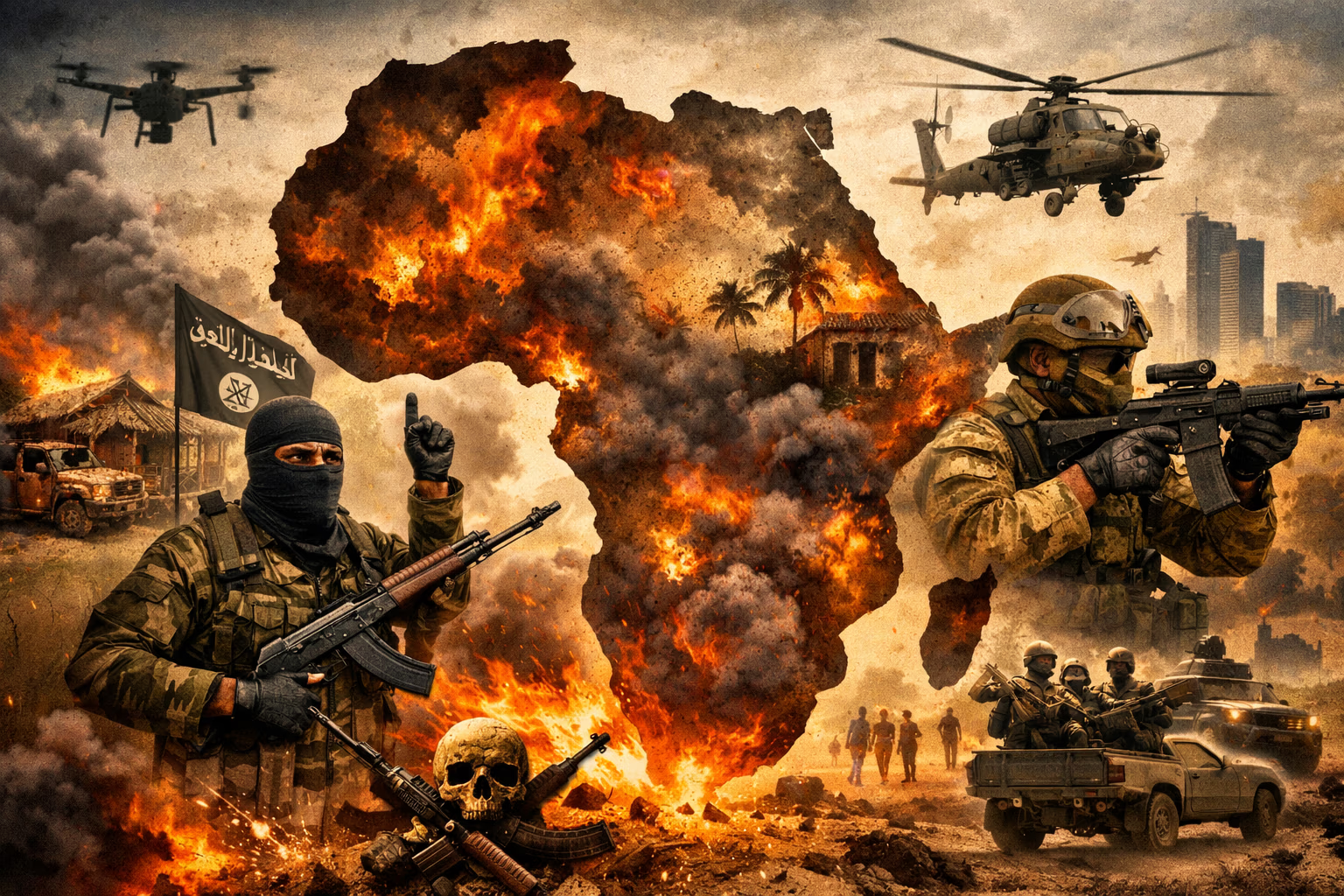
Africa remained the world’s most affected region by terrorism in 2025. Extremist groups continued to expand across the Sahel, the Lake Chad Basin, the Horn of Africa, and Central Africa by exploiting weak government, poverty, political instability, and poor border control (Institute for Economics & Peace [IEP], 2026). Groups such as Jama’at Nusrat al-Islam wal Muslimeen (JNIM), Islamic State West Africa Province (ISWAP), Boko Haram, al-Shabaab, and the Allied Democratic Forces are no longer operating only as terrorist organisations. Many now behave like armed political movements that control territory, collect taxes, regulate trade routes, spread propaganda, and challenge state authority.
This is an important shift. Terrorism in Africa is no longer simply about bombings or isolated attacks. It is increasingly about the weakening of states and the rise of armed groups that compete with governments for power and influence. In many rural areas, extremist organisations have become more visible and active than the state itself. This shows that Africa’s terrorism crisis is deeply connected to governance failures, economic inequality, and political instability rather than religion alone (United Nations Development Programme [UNDP], 2023).
Another major trend is that extremist groups are becoming more organised and adaptable. They are learning from conflicts in the Middle East and South Asia while adjusting their tactics to local African realities. Instead of relying only on violence, many groups now combine military attacks with recruitment campaigns, economic control, taxation, and local governance systems. This has made them more difficult to defeat.
The Sahel: Africa’s New Centre of Insurgency
The Sahel region has become one of the most dangerous conflict zones in the world. Countries such as Burkina Faso, Mali, and Niger continue to experience severe extremist violence despite years of military operations and foreign assistance (IEP, 2026).
The crisis in the Sahel is important because it reveals how terrorism grows where governments are weak. Large parts of the region suffer from poverty, corruption, poor infrastructure, ethnic tensions, weak security institutions, and lack of state presence. Extremist groups take advantage of these conditions to expand influence.
Burkina Faso: JNIM and the Collapse of State Authority
Burkina Faso remained one of the countries most affected by terrorism in 2025. Although terrorism-related deaths declined compared to previous years, insecurity remained widespread, especially in areas bordering Mali and Niger (IEP, 2026).
The most important issue is not only the number of attacks but the growing weakness of state authority. JNIM carried out most of the attacks in the country and continued expanding its influence despite military operations.
The rise of JNIM reflects a deeper governance crisis following the 2022 coup led by Ibrahim Traoré. Military leaders promised to restore security, yet extremist violence continued. This suggests that military coups do not automatically improve national security. In some cases, they may weaken institutions further by increasing political instability and reducing international cooperation.
Another important issue is that JNIM increasingly acts like an alternative authority in rural areas. In places where the government is absent, the group settles disputes, collects taxes, controls local trade routes, and imposes its own rules (International Crisis Group, 2025). Many civilians may not support the group ideologically, but they cooperate because the state is unable to provide security or services.
The withdrawal of French and American support also weakened regional counterterrorism efforts. Burkina Faso’s tensions with the Economic Community of West African States further reduced regional coordination against extremist groups (IEP, 2026). As regional cooperation weakened, militants found it easier to move across borders and expand operations.
Niger: The Rise of Islamic State Influence
Niger became the third most terrorism-affected country globally in 2025. The Tillabéri region remained especially dangerous because it lies near the unstable borders of Mali and Burkina Faso (IEP, 2026).
One of the most significant developments was the rapid growth of Islamic State-linked groups. Their attacks and deaths increased sharply compared to the previous year. At the same time, JNIM also remained active.
This situation reveals a growing competition between extremist groups across the Sahel. Rivalry between Islamic State affiliates and JNIM is important because it can increase violence. Each group tries to prove its strength through deadly attacks, territorial expansion, and recruitment efforts.
Niger’s political instability after the 2023 coup also contributed to insecurity. The breakdown of relations with Western countries reduced international military cooperation and intelligence-sharing (African Union Peace and Security Council, 2024).
Although Niger later strengthened ties with Russia, Russian-backed security operations struggled to stop extremist expansion (IEP, 2026). This demonstrates that foreign military partnerships alone cannot solve terrorism problems without strong local governance and effective state institutions.
Nigeria: Fragmentation and the Evolution of Extremism
Nigeria experienced one of the sharpest increases in terrorist violence in Africa during 2025. Most attacks remained concentrated in Borno State, where civilians continued to suffer heavily (IEP, 2026).
However, the most important trend in Nigeria is not simply rising violence but the fragmentation of extremist groups.
ISWAP’s Strategic Approach
ISWAP emerged again as Nigeria’s deadliest extremist group. Unlike Boko Haram’s earlier strategy of extreme brutality against civilians, ISWAP has adopted a more calculated approach.
The group increasingly tries to build relationships with local communities while targeting government institutions and military facilities. This strategy helps the group gain influence and recruit supporters more effectively.
ISWAP’s approach reflects a broader shift in modern insurgencies. Extremist groups are no longer relying only on fear. Many now try to present themselves as alternative authorities capable of providing order, protection, and economic opportunities in neglected areas.
Boko Haram and New Extremist Factions
Boko Haram also intensified attacks in 2025, while new groups such as Lakurawa emerged (IEP, 2026). This growing fragmentation makes counterterrorism efforts more difficult because governments are fighting multiple organisations with different structures and tactics.
The Nigerian case also highlights the relationship between economic hardship and insecurity. Northern Nigeria faces high unemployment, poverty, poor education, and weak infrastructure. Many young people feel abandoned by the state, making them vulnerable to extremist recruitment (World Bank, 2024).
This means terrorism in Nigeria is not only driven by ideology. It is also connected to economic frustration, inequality, and weak governance.
Mali: Political Instability and Weak Governance
Although terrorism-related deaths declined in Mali, extremist violence remained a major threat in 2025. JNIM continued attacking villages, military camps, and security forces, especially in Mopti and Segou regions (IEP, 2026).
Mali’s crisis is closely linked to political instability. Since 2020, the country has experienced repeated military coups and delayed democratic transitions. These developments weakened public trust in state institutions (Freedom House, 2025).
Extremist groups often benefit when citizens lose confidence in the government. In many rural communities, people see the state as weak, corrupt, or absent. JNIM exploits these frustrations by presenting itself as a force capable of enforcing order and justice.
The withdrawal of French, American, and United Nations forces also transformed Mali’s security environment. The government increasingly relied on Russian-backed Africa Corps forces, formerly associated with the Wagner Group. However, military operations alone failed to restore full state control, especially in northern Mali (International Crisis Group, 2025).
This demonstrates a broader weakness in counterterrorism strategies across the Sahel. Governments often focus mainly on military responses while paying less attention to governance reforms, economic development, and reconciliation with local communities.
Democratic Republic of the Congo: Terrorism Inside a Broader Conflict
The situation in the Democratic Republic of the Congo shows how terrorism becomes more dangerous in regions already affected by civil conflict.
The ADF intensified attacks in North Kivu and Ituri provinces in 2025, contributing to rising civilian deaths (IEP, 2026). The group targeted villages, churches, funerals, and local communities through massacres and kidnappings.
The return of the March 23 Movement further complicated the situation. As government forces focused on fighting M23 rebels, the ADF exploited the security vacuum to expand operations (United Nations Security Council, 2025).
This shows how multiple conflicts can strengthen extremist organisations. When governments are overstretched by several security crises at once, militant groups gain opportunities to regroup and expand.
Another important issue is that violence in eastern Congo has become increasingly regional. Armed groups move across borders involving Uganda, Rwanda, and the DRC. This creates a regional conflict system that is difficult for one country alone to manage.
Somalia: The Limits of Military Success
Somalia recorded improvements in security indicators during 2025. Terrorism-related deaths declined, partly because of cooperation between Somali forces, local militias, the African Union Transition Mission in Somalia (ATMIS), and the United States (African Union, 2025).
However, al-Shabaab remained highly dangerous and resilient.
The group continued attacking military targets and government institutions while expanding influence in parts of central Somalia (IEP, 2026). This shows that military pressure alone has not eliminated the organisation.
Al-Shabaab survives partly because it functions like a parallel government in some regions. The group collects taxes, controls trade routes, enforces laws, and spreads propaganda. In some areas, civilians interact with al-Shabaab more frequently than with the Somali government.
This demonstrates a major challenge in modern counterterrorism. Extremist groups can survive even after losing territory if underlying political problems remain unresolved.
The Changing Nature of Extremist Tactics
Extremist organisations in Africa are evolving rapidly. Their tactics increasingly resemble long-term insurgencies rather than isolated terrorist attacks (UNDP, 2023).
From Terrorism to Governance
Groups such as JNIM, ISWAP, and al-Shabaab increasingly combine violence with governance activities. They collect taxes, regulate trade, settle disputes, and enforce local rules.
This is important because it allows extremist groups to gain influence beyond fear alone. In areas where governments fail to provide services, insurgents can appear more organised and effective than the state.
Cross-Border Mobility
Many extremist groups operate across national borders. Fighters move between Mali, Niger, Burkina Faso, Nigeria, and Chad using poorly controlled border areas (United Nations Office for West Africa and the Sahel [UNOWAS], 2025).
This weakens national counterterrorism efforts because insurgents can escape military operations by crossing into neighbouring countries.
Economic Warfare
Extremist groups increasingly target roads, markets, fuel supplies, and trade routes. These attacks damage local economies and weaken confidence in governments (UNOWAS, 2025).
Economic disruption is now a major part of insurgent strategy. By controlling local trade and taxation systems, extremist organisations also generate income to sustain their operations.
Propaganda and Recruitment
Extremist groups rely heavily on propaganda and recruitment campaigns. They exploit poverty, unemployment, corruption, ethnic tensions, and state neglect to attract fighters (UNDP, 2023).
Young people in marginalised communities are especially vulnerable because they often lack economic opportunities and trust in government institutions.
Broader Implications for Africa
The rise of extremist organisations has serious implications for Africa’s future security and development.
First, terrorism is increasingly becoming a long-term insurgency problem rather than a temporary security threat. Many extremist groups now control territory, influence local economies, and challenge state authority directly.
Second, weak governance remains one of the biggest drivers of insecurity. Extremist groups expand fastest in areas where governments fail to provide security, justice, and economic opportunities.
Third, regional instability is becoming more interconnected. Violence in one country increasingly affects neighbouring states because extremist groups operate across borders.
Fourth, international counterterrorism strategies have shown important limitations. Military operations may reduce attacks temporarily, but they often fail to address deeper causes such as poverty, corruption, political exclusion, and weak institutions.
Finally, the spread of extremist violence threatens Africa’s economic development. Insecurity discourages investment, disrupts agriculture and trade, increases humanitarian crises, and forces millions of people to flee their homes.
Conclusion
The activities of IS, JNIM, Boko Haram, ISWAP, al-Shabaab, and the ADF show that extremist organisations in Africa are becoming more organised, adaptable, and politically influential. These groups are no longer only carrying out terrorist attacks. They increasingly function as insurgent movements that compete with governments for territory, resources, and legitimacy.
Their expansion reflects deeper structural problems including weak governance, poverty, corruption, political instability, poor border control, and lack of economic opportunities. In many regions, extremist groups grow stronger because states fail to provide security and effective leadership.
The crisis also demonstrates the limits of military-focused counterterrorism strategies. Although military operations remain necessary, they cannot succeed alone. Sustainable solutions require stronger institutions, regional cooperation, economic development, intelligence-sharing, community engagement, and efforts to rebuild public trust in government.
Unless African states address these underlying problems, extremist organisations are likely to continue reshaping the continent’s security landscape for many years.
References
African Union. (2025). Security developments in Somalia and the role of ATMIS.
African Union Peace and Security Council. (2024). Regional responses to terrorism and unconstitutional changes of government in the Sahel.
Counter Extremism Project. (2025). Islamic State operations in Africa.
Freedom House. (2025). Freedom in the World 2025: Mali.
Human Rights Watch. (2025). Violence against civilians in eastern Congo and the Sahel.
Institute for Economics & Peace (IEP). (2026). Global Terrorism Index 2026.
International Crisis Group. (2025). The Sahel insurgency and governance crisis.
International Centre for Counter-Terrorism. (2024). Evolving tactics of jihadist organisations in Africa.
United Nations Development Programme (UNDP). (2023). Journey to Extremism in Africa.
United Nations Office for West Africa and the Sahel (UNOWAS). (2025). Cross-border insecurity and regional instability in the Sahel.
United Nations Security Council. (2025). Security situation in the Democratic Republic of the Congo.
World Bank. (2024). Economic vulnerability and insecurity in northern Nigeria.