








Introduction
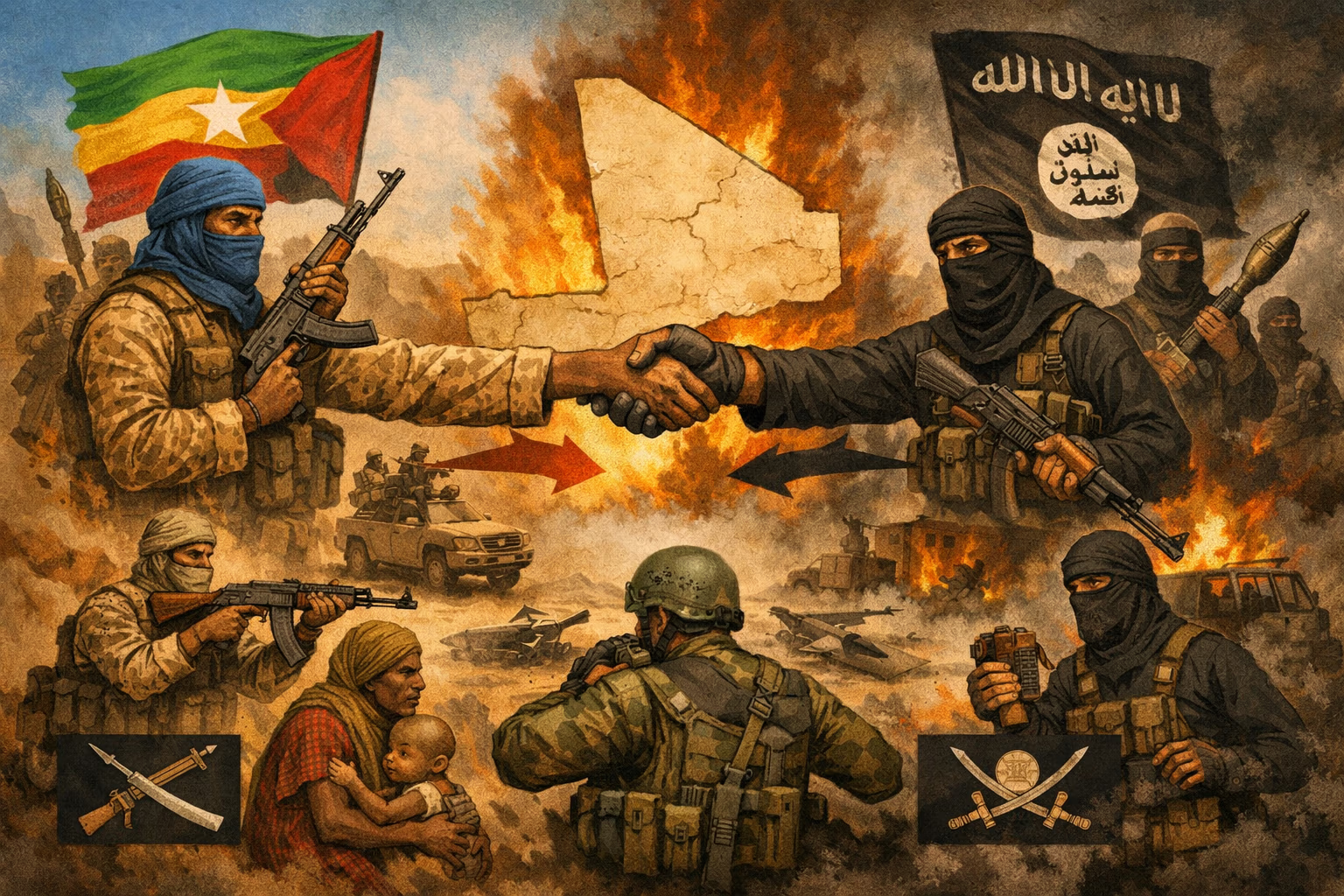
The security landscape in Mali continues to deteriorate amid the growing convergence between separatist insurgent groups and terrorist groups operating across the Sahel. The recent seizure of Kidal by the Front de Libération de l’Azawad (FLA), in collaboration with Jama’at Nusrat al-Islam wal-Muslimin (JNIM), represents a major turning point in Mali’s protracted conflict. The offensive dealt a symbolic and operational blow to the Malian Armed Forces (FAMa) and also raised critical questions regarding the evolving nature of these emerging armed alliances in the Sahel region. The partnership between the Tuareg separatist movement and the region’s most prominent terrorist group has blurred the distinction between separatism and terrorism, while exposing the growing fragility of Mali’s security architecture.
The capture of Kidal is particularly significant because of the city’s strategic and symbolic importance in northern Mali. Historically regarded as the political and cultural heartland of Tuareg separatist movements, Kidal has long served as a contested space between Bamako, separatist rebels, and jihadist factions. The city’s fall following a joint FLA–JNIM offensive suggests the emergence of a hybrid insurgent model in which tactical cooperation, shared governance interests, and overlapping military objectives increasingly outweigh ideological differences.
In an interview granted to Jeune Afrique on 5th May 2026, Alghabass ag Intalla, a senior FLA leader responsible for reconciliation within the movement, openly defended the alliance with JNIM, describing the Malian junta as a “common enemy” while acknowledging operational cooperation between the two groups. Although he insisted that the FLA does not subscribe to JNIM’s interpretation of Islam, he simultaneously endorsed governance structures rooted in Islamic principles and sharia oversight by imams and qadis (Jeune Afrique, 2026). These statements have intensified concerns regarding the extent to which the alliance is tactical, ideological, or potentially transformational.
This article argues that the emerging convergence between the FLA and JNIM represents a dangerous evolution in Mali’s conflict and security dynamics. While the alliance may presently be driven by strategic necessity, the increasing operational coordination between separatist and terrorist actors risk creating a durable hybrid threat capable of undermining state authority, disrupting counterterrorism operations and destabilising the wider Sahel region.
Background to the Mali Conflict
Mali’s contemporary security crisis is rooted in decades of political marginalisation, ethnic tensions, weak governance and vast underdevelopment in the country’s northern regions. Since independence in 1960, Tuareg groups in northern Mali have repeatedly rebelled against the central government, accusing Bamako of neglect, political exclusion and economic discrimination. These grievances have fuelled successive insurgencies seeking either greater autonomy or outright independence for the territory commonly referred to as Azawad.
The 2012 Tuareg rebellion represented a major turning point in Mali’s security trajectory. Armed Tuareg groups, including the National Movement for the Liberation of Azawad (MNLA), launched a large-scale rebellion against the Malian state following the collapse of Libya and the return of heavily armed Tuareg fighters from the Libyan conflict. However, jihadist groups such as Ansar Dine, Al-Qaeda in the Islamic Maghreb (AQIM), and the Movement for Unity and Jihad in West Africa (MUJAO) quickly exploited the instability and overshadowed the separatist rebellion (International Crisis Group, 2023).
Although the French-led Operation Serval succeeded in dislodging jihadist groups from major urban centres in 2013, extremist violence subsequently spread across central Mali and neighbouring Sahelian states. The formation of JNIM in 2017 further consolidated jihadist operations in the region under the leadership of Iyad ag Ghali, himself a prominent Tuareg figure with longstanding influence in northern Mali.
Over time, the distinction between separatist and jihadist actors became increasingly complex. While separatist groups primarily sought political autonomy, jihadist organisations aimed to establish governance systems based on their interpretation of Islamic law. Nevertheless, both actors often shared operational environments, local grievances, ethnic networks and opposition to the central government.
The withdrawal of French forces, the collapse of the Algiers Peace Agreement, and the growing involvement of Russian military contractors under the Africa Corps framework have further transformed the security environment. These developments created conditions in which tactical cooperation between separatist and jihadist groups became increasingly feasible.
The Kidal Offensive and the FLA–JNIM Alliance
The seizure of Kidal on 26th April 2026 marked one of the most significant developments in Mali’s conflict in recent years. The operation demonstrated not only the operational capabilities of the FLA and JNIM but also the extent to which insurgent coordination has evolved in northern Mali.
According to Alghabass ag Intalla, the alliance was formed primarily to confront a “common enemy”: the military junta led by Colonel Assimi Goïta, together with Russian Africa Corps personnel supporting the Malian government (Jeune Afrique, 2026).
The alliance appears to provide mutual benefits to both groups. For the FLA, cooperation with JNIM enhances military capacity, mobility, intelligence sharing and territorial control. JNIM, on the other hand, benefits from the local legitimacy, ethnic networks and territorial familiarity of Tuareg separatist actors. Such cooperation significantly undermines counterterrorism operations because it merges the tactical advantages of insurgent separatism with the asymmetric warfare expertise of the jihadists groups.
The operation also exposed the limitations of Mali’s current security strategy. Despite substantial military support from Russian Africa Corps personnel, Malian forces were unable to prevent the loss of Kidal. The offensive therefore raised serious concerns regarding the operational effectiveness of FAMa and the sustainability of Mali’s militarised counterterrorism approach. Kidal’s capture by separatist and jihadist forces shows how fluid alliances in the Sahel have become.
Strategic Cooperation or Ideological Convergence?
One of the most important questions emerging from the FLA–JNIM alliance concerns whether the partnership is merely tactical or reflects deeper ideological convergence.
Ag Intalla repeatedly emphasised that the alliance is not necessarily permanent and insisted that the FLA does not subscribe to JNIM’s interpretation of Islam (Jeune Afrique, 2026). However, several of his statements suggest significant ideological overlap between the two groups.
First, Ag Intalla openly acknowledged that the FLA and JNIM “share the same religion” and stated that their territory “has always been governed according to Islamic principles” (Jeune Afrique, 2026). He further endorsed governance through imams and qadis while supporting the establishment of Islamic commissions responsible for dispute resolution. These statements indicate that although the FLA rejects violent extremism, it nevertheless embraces forms of Islamic governance compatible with certain aspects of JNIM’s political objectives.
Second, the proposed governance arrangements in captured territories suggest operational integration beyond simple battlefield coordination. Ag Intalla explained that administration would be conducted “by consensus among all parties involved” (Jeune Afrique, 2026). Such arrangements imply shared authority structures that may gradually institutionalise cooperation between separatist and jihadist actors.
Third, the alliance reflects broader trends observable across the Sahel, where ideological distinctions between armed groups are increasingly overshadowed by shared strategic interests. In environments characterised by weak state authority, armed actors often prioritise survival, territorial control and resource access over rigid ideologies.
Nevertheless, important differences remain between the two groups. The FLA continues to frame itself as a nationalist and separatist movement seeking self-determination for Azawad, whereas JNIM pursues broader jihadist objectives linked to Al-Qaeda’s regional agenda. These differences may eventually create tensions between the two groups.
For now, the alliance demonstrates that working together for military reasons could eventually lead to deeper political and ideological cooperation that may change the nature of insurgency in Mali.
The Emergence of a Hybrid Threat
The growing convergence between the FLA and JNIM represents what can best be described as a hybrid threat. Hybrid threats involve the combination of conventional insurgency, terrorism, ideological mobilisation and irregular warfare strategies by interconnected armed actors.
Traditionally, separatist insurgencies and jihadist organisations have been treated as distinct security challenges requiring different policy responses. Separatist movements are often viewed as political actors with negotiable grievances, while jihadist groups are generally approached through counterterrorism frameworks. However, the FLA–JNIM alliance increasingly blurs these distinctions.
The operational cooperation between both groups risks legitimising jihadist influence within separatist-controlled areas while simultaneously granting separatist actors access to extremist military networks. This alliance creates serious challenges for regional governments and international actors attempting to distinguish between negotiable insurgents and designated terrorist organisations.
The alliance may also encourage similar forms of cooperation elsewhere in the Sahel. Armed groups operating in Burkina Faso, Niger and other unstable regions may increasingly adopt pragmatic alliances based on shared enemies and operational convenience rather than ideological alignment.
Furthermore, the alliance between the two groups makes intelligence gathering and military operations more difficult. Military actions against jihadist groups could increase separatist frustrations, while peace talks with separatists may unintentionally give legitimacy to their jihadist allies.
Implications for Mali and the Sahel
The FLA–JNIM convergence carries serious implications for Mali’s political stability and regional security.
For Mali, the alliance threatens to further weaken the authority of the central government in northern regions. The loss of Kidal not only damages the legitimacy of the junta but also demonstrates the inability of military-focused approaches alone to stabilise the country.
The situation also places significant pressure on Africa Corps personnel supporting Mali’s military operations. Following the restructuring of Wagner-linked operations under Russia’s Africa Corps framework, Moscow has sought to maintain influence in Mali through military assistance and counterinsurgency support. However, the Kidal offensive raises doubts regarding the effectiveness of these efforts.
Regionally, the alliance risks accelerating instability across the Sahel. Jihadist violence already affects Burkina Faso, Niger and parts of coastal West Africa. Increased coordination between separatist and extremist actors may enhance insurgent mobility, recruitment and territorial expansion throughout the region.
There are also significant humanitarian concerns. Continued offensives, drone strikes, and counteroffensives may displace civilians and deepen humanitarian suffering in northern Mali. Ag Intalla himself acknowledged fears regarding aerial bombardments and civilian insecurity (Jeune Afrique, 2026).
Recommendations
Addressing Mali’s emerging hybrid threat will require a multidimensional approach combining security, governance, intelligence and political dialogue.
First, Mali and its regional partners must strengthen intelligence-sharing mechanisms to better monitor cooperation between separatist and jihadist actors. Existing counterterrorism frameworks within the Sahel should be adapted to account for hybrid insurgent activities.
Second, military responses alone are unlikely to produce sustainable results. The Malian government should pursue carefully structured political engagement aimed at addressing longstanding grievances in northern Mali.
Third, regional organisations such as ECOWAS, AES and the African Union should intensify diplomatic engagement to prevent further fragmentation of Mali’s security environment. Greater coordination between countries facing insurgency will also be essential.
Fourth, counterinsurgency operations must prioritise civilian protection. Reports of abuses by both state and non-state actors continue to fuel local resentment and create recruitment opportunities for these insurgent groups.
Finally, the international community should support governance reforms, economic development initiatives and community reconciliation programmes capable of reducing the structural drivers of conflict in northern Mali.
Conclusion
The alliance between the FLA and JNIM represents a significant transformation in Mali’s conflict dynamics. Although the partnership may currently be driven by necessity and shared opposition to the Malian junta, the growing operational and governance convergence between separatist and jihadist actors risks producing a durable hybrid insurgency with far-reaching consequences for regional stability.
The seizure of Kidal demonstrates both the evolving adaptability of armed groups in the Sahel and the limitations of existing counterterrorism approaches. As ideological boundaries continue to blur, Mali and its regional partners face an increasingly complex security environment requiring more comprehensive and politically informed responses.
Ultimately, the FLA–JNIM alliance highlights the urgent need for strategies that address not only the military dimensions of insecurity but also the political, social and governance failures that continue to fuel conflict across the Sahel.
References
African Centre for Strategic Studies. (2024). Militant Islamist group dynamics in the Sahel. Washington DC: ACSS. https://africacenter.org/spotlight/militant-islamist-violence-sahel/
Institute for Economics & Peace. (2025). Global Terrorism Index 2025. Sydney: IEP. https://www.economicsandpeace.org/wp-content/uploads/2025/03/Global-Terrorism-Index-2025.pdf
International Crisis Group. (2023). Mali: Avoiding escalation in the north. Brussels: International Crisis Group. https://www.crisisgroup.org/africa/sahel/mali
Jeune Afrique. (2026, May 8). Alghabass ag Intalla (FLA): “Si les Russes n’avaient pas négocié avec nous, leur sort aurait été fatal”. Retrieved from https://www.jeuneafrique.com/1794461/politique/alghabass-ag-intalla-fla-si-les-russes-navaient-pas-negocie-avec-nous-leur-sort-aurait-ete-fatal/.
The Africa Report. (2026, May 8). Mali’s Tuareg rebel chief: “Kidal is only the beginning” of Azawad offensive. Retrieved from https://www.theafricareport.com/417968/malis-tuareg-rebel-chief-kidal-is-only-the-beginning-of-azawad-offensive/