







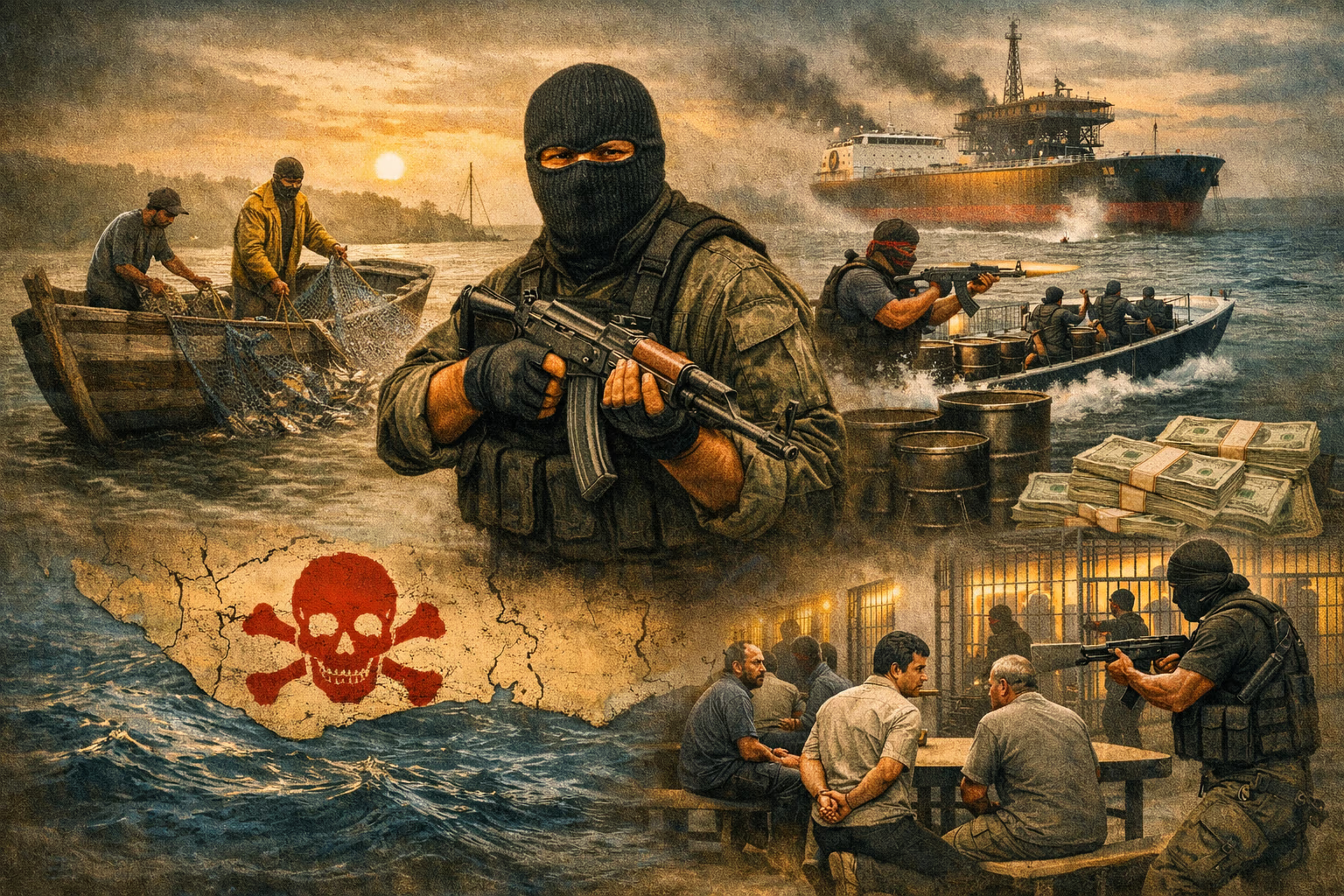
Shortly after ten o’clock on the night of February 26, 2026, armed men in high-speed boats approached a fleet of artisanal fishing vessels operating roughly 35 nautical miles off Senya Bereku in Ghana’s Central Region. The fishermen, 71 of them, were ordered onto their decks at gunpoint. AK-47 rifles kept them there while the attackers stripped four vessels of outboard motors, generators, and communication equipment. These were not incidental targets. They were the entire productive capital of the communities those fishermen came from. By morning, the attackers had gone. The Ghana Navy recovered all 71 men (GhanaWeb, 2026a). One of the rescued fishermen alleged on JoyNews that the attackers were Nigerian nationals, a claim that had not been independently verified by investigators at the time of reporting (GhanaWeb, 2026b). The suspects had not been apprehended.
The incident was widely described as a piracy attack, and legally, given its location beyond Ghana’s 12-nautical-mile territorial sea, that framing holds under Article 101 of UNCLOS. But the legal category captures only what happened, not why, and not why it is happening with increasing frequency in Ghanaian waters. Understanding that requires looking at the economic conditions that make maritime crime a viable livelihood for the men who carry it out, and at the structural arrangements that ensure the costs of addressing it fall almost entirely on the states least equipped to bear them.
WHAT CREATES A PIRATE
Piracy in West Africa is not primarily the product of opportunistic actors exploiting weak enforcement. It is the product of a coastal economy under sustained stress, in which the erosion of legal livelihoods has progressively narrowed the alternatives available to people with boats, maritime knowledge, and few other assets.
Across the Gulf of Guinea, artisanal fishing has long been the economic foundation of coastal communities. In Ghana alone, the sector employs an estimated two million people directly and indirectly. But over the past two decades that foundation has been undermined from above and below simultaneously. Industrial trawling by distant-water fleets, much of it operating illegally or in regulatory grey zones, has depleted fish stocks in coastal waters. Ghana’s own phenomenon of saiko, the illegal transshipment of fish from industrial trawlers to local canoes at sea, has accelerated stock depletion while distorting local markets by flooding them with undersized, cheap fish that artisanal fishermen cannot compete with (MyJoyOnline, 2026). The Food and Agriculture Organization estimates that a majority of assessed fish stocks in West African waters are now either fully exploited or overexploited. For artisanal fishermen, this translates into declining catches, rising fuel costs, and incomes that no longer cover the debt servicing on the equipment that keeps them at sea.
Economic pressure alone does not produce piracy. But it alters the calculations that shape behaviour. When legal livelihoods become unviable in communities where boats, navigation skills, and knowledge of maritime routes are already widely held, the structural distance between fishing and maritime crime shortens. The transition is rarely sudden or direct. It begins at the margins: carrying smuggled fuel, facilitating illegal fishing operations, providing local intelligence to larger networks. Over time, these activities can be absorbed into more organised forms of criminal enterprise. The Niger Delta, where economic marginalisation, environmental damage from decades of oil extraction, and governance failure created the conditions for militant groups and criminal networks to converge, is the documented endpoint of that trajectory. West African piracy did not emerge from nowhere. It emerged from somewhere specific, and that somewhere is worth understanding.
NETWORKS, NOT OUTLAWS
The image of piracy as small groups of armed men in speedboats acting on impulse conceals a more consequential reality. Maritime crime in the Gulf of Guinea is sustained by networks with financing, logistics, and transnational reach. Understanding this matters because it determines what kind of response can actually be effective.
The March 2025 attack on the Mengxin 1, a Ghanaian-registered, Chinese-operated fishing vessel attacked approximately 16 nautical miles off Accra, illustrates the structure precisely. Five attackers arrived by wooden canoe, boarded the vessel, destroyed its communication systems, and abducted three senior Chinese officers: the captain, chief mate, and chief engineer. The victims were blindfolded and transported by high-speed boat for 24 hours across the Gulf of Guinea to a remote camp in Nigeria’s Niger Delta, where they were held for nearly a month before being abandoned and eventually repatriated (Zagazola, 2025). The investigation led by Ghana’s Criminal Investigations Department revealed that the operation had not been improvised. It involved external attackers, internal collaborators among the vessel’s own crew, a logistics chain spanning two national jurisdictions, and a holding facility maintained in advance. This was a planned commercial operation, not opportunistic violence.
Subsequent arrests connected the crime to a network that included Nigerian nationals Sueva Victor and Eugene Chibuke, now arraigned at the Tema District Court, as well as the vessel’s own bosun and two Chinese crew members charged with conspiracy and abetment. The presence of inside men is a recurring feature of maritime crime in the region. Criminal networks invest in access to legitimate maritime operations precisely because that access makes attacks cheaper to execute and harder to detect. Disrupting piracy, therefore, requires dismantling the financial and logistical structures that sustain these networks, not simply intercepting attacks at sea after the network has already functioned.
THE GEOGRAPHIC SHIFT AND WHAT IT SIGNALS
For most of the past two decades, Nigeria was the operational centre of maritime crime in the Gulf of Guinea. In 2020, the International Maritime Bureau (IMB) recorded 81 incidents across the region, the majority linked to Nigerian waters and the Niger Delta corridor. Nigeria’s subsequent investment in its Deep Blue Project, a 200-million-dollar maritime security programme deployed from 2021, produced a measurable result: of the 59 piracy incidents recorded across the Gulf between 2022 and 2024, only three occurred in Nigerian waters (Center for Maritime Strategy, 2025). The project did not eliminate the criminal networks operating in the region. It displaced them.
Ghana now sits at the receiving end of that displacement. The Senya Bereku attack in February 2026, targeting artisanal fishing vessels rather than commercial shipping, represents a tactical adaptation that is particularly difficult to counter. Attacks on artisanal fleets are lower-profile than kidnap-for-ransom operations against commercial vessels. They require less sophisticated equipment and planning. They cause disproportionate economic damage to communities whose entire livelihood floats in the vessels being stripped. And because artisanal fishing grounds are diffuse and largely unmonitored, they are structurally harder to defend through naval patrol alone. Security analysts have drawn explicit comparisons with Somalia in the early 2000s, where the same combination of depleted fish stocks, economic desperation, and inadequate state response eventually produced a piracy industry that threatened 12 percent of global trade through the Gulf of Aden (Modern Ghana, 2026). The parallel is not a prediction. It is a structural warning.
WHAT STATES ARE DOING, AND WHAT IT COSTS
Ghana’s institutional response to this pressure has been substantial. The Fisheries and Aquaculture Act 2025 expanded the Inshore Exclusive Zone from six to twelve nautical miles, mandated GPS tracking and electronic monitoring for vessels in Ghanaian waters, and established enforcement mechanisms with penalties sufficient to affect the calculations of foreign industrial operators. The Ghana Navy commissioned the GNS Achimota, a 65-metre offshore patrol vessel from Japan and the most capable platform in the Navy’s history, in December 2024. The Ezinlibo Forward Operating Base, commissioned in the Western Region, provides the shore-based logistics infrastructure to sustain deep-water patrols and protect offshore oil and gas installations. The Navy’s annual sea hours have increased from approximately 1,000 to around 20,000 under the current modernisation programme (ADF Magazine, 2025). The prosecution of the Mengxin 1 suspects at the Tema District Court is an attempt to close what security analysts call the legal finish, the deterrence loop that begins with arrest and must end in conviction to be complete.
In February 2026, five ECOWAS member states, Ghana, Côte d’Ivoire, The Gambia, Liberia, and Sierra Leone, committed to joining Nigeria in operationalising a Combined Maritime Task Force designed to conduct joint patrols across national exclusive economic zones and close the jurisdictional gaps that criminal networks exploit by crossing maritime boundaries to avoid pursuit (Guardian Nigeria, 2026). The Ghana-Nigeria dimension of this cooperation is worth noting specifically. At the same moment that Ghana is prosecuting Nigerian nationals in its domestic courts, the two states are deepening naval cooperation at the regional level. This is not contradiction, it is the correct response to a problem that no single state can resolve, regardless of how seriously it invests in enforcement.
Here is what that investment costs, and who pays it. The Gulf of Guinea remains on the Joint War Committee’s list of areas of enhanced risk for hull war purposes, maintained by the London insurance market. Vessels entering the region pay Additional War Risk Premiums that can exceed one percent of hull value per voyage. The estimated annual cost of piracy and maritime crime to the region exceeds two billion dollars (ResearchGate, 2026). That cost is distributed through elevated freight rates, deterred shipping, and suppressed port investment, falling ultimately on the economies of West African states. The premium income flows to the insurance market in London. Ghana is funding naval modernisation, passing legislation, prosecuting foreign suspects, and committing assets to regional task forces. The global economic system that prices maritime risk is not contributing to the reduction of the conditions that generate it.
THE INTELLIGENCE GAP NAVAL INVESTMENT CANNOT CLOSE
Ghana’s maritime security investment has extended the Navy’s reach significantly. What it has not resolved is a geographic problem that no fleet of vessels can fully solve. Artisanal fishing grounds are diffuse, shift with fish stocks and seasons, and stretch across hundreds of nautical miles of coastline that no patrol schedule can cover continuously. The criminal networks that have moved into Ghanaian waters understand this geography as well as the fishermen who work it. They operate in the gaps.
Those gaps already have a persistent human presence in them. Hundreds of thousands of Ghanaian fishermen go to sea along the country’s 540-kilometre coastline every day. They know what belongs in those waters and what does not. Artisanal fishing canoes and dugouts do not travel by speedboat. The fuel economics alone make that impossible. A speedboat in coastal fishing waters is not a background feature of the maritime environment. It is an anomaly, and the fishermen who encounter it know immediately that something is wrong. That knowledge is the most geographically distributed, continuously updated maritime intelligence available anywhere along Ghana’s coast. It is currently being generated and discarded, because there is no systematic architecture for capturing it.
This is the most consequential gap in Ghana’s current security architecture, and it matters analytically for a reason beyond the operational one. The Senya Bereku attack, with its atypical targeting of outboard motors and generators rather than crew members for ransom, does not fit the signature of the established transnational criminal networks whose operations the Mengxin 1 case documented. Organised networks operating in the Gulf of Guinea invest in kidnap-for-ransom precisely because it generates returns large enough to sustain their logistics and financing chains. Equipment theft from fishing canoes does not. The Senya Bereku attack may represent a different and lower-order threat, one rooted closer to home, in the same coastal economic desperation the piece has traced from the beginning. Or it may represent an established network testing new terrain. Distinguishing between the two is not a matter of additional patrol hours. It requires the kind of granular, community-level intelligence that only people already present in those waters can provide.
Converting that presence into a functioning early warning system is therefore not a supplementary recommendation to the investments Ghana has already made. It is the layer without which those investments cannot reach the full extent of the problem. A community-based risk register, maintained at the district level and connected to a reliable reporting channel between fishing landing sites and naval command, would give the Navy persistent situational awareness in waters it cannot continuously cover. Training key personnel in fishing communities to identify threat indicators, preserve evidence, and call in observations through a dedicated channel closes the intelligence loop that begins at sea and must end in a command room to be operationally useful. Fishermen are already the frontline. The question is whether the institutions behind them are organised to receive what the frontline sees. But the strategic argument goes further than operations. A fisherman who is trained, recognised, and formally connected to the security architecture has a relationship with the state that directly competes with the relationship the criminal network is offering. When the state builds that architecture, it is not only acquiring intelligence. It is contesting the recruitment.
THE SEA IS ALSO AN ECONOMY
The Gulf of Guinea’s piracy problem has been declining in aggregate terms. The IMB recorded 21 incidents in 2025, compared to 81 at the 2020 peak, and explicitly commended Gulf of Guinea authorities for their role in that reduction (ICC-IMB, 2026). That progress is real and the states that produced it deserve recognition for it. But incident numbers declining in one jurisdiction while rising in a neighbouring one is displacement, not resolution. And enforcement that suppresses the crime without addressing the conditions that produce the criminal is a holding operation, not a solution.
The sea off Ghana’s coast is a working sea. It feeds families in Senya Bereku, Elmina, and Moree. It carries the country’s trade through the port at Tema. It sits above oil reserves that anchor the national budget. The armed men who attacked 71 fishermen in February 2026 almost certainly came from communities structured by the same economic pressures that those fishermen themselves were navigating. That is not a justification. It is a diagnosis.
What that diagnosis demands is a response that operates at three levels simultaneously. At the enforcement level, the legal finish must be completed: arrests must lead to prosecutions and prosecutions to convictions that the networks financing maritime crime actually feel. At the intelligence level, fishing communities must be formally integrated into a risk register and early warning system, with trained personnel, reliable reporting channels, and institutional relationships between landing sites and naval command that function in both directions. At the structural level, IUU fishing by industrial fleets must be enforced against seriously, the saiko trade must be dismantled, and the coastal communities that currently supply the labour for maritime crime must have a viable economic alternative to the networks recruiting from their edges.
Until all three levels are being addressed simultaneously, the Gulf of Guinea will continue to produce what it has always produced when coastal communities run out of options: people with boats and nothing left to lose. The question is not whether Ghana has the institutional capacity to respond. The evidence suggests it does. The question is whether that capacity is being deployed with the comprehensiveness the problem demands. And there is a harder question behind it: Ghana cannot resolve the structural conditions generating maritime crime while simultaneously absorbing the full cost of suppressing its symptoms. The global economic system that benefits from safer shipping lanes through the Gulf of Guinea has no current obligation to contribute to either. That asymmetry is not a footnote to this problem. It is the political economy of it.
References
- ADF Magazine. (2025, January). Ghana commissions its largest forward operating base, receives new ship. https://adf-magazine.com/2025/01/ghana-commissions-its-largest-forward-operating-base-receives-new-ship/
- Atlantic Council. (2025, November). Atlantic piracy, current threats, and maritime governance in the Gulf of Guinea. https://www.atlanticcouncil.org/in-depth-research-reports/issue-brief/atlantic-piracy-current-threats-and-maritime-governance-in-the-gulf-of-guinea/
- Center for Maritime Strategy. (2025, August). Piracy in the Gulf of Guinea: Progress and future challenges. https://centerformaritimestrategy.org/publications/piracy-in-the-gulf-of-guinea-progress-and-future-challenges/
- Food and Agriculture Organization. (2023). The state of world fisheries and aquaculture 2022. FAO.
- GhanaWeb. (2026a, February 26). Ghana Navy launch search and rescue operation after attack on fishermen. https://www.ghanaweb.com/GhanaHomePage/NewsArchive/Ghana-Navy-launch-search-and-rescue-operation-after-attack-on-fishermen-2023420
- GhanaWeb. (2026b, February 26). ‘They threatened to kill us’: Rescued fisherman speaks after armed sea attack. https://www.ghanaweb.com/GhanaHomePage/NewsArchive/They-threatened-to-kill-us-Rescued-fisherman-speaks-after-armed-sea-attack-2023452
- Guardian Nigeria. (2026, February 24). Five ECOWAS nations commit to strengthening West Africa maritime security. https://guardian.ng/news/world/africa/five-ecowas-nations-commit-to-strengthening-west-africa-maritime-security/
- ICC International Maritime Bureau. (2026, January). Global maritime piracy and armed robbery increased in 2025. https://iccwbo.org/news-publications/report/global-maritime-piracy-and-armed-robbery-increased-in-2025/
- Marine Insight. (2026). Ghana Navy rescues 71 fishermen after armed pirates attack their boats. https://www.marineinsight.com/ghana-navy-rescues-71-fishermen-after-armed-pirates-attack-their-boats/
- Ministry of Fisheries and Aquaculture Ghana. (2025). Fisheries and Aquaculture Act, 2025 (Act 1146). https://www.mofaq.gov.gh
- Modern Ghana. (2026, April 10). Piracy returns: Ghana must guard its waters against a fishermen-led threat. https://www.modernghana.com/news/1480184/piracy-returns-ghana-must-guard-its-waters-agains.html
- MyJoyOnline. (2026). Ghana Industrial Trawlers Association demands urgent action on maritime security. https://www.myjoyonline.com/ghana-industrial-trawlers-association-demands-urgent-action-on-maritime-security-after-fishermen-were-attacked-at-sea/
- ResearchGate. (2026). The economic impact of piracy: A critical assessment of maritime security and trade disruptions in the Gulf of Guinea. https://www.researchgate.net/publication/399739800
- United Nations Convention on the Law of the Sea. (1982). Article 101: Definition of piracy. https://www.un.org/depts/los/piracy/piracy_legal_framework.htm
- Zagazola. (2025). Three Chinese crew members rescued in Nigeria after pirate attack on fishing vessel in Ghanaian waters. https://zagazola.org/index.php/breaking-news/three-chinese-crew-members-rescued-in-nigeria-after-pirate-attack-on-fishing-vessel-in-ghanaian-waters