








1. Introduction
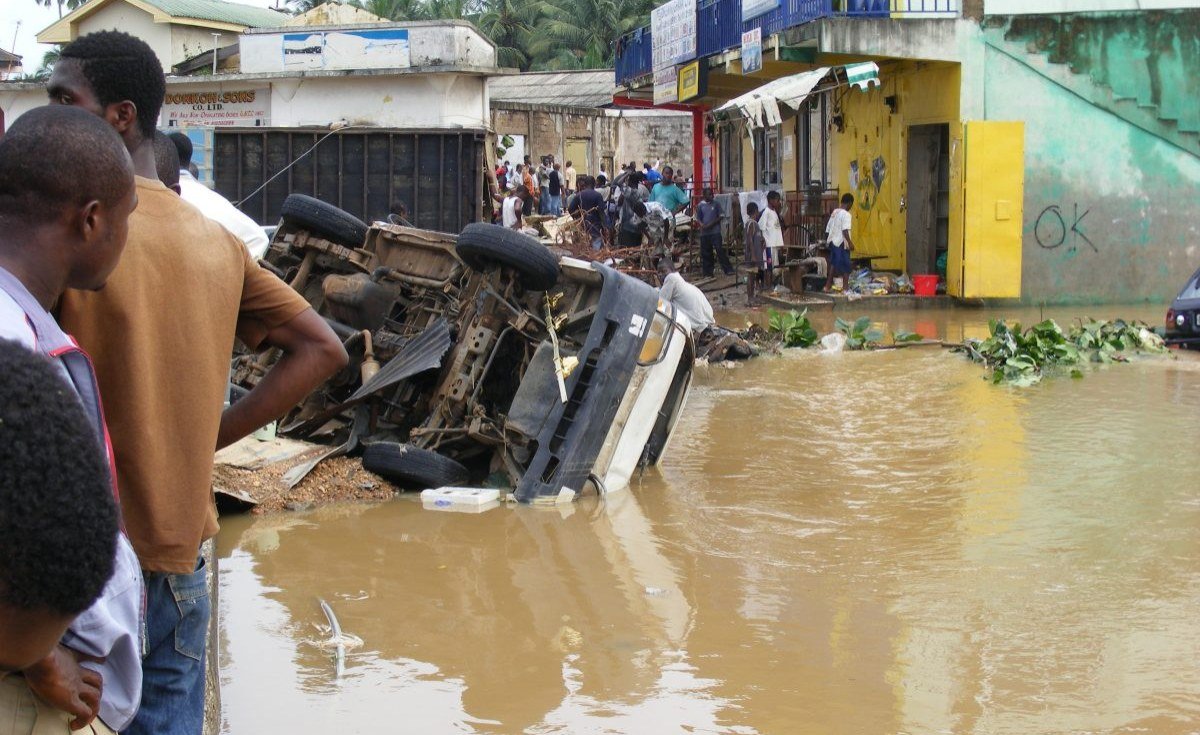
Flooding has become one of the most recurrent and destructive natural hazards in Ghana, resulting in significant loss of life, displacement, infrastructure damage and economic disruption. Although floods occur across different ecological zones, the Greater Accra Metropolitan Area (GAMA) has experienced increasingly frequent and severe flood events over the past two decades. The heavy rainfall of 29 June 2026 once again exposed the country’s vulnerability, affecting seven regions, disrupting livelihoods and displacing thousands of residents. By 30 June 2026, official reports confirmed at least 12 deaths, seven missing persons and approximately 7,761 affected households in Accra alone (Appiah-Osei, 2026; GhanaWeb, 2026).
Flood disasters in Ghana are driven by the interaction of extreme rainfall and long-standing urban development challenges. Rapid urbanisation, encroachment on waterways, inadequate drainage infrastructure, poor solid waste management and weak enforcement of planning regulations have increased the exposure of people and property to flood hazards (see Mensah, & Ahadzie, 2020). Consequently, while extreme rainfall often triggers flood events, the scale of their impacts reflects broader development and governance challenges.
Existing studies have largely concentrated on the causes of flooding and long-term mitigation strategies such as drainage improvement, land-use planning and climate adaptation. Comparatively less attention has been paid to the institutional challenges encountered during emergency response once flooding occurs. Yet, given the persistence of flood risks and the practical difficulties associated with removing settlements from waterways, effective disaster preparedness and emergency response remain essential for reducing flood-related fatalities.
This article examines the institutional challenges experienced during the response to the June 2026 floods in Ghana. Drawing on perspectives from planners, emergency responders, disaster management officials and researchers, it identifies key constraints affecting coordination, operational capacity and emergency preparedness. Additionally, the article argues that while floods are primarily driven by extreme rainfall and unsustainable urban development, strengthening the preparedness and coordination of security and emergency institutions is essential for reducing the human consequences of recurring flood disasters.
2. Flood Preparedness
Successive governments in Ghana have implemented various measures to reduce flood risk, including the construction and expansion of drainage systems, dredging of major watercourses such as the Odaw River, demolition of structures built within waterways, desilting exercises, public education campaigns and the development of national disaster management policies (see Almoradie et al., 2020; Aniaggyei, 2023). At the institutional level, the National Disaster Management Organisation (NADMO), Metropolitan, Municipal and District Assemblies (MMDAs), the Ghana National Fire Service, the Ghana Police Service and other emergency agencies have been mandated to prepare for, respond to and coordinate disaster management activities.
Despite these efforts, flooding continues to occur almost annually, particularly in the Greater Accra Metropolitan Area. While structural interventions remain necessary, they have not eliminated flood risk because rapid urbanisation, continued development within flood-prone areas and increasingly intense rainfall continue to outpace mitigation efforts. Consequently, flood preparedness has become an equally important component of disaster risk management. Recognising that flood events cannot always be prevented, emergency institutions must be adequately prepared to minimise casualties and protect affected communities.
The floods of 29 June 2026 underscore this reality. Beyond exposing weaknesses in urban infrastructure, the disaster highlighted the importance of institutional preparedness, operational capacity and inter-agency coordination in emergency response. As climate change increases the likelihood of extreme weather events, strengthening the preparedness of security and emergency institutions through improved coordination, adequate logistics, specialised training and effective emergency planning is essential for reducing flood-related deaths and enhancing national disaster resilience (Behera, 2024; Buller, 2025).
3. Institutional Challenges in Flood Disaster Response
To complement the review of flood governance in Ghana, the paper draws on insights from ten key informants purposively selected for their professional involvement in disaster management, emergency response and urban planning. The participants comprised two urban planners, two officers from the Ghana Police Service, two officers from the Ghana National Fire Service, two officials from the National Disaster Management Organisation (NADMO) based in Ho, and two researchers with expertise in urban governance and disaster management. The interviews were intended to provide expert perspectives on the operational realities of flood disaster response rather than statistically representative views. Although the June 2026 floods primarily affected Greater Accra, the inclusion of NADMO officials from Ho was deliberate. The Volta Region experienced significant flooding in 2023, making its disaster management officials well placed to reflect on institutional preparedness, operational challenges and inter-agency coordination from another regional context. Through the interviews, four interrelated themes emerged: fragmented institutional governance, inadequate operational capacity, bureaucratic and logistical constraints, and the growing reliance on community-led emergency response.
3.1 Fragmented governance and weak institutional coordination
The dominant issue raised by respondents was the fragmented nature of Ghana’s disaster governance system. Although disaster response involves several institutions with clearly established legal mandates, respondents argued that coordination among these organisations remains weak, particularly during large-scale emergencies. Rather than operating as an integrated response system, agencies often function independently, creating uncertainty regarding institutional leadership and slowing emergency interventions. One researcher attributed these coordination challenges to the increasing administrative fragmentation of metropolitan Accra:
When Accra was under one mayor, Accra worked and there was some coordination. We don’t know who is responsible for what. There are so many institutional overlaps and we cannot hold anyone responsible. We don’t know who is responsible for what anymore. The segregation of Accra into small jurisdictions is causing this issue. In political theory, we call it gerrymandering: creating a lot of constituencies just for political gain. (Researcher 2, IDI, 2026)
Over the past two decades, Greater Accra has been divided into an increasing number of Metropolitan, Municipal and District Assemblies (Gaisie et al., 2019). While decentralisation has strengthened local administration and political representation (Ahoi, 2009), respondents suggested that it has also complicated disaster governance by dispersing responsibilities across multiple jurisdictions. Floodwaters frequently cut across municipal boundaries, requiring coordinated action among several assemblies and emergency institutions. Where coordination mechanisms are weak, overlapping responsibilities and fragmented authority may delay rescue operations and reduce institutional effectiveness. This concern was reinforced by one of the planners interviewed, who characterised disaster management as operating through institutional silos rather than collaborative governance: “What we have is silo approach execution. There is no coordination. The various institutions have conflicting objectives and as you travel outside Accra, the human resource reduces. So it makes solving the issues or responding to these pressing issues difficult.” (Planner 1, IDI, 2026)
The reference to a “silo approach” reflects a broader governance problem in which institutions pursue their statutory mandates independently with limited integration of planning, information sharing or operational decision-making (Buylova et al., 2025). Effective flood response requires multiple agencies including NADMO, the Fire Service, Police Service, health authorities and local governments to operate simultaneously. When these institutions function independently rather than collaboratively, emergency responses become slower and less coordinated. Respondents therefore viewed weak institutional coordination not simply as an operational issue but as a structural governance challenge requiring stronger metropolitan coordination mechanisms and clearer lines of accountability.
3.2 Operational capacity constraints
Beyond coordination challenges, respondents consistently emphasised that disaster response institutions operate under significant resource constraints. While emergency agencies are expected to undertake rescue operations, evacuations and emergency coordination, they frequently lack the equipment, logistics and financial resources necessary to perform these responsibilities effectively. A Fire Service officer reflected on the operational realities experienced during the June 2026 floods: “I was on duty that day and it was stressful. We don’t have the necessary equipment for rescue because it is expensive. All we can do is security and not safety. Safety and security go hand in hand.” (Fire Service Officer, IDI, 2026). Similarly, a police officer acknowledged that although the Police Service is often among the first institutions to arrive at disaster scenes, it lacks the specialised equipment required for flood rescue operations: “We are among the first responders when these issues arrive but the truth is we are not equipped to handle this.” (Police Officer, IDI, 2026)
These accounts illustrate that the challenge confronting emergency institutions is not necessarily the absence of professional commitment but rather limited operational readiness. Respondents consistently described situations in which personnel were willing to respond but lacked the equipment required to undertake safe and effective rescue operations. Such limitations become particularly critical during flash floods where delayed interventions may significantly increase the risk of fatalities. Resource shortages were described most vividly by officials from NADMO. One official explained that even basic logistical support remains inadequate:
We always fall on the assembly for support. Even when we request for a pick up from the Assembly, we chase but at last we only fall on public transport. This whole region, we only have one pickup which has been used by the Regional Director. Even the furniture at the office, we bought them ourselves. Some of the computers here, we used our own resources. (NADMO Official 1, IDI, 2026)
This testimony suggests that institutional capacity challenges extend beyond emergency situations to encompass chronic underinvestment in disaster management institutions. The inability to access transport, communication equipment and other basic logistical resources limits the speed with which disaster officials can mobilise during emergencies. More broadly, these constraints point to persistent gaps between institutional mandates and the resources allocated for their implementation.
3.3 Community-led rescue and the governance gap
The most striking theme emerging from the interviews was the increasing reliance on community members during emergency rescue operations. Several respondents noted that local residents often become the first responders because they are already present within affected communities before formal emergency services arrive. One researcher observed:
The institutions responsible are not working. It is the street boys who are doing the rescue. It is a challenge because they are not trained well and may result in casualties. I have seen several videos on social media where street boys are doing the rescue and I must commend them. (Researcher 1, IDI, 2026)
Although expressed in strong terms, this observation reflects a broader concern regarding the gap between institutional expectations and operational realities. Community volunteers frequently provide immediate assistance during floods by rescuing stranded residents, directing traffic and assisting with evacuations. Their rapid mobilisation demonstrates significant levels of local solidarity and social resilience. However, respondents also recognised the risks associated with relying on untrained volunteers. Without appropriate rescue training, protective equipment or coordination with formal emergency agencies, community responders may expose themselves and others to additional danger. Rather than viewing community participation as a substitute for formal disaster management, the interviews suggest that it should be recognised as an important component of Ghana’s disaster governance system. Formal institutions should therefore develop mechanisms for training, supporting and coordinating community volunteers so that spontaneous local action complements rather than replaces professional emergency response.
Policy Recommendations
The recurrence of flooding in Ghana suggests that emergency response should no longer be treated as an ad hoc activity activated only after flood events occur. While long-term interventions such as improved drainage infrastructure, enforcement of planning regulations and the removal of structures from waterways remain essential, these measures have proven politically and operationally difficult to implement consistently. Consequently, flood disasters are likely to remain a recurring feature of Ghana’s urban landscape. Security and emergency institutions must therefore be adequately prepared to minimise casualties and protect lives during future flood events. The following recommendations are proposed:
- Establish a Unified Flood Incident Command System for all major flood emergencies to clearly define institutional responsibilities and improve coordination among NADMO, the Ghana Police Service, the Ghana National Fire Service, the National Ambulance Service, the Ghana Armed Forces and Metropolitan, Municipal and District Assemblies (MMDAs).
- Metropolitan, Municipal and District Assemblies (MMDAs) should ensure that property tax revenues are transparently and efficiently invested in flood mitigation measures, including drainage maintenance, waste management, and the enforcement of development control regulations, to strengthen urban flood resilience.
- Increase operational logistics for frontline agencies, particularly NADMO district and regional offices, through dedicated funding for emergency vehicles, communication systems, fuel, protective equipment and routine maintenance.
- Develop community-based emergency response units in flood-prone communities by training local volunteers in basic water rescue, first aid, evacuation procedures and emergency communication. These volunteers should operate under the supervision of the Ghana National Fire Service and NADMO rather than as informal responders.
- Develop flood-specific standard operating procedures (SOPs) for all emergency institutions, outlining agency responsibilities before, during and after flood events, including evacuation protocols, traffic management, rescue coordination and post-disaster recovery.
- Improve inter-agency communication systems through a common emergency communication platform that enables real-time information sharing between security agencies, emergency responders and local government authorities during flood events.
- Increase specialised flood rescue training for police officers, fire service personnel and NADMO staff, recognising that flood response requires technical skills that differ from conventional emergency operations.
- Strengthen metropolitan-level coordination across the Greater Accra Metropolitan Area, recognising that floodwaters frequently cross administrative boundaries and require coordinated responses among multiple assemblies rather than isolated municipal interventions.
- Prioritise life-saving as the primary objective of flood response. Given the continuing occupation of waterways and other flood-prone areas, emergency planning should assume that severe flooding will recur. Disaster preparedness should therefore focus on reducing fatalities through rapid evacuation, timely rescue operations, efficient emergency communication and adequate deployment of personnel and resources.
Conclusion
The June 2026 floods reaffirm that flooding in Ghana is driven by the interaction of extreme rainfall and long-standing urban development challenges, including continued occupation of waterways, inadequate drainage infrastructure and weak enforcement of planning regulations. While addressing these underlying drivers remains critical, the persistence of development challenges means that severe flooding is likely to continue in the foreseeable future. Under these circumstances, the effectiveness of disaster response institutions becomes a decisive factor in reducing the human consequences of flood disasters. The interviews presented in this article demonstrate that emergency agencies are constrained by fragmented institutional responsibilities, inadequate logistics, limited operational resources and weak inter-agency coordination. These challenges reduce their ability to respond rapidly during emergencies despite the commitment of frontline personnel.
For Ghana’s security and emergency institutions, the policy priority should therefore move beyond reacting to individual flood events towards building a permanent culture of preparedness. Annual floods should be anticipated rather than treated as exceptional events. Investing in coordinated command structures, specialised rescue capacity, interoperable communication systems and community-based preparedness will significantly enhance the ability of institutions to save lives when floods occur. Although security agencies cannot prevent extreme rainfall or reverse decades of unplanned urban development, they can substantially reduce flood-related fatalities through better planning, stronger coordination and sustained operational readiness.
Reference
Ahoi, K. (2007). Local Government and Decentralization in Ghana, Unimax Macmillan Ltd, Accra, Ghana
Almoradie, A., De Brito, M. M., Evers, M., Bossa, A., Lumor, M., Norman, C., Yacouba, Y., & Hounkpe, J. (2020). Current flood risk management practices in Ghana: Gaps and opportunities for improving resilience. Journal of Flood Risk Management, 13(4). https://doi.org/10.1111/jfr3.12664
Aniaggyei, R. (2023). Govt announces initiatives to tackle rising flood risks in Ghana. www.modernghana.com. July 17, 2026. https://www.modernghana.com/news/1261815/govt-announces-initiatives-to-tackle-rising-flood.html
Appiah-Osei, E (2026). June 29 Floods: 12 dead, seven missing, 7,761 households displaced. gna.org.gh. July 17, 2026. https://gna.org.gh/2026/06/june-29-floods-12-dead-seven-missing-7761-households-displaced/
Behera S.K. (2024) Understanding the impact of climate change on extreme events. Front Sci 2:1433766. doi: 10.3389/fsci.2024.1433766
Buller, S (2025) Extreme Weather Preparedness, Planning, and Resilience: Moving Towards a Proactive Whole-of-Society Approach. www.theicpem.org. July 17, 2026. https://www.theicpem.org/post/extreme-weather-preparedness-planning-and-resilience-moving-towards-a-proactive-whole-of-society-1
Buylova, A., Nasiritousi, N., Bergman, J., Sanderink, L., Wickenberg, B., Casiano Flores, C., & McCormick, K. (2025). Bridging silos through governance innovations: The role of the EU cities mission. Frontiers in Sustainable Cities, 6. https://doi.org/10.3389/frsc.2024.1463870
GhanaWeb (2026). 12 Dead, 150 Rescued: GNFS gives breakdown of June 29 flood tragedy. Ghanaweb.com. July 17, 2026. https://www.ghanaweb.com/GhanaHomePage/NewsArchive/12-Dead-150-Rescued-GNFS-gives-breakdown-of-June-29-flood-tragedy-2041119
Gaisie, E., Kim, H. M., & Han, S. S. (2019). Accra towards a city-region: Devolution, spatial development and urban challenges. Cities, 95, 102398. https://doi.org/10.1016/j.cities.2019.102398
Mensah, H., & Ahadzie, D. K. (2020). Causes, impacts and coping strategies of floods in Ghana: A systematic review. SN Applied Sciences, 2(5). https://doi.org/10.1007/s42452-020-2548-z