








The Invisible War: Intelligence Infiltration and the Defeat of the GIA
Lessons from the Black Decade (Part 3 of 5)
Introduction
Conventional armies are notoriously ill-equipped to fight ghosts. In the early years of the Algerian Civil War, the national army (ANP) attempted to crush the Islamist insurgency using the only tools it knew: massive sweep operations, armoured columns, and artillery. This approach not only failed to secure the rugged mountainous terrain and dense urban banlieues, but the resulting collateral damage also alienated the very civilian population the state needed to protect.
As we discussed in Part 2, political mechanisms like the Civil Concord were vital for draining the insurgency of its pragmatic fighters. However, for the hardened, irreconcilable fanatics of the Armed Islamic Group (GIA), a different weapon was required. The state realised that to defeat a clandestine, networked enemy, the tip of the counter-insurgency spear could not be conventional infantry; it had to be intelligence.
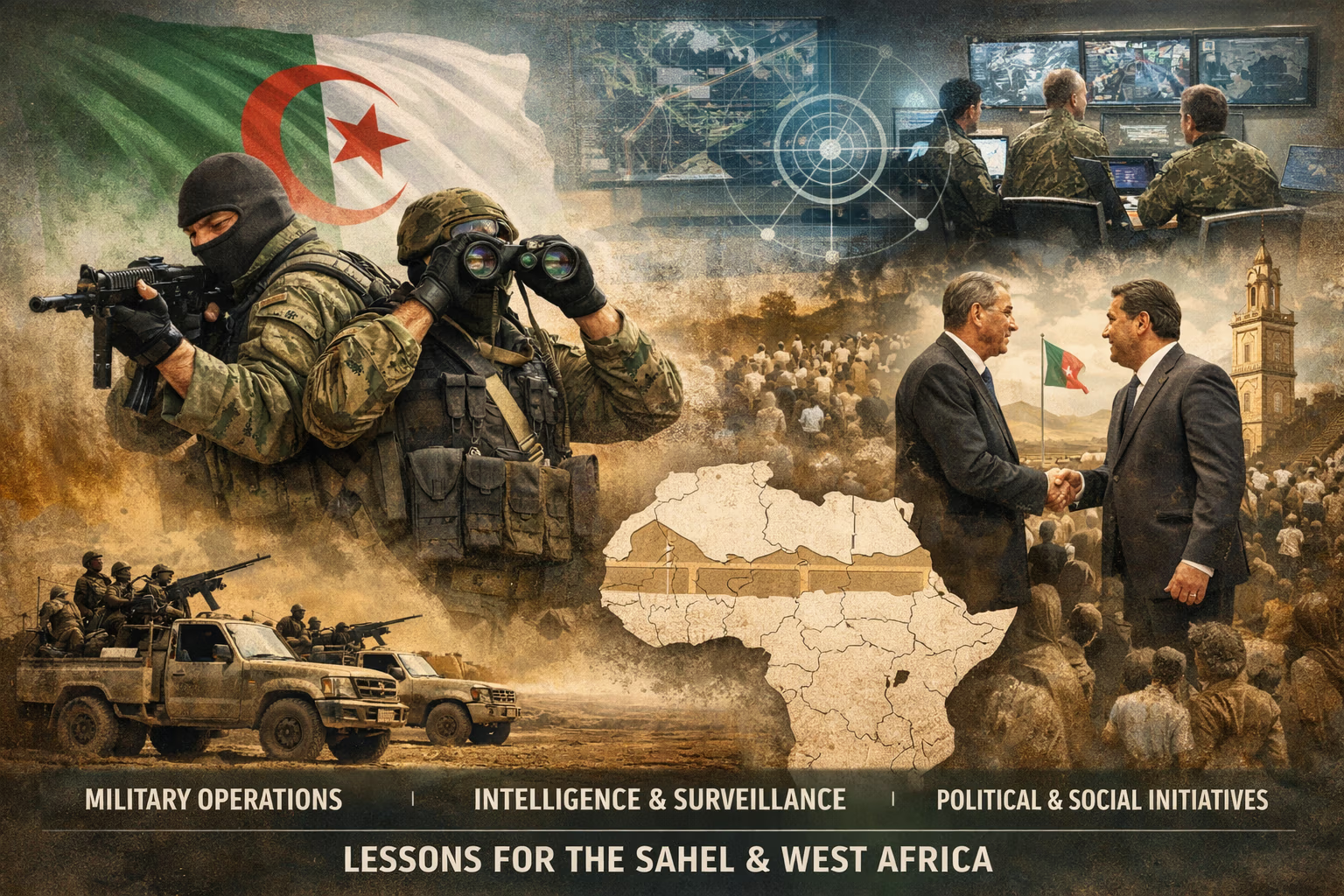
This third instalment analyses the strategic pivot toward human intelligence (HUMINT) led by Algeria’s intelligence service, Département du Renseignement et de la Sécurité (DRS). By infiltrating the GIA and turning its internal dynamics into a weapon of self-destruction, the Algerian intelligence apparatus executed a masterclass in clandestine warfare that holds urgent, actionable lessons for West African states today.
The Shift: From Physical Terrain to Human Terrain
By the mid-1990s, the DRS had usurped the conventional army as the primary director of the war effort. The intelligence doctrine shifted from trying to physically hold territory to mapping and manipulating the “human terrain.”
Terrorist networks like the GIA—and their modern Sahelian descendants like JNIM—rely entirely on trust. Because they operate in the shadows, absolute loyalty is their only defence against state security. The DRS recognised that if they could destroy this internal trust, the organisation would collapse under the weight of its own paranoia.
The Weaponisation of Paranoia: Infiltrating the GIA
The DRS launched one of the most aggressive and complex infiltration campaigns in modern counterterrorism history. Rather than simply capturing GIA commanders, intelligence operatives worked to flip them, insert moles, and manipulate the group’s communications to an extent that it was believed the intelligence services were running the insurgency.
The strategic effects were devastating to the insurgency:
- Induced Fratricide: As DRS informants leaked highly specific operational details, GIA operations began to fail with suspicious regularity. This sparked intense paranoia within the GIA’s high command. Convinced they were surrounded by spies, GIA leaders (most notably Djamel Zitouni and Antar Zouabri) began conducting brutal internal purges, torturing and executing their own lieutenants. The DRS successfully manipulated the GIA into killing more of its own experienced commanders to the extent of other insurgent actors claiming the state was in control of the GIA leadership.
- Ideological Sabotage: Infiltration went beyond mere informants; it extended to ideological manipulation. The intense paranoia fuelled a descent into extreme Takfirism (the act of declaring other Muslims of apostasy). GIA leaders began issuing radical fatwas (a non-binding legal opinion or clarification on a point of Islamic law issued by a qualified scholar in response to a specific question) declaring the entire Algerian population to be apostates for failing to actively join the rebellion. This ideological self-sabotage was the catalyst for the horrific civilian massacres of 1997. While deeply traumatic, strategically, it permanently severed the GIA from its popular support base.
- “Pseudo-Operations”: The DRS frequently utilised pseudo-gangs—state operatives posing as insurgent factions. These units would intercept rebel supply lines, sow confusion between different militant camps, and gather intelligence from sympathisers who believed they were speaking to genuine jihadists.
By the time the GIA was finally dismantled, it was a fractured, deeply paranoid organisation that had effectively eaten itself alive. The surviving rational actors—recognising the GIA’s self-destruction—splintered off to form the GSPC (which, as discussed in Part 1, was subsequently pushed south into the Sahel).
Recommendations for Coastal West Africa
Observing the creeping threat of Sahelian spillover toward the Gulf of Guinea, the lessons of the DRS campaign are highly relevant. While the brutal excesses of the 1990s should not be replicated, the fundamental intelligence doctrine is sound. Coastal states (Ghana, Togo, Benin, and Côte d’Ivoire) are currently in the “preventative” phase, where intelligence is vastly more important than infantry.
- Prioritise HUMINT over Technical Assets: Western counterterrorism assistance in the region heavily favours technical intelligence (drones, signals intercepts). While useful, terrorists in the Sahel adapt by limiting digital communications. Coastal states must heavily invest in local human intelligence networks not limited to their northern border regions but also other regions of concern, prioritising linguistic and cultural fluency over high-tech surveillance.
- Map the Social Architecture: As noted in our previous analysis, jihadists embed themselves into local communities via marriage alliances and tribal dispute mediation. Intelligence agencies must aggressively map these family trees, tribal grievances, and economic dependencies before the militants establish a foothold. You cannot infiltrate a network if you do not understand its social architecture. This is where social network analysis becomes the essential tool for this task.
- Exploit Factional Rivalries: The Sahelian jihadist landscape is highly fractured (e.g., the ongoing turf wars between JNIM and Islamic State Sahel Province). Intelligence services participating in any regional security framework should actively seek to exacerbate these rivalries through targeted disinformation and psychological operations, encouraging the groups to expend resources fighting one another.
Conclusion
The Algerian state did not simply outgun the Islamists; they out-thought them. The defeat of the GIA proves that the most effective way to destroy a terrorist network is not necessarily an airstrike, but an embedded informant. When a clandestine group can no longer trust its own members, it ceases to be an operational threat and becomes a self-liquidating entity.
For the nations of West Africa, the mandate is clear: the war will not be won only by the armies patrolling the borders, but by involving the intelligence officers mapping the shadows.
In Part 4, The Ideological Firewall, we will explore how the Algerian state followed up its intelligence victories by reclaiming control of the “religious marketplace” and occupying the ungoverned spaces—the ultimate preventative strategy for the Gulf of Guinea.
References
- Amnesty International (1997). Algeria: Civilians caught in a spiral of violence amidst the indifference of the international community. Amnesty International
- Gray, H.-D. (2007). Al-Qaeda in the Islamic Maghreb: the evolution from Algerian Islamism to transnational terror. International Scholars Journals
- Filiu, J.-P. (2009). The Local and Global Jihad of al-Qa’ida in the Islamic Maghrib. The Middle East Journal.
- Orton, K. (2014). Algeria’s ‘Years of Blood’: Not Quite What They Seem. Kyle Orton’s Blog
- Roberts, H. (2003). The Battlefield Algeria, 1988-2002: Studies in a Broken Polity. Verso.
- Tawil, C. (2011). Brothers in Arms: The Story of al-Qa’ida and the Arab Jihadists. Saqi Books.
- Volpi, F. (2003). Islam and Democracy: The Failure of Dialogue in Algeria. Pluto Press.
- Wells, J. (2008). Terrorism in Algeria (1991-2002). Geopolitical Monitor