









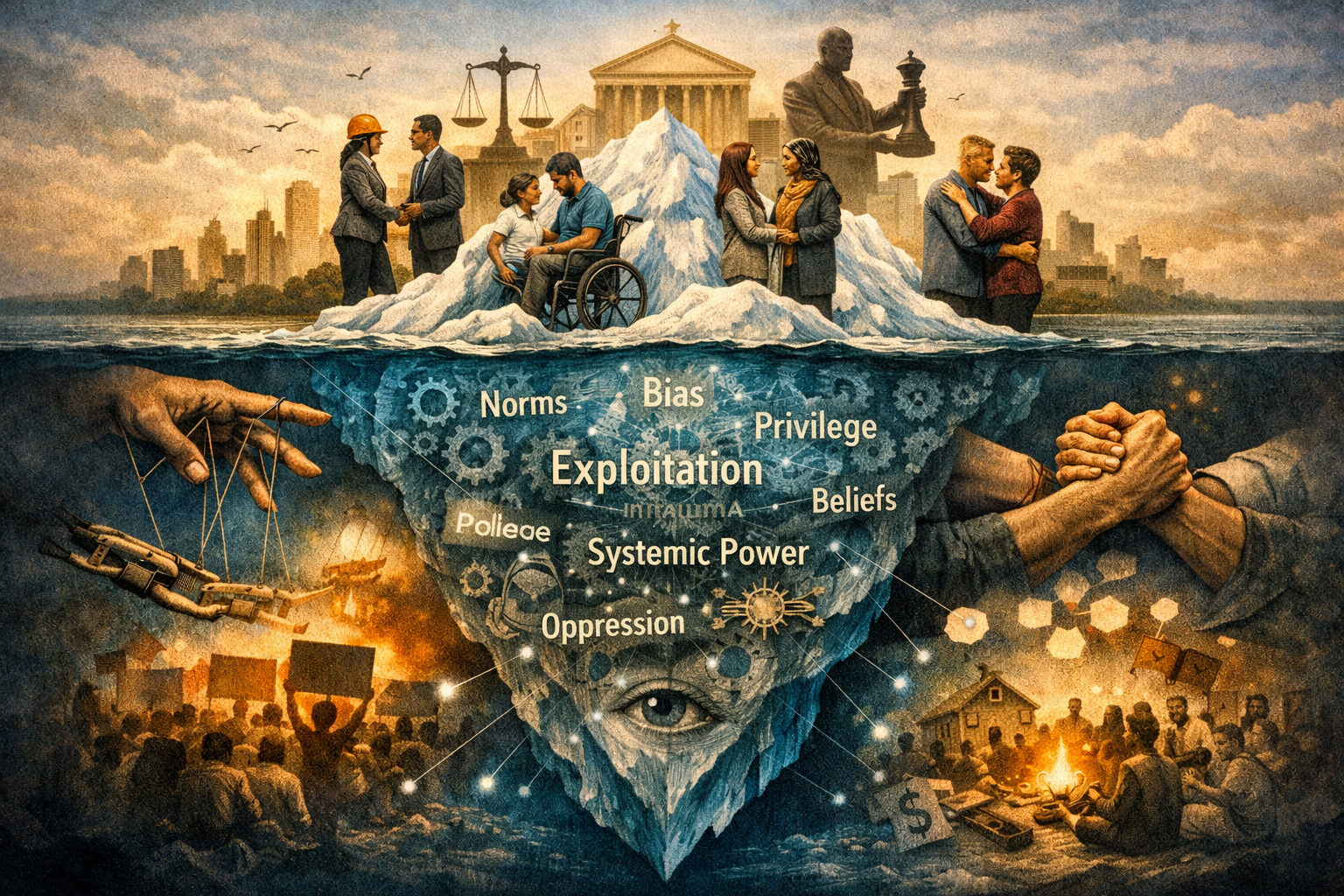
Equality has become one of the most widely invoked ideals in contemporary social discourse. Yet, paradoxically, it is also one of the most misunderstood. Much of the problem lies not in the aspiration for equality itself, but in the conceptual frameworks through which it is pursued. Contemporary debates, particularly in gender, development, and social justice are still deeply shaped by binary oppositions that simplify what is fundamentally complex. In doing so, they risk reproducing the very inequalities they seek to resolve. A more rigorous approach to equality requires a shift away from binary thinking toward an appreciation of social reality as layered, relational, and context-dependent (Archer, 1995). One useful way to illustrate this is through the iceberg metaphor. When one observes an iceberg from above the water, only a small portion is visible. From that limited perspective, it is easy to underestimate its size and significance. However, once one goes beneath the surface, the true scale becomes visible, dense, complex, and far more expansive than initially assumed. It is only at this point that one fully understands why the Titanic sank. As Peter Berger (1963) reminds us, “things are not always what they seem.” Social reality operates in much the same way: what is visible is only a fraction of what is real (Bhakar, 1975; Fryer, 2020).
This insight is crucial for understanding equality. Many dominant narratives rely on simplified oppositions such as men versus women, oppressors versus victims, or dominant versus marginalised groups. In gender discourse, for instance, it has become common to frame women as universally vulnerable and men as universally dominant (Mariachiara Di Cesare, 2014; Wright & Forsyth, 2026). While such framing may capture certain historical and structural truths, it obscures the deeper reality that power is not fixed, but strategic, and vulnerability is not inherent, but relational and context-specific (Foucault, 1980). Empirical observations by analysts reinforce this point, suggesting that both power and vulnerability shift depending on social, economic, and situational contexts. A person who appears dominant in one setting may simultaneously experience vulnerability in another. Likewise, those positioned as structurally disadvantaged may exercise significant forms of agency, resilience, and influence in different domains of life. To ignore this complexity is to misread how inequality actually operates.
One of the unintended consequences of binary equality frameworks is that they often generate new forms of imbalance while attempting to correct existing ones. When marginalisation is identified in one group, institutional responses frequently concentrate resources exclusively on that group, while assuming that the other group is inherently stable, privileged, or unaffected. This can lead to a form of policy imbalance where attention, funding, and intervention become unevenly distributed, producing new blind spots. A clear example can be seen in development and NGO interventions that focus heavily on empowering girls while simultaneously neglecting boys. While the intention is corrective and historically justified, the outcome can be the emergence of unaddressed vulnerabilities among boys and young men, particularly in contexts where economic hardship, educational exclusion, and social dislocation are also affecting them. Over time, this can generate a secondary crisis of inequality that reappears in different forms.
Another limitation in dominant equality discourse is its tendency to reduce inequality entirely to structural conditions while neglecting individual and contextual agency. Structures undoubtedly shape opportunities, but they do not determine outcomes in a uniform or mechanically predictable way. Even in scenarios where individuals begin from relatively equal starting points, the ways in which people interpret, navigate, and respond to opportunities diverge significantly. These divergences are shaped by differences in perception, aspiration, socialisation, risk tolerance, access to informal networks, and situational constraints that are often invisible in macro-level analyses. A simple illustration can be drawn from a 100-meter race. Imagine ten athletes starting from the same starting line, under the same rules, with identical equipment and equal access to training resources. From a purely structural perspective, this appears to be a situation of perfect equality. Yet, even under these controlled conditions, the outcomes of the race will not be identical. Some athletes will accelerate more effectively, others will pace themselves differently, some will respond better under pressure, and others may misjudge their energy distribution. Small differences in technique, decision-making, psychology, and adaptation to real-time conditions will produce unequal results.
This example highlights an important analytical point: equal starting conditions do not automatically generate equal outcomes. Human actors are not uniform units responding identically to identical inputs; they are differentiated agents whose internal dispositions and contextual interpretations shape how they convert opportunity into outcome. In this sense, inequality is not only a product of structural imbalance but also of variation in agency, strategy, and situational responsiveness. Any framework that ignores this dimension risks misunderstanding how social and competitive processes actually unfold in practice. Any serious account of equality must therefore account for the interaction between structure and agency, rather than privileging one at the expense of the other. Without this balance, equality policies risk becoming overly deterministic in diagnosis and overly simplistic in intervention, thereby missing the complex mechanisms through which inequality is actually produced and reproduced in everyday life.
To move meaningfully toward equality, therefore, requires moving beyond the assumption that equality is achieved simply by equalising inputs. It demands recognition that outcomes are shaped by a complex interplay of structure, agency, context, and relational dynamics. Equality cannot be fully understood if it is reduced to a question of redistribution alone. A more adequate framework is one that recognises that men and women, boys and girls, and all social categories contain internal diversity and shifting positionalities. Men can be vulnerable; women can exercise structural and situational power. Boys and girls can both experience exclusion in different domains, and physical, economic, and social capacities further complicate these dynamics. Without acknowledging this complexity, interventions risk becoming simplistic solutions to complex problems.
To address these limitations, equality policies should move beyond single-axis thinking and adopt intersectional and relational frameworks that recognise how vulnerability and advantage shift across contexts. Policy design must avoid treating social groups as fixed categories and instead engage with the fluidity of lived experience. Interventions should balance structural correction with agency-sensitive approaches, recognising not only the importance of redistributing resources but also how individuals interpret, navigate, and convert opportunities differently.
In addition, development and gender-focused programmes must avoid unintended asymmetries created by over-concentration on one group. While such interventions may be justified historically, they can generate new blind spots and reproduce inequalities in other forms if not carefully balanced. Policymakers and researchers should therefore adopt more complex methodological approaches that move beyond aggregate statistics to include qualitative and lived-experience-based analyses, which capture the contextual and relational dimensions of inequality.
Equality should be reframed not as the elimination of difference, but as the creation of conditions in which differences do not automatically translate into systematic disadvantage. This requires a more nuanced understanding of human agency, social structure, and the layered nature of reality itself.
Reference
Archer, M. S. (1995). Realist Social Theory: The Morphogenetic Approach. Cambridge: Cambridge University Press.
Berger, P. L. (1963). Invitation to sociology: A humanistic perspective. New York: Knopf Doubleday Publishing Group.
Mariachiara Di Cesare. (2014). Women, marginalization, and vulnerability: introduction. Genus, 70(2–3), 1–6. http://www.jstor.org/stable/genus.70.2-3.1
Bhaskar, R (1975) A Realist Theory of Science. London: Routledge.
Foucault, M. (1980). Power/Knowledge: Selected Interviews and Other Writings, 1972-79, (Ed. Colin Gordon). New York: Pantheon.
Fryer, T. (2020). A short guide to ontology and epistemology: Why everyone should be a critical realist. https://tfryer.com/ontology-guide/
Wright, C. E. F., & Forsyth, H. (2026). Cheap labour: gendered jurisdictions and feminizing capitalism. Women’s History Review, 35(1), 1–9. https://doi.org/10.1080/09612025.2025.2515780