








Introduction
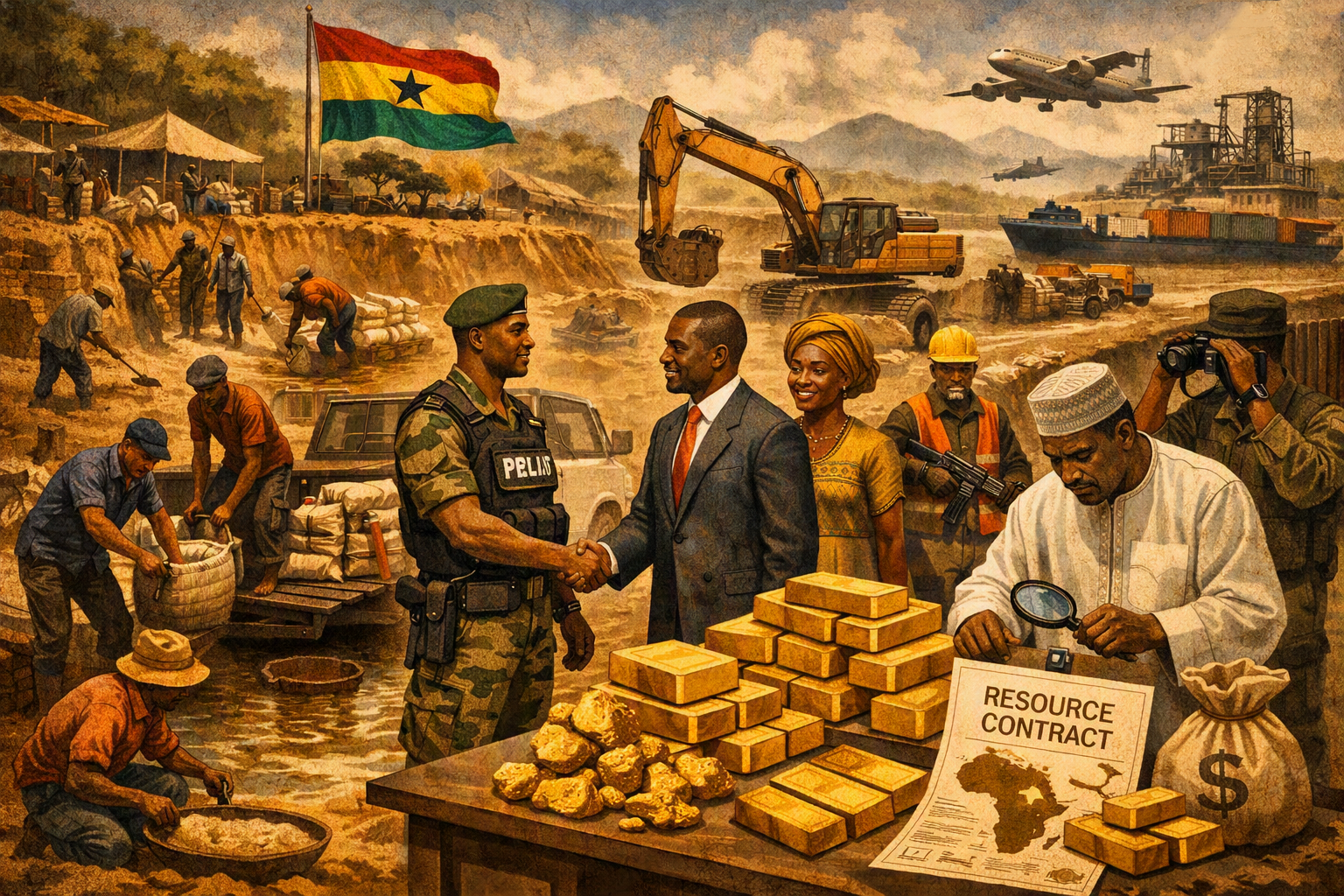
Governments across West Africa are notably adopting policies that are aimed at increasing control over mineral resources particularly gold. This phenomenon is better understood as part of a greater shift known as resource nationalism. Resource nationalism is characterized by governments implementing legal, regulatory and institutional measures to secure a greater economic share of benefits from natural resources. Currently, differences between governments and mining companies seem isolated, but it is really a large shift towards resource nationalism (Zhe &Sun, 2025).
Resource nationalism is gaining traction globally, particularly in Latin America and Africa, as countries seek greater control over their natural resources. Chile nationalized its copper mines in the 1970s (González & Castillo, 2024), while Bolivia nationalized its hydrocarbon sector in 2006 for increased public revenue (Kaup, 2010). In Tanzania, mining laws were amended in 2017 to enhance government ownership (Mwesiga et al., 2023). Recently, West African nations are revising mining laws in response to rising commodity prices and public demands for fair distribution (swp-berlin.org ; spglobal.com). Mali has notably raised its potential mining ownership from 20% to 35% in 2023 amid disputes with international firms regarding its legal framework (swp-berlin.org ; spglobal.com). Ghana is enhancing regulation without taking over operations to improve local benefits (reuters.com). Guinea focuses on domestic gold refining, and other nations are revising frameworks to boost revenue and oversight (reuters.com).
Overall, West Africa is shifting its resource governance to ensure extraction benefits national development, moving beyond just foreign investment attraction. West Africa is entering a new phase of resource governance, focusing on ensuring that mineral resource extraction directly benefits national development. While approaches vary by country, the common goal is managing and sharing the wealth generated from natural resources, which is a shift from merely attracting foreign investment.
What Is Driving The Shift?
One key driver of reforms in African mining jurisdictions is the sustained increase in global gold prices (Grynberg &Singogo, 2021). As prices reach record levels, governments aim to capture a larger share of mining profits by reviewing contracts, adjusting royalties, and increasing state involvement. Policymakers believe that, countries should receive greater economic returns from their valuable mineral resource (reuters.com).
Secondly, fiscal pressures have encouraged governments to reevaluate mining arrangements. There are growing demands for critical infrasturcture in the West Arican region under tight budgets. Thus, increasing revenues is seen as a way of domestic financing instead of outsourcing assistance and funds. In Ghana for instance, mining reforms have included modifications to royalties, licensing, and community development obligations to enhance governance and bolster national development (reuters.com).
Although West Africa is a major gold-producing region, communities near mining operations face poverty and environmental issues. Public expectations has led to debates about the equitable distribution of mining benefits, with civil society and policymakers questioning agreements favoring foreign investors over local needs. Growing concerns have intensified political support for reforms to enhance local participation, boost transparency, and retain more mining wealth within national economies (Kemp &Owen, 2025).
Governments in the Sahel region are emphasising economic sovereignty by linking control over mineral resources to national development. They aim to promote domestic value addition through refining and processing rather than just exporting raw minerals. Initiatives like Guinea’s large-scale gold refinery, and other projects in Ghana, Mali, and Burkina Faso, depicts a regional push to retain more economic value domestically (reuters.com).
Different Countries, Different Approaches
The rise of resource nationalism in West Africa shows a transformative perspective on mineral wealth ownership and management. Governments, aiming to enhance economic and social benefits for their citizens, are pursuing it through different policy approaches that reflect their national priorities, political contexts, and institutional capacities.
To start with, Mali has adopted a proactive stance in 2023 by implementing a new mining code that enhances the state’s equity stake in mining projects and updates the fiscal framework. The government has also contested existing agreements with international mining firms, asserting that they yield insufficient benefits for the country. These actions signify Mali’s intent to bolster state control over mineral resources and elevate public revenue from gold mining (reuters.com).
Second, Ghana adopted a regulatory and market-oriented strategy in its mining sector, focusing on legal reforms rather than nationalising assets. Key initiatives include amending mining laws, creating the Ghana Gold Board for better oversight of gold trading, to boost local participation and revenue collection. This approach aims to enhance state influence in the gold value chain while attracting private investment (goldbod.gov.gh ; reuters.com).
Third, Burkina Faso’s government has enhanced state involvement. This is done by revising its mining code to boost state participation in key projects and establishing a state owned mining company for managing certain assets. These reforms aim promote direct contributions of mining to economic development, amidst ongoing security challenges (cnbcafrica.com ; reuters.com ; swp-berlin.org).
Guinea aims to enhance economic value from its abundant bauxite reserves by fostering resource nationalism. The government encourages domestic investment in refining and mineral processing to lessen reliance on raw mineral exports. This strategy reflects a growing recognition of the benefits of local processing for retaining greater economic value (reuters.com).
Evidently, resource nationalism in West Africa varies across governments. Despite these differences, the overarching goal is to ensure that the region’s mineral wealth significantly contributes to national development, economic resilience, and long term prosperity.
What Comes Next
Whether through revised mining laws, increased state participation, or investments in local mineral processing, governments are seeking to capture more value from the region’s abundant resources (afdb.org).
The success of these efforts, however, will depend on more than stronger government control.
To guarantee that reforms result in sustainable economic development, it will be important to have strong institutions, open governance, consistent policies, and positive interactions with investors. The World Bank has often observed that when resource management changes are accompanied by sound governance, accountability, and investment-friendly policies, nations with abundant rich resources see better results (World Bank, 2024).
Mining companies and investors are reassessing the region’s investment landscape. Many recognise governments’ legitimate aspirations to increase national benefits from mineral resources, but they also seek stable regulatory frameworks that provide certainty for long term investments. Striking a balance between national interests and investor confidence will thus remain one of the region’s most important policy challenges (OCED, 2026).
Conclusion
In the end, the question of who owns the mines is no longer the only one under discussion. It is about how mineral wealth is managed, how its advantages are allocated, and if West Africa can turn its natural riches into long term economic development. Decisions made now will influence the mining industry’s future as well as the region’s overall growth trajectory for decades to come.
References
González, A., Sánchez, F. & Castillo, E. The nationalization of the large-scale copper mines in Chile: successful investment or financial failure?. Miner Econ 37, 787–807 (2024). https://doi.org/10.1007/s13563-023-00412-z
Grynberg, R., & Singogo, F. K. (2021). African Gold. Springer International Publishing.
https://documents1.worldbank.org/curated/en/099100824155021548/pdf/P17844617dfe6e0241ad25120b1320904c2.pdf (accessed July17, 2026)
https://goldbod.gov.gh/goldbod-at-1-a-strategic-reset-of-ghanas-gold-trading-architecture
https://www.afdb.org/en/news-and-events/africa-wants-make-its-critical-minerals-lever-industrialisation-and-economic-transformation-95515 (accessed July17, 2026)
https://www.cnbcafrica.com/2026/burkina-faso-grants-permit-to-state-owned-gold-miner-for-bouboulou-project (accessed July17, 2026)
https://www.oecd.org/content/dam/oecd/en/events/2026/04/critical-minerals-forum/oecd-critical-minerals-regional-note-africa.pdf (accessed July17, 2026)
https://www.reuters.com/world/africa/burkina-faso-nationalise-more-industrial-mines-prime-minister-says-2025-04-29/ (accessed July17, 2026)
https://www.reuters.com/world/africa/ghana-approves-revised-mining-law-strengthen-oversight-2026-07-15/ (accessed July16, 2026)
https://www.reuters.com/world/africa/gold-miners-set-stay-mali-despite-attacks-industry-sources-say-2026-04-28/ (accessed July17, 2026)
https://www.reuters.com/world/africa/guinea-plans-regional-gold-refining-hub-west-african-race-intensifies-2026-06-29 (accessed July16, 2026)
https://www.spglobal.com/market-intelligence/en/news-insights/research/2026/05/ghanas-gold-mining-reforms-resource-nationalism-by-regulation (accessed July16, 2026)
https://www.swp-berlin.org/en/publication/mta-spotlight-69-resource-nationalism-in-the-sahel (accessed July16, 2026)
https://www.swp-berlin.org/en/publication/mta-spotlight-69-resource-nationalism-in-the-sahel (accessed July17, 2026)
Kaup, B. Z. (2010). A neoliberal nationalization? The constraints on natural-gas-led development in Bolivia. Latin American Perspectives, 37(3), 123-138.
Kemp, D., & Owen, J. R. (2025). Global mining and the production of inequality: a case for continued inquiry. World Development Perspectives, 39, 100708.
Stevens, P., Lahn, G., & Kooroshy, J. (2015). The resource curse revisited. London: Chatham House for the Royal Institute of International Affairs.
Wilson, J. D. (2015). Understanding resource nationalism: economic dynamics and political institutions. Contemporary politics, 21(4), 399-416.
Zhe, W., & Sun, N. (2025). The Impact of Resource Nationalism on Africa’s Critical-Minerals Policy. Country, Area and Advanced Technology, 1(1).