







Introduction
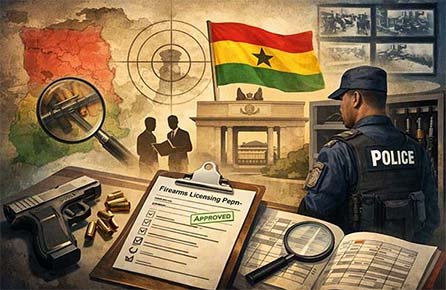
In June 2026, the Ministry of the Interior revoked every existing civilian firearm license in Ghana with effect from Tuesday, 23 June 2026, ordering all holders to undergo fresh vetting before any weapon could be legally re-registered (Citi Newsroom, 2026). The move, announced by the Minister for the Interior, Muntaka Mohammed-Mubarak, is the most sweeping domestic gun-control intervention Ghana has attempted in decades, and it offers a revealing case study of the country’s institutional capacity to regulate the instruments of violence it has itself licensed.
Anatomy of the Overhaul
The re-licensing overhaul did not emerge in isolation. It followed a National Arms Bill that NACSA moved through stakeholder review at a high-level meeting on 23-24 July 2025, explicitly framed as aligning Ghana’s legal framework with the ECOWAS Convention on Small Arms and Light Weapons, the Arms Trade Treaty, and the UN Programme of Action on Small Arms and Light Weapons (Ghana Citizenship, 2026). It was preceded by a nationwide Gun Amnesty Programme running from 1 December 2025 to 30 January 2026, which the Interior Minister disclosed had recovered 4,038 previously unregistered firearms from private citizens (Modern Ghana, 2026; Pulse Ghana, 2026). The Ministry had also committed, before the Public Accounts Committee of Parliament on 30 September 2025, to introducing a digital firearms licensing platform from December 2025 that would replace manual processing, enable online renewal and mobile-money payment, issue automated expiry reminders, and flag applicants with criminal records for in-person review (Graphic Online, 2025).
Under the new regime, every applicant and every renewing licence holder must pass a mandatory mental health assessment, undergo drug screening through the Narcotics Control Commission, and complete certified firearms-handling training, delivered in partnership with the Mental Health Authority and the Tesano training range (The Herald, 2026). The Minister explicitly linked the reform to a rise in suicides among licensed gun owners, stating that the state had identified gaps that allowed individuals with undiagnosed mental health conditions to obtain and retain firearm permits (AllAfrica, 2026; Modern Ghana, 2026a).
The Institutional Capacity Problem
The re-licensing drive exposes a structural weakness that pre-dates the current Minister: Ghana’s firearms governance is fragmented across institutions with overlapping but uncoordinated mandates. Primary licensing authority rests with the Ghana Police Service under the Arms and Ammunition Decree of 1972 (NRCD 9), while the National Commission on Small Arms and Light Weapons (NACSA), created to manage the proliferation of illicit arms, advises government on policy, and coordinates Ghana’s compliance with the ECOWAS Convention, the UN Firearms Protocol, and the UN Programme of Action. It however holds no independent licensing or enforcement power of its own (Ministry of the Interior, n.d.-a; Small Arms Commission, 2026). Meanwhile the military, Customs, and the Minerals Commission separately manage their own stockpiles, and no single national weapons register consolidates these holdings (ResearchGate, 2025).
This fragmentation has tangible consequences for throughput and oversight. The Ministry of the Interior’s own 2025 budget estimates show that firearms-import approvals operate at strikingly low volumes: only eleven permits to import arms and ammunition were issued in 2024, and just fifty-five of a targeted 105 permits to import pistols were granted, indicating both tight rationing of legal imports and a persistent gap between administrative targets and delivery (Ghana Citizenship, 2026). Against this backdrop, the June 2026 blanket revocation can be read less as confident regulatory strength than as an admission that the pre-existing manual, non-digitised registry could not reliably distinguish compliant licensed holders from high-risk ones,. This is precisely the diagnosis offered by the Minister himself when he announced that the Central Firearms Registry would be digitised, a commitment first made in March 2026 (Modern Ghana, 2026a).
A Trigger Event and Its Politics
The immediate political trigger for the June 2026 announcement was a shooting incident involving former Member of Parliament for Dome-Kwabenya, Sarah Adwoa Safo, at a property linked to a succession dispute within the Kristo Asafo Mission following the death of its founder in September 2025, which drew public attention to firearm misuse by personnel of licensed private security companies (Modern Ghana, 2026a). In the same period, the Ministry suspended the operating licence of Kantanka Security Services Limited with immediate effect over allegations of unauthorised firearm and ammunition use during a Kwabenya operation on 21 June 2026 (Modern Ghana, 2026a). This sequence illustrates a recurring pattern in Ghanaian security governance: high-visibility incidents, rather than routine institutional audit, have repeatedly been the proximate driver of regulatory tightening, from the Gun Amnesty Programme through to the licence revocation itself.
What It Reveals About State Capacity
Three inferences about state capacity follow from this episode. First, coordination capacity remains weak: NACSA can advise and educate but cannot license or enforce, while the Police Service licenses under a 1972 decree without a unified national database, producing exactly the register-integrity problem the digitisation programme is meant to fix (ResearchGate, 2025; Ministry of the Interior, n.d.-a). Second, the state’s regulatory reflex is currently event-driven rather than anticipatory, consistent with the pattern already observed in Ghana’s early-warning architecture: reforms follow scandals rather than preceding it. Third, the reform’s success is conditional on infrastructure that does not yet fully exist, that is, a functioning digital Central Firearms Registry, adequately staffed mental-health and drug-screening partners, and enforcement capacity to act on the criminal-record flags the new system promises. The credibility of this reform will be tested over the next licensing cycle rather than at the moment of announcement (The Herald, 2026; Modern Ghana, 2026).
For policymakers, the re-licensing overhaul should be read as a diagnostic opportunity. If Ghana can complete the digitisation of the Central Firearms Registry, consolidate NACSA’s advisory role with genuine inter-agency data-sharing, and sustain screening standards after the initial re-registration surge subsides, the episode may mark a genuine capacity upgrade. If the registry reverts to manual processing once political attention moves on, the June 2026 revocation will instead have been a costly but temporary disruption layered onto an unreformed system.
References
AllAfrica. (2026, June 24). Ghana: Private gun permits revoked, new strict re-registration process announced. https://allafrica.com/stories/202606240252.html
Citi Newsroom. (2026, June 23). Interior Minister revokes all firearm licences. https://www.citinewsroom.com/2026/06/interior-minister-revokes-all-firearm-licences/
Ghana Citizenship. (2026, March 15). Ghana firearm laws: Licensing, ownership and penalties. https://ghanacitizenship.com/ghana-firearm-laws/
Graphic Online. (2025, September 30). Digital gun licensing system to start by December 2025. https://www.graphic.com.gh/news/general-news/ghana-card-to-be-used-for-new-digital-gun-registry-by-december-2025.html
Ministry of the Interior. (n.d.-a). National Commission on Small Arms and Light Weapons. Republic of Ghana. https://www.mint.gov.gh/agencies/national-commission-on-small-arms-and-light-weapons/
Modern Ghana. (2026, June). Interior Minister revokes all private firearm permits, orders re-registration. https://www.modernghana.com/news/1504951/interior-minister-revokes-all-private-firearm-perm.html
Modern Ghana. (2026a, June). Ghana’s guns, ghosts and the mental health question: Why Muntaka’s bold reform must be more than a moment. https://www.modernghana.com/news/1504990/ghanas-guns-ghosts-and-the-mental-health-questio.html
Pulse Ghana. (2026, June 23). Interior Minister suspends all firearm licences, introduces mandatory mental health and drug screening. https://www.pulse.com.gh/story/interior-minister-suspends-all-firearm-licences-introduces-mandatory-mental-health-and-drug-screening-2026062312091202166
ResearchGate. (2025). Ghana’s arms control imperative: Legislative gaps, institutional capacity, and policy reform. https://www.researchgate.net/publication/393702711_Ghana’s_Arms_Control_Imperative_Legislative_Gaps_Institutional_Capacity_and_Policy_Reform
Small Arms Commission. (2026). History. National Commission on Small Arms and Light Weapons. https://www.smallarmscommission.gov.gh/history/
The Herald. (2026, June). Interior Ministry suspends firearms licensing, introduces mandatory mental health and drug tests for firearm licences. https://theheraldghana.com/interior-ministry-suspends-firearms-licensing-introduces-mandatory-mental-health-and-drug-tests-for-firearm-licences/