


• fr Français
  • en English
CISA NEWSLETTER
Advertisement
  • Home
  • Editions
    • March 2026
    • February 2026
    • January 2026
    • 2025
      • December 2025
      • November 2025
      • October 2025
      • September 2025
      • August 2025
      • July 2025
      • June 2025
      • May 2025
      • April 2025
      • March 2025
      • February 2025
      • January 2025
    • 2024
      • December 2024
      • November 2024
      • October 2024
      • September 2024
      • August 2024
      • July 2024
      • June 2024
      • May 2024
      • April 2024
      • March 2024
      • February 2024
      • January 2024
    • 2023
      • December 2023
  • News
    • All
    • Business
    • Politics
    • Science
    • World
    Okada Operations In Ghana; Economic Necessity Or Security Risk

    Okada Operations In Ghana; Economic Necessity Or Security Risk

    Cedi Appreciation and National Security in Ghana: Currency Stability Amid Persistent Structural Risks

    Cedi Appreciation and National Security in Ghana: Currency Stability Amid Persistent Structural Risks

    The Mirror in the Politician: How Ghanaian Society Breeds the Corruption It Condemns

    The Mirror in the Politician: How Ghanaian Society Breeds the Corruption It Condemns

    Terrorism Financing in The Sahel/West Africa: Mechanisms, Drivers, And Responses

    Terrorism Financing in The Sahel/West Africa: Mechanisms, Drivers, And Responses

    The Silent Threat: Impact of Human and Sex Trafficking on National Security

    The Silent Threat: Impact of Human and Sex Trafficking on National Security

    How JNIM is dominating the terrorism landscape in the Sahel

    How JNIM is dominating the terrorism landscape in the Sahel

    Trending Tags

    • Trump Inauguration
    • United Stated
    • White House
    • Market Stories
    • Election Results
  • Tech
    Securing Africa’s Digital Future: A Call to Action on Cybersecurity.

    Securing Africa’s Digital Future: A Call to Action on Cybersecurity.

    Trending Tags

    • Nintendo Switch
    • CES 2017
    • Playstation 4 Pro
    • Mark Zuckerberg
  • Entertainment
  • Lifestyle
    • All
    • Food
    • Health
    • Travel
    Security Contagion and the Urban Poor: Begging and the Invisible Threat in Accra’s Streets

    Security Contagion and the Urban Poor: Begging and the Invisible Threat in Accra’s Streets

    ECOWAS@50: Ghana as a Stakeholder in West Africa’s Integration Aspiration

    ECOWAS@50: Ghana as a Stakeholder in West Africa’s Integration Aspiration

    The Rise of Substance Abuse Among Ghanaian Youth: A Deep Dive into Music, Media, and Mental Health

    The Rise of Substance Abuse Among Ghanaian Youth: A Deep Dive into Music, Media, and Mental Health

    Impact Of Russia’s War in Ukraine on Africa’s Agriculture and Food Security

    Impact Of Russia’s War in Ukraine on Africa’s Agriculture and Food Security

    Transforming Africa’s Agriculture to Mitigate Food Crisis

    Transforming Africa’s Agriculture to Mitigate Food Crisis

    Framing Food Insecurity as A Security Contagion

    Framing Food Insecurity as A Security Contagion

    Trending Tags

    • Golden Globes
    • Game of Thrones
    • MotoGP 2017
    • eSports
    • Fashion Week
  • Review
    Key Drivers of Voter Choices for Ghana’s 2024 General Elections – A Review

    Key Drivers of Voter Choices for Ghana’s 2024 General Elections – A Review

  • CISA Ghana
No Result
View All Result
  • Home
  • Editions
    • March 2026
    • February 2026
    • January 2026
    • 2025
      • December 2025
      • November 2025
      • October 2025
      • September 2025
      • August 2025
      • July 2025
      • June 2025
      • May 2025
      • April 2025
      • March 2025
      • February 2025
      • January 2025
    • 2024
      • December 2024
      • November 2024
      • October 2024
      • September 2024
      • August 2024
      • July 2024
      • June 2024
      • May 2024
      • April 2024
      • March 2024
      • February 2024
      • January 2024
    • 2023
      • December 2023
  • News
    • All
    • Business
    • Politics
    • Science
    • World
    Okada Operations In Ghana; Economic Necessity Or Security Risk

    Okada Operations In Ghana; Economic Necessity Or Security Risk

    Cedi Appreciation and National Security in Ghana: Currency Stability Amid Persistent Structural Risks

    Cedi Appreciation and National Security in Ghana: Currency Stability Amid Persistent Structural Risks

    The Mirror in the Politician: How Ghanaian Society Breeds the Corruption It Condemns

    The Mirror in the Politician: How Ghanaian Society Breeds the Corruption It Condemns

    Terrorism Financing in The Sahel/West Africa: Mechanisms, Drivers, And Responses

    Terrorism Financing in The Sahel/West Africa: Mechanisms, Drivers, And Responses

    The Silent Threat: Impact of Human and Sex Trafficking on National Security

    The Silent Threat: Impact of Human and Sex Trafficking on National Security

    How JNIM is dominating the terrorism landscape in the Sahel

    How JNIM is dominating the terrorism landscape in the Sahel

    Trending Tags

    • Trump Inauguration
    • United Stated
    • White House
    • Market Stories
    • Election Results
  • Tech
    Securing Africa’s Digital Future: A Call to Action on Cybersecurity.

    Securing Africa’s Digital Future: A Call to Action on Cybersecurity.

    Trending Tags

    • Nintendo Switch
    • CES 2017
    • Playstation 4 Pro
    • Mark Zuckerberg
  • Entertainment
  • Lifestyle
    • All
    • Food
    • Health
    • Travel
    Security Contagion and the Urban Poor: Begging and the Invisible Threat in Accra’s Streets

    Security Contagion and the Urban Poor: Begging and the Invisible Threat in Accra’s Streets

    ECOWAS@50: Ghana as a Stakeholder in West Africa’s Integration Aspiration

    ECOWAS@50: Ghana as a Stakeholder in West Africa’s Integration Aspiration

    The Rise of Substance Abuse Among Ghanaian Youth: A Deep Dive into Music, Media, and Mental Health

    The Rise of Substance Abuse Among Ghanaian Youth: A Deep Dive into Music, Media, and Mental Health

    Impact Of Russia’s War in Ukraine on Africa’s Agriculture and Food Security

    Impact Of Russia’s War in Ukraine on Africa’s Agriculture and Food Security

    Transforming Africa’s Agriculture to Mitigate Food Crisis

    Transforming Africa’s Agriculture to Mitigate Food Crisis

    Framing Food Insecurity as A Security Contagion

    Framing Food Insecurity as A Security Contagion

    Trending Tags

    • Golden Globes
    • Game of Thrones
    • MotoGP 2017
    • eSports
    • Fashion Week
  • Review
    Key Drivers of Voter Choices for Ghana’s 2024 General Elections – A Review

    Key Drivers of Voter Choices for Ghana’s 2024 General Elections – A Review

  • CISA Ghana
No Result
View All Result
CISA NEWSLETTER
No Result
View All Result
Home ANALYSTS

Climate Displacement As A Security Crisis: When Migration Becomes A Threat Multiplier

Climate Displacement As A Security Crisis: When Migration Becomes A Threat Multiplier
Share on FacebookShare on Twitter

Introduction

The relationship between climate change and violent conflict has moved from academic hypothesis to empirical reality. Across sub-Saharan Africa where climate vulnerability is highest and institutional resilience lowest, the convergence of environmental stress, resource scarcity, and forced displacement is actively destabilising communities and fueling cycles of violence. This is not a future risk scenario. The data, drawn from multiple authoritative sources, present a picture of a continent already in the grip of complex, multi-causal displacement one that security frameworks have been consistently slow to recognise and even slower to address.

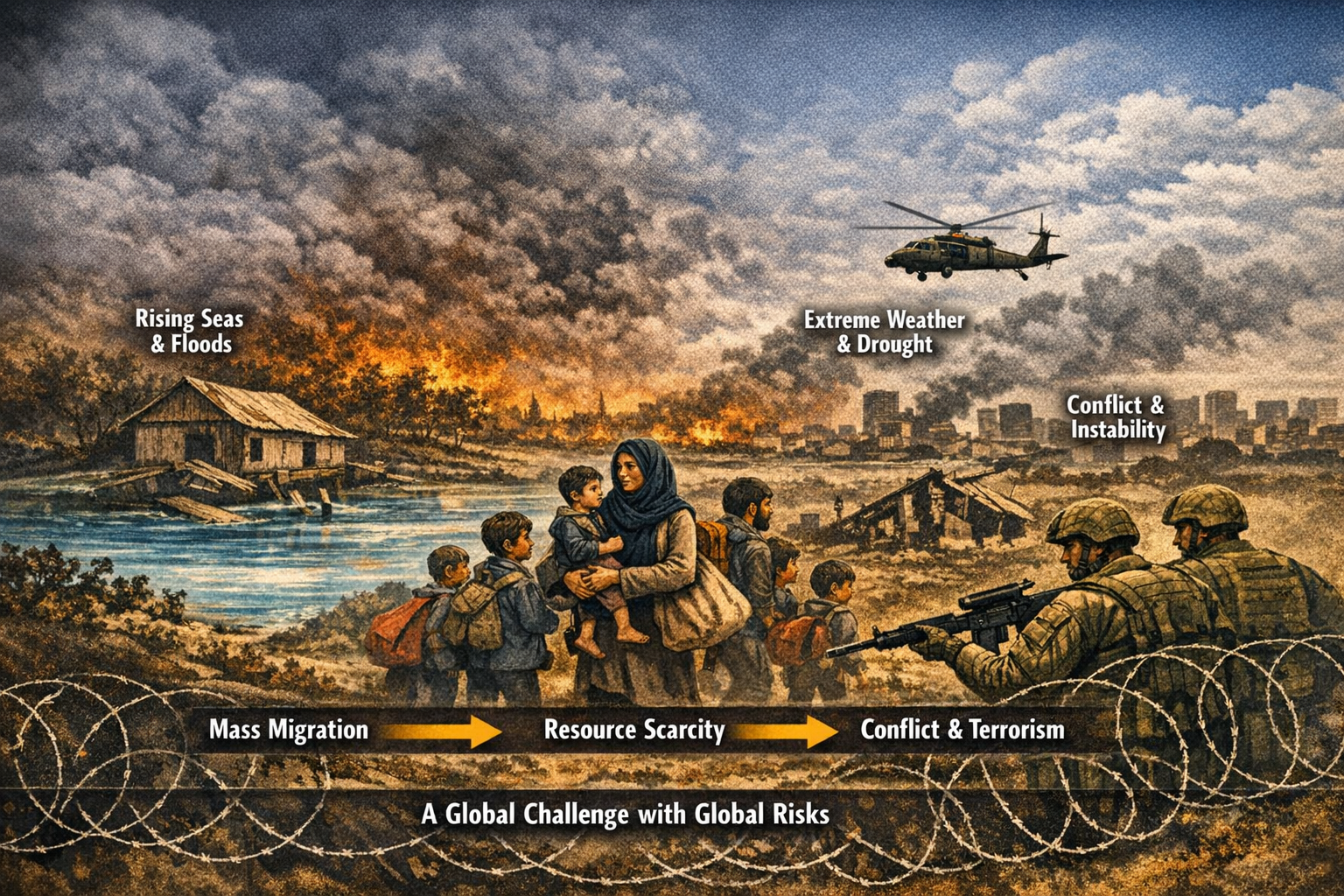
This article examines three interconnected dynamics, first the scale and character of climate-driven displacement across Africa, secondly, the pathways through which displaced populations become vectors of insecurity and finally, the policy frameworks required to address what is increasingly a security not merely humanitarian emergency.

The Scale of Displacement: A Continental Crisis

By mid-2025, 117 million people worldwide had been forcibly displaced by war, violence, and persecution (UNHCR, 2025). Of these, an estimated 45.7 million were African, accounting for approximately 43 percent of the global total with 69 percent displaced within their own borders as internally displaced persons (IDPs) (Africa Center for Strategic Studies, 2026). The continent now hosts the largest internally displaced population on earth.

The scale of the crisis reflects over a decade of compounding drivers. The number of IDPs in Africa has tripled since 2015, reaching 35.4 million by the end of 2024 (ISS Africa, 2025). Sub-Saharan Africa alone recorded 38.8 million IDPs by end-2024 representing 46 percent of the global total (IDMC, 2025). Critically, over the past decade, weather-related disasters have caused approximately 250 million internal displacements globally equivalent to around 70,000 per day, or two displacements every three seconds (UNHCR, 2025).

Sudan presents the starkest single-country illustration. The civil conflict has driven 14.4 million people from their homes representing a 14 percent annual increase including 10.1 million IDPs, the largest internal displacement figure of any country globally (Africa Center for Strategic Studies, 2026). In the Central Sahel, the situation is equally dire.  As of April 2025, Burkina Faso, Mali and Niger together housed an estimated 5.9 million IDPs and 2.1 million refugees and asylum seekers a 6 and 20 percent year-on-year increase respectively (Mixed Migration Centre, 2025). Burkina Faso alone has displaced close to 2.1 million people roughly 10 percent of its entire population (Mixed Migration Centre, 2025).

Three in every four refugees or people displaced by conflict are currently living in countries facing high-to-extreme exposure to climate-related hazards. (UNHCR, 2025)

The Climate-Conflict Nexus: Pathways to Insecurity

A landmark 2025 peer-reviewed study published in Climate Policy by Boeyink, Lichtenheld and colleagues applied the concept of “complex displacement” to capture situations where communities are forced to flee amid the interaction of climate change, disasters, and conflict noting that displacement outcomes are “rarely a result of individual triggers in isolation” (Tandfonline, 2025). Indeed, the data confirms this theoretical framing. According to UNHCR, 95 percent of all internal conflict displacements globally occur in countries that are highly vulnerable to the effects of climate change (UNHCR, 2022). In Africa specifically, eight of the 12 countries experiencing the greatest disaster-related displacement were also experiencing armed conflict simultaneously (Africa Center for Strategic Studies, 2026).

The pathways linking environmental stress to insecurity are multiple and mutually reinforcing. Resource competition is among the most direct: as climate change erodes agricultural land and depletes freshwater sources, pastoralist and farming communities are pushed into closer proximity with one another a dynamic consistently documented as a driver of intercommunal violence, particularly across the Lake Chad Basin and the Sahel’s agropastoral zones (IOM, 2022). The scale of this ecological crisis is stark. Three-quarters of Africa’s land is currently deteriorating, and over half of the continent’s refugee and IDP settlements are located in areas under severe ecological stress (UNHCR, 2025) conditions that directly compress communities’ access to food, water, and income, and further heighten the potential for conflict over dwindling resources.

Second, youth radicalisation: in parts of the Sahel, communities report that climate-linked livelihood losses are directly driving youth recruitment into armed groups (UNHCR, 2025). Large-scale displacement from rural to urban centres, driven partly by agricultural collapse, has been identified as a factor increasing the supply of recruitable youth for criminal and militant organisations (IOM, 2022). This dynamic in which environmental degradation first displaces, then radicalises represents one of the most consequential but least-addressed dimensions of the Sahel’s security crisis.

Third, governance erosion: states managing massive IDP flows face resource strain, legitimacy pressures, and increased ethno-political competition over land tenure. The UNHCR notes that the Central Sahel’s 2025 humanitarian appeal of $2.1 billion was only 19 percent funded, while its own $409.7 million Sahel appeal was only 32 percent funded (UNHCR, 2025). Underfunded displacement responses accelerate state fragility and state fragility, in turn, creates the permissive environment in which armed groups flourish.

The Protection Gap: Refugees, Idps and International Law

Perhaps the most consequential structural failure in responding to climate displacement is the absence of a legal protection framework. Climate migrants displaced by environmental degradation, sea-level rise, drought, and desertification are not recognised under the 1951 Refugee Convention or its 1967 Protocol. Unlike war refugees, they have no access to the rights, services, and legal protections that international refugee law affords (UNHCR, 2025). This is not a technical lacuna; it is a protection emergency.

By 2050, the fifteen hottest refugee camps in the world located in Gambia, Eritrea, Ethiopia, Senegal and Mali are projected to experience nearly 200 days per year of hazardous heat stress (UNHCR, 2025). The communities these camps house are, by legal definition, unprotected from this future. By 2040, the number of countries facing extreme climate hazards could rise from 3 to 65 (UNHCR, 2025). The international protection framework has not caught up with the reality it is meant to address.

Policy Implications

Three priority interventions emerge from this analysis. First, legal reform: the international community must revisit and expand the Refugee Convention to incorporate climate-displacement protections. The Nansen Initiative’s Agenda for the Protection of Cross-Border Displaced Persons in the Context of Disasters and Climate Change provides a credible starting framework, but requires political will to operationalise.

Second, integrated programming: security and humanitarian actors must abandon siloed responses. Displacement programming that ignores security drivers, and security programming that ignores displacement drivers, will both fail. Joint planning between UNHCR, national security ministries, regional bodies and development banks is essential to address the climate-conflict-displacement nexus as the interconnected system it is.

Third, climate finance reform: fragile and conflict-affected countries hosting displaced populations currently receive only a quarter of the climate finance they need (UNHCR, 2025). The climate finance architecture must be redesigned to channel resources to front-line displaced communities, not only to stable economies with stronger administrative absorptive capacity.

Conclusion

Climate-driven displacement is a security issue. The evidence from Africa’s Sahel to its Great Lakes region demonstrates clearly that environmental stress, forced movement, and violent conflict are not separate phenomena to be managed by different agencies with different mandates. They are facets of a single, integrated crisis. Security research and policy must reflect this reality and must do so before the window for managed adaptation closes entirely. The challenges posed by the realities of climate displacement requires urgent action by regional bodies in a coordinated manner to ensure effective environmental and security management.

References

1.  Africa Center for Strategic Studies (2026, January). Africa’s Colliding Conflicts Compound Forced Displacement Crisis. Africa Center, Washington D.C.

2.  IDMC (2025). 2025 Global Report on Internal Displacement (GRID). Internal Displacement Monitoring Centre, Geneva.

3.  IOM (2022). Conflict Drives Displacement Amidst Rising Climate Shocks: Africa Migration Report. International Organization for Migration, Geneva.

4.  ISS Africa (2025). African Refugees Bear the Brunt of Shifting Global Politics. Institute for Security Studies, Pretoria.

5.  Mixed Migration Centre (2025). Keeping Track in Africa. MMC Regional Overview, November 2025.

6.  Tandfonline (2025). A Review of the Climate Change Disaster Conflict Nexus and Humanitarian Framing of Complex Displacement. Climate Policy, DOI: 10.1080/17565529.2025.2514027.

7.  UNHCR (2025). No Escape II: The Way Forward: Climate Shocks and Forced Displacement. UN Refugee Agency, Geneva (published COP30, November 2025).

8.  UNHCR (2025). Highlights of Forced Displacement Trends, Protection Risks and Solutions in West and Central Africa. Press Release, June 2025.

Tags: 20264th Edition 2026Apr week3
ShareTweet
Previous Post

Ecowas, The Aes And The Crisis Of West Africa’s Counterterrorism Architecture

Next Post

Critical Minerals, Resource Nationalism, And The Securitisation Of Africa’s Subsoil

Next Post
Critical Minerals, Resource Nationalism, And The Securitisation Of Africa’s Subsoil

Critical Minerals, Resource Nationalism, And The Securitisation Of Africa's Subsoil

Leave a Reply Cancel reply

Your email address will not be published. Required fields are marked *

  • Trending
  • Comments
  • Latest
Africa's Natural Resources: Who’s After What And What’s The Continent’s Strategy In The Scramble Game?

Africa’s Natural Resources: Who’s After What And What’s The Continent’s Strategy In The Scramble Game?

March 14, 2026
Effects of overpopulation in class on quality of education

Effects of overpopulation in class on quality of education

March 25, 2024
The Growing Influence Of AES On African Countries

The Growing Influence Of AES On African Countries

April 1, 2025
Slums and Security in Africa: A Growing Threat

Slums and Security in Africa: A Growing Threat

July 25, 2025
Integration of environmental security into Ghana’s National Security Strategy safeguards the future

Integration of environmental security into Ghana’s National Security Strategy safeguards the future

10
Border Security: A Door Left Wide Open

Border Security: A Door Left Wide Open

3
Polls close in Liberia

Liberia: Once a war-torn country, now Africa’s beacon of democracy – Lessons for Africa

1
Alliance Of Sahel States Formation: Objectives & Implications for ECOWAS

Alliance Of Sahel States Formation: Objectives & Implications for ECOWAS

1
Drones, Ai And The New Face Of Terrorism In The Sahel

Drones, Ai And The New Face Of Terrorism In The Sahel

April 16, 2026
Critical Minerals, Resource Nationalism, And The Securitisation Of Africa’s Subsoil

Critical Minerals, Resource Nationalism, And The Securitisation Of Africa’s Subsoil

April 16, 2026
Climate Displacement As A Security Crisis: When Migration Becomes A Threat Multiplier

Climate Displacement As A Security Crisis: When Migration Becomes A Threat Multiplier

April 16, 2026
Ecowas, The Aes And The Crisis Of West Africa’s Counterterrorism Architecture

Ecowas, The Aes And The Crisis Of West Africa’s Counterterrorism Architecture

April 16, 2026

Popular Stories

  • Africa's Natural Resources: Who’s After What And What’s The Continent’s Strategy In The Scramble Game?

    Africa’s Natural Resources: Who’s After What And What’s The Continent’s Strategy In The Scramble Game?

    0 shares
    Share 0 Tweet 0
  • Effects of overpopulation in class on quality of education

    0 shares
    Share 0 Tweet 0
  • The Growing Influence Of AES On African Countries

    0 shares
    Share 0 Tweet 0
  • Slums and Security in Africa: A Growing Threat

    0 shares
    Share 0 Tweet 0
  • The Concept of Beauty in Africa

    0 shares
    Share 0 Tweet 0

CISA Newsletter

Headlining West African News

Follow Us

Browse by Category

  • ANALYSTS
  • Business
  • ECONOMY
  • EDITORIAL
  • Environment
  • Food
  • Health
  • Lifestyle
  • News
  • Politics
  • Review
  • Science
  • Sports
  • Tech
  • Travel
  • Uncategorized
  • World

Recent News

Drones, Ai And The New Face Of Terrorism In The Sahel

Drones, Ai And The New Face Of Terrorism In The Sahel

April 16, 2026
Critical Minerals, Resource Nationalism, And The Securitisation Of Africa’s Subsoil

Critical Minerals, Resource Nationalism, And The Securitisation Of Africa’s Subsoil

April 16, 2026
  • About
  • Advertise
  • Privacy & Policy
  • Contact

© 2023 CISA Ghana Newsletter - Headlines West Africa.

  • fr Français
  • en English
No Result
View All Result
  • Home
  • Editions
    • March 2026
    • February 2026
    • January 2026
    • 2025
      • December 2025
      • November 2025
      • October 2025
      • September 2025
      • August 2025
      • July 2025
      • June 2025
      • May 2025
      • April 2025
      • March 2025
      • February 2025
      • January 2025
    • 2024
      • December 2024
      • November 2024
      • October 2024
      • September 2024
      • August 2024
      • July 2024
      • June 2024
      • May 2024
      • April 2024
      • March 2024
      • February 2024
      • January 2024
    • 2023
      • December 2023
  • News
  • Tech
  • Entertainment
  • Lifestyle
  • Review
  • CISA Ghana

© 2023 CISA Ghana Newsletter - Headlines West Africa.

  • English
  • Français (French)