









Introduction and Contextual Framework
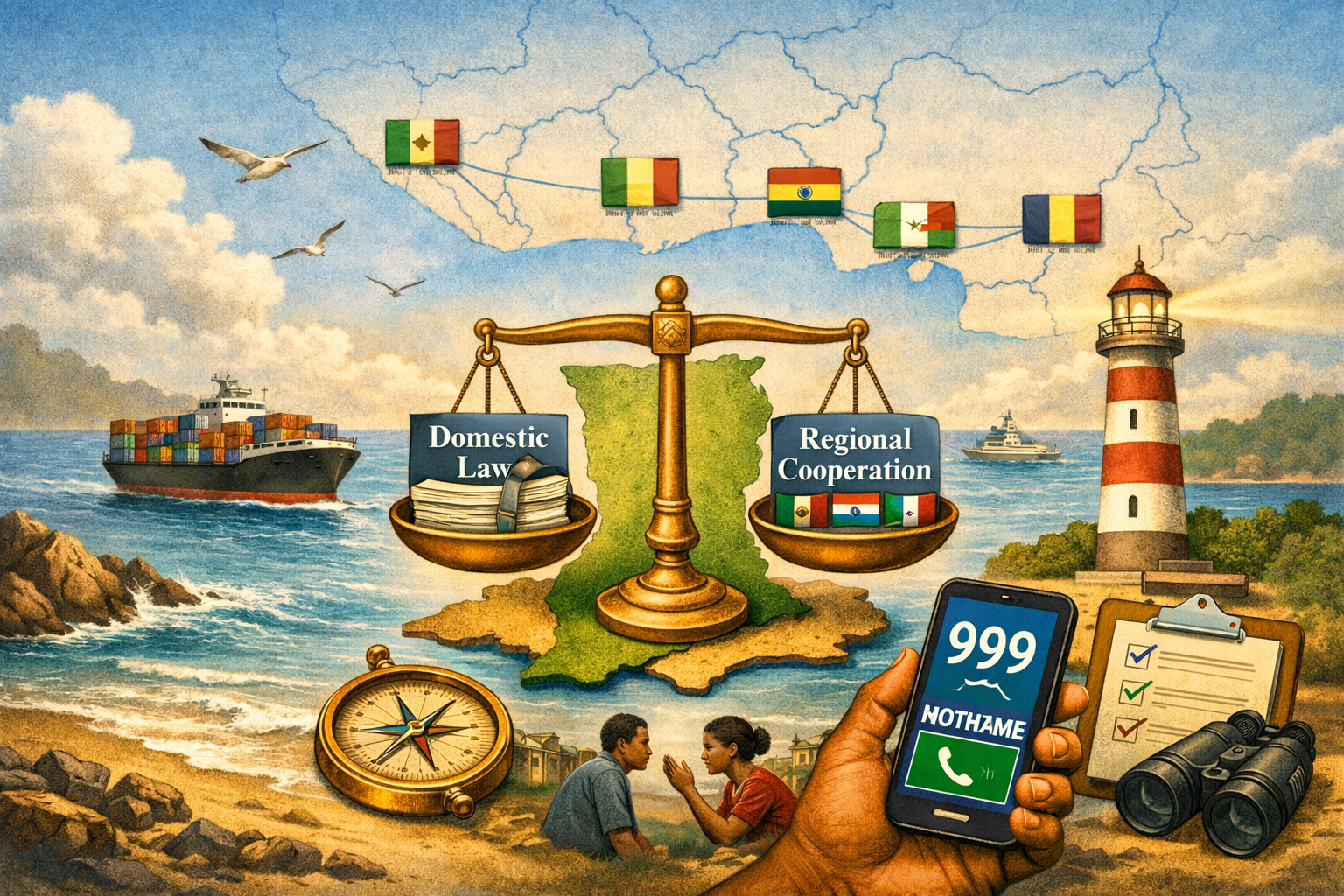
The Gulf of Guinea occupies a strategic position in global maritime commerce, energy transport, and regional security. It is also one of the most persistent maritime crime zones in Africa, where piracy, armed robbery, illegal fishing, trafficking, and other illicit activities continue to shape security policy and economic risk. Ghana sits at the heart of this environment as the host of Zone F in the Yaoundé Architecture, which gives it a central role in regional maritime coordination and incident response (DCAF – Geneva Centre for Security Sector Governance, 2023). This position is not merely symbolic. It places Ghana in a space where maritime security, legal enforcement, and economic sovereignty intersect. Yet the legal framework that should convert maritime interception into criminal accountability remains underdeveloped, creating a gap between operational success and judicial outcome (University of Ghana School of Law, 2025).
The core problem is that Ghana has strengthened its maritime surveillance and response capacity faster than it has modernized its domestic piracy law. The result is a state that can identify, pursue, and arrest suspected pirates but still faces difficulty translating those arrests into successful convictions under domestic law (Parliament of Ghana, 2025). This is not a trivial legislative delay. It is a structural weakness that reduces deterrence and weakens the legal credibility of the entire maritime security system. A security architecture becomes effective only when it can move from detection to prosecution without losing legal force along the way. In Ghana’s case, that final legal step remains fragile.
The argument of this article is that Ghana’s piracy challenge is fundamentally a problem of statutory misalignment. Regional maritime cooperation has improved significantly, but its effectiveness is constrained by domestic legal rules that do not fully capture modern piracy as defined in the United Nations Convention on the Law of the Sea, especially Article 101 (United Nations, 2026). That gap undermines the logic of the Yaoundé Architecture, because the architecture depends not only on naval coordination but also on domestic legal harmonization. In other words, the regional system can catch pirates, but the national legal order must still be able to convict them.
Regional Security Architecture
The Yaoundé Architecture was established to create a coordinated maritime security system for West and Central Africa. It connects national, zonal, regional, and interregional centers in a layered framework designed to improve information sharing, incident reporting, and operational response to maritime threats (DCAF – Geneva Centre for Security Sector Governance, 2023). Its design reflects a serious attempt to overcome the long-standing fragmentation that previously allowed maritime crime to move across jurisdictional boundaries with relative ease. The architecture has therefore become one of the most important security innovations in the Gulf of Guinea.
There is evidence that this framework has had a measurable effect. Regional reports and commentary suggest that piracy incidents have declined in recent years, indicating improved coordination and response capacity (African Union, 2026; European Union Institute for Security Studies, 2025). This is important because it shows that cooperative mechanisms can reduce maritime insecurity when they are sustained and supported politically. However, operational success should not be mistaken for legal completion. A reduction in incidents does not mean that the prosecution problem has been solved. It simply means that the maritime side of the response has become more effective.
That is where the architecture’s weakness becomes visible. The Yaoundé system works best at the level of communication and interception, but its effectiveness weakens once a case enters the criminal justice pipeline. Arresting a suspect at sea is only the first stage. The next stages involve charging, proving, and convicting under national law. If domestic legislation is outdated or unclear, then regional operational success can collapse in court (DCAF – Geneva Centre for Security Sector Governance, 2023). This is the central tension in Ghana’s case. The architecture can deliver suspects to shore, but it cannot guarantee that the law on shore is ready to process them.
This tension creates a form of enforcement asymmetry. States cooperate well enough to locate and intercept maritime threats, but they do not yet share a sufficiently unified legal basis for prosecution. That means the architecture operates more smoothly in the domain of security coordination than in the domain of criminal accountability. From a security perspective, this is a serious weakness because it allows criminal networks to exploit the gap between arrest and conviction. A maritime offender who knows that prosecution is uncertain may still calculate that the risk of capture is tolerable, especially if charges are likely to be downgraded or delayed.
Ghana’s most serious legal weakness lies in the mismatch between its domestic piracy provisions and the international definition of piracy under UNCLOS. Article 101 of UNCLOS defines piracy as illegal acts of violence, detention, or depredation committed for private ends on the high seas or outside the jurisdiction of any state, typically by one private ship or aircraft against another (United Nations, 2026). This definition reflects the realities of modern maritime crime and gives states a common baseline for prosecution. Ghana’s domestic law, however, still reflects an older and narrower legal structure that does not fully align with this standard (University of Ghana School of Law, 2025).
This mismatch matters because criminal law requires precision. If the domestic statute does not fully capture the conduct involved in contemporary piracy, prosecutors are left with a weak charging framework. Judges are then forced to interpret older language against newer criminal conduct, and that can create hesitation, inconsistency, or outright failure. In constitutional systems grounded in legality, courts cannot simply invent an offence that Parliament has not clearly enacted. That means the burden falls on the legislature to ensure that domestic law clearly mirrors the offence category it wishes to punish (Modern Ghana, 2018).
The practical consequence is that some piracy cases may be forced into lesser offences such as assault, unlawful possession of weapons, or related charges that do not reflect the full gravity of the conduct. This charge dilution is more than a technical inconvenience. It weakens deterrence, narrows sentencing possibilities, and can reduce the symbolic force of the prosecution itself (University of Ghana School of Law, 2025). A pirate who should be prosecuted for a transnational maritime offence may end up facing only fragmented charges that fail to communicate the broader security harm. That creates a legal environment where the state appears active but incomplete.
This is especially concerning in the Gulf of Guinea, where piracy is not a random or isolated crime. It is tied to organized criminal opportunity, maritime geography, and commercial vulnerability. When law fails to classify the offence properly, it also fails to capture the networked nature of the threat. That means the state may punish the immediate act but leave untouched the broader criminal structure that made the attack possible. A strong maritime security regime must therefore go beyond arrest and reach the underlying legal category of the conduct.
Why Domestic Incorporation Matters
The principle of domestic incorporation is central to this article. International conventions do not automatically become executable domestic crimes unless national law gives them force. UNCLOS provides a clear international standard, but domestic courts still need local legislation that allows judges and prosecutors to apply that standard directly (United Nations, 2026). In Ghana, this is especially important because the constitutional principle of legality prevents courts from convicting people on the basis of vague or undeveloped criminal definitions (Modern Ghana, 2018). Because Ghana operates as a dualist legal system, international treaties and conventions, including UNCLOS, do not automatically become part of domestic law upon ratification. Ghana remains required under its constitutional framework to domesticate UNCLOS through Parliamentary action before its definitions and terms can be applicable in domestic courts.
This is why legislative reform has been a repeated subject of public and institutional discussion in Ghana. Policy actors have acknowledged the need for stronger maritime criminal law and have pushed for a standalone maritime offences framework that would more clearly cover piracy and related conduct (Ghana Maritime Authority, 2021; Parliament of Ghana, 2025). This is a significant signal. It shows that the gap is not invisible. The challenge is not awareness but conversion of awareness into statute.
The evidentiary side of the problem is equally important. Maritime prosecutions increasingly rely on digital records, including satellite data, radar logs, AIS information, and maritime incident reports. Ghana’s Electronic Transactions Act recognizes the admissibility of electronic records, but it does not spell out the specialized maritime evidentiary issues that arise in piracy cases (Parliament of Ghana, 2008). If the prosecution cannot confidently present and authenticate these digital materials, then even a well-drafted piracy law may still face practical barriers in court. Legal reform must therefore include both offence definition and evidentiary support.
This is why the piracy gap should be understood as a systems problem. It is not enough to say that piracy is criminal. The legal system must also know how the crime is defined, how it is proven, where it is tried, and what penalties apply. When any part of that chain is weak, enforcement suffers. In Ghana’s present context, there is a further and equally consequential weak link that operates upstream of both statute and courtroom: the capacity of the naval officers who make the arrest to preserve the evidentiary foundation on which any prosecution must rest.
Strategic Reform Agenda
Comprehensive maritime security within the West African sub region cannot be achieved through naval deployments alone. It demands a thorough transformation of Ghana’s domestic legal architecture across distinct legislative pillars.
First, the state must prioritize the creation of a standalone maritime offences bill. Rather than relying on scattered criminal codes, a dedicated statute is necessary to explicitly codify international United Nations Convention on the Law of the Sea definitions within domestic law. This framework must expand beyond traditional piracy to comprehensively cover modern security threats, including ship hijacking, armed robbery within territorial waters, maritime terrorism, and active participation in transnational criminal ventures. Consolidating these offences into a single, cohesive act will drastically reduce judicial ambiguity, provide prosecutors with clear statutory pathways, and establish a rigorous foundation for sentencing that reflects the geopolitical seriousness of these crimes.
Second, this legislative push requires an immediate amendment to Section 193 of the Criminal Offences Act. The current domestic text contains a narrow legal definition that risks clashing with international standards, creating dangerous loopholes during complex trials. Revising this section ensures strict harmony across Ghana’s entire penal framework. If the general penal code and new maritime statutes do not speak the same legal language, defense counsel will inevitably exploit these interpretative contradictions. Aligning these definitions removes jurisdictional uncertainty and insulates high-profile prosecutions from procedural challenges.
Third, procedural overhauls must modernize courtroom evidentiary standards to accommodate data-driven enforcement. While tactical naval interceptions rely heavily on modern technology, the Evidence Act, 1975 (NRCD 323) predates the digital era. The law must be explicitly amended to clarify the admissibility of electronic assets, such as satellite imagery, radar outputs, and automated vessel tracking logs. Without express statutory recognition for machine-generated geospatial data, prosecutors will continue to waste vital trial windows manually authenticating parameters that operational security teams already accept as indisputable fact.
Fourth, structural changes must introduce institutional specialization within the judiciary. Establishing a dedicated maritime division within the High Court would allow a select pool of judges to develop deep expertise in admiralty law, ocean governance, and complex transnational crime. Because maritime disputes involve technical jargon, international treaties, and unique jurisdictional challenges, a specialized court structure is vital. This institutional focus would eliminate legal fragmentation, accelerate case timelines, and ensure that sophisticated maritime syndicates are evaluated by an equally sophisticated bench.
Finally, the domestic legal regime must be reinforced through integrated bilateral and sub-regional enforcement cooperation. Because maritime syndicates deliberately exploit national boundaries, Ghana must anchor its domestic laws within regional frameworks to facilitate swift evidence-sharing, streamlined extradition protocols, and coordinated cross-border prosecutions. Strengthening these legal ties with neighboring Gulf of Guinea states prevents suspects from fleeing into legal vacuums. In strategic terms, this cooperative legal network completes the regional security chain, ensuring that tactical interceptions at sea lead directly to successful judicial outcomes.
The Operational Gap: Naval Arrest, Evidence Preservation, and the Training Deficit
The prosecution failure problem in Ghana is not solely a product of statutory deficiency. It has an operational dimension that sits upstream of every legal reform yet proposed and that no amount of legislative drafting can by itself resolve. That dimension is the gap between the naval skills required to intercept a suspected pirate at sea and the investigative skills required to preserve the evidentiary record of that interception in a form that a criminal court can act upon. These are not the same skill set. Naval training historically orients officers toward kinetic objectives such as threat identification, rules of engagement, tactical boarding, and force protection. The discipline required to treat the scene of a maritime arrest as a crime scene which includes to document the circumstances of boarding, seal and label physical evidence, maintain a continuous chain of custody, and record contemporaneous witness observations belongs to a different professional register altogether. An officer who is fully competent at the former is not, for that reason, equipped for the latter.
This distinction has produced documented consequences across the Gulf of Guinea. In several instances, suspects apprehended at sea have escaped conviction not because the law was absent or inapplicable, but because the arrest record was procedurally deficient. Evidence was contaminated, improperly seized, or inadequately documented at the point of interception. Chain-of-custody protocols were not observed, and the continuity of evidence from the vessel to the dock could not be established to the criminal standard. In those cases, the failure was operational rather than statutory. Courts cannot convict on the basis of evidence that was not properly preserved before it ever reached them, and no amendment to the Criminal Offences Act or the Electronic Transactions Act can retroactively repair what was lost or compromised on the day of arrest (Africa Center for Strategic Studies, 2015).
The international response to this problem has taken concrete shape. The United Nations Office on Drugs and Crime’s Global Maritime Crime Programme has developed an Integrated Training Package that explicitly links maritime interdiction to criminal prosecution by training coast guard and naval personnel alongside forensic investigators, evidence handlers, and prosecutors in a single, sequenced curriculum. The package includes a Visit, Board, Search and Seizure course followed immediately by a mock crime scene exercise conducted aboard a vessel, which brings operational personnel into contact with the forensic and evidentiary standards their arrests will be judged against (UNODC Global Maritime Crime Programme, 2023). INTERPOL’s Project AGWE, which names Ghana as one of five priority states in the Gulf of Guinea, has similarly embedded mock crime scenes and simulated criminal trials into its maritime law enforcement programme, so that naval first responders are trained with direct reference to the evidentiary demands that prosecutors will later face (INTERPOL, n.d.). Denmark’s Maritime Security Programme for the Gulf of Guinea has further funded Visit, Board, Search and Seizure Training Centres in both Ghana and Nigeria, with an explicit mandate covering maritime policing, criminal investigation, and evidence collection (Royal Danish Embassy Accra, 2023).
These initiatives are significant but structurally limited. They are episodic, externally funded, and not yet embedded within Ghana’s own naval institutional framework as a standing requirement. Ghana does not currently appear to operate a nationally owned training curriculum that integrates evidentiary discipline into routine naval law enforcement operations. That absence is analytically important because it means the prosecution chain remains vulnerable at its very first link, regardless of how much the statutory and judicial frameworks downstream are reformed. A piracy law is only as strong as the evidentiary record that activates it, and that record is made or destroyed at the moment of arrest. Until the Ghana Navy institutionalizes specialized training that treats maritime arrest as a law enforcement act governed by the rules of criminal evidence, the country will continue to face prosecution failures that no legislature can prevent.
Ghana’s piracy challenge is best understood as a legal modernization problem rather than a failure of naval capability. The country has built real operational capacity within the Yaoundé Architecture, and regional cooperation has clearly improved maritime awareness and response capacity (DCAF – Geneva Centre for Security Sector Governance, 2023; European Union Institute for Security Studies, 2025). Yet the domestic legal framework has not advanced at the same pace. That leaves Ghana with a system that can intercept maritime criminals but cannot always prosecute them effectively.
This gap is significant because maritime security depends on the credibility of punishment. If arrest does not lead reliably to conviction, then deterrence weakens and the value of regional coordination falls. Ghana therefore needs legal reform that is specific, modern, and tightly aligned with international law. A dedicated piracy statute, an amended penal code, stronger digital evidence rules, and more specialized judicial capacity would not merely improve one area of law. They would strengthen the entire security architecture.
The broader lesson is that maritime security is only as strong as the legal system that supports it. The Yaoundé Architecture has delivered important operational gains, but its long-term success depends on whether member states, especially Ghana, can convert those gains into courtroom outcomes. Until that happens, the architecture will remain effective at sea but incomplete on land.
References
Africa Center for Strategic Studies. (2015). Combating Piracy in the Gulf of Guinea. From https://africacenter.org/publication/combating-piracy-gulf-guinea-html/
African Union. (2026, May 15). Operationalisation of the Combined Maritime Task Force in the Gulf of Guinea. Retrieved June 08, 2026 from Operationalisation of the Combined Maritime Task Force in the Gulf of Guinea: https://africanunion.org
DCAF – Geneva Centre for Security Sector Governance. (2023, December 11). Context and stakeholder analysis of Maritime Security and Justice in the Gulf of Guinea. Retrieved June 8, 2026 from Context and stakeholder analysis of maritime security and justice in the Gulf of Guinea: https://www.dcaf.ch/resources
European Union Institute for Security Studies. (2025, January 8). Deep waters: The maritime security landscape in the Gulf of Guinea. Retrieved January 8, 2025 from European Union Institute for Security Studies: https://www.iss.europa.eu/publications/briefs/deep-waters-maritime-security-landscape-gulf-guinea
Ghana Maritime Authority. (2021, December 14). Maritime stakeholders want 15 years minimum jail time for convicted pirates. Ghana Maritime Authority. From https://ghanamaritime.gov.gh/maritime-stakeholders-want-15-years-minimum-jail-time-for-convicted-pirates/
INTERPOL. (n.d.). Project AGWE, West Africa. From https://www.interpol.int/en/Crimes/Maritime-crime/Projects/Project-AGWE-West-Africa
Modern Ghana. (2018, November 24). A mere layman’s review to the learned. Modern Ghana. From https://www.modernghana.com/news/900023/a-mere-laymans-review-to-the-learned.html
Parliament of Ghana. (2008, December 19). The Electronic Transactions Act, 2008 (Act 772). From Parliament of Ghana: https://repository.parliament.gh/server/api/core/bitstreams/c42be318-f8a0-46ab-b912-481d687f8d19/content
Parliament of Ghana. (2025, October 21). Piracy, Maritime Crime, and Maritime Domain Awareness, and the Domestication of UNCLOS. Retrieved June 8, 2026 from Parliament of Ghana: https://www.parliament.gh/floor?dis=150
Royal Danish Embassy Accra. (2023). Maritime Security — Danida. From https://um.dk/ghana/en/danida-en/maritime-security
United Nations. (2026, April 23). Legal framework for the repression of piracy under UNCLOS. Retrieved June 8, 2026 from Division for Ocean Affairs and The Law of the Sea: https://www.un.org/depts/los/
University of Ghana School of Law. (2025, October 27). University of Ghana School of Law leads multi-stakeholder dialogue on maritime piracy. University of Ghana School of Law leads multi-stakeholder dialogue on maritime piracy. From https://law.ug.edu.gh/news/university-ghana-school-law-leads-multi-stakeholder-dialogue-maritime-piracy
UNODC Global Maritime Crime Programme. (2023). Integrated Training to Tackle Maritime Crimes Through Strengthened Judicial and Law Enforcement Capacity. United Nations in Bangladesh. From https://bangladesh.un.org/en/254904-integrated-training-tackle-maritime-crimes-through-strengthened-judicial-and-law-enforcement