







1. Introduction
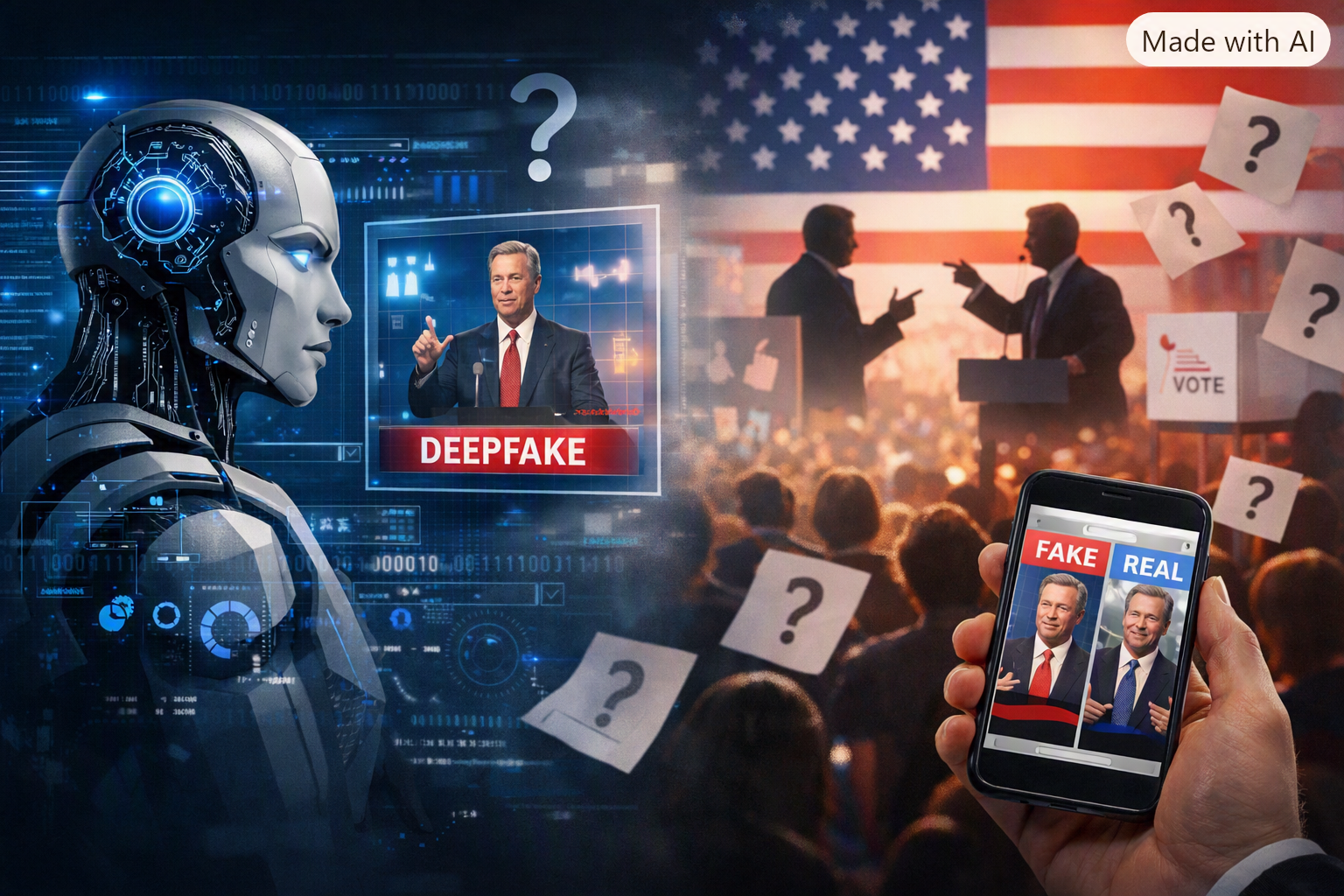
Artificial intelligence (AI) is changing the way political information is created and shared. New AI tools can produce realistic videos, pictures and audio of people saying or doing things that never happened. This creates a serious problem for elections because voters may be exposed to false information that looks real.
However, there is another problem that may be even harder to address. Politicians can use the existence of fake AI content to deny real evidence. When a politician is confronted with an embarrassing video or audio recording, they can simply claim that it is fake or was created by AI. Even when the evidence is genuine, the claim can create doubt in the minds of voters. This is known as the “liar’s dividend” (Chesney & Citron, 2019).
The liar’s dividend does not necessarily require people to believe a politician’s denial. It may be enough to make people unsure about what is true. This is important because proving that a video is genuine can take much longer than claiming that it is fake.
The problem is becoming increasingly important in Africa, especially during elections. Social media platforms such as WhatsApp, Facebook, TikTok, YouTube and X allow political information to spread very quickly. A fake video can reach thousands of people before journalists or fact-checkers have time to investigate it.
This article examines how AI can strengthen the liar’s dividend and considers examples from Nigeria, South Africa and Zambia. The cases show two connected problems: the creation of false political evidence and the denial of genuine evidence.
2. Understanding the Liar’s Dividend
The term “liar’s dividend” is linked to research on deepfakes and political communication. Chesney and Citron (2019) warned that deepfake technology could allow people accused of wrongdoing to claim that genuine recordings had been created using AI.
The idea is simple. In the past, a politician confronted with a damaging recording might have had to explain what they said. Today, they can say, “That video is fake,” or “It was created using AI”, or “It has been doctored with AI”. Because people know that AI can be used to create fake but realistic videos and voices, the politician’s denial may appear possible even when there is no evidence to support it. This then questions the veracity of what is already “true”.
This creates a different type of misinformation. Traditional misinformation tries to convince people that a false story is true. The liar’s dividend tries to convince people that the truth cannot be known.
For example, imagine that a politician is recorded making a controversial statement. If the recording is genuine, the politician may face public criticism. But if the politician claims that AI was used to create the recording, public attention may shift from the statement itself to the question of whether the recording is genuine. This can delay accountability and give the politician time to defend themselves.
3. AI and Elections in Africa
The liar’s dividend is especially important during elections because political information can influence how citizens vote. In many African countries, elections are highly competitive, and political campaigns often focus strongly on individual candidates.
A short video showing a presidential candidate making a controversial statement can therefore have a major effect. At the same time, many voters receive political information through social media and messaging platforms rather than directly from traditional news organisations.
The speed of social media creates a major problem. False information can be produced and shared within minutes, while verification can take hours or days.
Political supporters can also play an important role. People often believe information that supports the political candidate or party they already support. They may reject information that harms their preferred candidate. AI can make this problem worse because supporters can claim that damaging information is simply a deepfake.
4. Nigeria: The “Balablu” Video
Nigeria’s 2023 presidential election provides a useful example of the liar’s dividend.
During the campaign, a video circulated showing presidential candidate Bola Tinubu making the now-famous “Balablu Bulaba” slip at a political event in Imo State while trying to explain his refusal to attend town‑hall debates on certain broadcast stations. The gaffe was used against Mr Tinubu by his political rivals to argue that his incoherence made him unfit for the presidency. However, the spokesperson for Mr Tinubu’s presidential campaign at the time claimed that the video had been doctored. He argued that parts of the original video had been taken and manipulated before being shared online.
The Centre for Democracy and Development investigated the claim. It compared the disputed video with the original recording from Television Continental and concluded that the video had not been doctored. CDD therefore found the spokesperson’s claim to be false (CDD West Africa, 2023). This clearly demonstrates the basic mechanism of the liar’s dividend. An inconvenient and genuine recording was described as manipulated. The political debate therefore moved away from what Tinubu had said and towards whether the evidence could be trusted. It is worthy to note that politicians have always denied damaging evidence even before the advent of AI. However, what AI changes in this regard is the credibility of the denial. Today, people know that realistic fake videos and audios can actually be produced. As a result, the statement, “It is AI”, can be used to create doubt even when the evidence is genuine.
5. South Africa: The Fake Trump Endorsement
South Africa’s 2024 election provides a different example. During the election campaign, a video circulated appearing to show the then former US President Donald Trump supporting Jacob Zuma’s uMkhonto weSizwe (MK) Party. The video was fake. Africa Check and AFP Fact Check investigated the material and found that it had been created by manipulating an older video of Trump. The original footage came from a 2017 NBC interview, before the MK Party was formed. The manipulated version made Trump appear to endorse the party during South Africa’s 2024 election campaign. AFP Fact Check also reported that the audio had been manipulated to make Trump appear to deliver the endorsement.
This is a clear example of AI-assisted political disinformation which, nonetheless, is important to understanding the liar’s dividend. When voters repeatedly see convincing fake videos, they become aware that political videos can be manipulated. This can make it easier for politicians to dismiss genuine videos in the future. This therefore shows how AI can help create the conditions for the liar’s dividend. The more common deepfakes become, the easier it may be for politicians to say, “That video could be AI.”
6. Zambia: The Fake Hichilema Announcement
Zambia provides another clear example of AI-generated political misinformation. In October 2023, a video circulated appearing to show President Hakainde Hichilema announcing that he would not seek re-election in 2026. Such an announcement would have been politically important because it could affect the plans of political parties, possible candidates and voters. Africa Check investigated the video and concluded that it had been created using AI. AFP Fact Check also examined the material and reached the same conclusion. The ruling United Party for National Development rejected the video as fake.
This case also shows how AI can create false political statements that appear believable. A citizen watching the video without knowing its origin could reasonably think that the president had made the announcement.
It also shows the longer-term danger. Once voters learn that a convincing video of a president can be created using AI, they may become more suspicious of political videos generally. In the future, a genuine statement from the president could potentially be dismissed as AI-generated.
7. Why the Liar’s Dividend Can Be Powerful
One reason the liar’s dividend works is that ordinary citizens usually do not have the tools to determine whether a sophisticated video or audio recording is genuine.
A politician can deny a recording immediately. Proving that the recording is authentic may take much longer.
Journalists may need to find the original recording, compare different versions, speak to witnesses and consult technical experts. Fact-checkers may also need to investigate when and where the material first appeared.
This creates a major advantage for the person making the denial.
Research by Groh et al. (2022) also shows that people can have difficulty identifying political deepfakes. Their research examined how people respond to synthetic political speech in text, audio and video.
The problem is therefore not simply that citizens are easily deceived. Rather, sophisticated synthetic media makes it increasingly difficult for ordinary people to establish authenticity on their own.
8. Political Polarisation and Public Trust
Political polarisation can make the liar’s dividend even more effective.
Voters often receive information from people and organisations they already trust. A supporter of a political party may be more likely to believe the party’s explanation when damaging information appears online.
This can create two different versions of reality. Supporters of one party may believe that a video is genuine, while supporters of another party may believe that it is fake.
The result can be a serious decline in public trust. Citizens may stop trusting politicians, journalists, fact-checkers and even election institutions.
This creates a difficult situation for democracy. Political disagreements are normal in a democracy, but citizens still need some agreement about basic facts. If people cannot agree about whether a political leader actually made a particular statement, evidence becomes less useful in holding that leader accountable.
9. The Impact on Journalism
The liar’s dividend also creates new problems for journalists and fact-checkers.
In the past, journalists could often investigate what a politician said by checking an original recording or speaking to people who were present. With AI-generated media, they must also consider whether the recording itself has been manipulated.
This increases the time and resources required for fact-checking.
The problem is particularly serious during elections. A false video may reach thousands of people before journalists have time to check it. Even when a fact-check later proves that the video is false, many people may never see the correction.
This means that African media organisations need stronger digital verification skills. Fact-checkers also need to explain clearly how they determine whether a piece of content is genuine or fake.
10. How African Democracies Can Respond
Fighting the liar’s dividend requires more than AI-detection software. African countries need stronger cooperation between journalists, fact-checkers, election bodies, civil-society organisations and technology experts.
Election authorities can establish systems for quickly checking viral political claims during election periods. News organisations can train journalists in digital verification. Fact-checking organisations can work together to investigate high-impact political content.
Citizens also need basic AI and media literacy. People should understand that the statement “This is AI-generated” is itself a claim that requires evidence.
At the same time, citizens should not automatically believe everything they see online. They should ask where the material came from, whether an original version exists and whether reliable independent sources have verified it.
The goal should be careful verification rather than automatic trust or automatic disbelief.
11. Conclusion
AI is changing politics by making it easier to create convincing false information. But its most serious effect may be broader than the creation of deepfakes. AI may also make it easier for politicians to deny genuine evidence or create uncertainty about it.
This uncertainty can become politically useful. Once people know that AI can create fake videos and audio, politicians can claim that damaging evidence is also fake. They may not need to prove the claim. Creating doubt may be enough.
The central danger, therefore, is not simply that people will believe AI-generated lies. It is that people may eventually become unsure about whether the truth can be established at all.
For African democracies, this is a serious challenge. Elections depend on citizens having access to reliable information about political leaders and their actions. If genuine evidence can easily be dismissed as AI-generated, political accountability becomes weaker.
The response must therefore focus not only on detecting deepfakes but also on strengthening the institutions that establish truth. Strong journalism, independent fact-checking, digital literacy and credible election institutions will become increasingly important.
Ultimately, the liar’s dividend shows that AI can do more than make falsehoods look true. It can make the truth easier to question.
References
Africa Check. (2023, October 31). Zambian president Hakainde Hichilema didn’t announce he won’t run in 2026 elections – Video fabricated using AI. https://africacheck.org/fact-checks/meta-programme-fact-checks/zambian-president-hakainde-hichilema-didnt-announce-he-wont
Africa Check. (2024, April 11). No, former US president Donald Trump has not backed South Africa’s newly formed uMkhonto weSizwe Party – Video doctored. https://africacheck.org/fact-checks/meta-programme-fact-checks/no-former-us-president-donald-trump-has-not-backed-south
Africa Check. (2024, July 17). The use of generative AI in South Africa’s 2024 election. https://africacheck.org/fact-checks/blog/expectations-versus-reality-use-generative-ai-south-africas-2024-election
AFP Fact Check. (2023, October 26). AI-generated video of Zambian president misleads about election plans. https://factcheck.afp.com/doc.afp.com.33Z363J
AFP Fact Check. (2024, March 20). Doctored video does not show Trump backing new South African party. https://factcheck.afp.com/doc.afp.com.34LT2UZ
Centre for Democracy and Development West Africa. (2023, February 10). Dele Alake’s claim is false—TVC video shows Tinubu’s Balablu gaffe was not doctored. https://cddfactcheck.org/fact-check-dele-alakes-claim-is-false-tvc-video-shows-tinubus-balablu-gaffe-was-not-doctored/
Chesney, R. M., & Citron, D. K. (2019). Deep fakes: A looming challenge for privacy, democracy, and national security. California Law Review, 107(6), 1753–1820.
Groh, M., Sankaranarayanan, A., Singh, N., Kim, D. Y., Lippman, A., & Picard, R. (2022). Human detection of political speech deepfakes across transcripts, audio, and video.
Schiff, K. J., Schiff, D. S., & Bueno, N. (2024). The liar’s dividend: Can politicians claim misinformation to evade accountability? American Political Science Review.