







Introduction
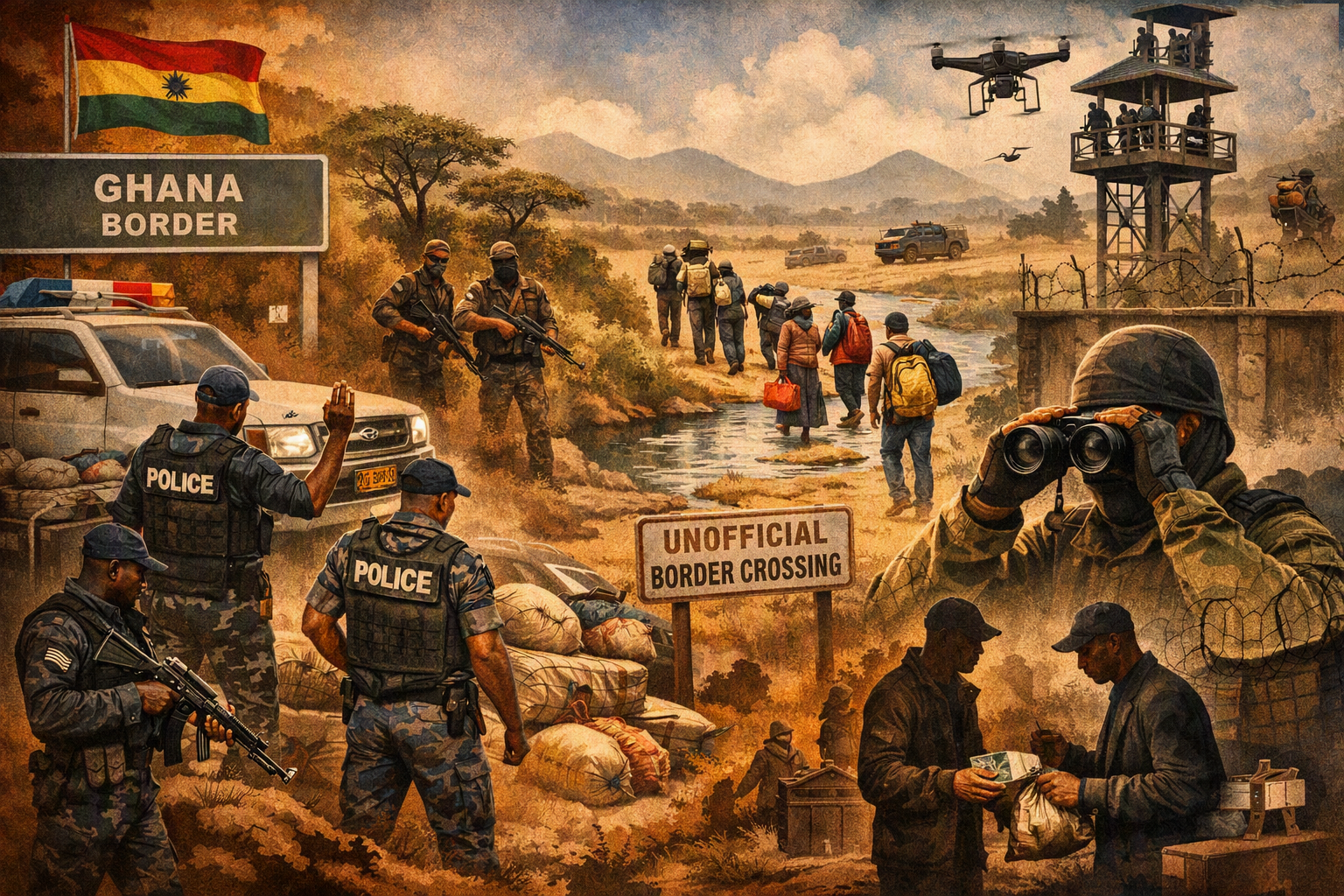
For many West Africans, crossing a border is part of ordinary life. Traders move between markets, families remain connected across neighbouring states, and workers travel in search of income. This daily movement is one of the clearest benefits of regional integration. It is also coming under growing security pressure.
On 11th June 2026, the Ghana Immigration Service warned that criminal networks were abusing the ECOWAS free movement system for irregular migration, child trafficking, cyber fraud, organised street begging and other crimes (Ghana Immigration Service [GIS], 2026). The warning should be taken seriously. It should not, however, become a reason to view every foreign traveller as a suspect. Broad suspicion can punish lawful migrants while the organisers, financiers and recruiters remain hidden.
A right, not a free-for-all
ECOWAS free movement is sometimes described as an open-border policy, but that description is misleading. The 1979 protocol gives community citizens the right to enter, reside and establish themselves in member states. For a visa-free visit of up to 90 days, a traveller is expected to carry a valid travel document and use an official entry point. Member states may also refuse entry to people who are inadmissible under national law.
The real problem is therefore not the right to move. It is the uneven way the system is managed. A person may enter Ghana legally and later be taken to a house where documents are seized, movement is restricted or online fraud is forced on them. Another person may be moved through an unofficial route by a smuggler. A third may be a genuine trader whose papers are in order. These situations require different responses, even when the people involved share the same nationality.
The network is the threat
A police operation in Accra in October 2025 shows why this distinction matters. Authorities rescued 57 Nigerian nationals, aged 18 to 26, who had reportedly been promised jobs and other opportunities in Ghana. Police said they were later forced to carry out online romance scams. Five suspected organisers were arrested, and dozens of laptops and phones were recovered (Acquah, 2025). The people found inside the operation were not one simple group of “foreign cybercriminals.” Some were alleged organisers; others were young trafficking victims.
The same care is needed when discussing migrant smuggling and human trafficking. Smuggling usually involves payment to help someone cross a border unlawfully. Trafficking centres on exploitation and can happen with or without an international border crossing. A smuggling journey may also turn into trafficking when a person is threatened, confined or forced to work (United Nations Office on Drugs and Crime [UNODC], 2025). When officials mix these offences together, victims may be charged while the people exploiting them escape.
Public debate also needs proportion. Ghana’s 2021 census found that non-Ghanaians made up about one per cent of the population, and 92 per cent of that group were ECOWAS nationals. A number of serious cases can reveal a security gap, but they should not be used to define a much larger population of traders, students, workers and families who move lawfully.
Where the system breaks down
The chain often begins far from a border post. A recruiter may offer a job through a friend, a family contact or a social-media message. The traveller may carry genuine documents and answer routine questions correctly because the promised work still appears real. By the time the deception becomes clear, the person may be in another town, living in accommodation chosen by the recruiter and owing money for transport, food or training.
Transport and accommodation are therefore important parts of the security picture. Drivers, ticket agents, landlords and hotel operators may notice repeated group arrivals, young people who do not know their destination, someone holding several passports, or occupants who are rarely allowed outside. These signs do not prove a crime. They do, however, justify a safe way to alert the authorities without putting a potential victim in greater danger.
The financial and digital trail can be even more useful than the travel route. Recruitment fees, mobile-money transfers, rent payments, SIM registrations, device purchases and online accounts can connect a recruiter in one country to an organiser in another. If agencies examine only the border crossing, they may miss the network that made the journey possible and the people who continue to profit after the traveller arrives.
When enforcement becomes too broad
Mass checks and nationality-based sweeps may create an appearance of action, yet they often produce weak security results. They focus attention on the most visible people rather than the least visible organisers. They can also discourage migrants and border residents from reporting recruiters, corrupt transport agents, abusive employers or suspicious houses. Once communities fear that any contact with the authorities could lead to detention or removal, valuable information is lost.
There is yet another danger. If a trafficked person is treated first as an immigration offender, signs of exploitation may be missed. Officers need time, interpreters and trained support staff to ask what was promised, who arranged the journey, who controls the person’s documents, whether the person can leave freely and who receives the money. Children require separate protection. These are not soft concerns. They are basic steps for identifying the real offenders.
Trust as a security asset
Migrants and border residents are often the first people to hear about a false recruiter, a suspicious journey or a house where young people are being controlled. Their information can help officers act swiftly. That cooperation depends on trust. A witness who expects harassment, an unofficial fee or immediate detention is less likely to report what they know.
Ghana can strengthen security by providing confidential reporting channels, clear complaint procedures and a limited period in which possible victims and witnesses can seek help before their immigration status is considered. Community meetings in the languages used along border routes would also help people understand both their rights and the signs of trafficking. Humane treatment is not separate from intelligence gathering; it makes useful intelligence more likely.
Recommendations
- Follow the money and the organisers. Investigators should trace recruitment messages, transport payments, rented properties, SIM cards, bank and mobile-money accounts, devices and the movement of proceeds. The aim should be to identify the people who plan, fund and profit from the crime, not simply those who are easiest to arrest.
- Screen for trafficking before charging immigration offences. A person with irregular documents may still be a victim or a key witness. Ghana needs a consistent front-line process for separating organisers, willing participants, victims and children. Early legal advice, interpretation and social support can improve both protection and prosecution.
- Share information across borders, with safeguards. The ECOWAS protocol already calls on member states to exchange information that affects its implementation. Faster checks on travel documents, missing-person reports, wanted recruiters and repeated phone numbers could close major gaps. Any regional database, however, needs clear access rules, correction procedures, time limits and independent oversight. A mistaken flag should not follow an innocent person across West Africa.
- Work with the people who see the warning signs first. Transport unions, border communities, migrant associations, landlords, schools and employers may notice group travel, false job promises, document confiscation or overcrowded houses before a national agency does. Safe reporting channels are essential. Witnesses should be able to share information without automatically exposing themselves to detention or removal.
- Measure outcomes, not round-ups. Success should be judged by organisers prosecuted, criminal assets recovered, victims safely reintegrated, children returned to school and lawful travellers processed more efficiently. Large arrest figures may attract attention, but they do not prove that a network has been dismantled.
The Ghana Immigration Service’s 2023–2029 Strategic Plan already links border management, transnational crime prevention and fair migration control. It also recognises that migration governance requires cooperation among agencies and outside partners. The task now is to turn those principles into daily practice at border posts, transport stations, neighbourhoods and courts.
Conclusion
Free movement and national security are not opposites. Properly managed legal routes create records, allow document checks and give travellers clear points of contact with the state. Harsh or unpredictable enforcement can have the opposite effect by pushing people toward informal routes and making communities less willing to cooperate.
Ghana does not need to choose between regional integration and public safety. It needs security that is precise enough to protect both. That means keeping the door open to lawful West African movement while closing the space in which recruiters, traffickers and cybercrime groups operate. The best border is not one that treats everyone as a threat. It is one that makes ordinary travel easier and organised crime harder.
References
Acquah, E. (2025, October 23). Ghana police rescue 57 Nigerians in crackdown on human trafficking and cybercrime. Associated Press. https://apnews.com/article/ghana-online-romance-scam-human-trafficking-cybercrime-b4d2f1a70c0031fb87b6d575efb55e84
Economic Community of West African States. (1979). Protocol A/P.1/5/79 relating to free movement of persons, residence and establishment. https://ecowas.int/wp-content/uploads/2024/08/PROTOCOL-RELATING-TO-FREE-MOVEMENT-OF-PERSONS.pdf
Ghana Immigration Service. (2023). Ghana Immigration Service 2023–2029 strategic plan. https://gis.gov.gh/wp-content/uploads/2024/02/GIS-STRATEGIC-PLAN-2023-2029.pdf
Ghana Immigration Service. (2026, June 11). GIS warns of abuses in the implementation of the ECOWAS Free Movement Protocol. https://gis.gov.gh/6299-2/
Ghana Statistical Service. (2021). 2021 Population and Housing Census: Background characteristics—Non-Ghanaians by country and region of residence.
United Nations Office on Drugs and Crime. (2025, October). Not the same crime: Understanding the difference between human trafficking and migrant smuggling. https://www.unodc.org/unodc/en/frontpage/2025/October/not-the-same-crime_-understanding-the-difference-between-human-trafficking-and-migrant-smuggling.html