






Pandemics are fought on two fronts. The first is against the pathogen itself; the second is against the misinformation that accompanies it. Across Africa, recent public health emergencies—including repeated Ebola outbreaks and the COVID-19 pandemic—have demonstrated that false information, rumours and conspiracy theories can spread as rapidly as viruses, undermining public trust, delaying treatment, fuelling violence against health workers and ultimately costing lives. In many cases, misinformation has become a public health emergency in its own right, posing a significant threat to human security across the continent.
Human security extends beyond protecting states from military threats. It encompasses the protection of people’s lives, health, livelihoods and dignity (United Nations Development Programme [UNDP], 1994). When misinformation discourages people from seeking treatment, rejecting vaccines or cooperating with health authorities, it directly threatens these pillars of human security by increasing preventable illness, deaths, economic disruption and social instability.
Ebola: When Rumours Become Deadly
Since Ebola was first identified in 1976 in what is now the Democratic Republic of the Congo (DRC), outbreaks have repeatedly exposed the devastating consequences of misinformation. Although advances in surveillance, laboratory testing, vaccines and outbreak response have significantly improved disease control, community mistrust continues to undermine containment efforts.
The ongoing 2026 Bundibugyo virus outbreak in eastern DRC and neighbouring Uganda illustrates this challenge. As health authorities intensified efforts to isolate patients, conduct contact tracing and carry out safe burials, misinformation spread rapidly through communities and online. False claims that Ebola did not exist, that treatment centres were harvesting organs, or that humanitarian organisations had fabricated the outbreak for financial gain fuelled widespread distrust (BBC Verify, 2026).
The consequences quickly became violent.
In Bunia, eastern DRC, a Red Cross burial team transporting the body of an Ebola victim was attacked by an angry crowd convinced the coffin was empty. One of the volunteers recalled being beaten with machetes and spades as community members attempted to seize the coffin. Similar incidents occurred across affected communities, including attacks on treatment centres, assaults on healthcare workers and attempts to remove bodies from hospitals before safe burials could be conducted (BBC Verify, 2026).
These attacks are particularly dangerous because Ebola spreads through direct contact with infected bodily fluids, and the bodies of deceased victims remain highly infectious. Safe and dignified burial practices remain among the most effective interventions for interrupting transmission during Ebola outbreaks. When communities reject these measures because of misinformation, opportunities for the virus to spread increase significantly (World Health Organization [WHO], 2024).
Misinformation has also discouraged infected individuals from seeking treatment. Rumours that Ebola patients were being killed for their organs or would never return from treatment centres created widespread fear of isolation. Some patients concealed symptoms or fled health facilities, remaining within their communities where they continued transmitting the virus to family members and neighbours (International Medical Corps, 2026).
Healthcare workers themselves have become targets. During recent outbreaks, Ebola treatment centres have been vandalised, isolation facilities burned and response teams attacked by hostile crowds acting on false information. Such incidents not only disrupt emergency operations but also discourage frontline workers from serving in affected communities, further weakening already fragile health systems.
COVID-19: The Global Infodemic
Africa experienced a similar challenge during the COVID-19 pandemic.
Recognising the unprecedented spread of false information, the World Health Organization described the situation as an “infodemic”—an overabundance of information, including misinformation and disinformation, that makes it difficult for people to identify trustworthy sources and make informed decisions (WHO, 2020).
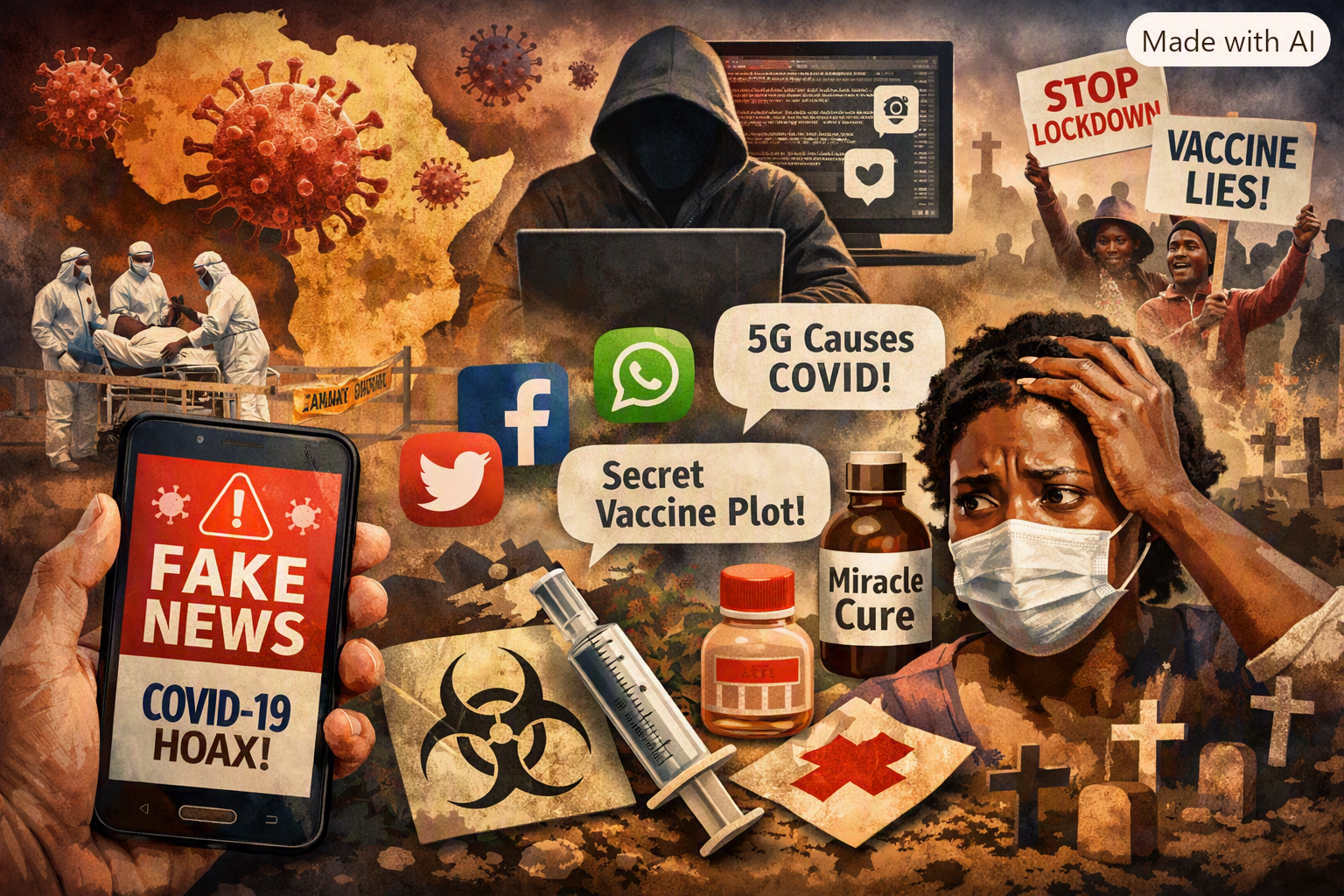
Across the continent, social media platforms, messaging applications and word-of-mouth networks became channels for conspiracy theories and unverified medical advice. False claims circulated that Africans were naturally immune to COVID-19, that vaccines were designed to reduce African populations, that the virus was linked to 5G technology or that herbal remedies alone could cure the disease (WHO, 2020.
Why the Scepticism
While many of these claims were demonstrably false, it is equally important to recognise that public scepticism did not emerge in a vacuum. Historical instances of unethical medical research, pharmaceutical misconduct, lack of transparency in some public health programmes and commercial profiteering have contributed to lingering mistrust among many communities. These historical experiences make it even more important for governments and health institutions to communicate openly, acknowledge legitimate concerns and ensure transparency during health emergencies.
The pandemic also exposed significant global inequities in access to vaccines. Many African countries experienced lengthy delays in receiving COVID-19 vaccines as wealthier nations prioritised vaccinating their own populations and secured much of the early global supply. This unequal distribution fuelled perceptions of injustice and reinforced existing suspicions about international health governance. While vaccine inequity is distinct from misinformation, it created an environment in which misinformation could spread more easily because trust had already been weakened.
These factors contributed to lower compliance with some public health measures. In several countries, many citizens ignored mask mandates, physical distancing guidelines and vaccination campaigns because they believed the virus was exaggerated or fabricated. At the same time, delayed vaccine availability complicated immunisation efforts, demonstrating that both misinformation and unequal access influenced pandemic outcomes across Africa (Africa Centres for Disease Control and Prevention [Africa CDC], 2022.
The consequences extended beyond health. Businesses closed, schools remained shut for extended periods, healthcare systems became overwhelmed and livelihoods were disrupted. False information also contributed to stigma against infected individuals, discrimination against healthcare workers and growing distrust of government institutions responsible for managing the pandemic.
Misinformation as a Human Security Threat
The experiences of Ebola and COVID-19 demonstrate that misinformation is no longer merely a communication challenge—it is a human security issue.
Health security is undermined when people refuse testing, treatment or vaccination because they believe false information. Personal security is threatened when healthcare workers become victims of violence or communities attack treatment facilities. Economic security deteriorates as prolonged outbreaks disrupt trade, tourism and employment, while food security may also suffer when movement restrictions and conflicts interrupt agricultural production and supply chains. Ultimately, misinformation weakens trust between citizens and public institutions, reducing governments’ ability to respond effectively during crises.
Beyond public health, these dynamics have broader national security implications. A nation whose citizens lose confidence in public institutions becomes more vulnerable to instability, social unrest and manipulation by malicious actors. In this sense, misinformation can undermine national resilience and security without a single shot being fired.
This erosion of trust creates a dangerous cycle. Communities that distrust authorities become less likely to report symptoms, cooperate with contact tracing or comply with public health interventions. Delayed detection enables diseases to spread more widely, requiring longer and more expensive emergency responses.
Building Trust Through Risk Communication
The fight against misinformation requires more than simply correcting false claims. Effective risk communication depends on building trust before and during health emergencies.
During recent Ebola outbreaks, organisations such as the International Medical Corps and the DRC Ministry of Health strengthened Risk Communication and Community Engagement (RCCE) programmes by working closely with trusted community health workers, religious leaders, traditional authorities and Ebola survivors. These local voices helped explain isolation procedures, treatment protocols and safe burial practices in culturally appropriate ways, increasing community acceptance of response measures (International Medical Corps, 2026).
Survivors played an especially important role. Having experienced Ebola firsthand, they became credible advocates capable of reassuring communities that treatment centres were places of healing rather than death. Their testimonies helped counter rumours more effectively than messages delivered solely by external organisations.
Similarly, lessons from COVID-19 have highlighted the importance of transparent communication, timely dissemination of accurate information and partnerships with local media. Radio broadcasts, community outreach programmes and social media campaigns delivered in local languages have proven particularly effective in reaching underserved populations while addressing misinformation before it gains momentum.
Building trust also requires strengthening national and regional public health institutions. African governments should continue investing in their Centres for Disease Control, disease surveillance systems and research institutions while ensuring that decisions are communicated transparently. In addition, scientifically tested and regulated herbal medicines with proven efficacy should be integrated into national healthcare systems where appropriate. Recognising credible traditional medicine alongside conventional medicine can improve public confidence, particularly in communities where traditional healers remain trusted sources of healthcare.
A Continental Imperative
Africa’s growing connectivity presents both opportunities and risks. While digital technologies enable faster dissemination of life-saving information, they also allow misinformation to spread instantly across borders. As future disease outbreaks become increasingly likely due to urbanisation, climate change, environmental degradation and increased human-animal interaction, combating misinformation must become an integral component of pandemic preparedness.
Strengthening public trust should therefore receive the same priority as strengthening laboratories, surveillance systems and emergency operations centres. Investments in media literacy, community engagement, trusted local leadership, transparent governance and evidence-based public communication can significantly reduce the impact of false narratives during health emergencies.
Conclusion
The history of Ebola and the experience of COVID-19 reveal that pandemics are not driven solely by biology. They are also shaped by information—and by trust.
False narratives can spread faster than viruses, turning fear into violence, weakening public confidence and undermining life-saving interventions. At the same time, historical failures, unequal access to healthcare resources and unethical practices in parts of the global health system have contributed to public scepticism that cannot simply be dismissed. Rebuilding confidence therefore requires transparency, accountability and equitable access to healthcare alongside effective communication.
In Africa, where many health systems already operate under significant constraints, misinformation magnifies vulnerabilities and threatens every dimension of human security. Protecting lives during future pandemics will therefore require more than vaccines, medicines and healthcare workers. It will require trusted communication, stronger public institutions, equitable global cooperation, scientifically grounded healthcare—including validated traditional medicine where appropriate—and sustained efforts to ensure that accurate information travels faster, and farther, than dangerous rumours.
References
Africa Centres for Disease Control and Prevention. (2022). COVID-19 vaccine demand and uptake in Africa.
BBC Verify. (2026). Misinformation fuels attacks during the Democratic Republic of the Congo Ebola outbreak.
International Medical Corps. (2026). Fighting misinformation during the Ebola outbreak in the Democratic Republic of the Congo.
United Nations Development Programme. (1994). Human Development Report 1994: New Dimensions of Human Security.
World Health Organization. (2020). Managing the COVID-19 infodemic: Promoting healthy behaviours and mitigating the harm from misinformation and disinformation.
World Health Organization. (2024). Ebola virus disease: Fact sheet.