







Introduction
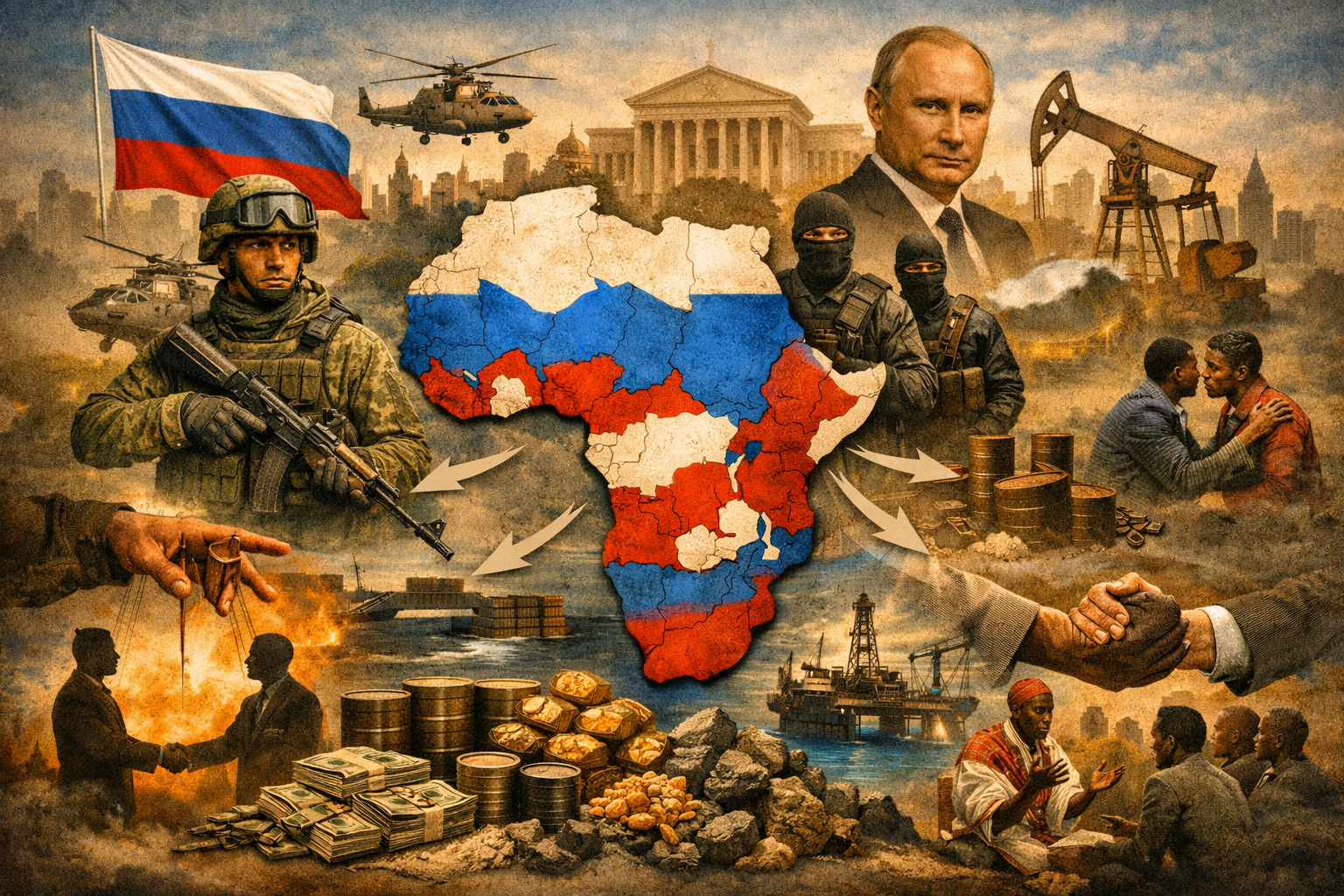
For much of the past decade, Russia has increased its engagement in Africa, particularly in the Sahel and other regions. In political discourse, this engagement has often been framed as an alternative to established Western partnerships, with emphasis placed on sovereignty, non-interference, and security cooperation. This framing has gained attention in contexts where dissatisfaction with long-standing Western engagement, persistent insecurity, and limited economic transformation have been reported.
This article examines Russia’s engagement in Africa by focusing on four areas: security cooperation, economic relations, financial networks, and information-related activities. Existing literature indicates that Russia’s presence in Africa spans military cooperation, resource-linked economic arrangements, and financial adaptations associated with broader geopolitical shifts (Bamidele, 2025; Faulkner & Parrens, 2025).
The analysis situates Russia’s role within broader patterns of external engagement in Africa. It focuses on identifying observable continuities and variations across different external actors in terms of security provision, economic involvement, and financial interaction. The article does not treat Russia as a distinct model but instead examines its activities in relation to established patterns of external engagement on the continent.
Security Engagement and Stability Outcomes
Security cooperation constitutes a major component of Russia’s engagement in Africa (Bamidele, 2025). In several African contexts, governments face insurgencies, terrorism, organised crime, separatist movements, and political instability. Within this environment, security cooperation has remained a significant dimension of external engagement. In some cases, Russian security cooperation has included arms transfers, military training, and the deployment of private security actors. Available literature indicates that, in contrast to some Western partnerships that have included governance-related conditions such as institutional reform, human rights provisions, or democratic accountability frameworks, Russian engagements have often involved fewer explicit political conditions (Faulkner & Parrens, 2025). In contexts of immediate security pressure, such arrangements have been adopted by state actors seeking rapid security support. In the Sahel, including transitions involving military governments, Russian-linked security arrangements have been described in the literature as part of broader shifts in external security partnerships (Sour, 2026).
In some instances, external security engagement has been associated with expectations of improved territorial control and reductions in armed group activity. However, empirical reporting suggests that security conditions in certain contexts, including Mali, remain complex, with continued presence and activity of armed groups in multiple regions (The Sentry, 2025). The case of Mali illustrates the persistence of insecurity under changing external security partnerships. Available reports indicate that, despite shifts in external actors, armed group activity and territorial contestation have continued in several areas. In this context, changes in external security partnerships have not necessarily corresponded with uniform changes in underlying conflict dynamics.
Recent reporting on adjustments involving Russian-linked security actors, including operational withdrawals and restructuring in parts of the Sahel, reflects ongoing changes in the organisation of external security cooperation (Reuters, 2026). These developments have been interpreted in the literature as evidence of the operational constraints facing external military actors in contexts where insecurity is structurally embedded. From a broader analytical perspective, security studies literature distinguishes between immediate security provision and long-term stability. Military interventions can alter short-term tactical conditions, but they do not directly address underlying structural drivers such as governance capacity, state legitimacy, and socio-economic inequality. In this sense, insurgency persistence is often associated with broader political and institutional conditions rather than the availability of military force alone.
Was Russia’s Economic Promise Always an Illusion? A Comparative Perspective
Unlike China, Russia has not financed large-scale infrastructure programmes across the African continent. Unlike the European Union, it is not among Africa’s most significant trading partners. Unlike the United States, it does not provide substantial access to global capital markets, advanced technologies, or large-scale development financing. In material terms, Russia’s economic footprint in Africa remains relatively modest despite the increasing visibility of its political and security presence (Klomegâh, 2025; Klomegâh, 2026).
This disconnect between geopolitical influence and economic investment raises a fundamental question: can a state meaningfully position itself as a development partner when it lacks the economic capacity to sustain structural transformation abroad? The issue is not simply that Russia invests less than other global actors. It is that its domestic economic constraints significantly limit the scale and diversity of its external engagements.
The war in Ukraine has intensified these constraints. Military expenditure has absorbed a growing share of national resources, while international sanctions have restricted access to global financial markets, reduced foreign investment inflows, and limited technological imports (Atlantic Council, 2025; Reuters, 2025). Although the Russian economy has demonstrated short-term resilience through energy exports and fiscal adjustments, its long-term capacity to finance large-scale external development projects remains constrained. This structural limitation directly shapes the nature of Russia’s engagement in Africa.
Rather than functioning as a broad-based development partner, Russia’s African engagement increasingly takes on a selective and strategic character. In many cases, cooperation is centred on access to minerals, energy resources, and political alignment rather than industrial transformation or human development. This pattern produces a relationship that is more transactional than developmental: security assistance is exchanged for mining concessions, diplomatic support is exchanged for geopolitical alignment, and strategic cooperation is exchanged for access to extractive sectors (Baranowski et al., 2025; Robert Lansing Institute, 2025).
What is largely absent from this model is a coherent and sustained strategy for structural economic transformation. In this sense, Russia’s engagement begins to resemble the very external logics it has historically criticised. For decades, African scholars and policymakers have critiqued Western engagement for privileging resource extraction over productive investment and industrial development (Sabbi, 2025). Yet, many contemporary Russian initiatives reproduce similar patterns, albeit under different political narratives. The language of partnership has shifted, but the underlying political economy often remains familiar.
This tension becomes clearer when Russia’s footprint is compared systematically with that of Western and multilateral actors. While Russia’s presence is concentrated in a narrow set of sectors particularly nuclear cooperation and extractive industries, Western and allied investment is distributed across a broader developmental portfolio including infrastructure, energy transition, digital systems, health, and industrial corridors.
Table 1: Comparative Investment Snapshot (Africa, recent years)
| Area | Russia | Western nations/partners |
| Nuclear energy | Very strong | limited |
| Railways & transport corridors | Limited | Very strong |
| Digital infrastructure | Limited | Very strong |
| Mining and critical minerals | Growing but narrow | Very strong and diversified |
| Renewable energy | Limited | Very strong |
| Health systems | Limited | Strong |
| Overall investment scale | Tens of billions (concentrated, opaque in parts) | Hundreds of billions pledged/mobilised |
A clearer picture emerges when flagship projects are considered. Russia’s most significant confirmed project remains the El Dabaa Nuclear Power Plant in Egypt, valued at approximately $30 billion, representing an exceptional rather than typical case of Russian overseas investment (Joshi, 2024). Other engagements, such as proposed pipelines in Congo, gold refinery projects in Mali, and various nuclear cooperation agreements across Burkina Faso, Mali, Ethiopia, and Zimbabwe, remain either at early stages or lack publicly disclosed financial commitments (Clothia, 2025; The Voice of Africa, 2025). By contrast, Western and allied initiatives demonstrate both larger scale and broader sectoral coverage. The European Union’s Global Gateway strategy alone targets approximately €150 billion for Africa, spanning transport, digital infrastructure, energy transition, and health systems (European Commission, n.d; Ergenc, & Yun, 2025). Additional commitments include €15.5 billion in renewable energy financing under Team Europe initiatives. The United States, alongside partners, has supported flagship programmes such as the Lobito Corridor, with over $2 billion in EU mobilisation and additional financing from development banks and U.S. agencies (U.S. Embassy in Tanzania, 2024). The U.S. has also committed nearly $500 million to infrastructure and critical minerals development in Zambia (Reuters, 2026).
The contrast is not simply quantitative; it is structural. Western and multilateral investments, despite their political complexities, are broadly oriented toward infrastructure systems and productive capacity. Russia’s engagements, by contrast, are concentrated in strategic extraction, nuclear cooperation, and selective state-to-state alliances. This divergence matters because it reveals the limits of Russia’s “development partner” narrative. While Moscow presents itself as an alternative to Western conditionality and dominance, its actual economic presence in Africa often lacks the scale, diversification, and institutional depth required for structural transformation. In this sense, Russia’s economic promise is not entirely an illusion but it is severely constrained by material realities that limit its transformative potential.
Expansion of Russia’s Shadow Financial Networks
The limitations of Russia’s economic model have become more visible through its increasing use of alternative financial arrangements developed in response to Western sanctions. Following the escalation of financial restrictions after the war in Ukraine, Russian-linked entities have expanded the use of parallel payment systems, intermediary firms, and cross-border financial arrangements intended to reduce reliance on Western-dominated banking infrastructures (Kennedy et al., 2025). These developments have been described in some policy and media discussions as part of a broader shift toward a more multipolar financial system (see Wang, 2025). These financial mechanisms are primarily designed to maintain the continuity of Russian trade and financial transactions under conditions of restricted access to global financial markets (Madatova, 2025). Their operational logic is shaped by the need to sustain cross-border payments, manage foreign currency flows, and facilitate international transactions outside conventional Western regulatory systems. As such, they function within a broader set of adaptations to financial sanctions and restrictions. For African countries engaging with or participating in such networks, these arrangements may involve exposure to financial systems that operate outside standard global regulatory frameworks. In such contexts, transactions may occur through intermediary institutions or payment channels that are not fully integrated into mainstream international banking systems. Some reports have noted that participation in sanction-affected financial networks can be associated with regulatory uncertainty and potential secondary compliance risks (see Zambian Observer, 2026).
Conclusion: Beyond Russia, Beyond the West
Russia’s growing influence in Africa reflects a broader historical pattern in which external powers are repeatedly viewed as potential solutions to the continent’s developmental challenges. From colonial powers and international financial institutions to China and now Russia, African states have often placed significant expectations on external partnerships. While Russia has successfully positioned itself as an alternative to the West and capitalised on widespread frustration with Western policies, its engagement increasingly reveals many of the same contradictions that have characterised previous relationships. Its security partnerships have not delivered lasting stability, its economic footprint remains limited, and its influence operations often appear more developed than its developmental contributions.
The central lesson is that Africa’s future cannot be secured through the replacement of one external dependency with another. Whether influence originates from Moscow, Washington, Paris, Brussels, or Beijing, external powers ultimately pursue their own strategic interests. The challenge for African governments is therefore not to identify a perfect partner but to build the institutional, economic, and political capacity necessary to engage all partners on favourable terms. Genuine sovereignty is not measured by the ability to switch alliances; it is measured by the ability to make independent choices without becoming vulnerable to external pressure.
Russia’s greatest achievement in Africa may be its exposure of Western failures, but its greatest limitation is its inability to provide a fundamentally different development model. Africa does not need a new patron or a new geopolitical camp to follow. It needs stronger institutions, productive economies, accountable governance, and strategic autonomy. Until African states prioritise these foundations, the continent risks remaining trapped in a cycle of geopolitical disappointment, replacing one external dependency with another while the underlying challenges of development remain unresolved.
Reference
Atlantic Council,. Russia Sanctions Database. www.atlanticcouncil.org. June 20, 2026. https://www.atlanticcouncil.org/blogs/econographics/russia-sanctions-database/
Bamidele, S. (2025). Russia’s Strategic Engagement in Africa: Great Power Competition, Sovereignty, and the Politics of Multipolarity. Jadavpur Journal of International Relations, 29(2), 195-213.
Baranowski, M., Jabkowski, P., & Kammen, D. M. (2025). From the Russian invasion of Ukraine to the battlefield of the future: The geopolitical fight for Ukraine. Energy Research & Social Science, 123, 104043. https://doi.org/10.1016/j.erss.2025.104043
Clothia, F. (2025). Mali begins building Russian-backed gold refinery . www.bbc.com. June 28, 2026. https://www.bbc.com/news/articles/c98w49220rko
Ergenc, C., & Yun, C. (2025). How the EU’s Global Gateway Can Compete in the Global South. carnegieendowment.org. June 28, 2026. https://carnegieendowment.org/europe/strategic-europe/2025/10/how-the-eus-global-gateway-can-compete-in-the-global-south
European Commission,. Global Gateway . commission.europa.eu. June 28, 2026. https://commission.europa.eu/topics/international-partnerships/global-gateway_en
Faulkner, C. M., & Parrens, R. (2025). Russia in Africa: Private Military Proxies in the Sahel. gjia.georgetown.edu. June 20, 2026. https://gjia.georgetown.edu/global-governance/russia-in-africa-private-military-proxies-in-the-sahel/
Joshi, R. (2024). El Dabaa Nuclear Power Plant. www.power-technology.com. June 28, 2026. https://www.power-technology.com/projects/el-dabaa-nuclear-power-plant/
Kennedy, J., Bryan, E., Ploom, I., & Veebel, V. (2025). Russia’s Use of Crypto Schemes – RAND. www.rand.org. June 20, 2026. https://www.rand.org/pubs/commentary/2025/08/russias-use-of-crypto-schemes.html
Klomegâh, K. K.. (2026). Lack of financial support holding back Russia’s economic influence in Africa: A case study of missed opportunities in Nigeria. thebftonline.com. June 20, 2026. https://thebftonline.com/2026/01/03/the-tanjia-musa-fire-festival-reclaiming-gwollus-legacy-and-repositioning-northern-ghana/
Klomegâh, K. K. (2025). Why is Russia’s Economic Presence Invisible Across Africa?. www.africa-press.net. June 20, 2026. https://www.africa-press.net/south-sudan/all-news/russias-economic-presence-in-africa-remains-invisible
Madatova, O. V. (2025). Transformation of cross-border financial transactions under sanctions pressure: Analysis of alternative payment mechanisms and strategies for ensuring Russia. Финансы И управление, (1), 97-131. https://doi.org/10.25136/2409-7802.2025.1.73076
Reuters,. (2025). What international sanctions have been placed on Russia? . www.reuters.com. June 20, 2026. https://www.reuters.com/business/energy/what-international-sanctions-have-been-placed-russia-2025-10-23/
Reuters,. (2026). Russia’s Africa Corps confirms withdrawal from Mali’s Kidal. www.reuters.com. June 20, 2026. https://www.reuters.com/world/africa/russias-africa-corps-confirms-withdrawal-malis-kidal-2026-04-27/
Reuters,. (2026). Zambia, US expand use of $491 million grant programme to critical metals infrastructure. www.reuters.com. June 28, 2026. https://www.reuters.com/world/africa/zambia-us-expand-use-491-million-grant-programme-critical-metals-infrastructure-2026-06-18/
Robert Lansing Institute ,. (2025). How Russia’s MoD Secures and Exploits Sahel’s Strategic Minerals. lansinginstitute.org. June 20, 2026. https://lansinginstitute.org/2025/08/15/how-russias-mod-secures-and-exploits-sahels-strategic-minerals/
Sabbi, M. (2025). Homegrown Internationalism? Challenging Epistemic Dialogue in Africa’s Development Cooperation. Africa Spectrum, 60(2), 181-208.
Sour, L. (2026). The Matryoshka Strategy: Russia’s Hybrid Tactics in the Sahel. Africa Spectrum, 0(0).
The Sentry,. (2025). Investigative Report Details “Meltdown” of Russia’s Wagner Group in Mali. thesentry.org. June 20, 2026. https://thesentry.org/2025/08/27/80784/investigative-report-details-meltdown-of-russias-wagner-group-in-mali/
The Voice of Africa,. (2025). Russia Deepens Footprint in Africa With Mali Energy and Mining Deals. thevoiceofafrica.com. June 28, 2026. https://thevoiceofafrica.com/2025/06/25/russia-deepens-footprint-in-africa-with-mali-energy-and-mining-deals/
U.S. Embassy in Tanzania,. (2024). Partnership for Global Infrastructure and Investment in the Lobito Trans-Africa Corridor. tz.usembassy.gov. June 28, 2026. https://tz.usembassy.gov/fact-sheet-partnership-for-global-infrastructure-and-investment-in-the-lobito-trans-africa-corridor/
Wang, J. (2025). Paradigm Shift in the Making? Geopolitical Challenges and Institutional Changes in the International Monetary System: From Neoliberalism to a Pluralist Multipolar Financial Order. Global Policy. https://doi.org/10.1111/1758-5899.70089
Zambian Observer. (2026). Russia Expands Sanctions Workaround Network into Africa. zambianobserver.com. June 20, 2026. https://zambianobserver.com/russia-expands-sanctions-workaround-network-into-africa/