









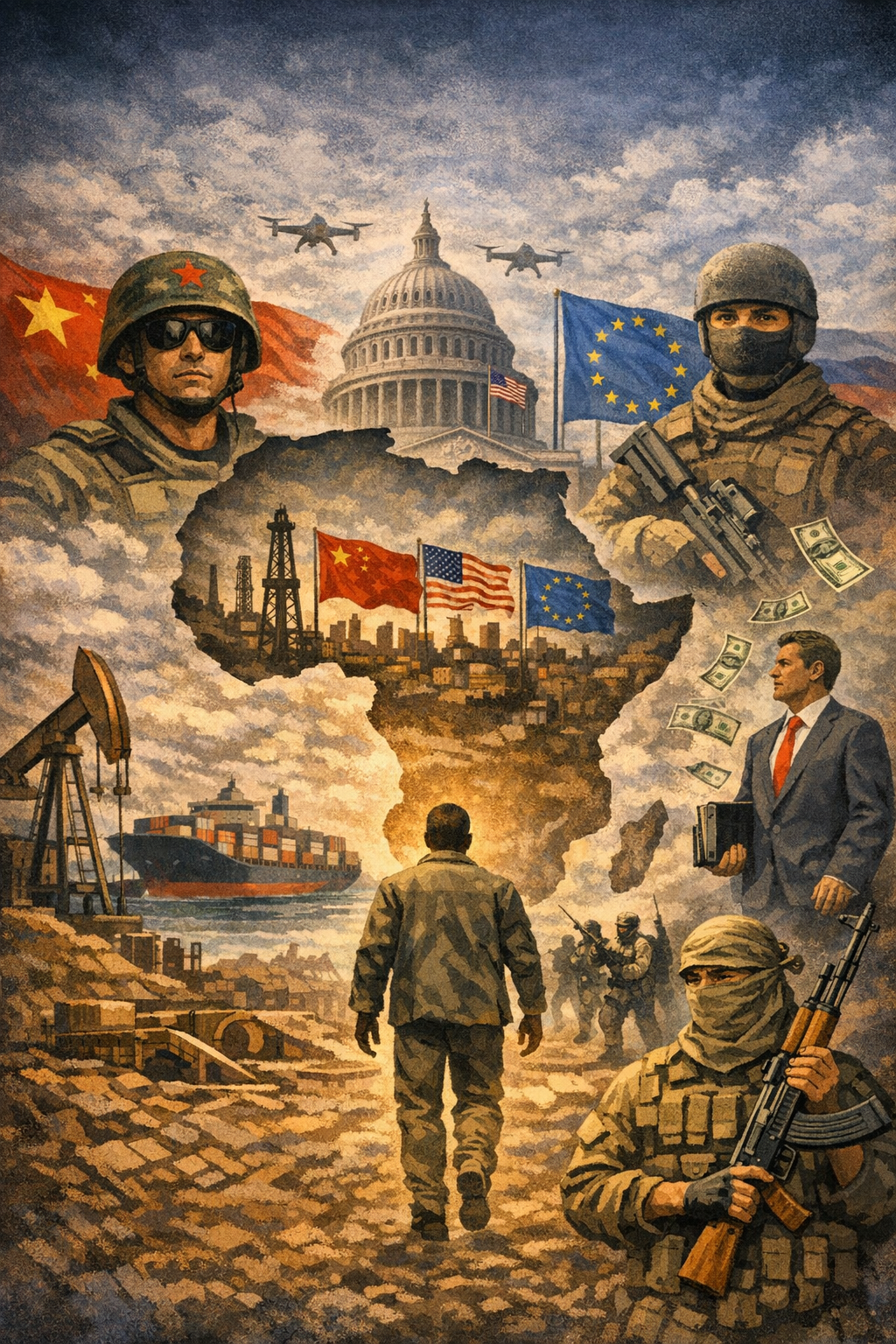
Africa’s renewed centrality in global politics has brought with it an intensification of engagement from major external powers, most notably Europe, the United States, Russia, and China. These actors approach the continent through distinct institutional logics and strategic orientations: Europe through regulatory frameworks and development partnerships, the United States through market liberalism and private capital, Russia through security and geopolitical maneuvering, and China through state-led economic expansion anchored in its vast network of state-owned enterprises (SOEs). At the level of discourse, these engagements are framed in mutually exclusive terms-normative partnership, investment facilitation, sovereignty protection, or South–South cooperation. However, such distinctions, while analytically useful at the surface, risk obscuring a deeper convergence.
This article argues that despite their divergent approaches, these external powers are united by a common structural outcome: the pursuit of maligned interests that shape African markets and institutions in ways that reinforce unequal power relations, enable elite alignment as well as constrain long-term autonomous development. Maligned interests, as conceptualised here, do not imply deliberate exploitation or coordinated intent. Rather, they refer to the systemic consequences of external engagement strategies that are presented as mutually beneficial but ultimately reproduce uneven power relations and developmental dependency. The central claim advanced in this article is that the differences among Europe, the United States, Russia, and China lie not in whether they pursue maligned interests, but in how those interests are operationalised. Europe governs through rules, the United States through markets, Russia through security, and China through state-capitalist enterprises. These distinct modalities produce varied entry points into African economies, but they converge in generating forms of market capture that limit local agency and reconfigure development trajectories in externally aligned directions.
Europe: Regulatory Power and the Reproduction of Asymmetry
Europe’s engagement with Africa is deeply embedded in historical continuities that extend from colonial administration to contemporary development cooperation. Specifically, Britain and France’s approach in the continent is characterised by an emphasis on governance, institutional reform as well as regulatory alignment. Trade agreements, development assistance in the form of aid, and policy frameworks are often structured around norms of transparency, accountability, and market efficiency. However, this regulatory orientation also functions as a mechanism of control. Standards and conditionalities, while framed as neutral or beneficial, frequently reflect European institutional preferences and economic interests. They shape the conditions under which African economies can access markets, often privileging European firms that are better positioned to comply with these standards. In this sense, Europe exercises a form of power that is less visible but deeply entrenched: the power to define the rules of engagement. The maligned interest embedded in this model lies in its capacity to reproduce asymmetry under the guise of partnership. By structuring the regulatory environment, Europe influences not only what kinds of economic activities are viable but also who is able to participate in them. The result is a form of dependency that is institutional rather than overtly coercive, yet no less consequential.
The United States: Market Liberalism and Selective Integration
The United States since the Cold War have approached Africa through a framework grounded in market liberalism and private sector expansion. Its engagement is often mediated through multinational corporations, investment initiatives, and financial institutions that promote open markets and entrepreneurial activity. This model is presented as enabling growth through integration into the global economy. Yet the emphasis on market forces introduces its own set of constraints. American engagement tends to be selective, focusing on sectors that promise high returns, such as energy, technology, and finance. This selectivity limits the breadth of economic transformation and often results in enclave development, where economic activity is concentrated in isolated sectors with weak linkages to the broader economy. Moreover, the promotion of liberal market policies can undermine state-led development strategies, reducing the capacity of African governments to direct industrialisation or protect emerging industries. In this context, the maligned interest is expressed through a model that privileges external capital and market efficiency over structural transformation, embedding African economies more deeply within global hierarchies of production and consumption.
Russia: Security, Sovereignty, and Strategic Entrenchment
Russia’s engagement in Africa is distinct in its emphasis on security cooperation and geopolitical positioning. Through military agreements, arms sales as well as security partnerships, Russia positions itself as an alternative to Western influence, often appealing to principles of sovereignty and non-interference especially in the Sahel. However, this model is not devoid of economic implications. Security arrangements are frequently linked to access to natural resources or strategic concessions, creating a nexus between political support and economic extraction. In contexts where governance structures are fragile, such arrangements can reinforce authoritarian tendencies and limit transparency. The maligned interest in this case is rooted in the consolidation of influence through security dependency. While offering immediate benefits in terms of regime stability or military capacity, this approach can entrench power structures that are resistant to reform and disconnected from broader developmental goals. The result is a form of engagement that prioritises strategic control over inclusive growth.
China: State Capitalism and the Depth of Market Capture
China’s approach represents perhaps the most structurally distinctive model among external actors. Anchored in a system of state capitalism, its engagement is driven by a vast network of state-owned enterprises that operate as both commercial entities and instruments of national strategy. These enterprises benefit from access to state-backed financing, policy support, and diplomatic coordination, enabling them to undertake large-scale projects across the African continent. The scale of China’s SOE sector is unparalleled, encompassing hundreds of thousands of firms with varying degrees of state ownership. This includes not only wholly state-owned enterprises but also partially state-owned firms and private companies like Tencent, Baidu, Huawei and Alibaba. These are subjected to state influence through regulatory and financial mechanisms. The result is a system in which economic activity is closely aligned with state objectives, blurring the boundary between public and private.
In Africa, Chinese SOEs have become central to infrastructure development, particularly in sectors such as transportation, energy, and construction. These projects address critical development needs but also facilitate deeper forms of market capture. Through state-backed financing arrangements, vertical integration, and long-term contractual frameworks, Chinese firms establish a sustained presence that extends beyond individual projects. The maligned interest embedded in this model lies in its capacity to synchronise economic expansion with strategic influence. By embedding itself within the structural foundations of African economies roads, railways, energy systems, China’s engagement creates forms of dependency that are both material and institutional. While delivering tangible benefits, it also constrains the space for alternative development pathways.
Conclusion
Despite their differences, the approaches of Europe, the United States, Russia, and China converge in producing a similar set of structural outcomes. Each, in its own way, contributes to the shaping of African markets in directions that align with external interests. Whether through regulatory frameworks, market mechanisms, security arrangements, or state-led enterprises, these actors participate in processes that can marginalise local actors, concentrate benefits among elites, and limit the scope for autonomous development.
This convergence is not accidental. It reflects the broader dynamics of the global political economy, in which power is exercised through a combination of economic, institutional, and political means. African states, operating within this system, navigate a complex landscape of opportunities and constraints, engaging with external actors while attempting to assert their own developmental priorities. The challenge for African states, therefore, is not simply to choose between external partners, but to fundamentally reshape the terms of engagement. This requires strengthening institutional capacity, enhancing transparency, and developing strategies that prioritize local participation and value creation. Only through such measures can the continent move beyond the constraints imposed by maligned interests and assert a more autonomous trajectory within the global political economy.