






Introduction
In March 2026, Ghana became indirectly entangled in a rapidly escalating geopolitical crisis linked to Israeli military operations against Iran. Although geographically distant from the Middle East, Ghana’s role in international peacekeeping and multilateral diplomacy positioned it within the strategic periphery of these developments.
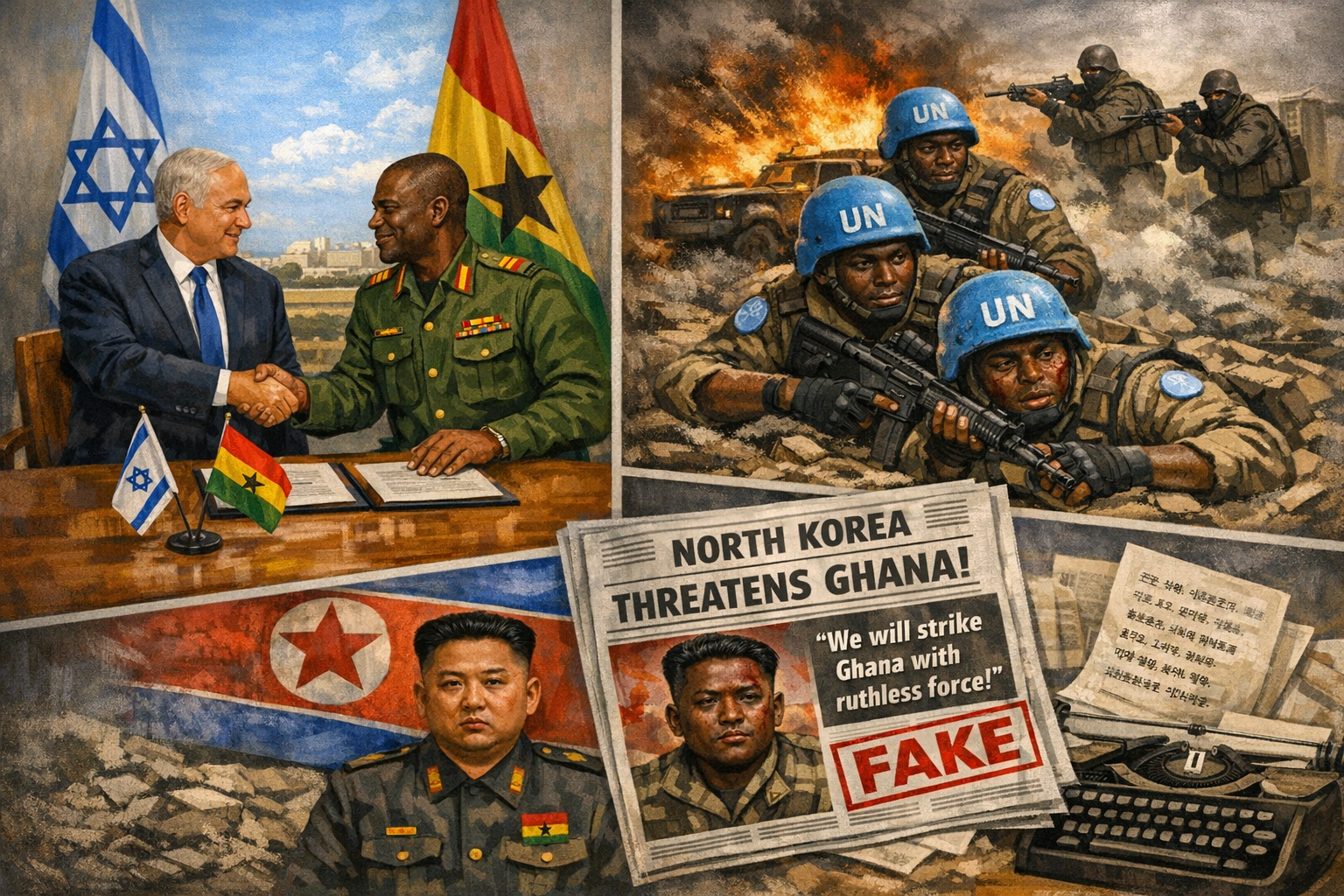
On 5 March 2026, Israel’s ambassador to Ghana publicly urged the country to support international efforts to pressure Iran (Damalie, 2026). Less than twenty-four hours later, a Ghanaian peacekeeping base operating under the United Nations Interim Force in Lebanon (UNIFIL) was struck by missiles, critically injuring two soldiers (Ghana Armed Forces, 2026; Reuters, 2026). In the immediate aftermath, misinformation circulated on social media platforms claiming that North Korea had pledged military support for Ghana—claims that were subsequently discredited (Tempo.co, 2026).
This article examines these developments as an interconnected sequence rather than isolated incidents. It seeks to address three key questions: (1) how diplomatic outreach and military action intersected in this case; (2) how misinformation emerged and spread; and (3) what these dynamics reveal about Ghana’s vulnerability within contemporary geopolitical conflicts.
Operational Context: Escalation and Peacekeeping Exposure
The events occurred within the broader context of a large-scale US-Israel military campaign targeting Iranian strategic infrastructure and leadership. The operation, described by Israeli authorities as necessary to counter Iran’s military capabilities, involved coordinated strikes across multiple locations (Israel Defense Forces [IDF], 2026a).
The escalation triggered retaliatory responses from Iranian-aligned groups, particularly Hezbollah, which launched rocket and drone attacks into northern Israel (Jerusalem Post, 2026). Israeli counter-operations in southern Lebanon intensified hostilities in areas where UN peacekeeping forces were deployed.
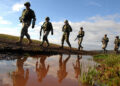
Ghanaian troops, serving under UNIFIL, were positioned within this operational environment. As hostilities escalated, the risk exposure of peacekeepers increased significantly, highlighting the evolving nature of peacekeeping missions in high-intensity conflict settings.
Israel’s Diplomatic Appeal to Ghana
Israel’s diplomatic engagement with Ghana reflected a strategic effort to mobilize international support. Ghana’s membership in the International Atomic Energy Agency (IAEA) Board of Governors and its influence within regional organizations such as ECOWAS and the African Union positioned it as a valuable diplomatic actor (Damalie, 2026).
The appeal also leveraged Ghana’s reputation as a stable democratic state and credible participant in multilateral diplomacy. By securing Ghana’s support, Israel sought to enhance the legitimacy of its campaign and potentially influence broader African diplomatic alignments.
The framing of the appeal was notable. Israeli messaging distinguished between opposition to Iran’s political leadership and hostility toward the Iranian state, thereby attempting to align its position with normative principles rather than purely strategic interests.
The Attack on Ghanaian Peacekeepers
On 6 March 2026, missiles struck a Ghanaian UNIFIL base in Al Qawzah, southern Lebanon, critically injuring two soldiers and damaging key infrastructure (Reuters, 2026; UNIFIL, 2026). The attack occurred amid ongoing hostilities between Israeli forces and Hezbollah militants.
Attribution of the strike remained contested. Lebanese authorities attributed responsibility to Israel, while Israeli officials confirmed military activity in the area but did not explicitly acknowledge involvement in the specific incident (Times of Israel, 2026). Despite this ambiguity, the attack prompted significant international concern.
The United Nations condemned the incident, with Secretary-General António Guterres indicating that it could constitute a violation of international humanitarian law (UN News, 2026). Ghana formally protested and called for an independent investigation (Government of Ghana, 2026).[ZK1]
The incident underscores the vulnerability of peacekeeping forces operating in conflict zones where distinctions between combatants and non-combatants are increasingly blurred.
The Diplomacy–Kinetic Gap
The temporal proximity between Israel’s diplomatic appeal and the subsequent attack highlights a critical dynamic that may be conceptualized as a “diplomacy–kinetic gap.” This refers to the divergence between diplomatic objectives and the outcomes of military operations.
While Israel’s diplomatic outreach aimed to build international support, the attack on Ghanaian peacekeepers—whether intentional or incidental—undermined this objective by generating diplomatic friction. The incident illustrates how military actions can produce unintended political consequences, particularly when they affect third-party actors.
Three interpretations may be considered: operational coincidence within a rapidly evolving conflict environment; a failure to coordinate military and diplomatic strategies; or indirect geopolitical signaling.
Misinformation and the North Korean Narrative
In the aftermath of the attack, misinformation emerged as a significant dimension of the crisis. Social media platforms circulated claims that North Korean leader Kim Jong Un had pledged military support for Ghana (Mbuemo, 2026; Vxebo_, 2026). These claims were not supported by any credible evidence.
Verification indicated that no such statement was issued through official North Korean media or reported by reputable international sources (Tempo.co, 2026). While North Korea did condemn U.S. and Israeli actions against Iran, these statements did not reference Ghana (Chosun Ilbo, 2026; Korea JoongAng Daily, 2026).
The spread of this misinformation reflects several dynamics: the emotional impact of the attack, the blending of factual and fabricated elements, and the resonance of broader geopolitical narratives. This case illustrates how misinformation can exploit real-world events to shape public perception and complicate policy responses.
Strategic Implications for Ghana
The convergence of these developments highlights multiple vulnerabilities for Ghana. Diplomatically, Ghana faces increasing pressure from external actors seeking alignment in geopolitical conflicts. Maintaining neutrality while safeguarding national interests requires careful strategic positioning.
From a security perspective, the incident underscores the risks associated with peacekeeping deployments in volatile environments. It raises important questions regarding force protection and operational mandates.
Informationally, the rapid spread of misinformation demonstrates the need for enhanced national capacity to verify and respond to false narratives in real time.
Legally, Ghana’s reliance on international mechanisms reflects the importance of multilateral institutions for states lacking coercive power. The call for an independent investigation demonstrates the use of legal frameworks to pursue accountability.
Conclusion
The events of early March 2026 illustrate the increasingly interconnected nature of modern conflict. Diplomacy, military operations, and information warfare interact in ways that produce complex and often unintended outcomes.
Ghana’s experience demonstrates how states can become entangled in geopolitical crises despite geographic distance. The sequence of diplomatic engagement, military incident, and misinformation highlights the multidimensional challenges facing contemporary foreign policy.
Strengthening resilience across diplomatic, security, and informational domains will be essential for navigating similar crises. In an environment where narratives evolve as rapidly as events, the ability to manage both physical and informational threats has become a central component of statecraft.
References
Awuku, S. (2026, March 9). Ghana must choose diplomacy over alignment in the Israel-Iran crisis. GhanaWeb.
Chosun Ilbo. (2026, March 1). North Korea condemns U.S., Israel’s Iran airstrikes.
Damalie, P. E. (2026, March 6). Israel calls for Ghana’s support in Iran campaign. Daily Graphic.
Ghana Armed Forces. (2026, March 6). Ghana battalion position in southern Lebanon comes under missile attack [Post]. X.
Ghana News Agency. (2026, March 3). President Mahama calls for cessation of United States/Israel and Iran conflict.
Government of Ghana. (2026, March 7). Ghana demands UN war crimes probe after missile attack on peacekeepers in Lebanon.
Israel Defense Forces. (2026a, March 9). Operation Roaring Lion: Real-time updates.
Jerusalem Post. (2026, March 9). IDF expects Iran can keep up fire for extended period despite reduction in ballistic missiles.
Korea JoongAng Daily. (2026, March 2). North Korea appears on edge in response to U.S.-Israeli strikes.
Mbuemo [@Cest_mbuemo]. (2026, March 7). Post on X.
Reuters. (2026, March 6). Ghana peacekeeping battalion hit by missile attacks in Lebanon.
Tempo.co. (2026, March 7). Fact check: Kim Jong Un did not pledge to help Iran fight the U.S. and Israel.
Times of Israel. (2026, March 6). Two UN peacekeepers from Ghana critically wounded in Lebanon missile attack.
UNIFIL. (2026, March 6). Statement on injuries to peacekeepers [Post]. X.
UN News. (2026, March 7). UN chief condemns attack on peacekeepers in Lebanon.
Vxebo_ [@Vxebo_]. (2026, March 7). Post on X
[ZK1]Kindly add comments from Lebanon and Ireland condemning the attack