








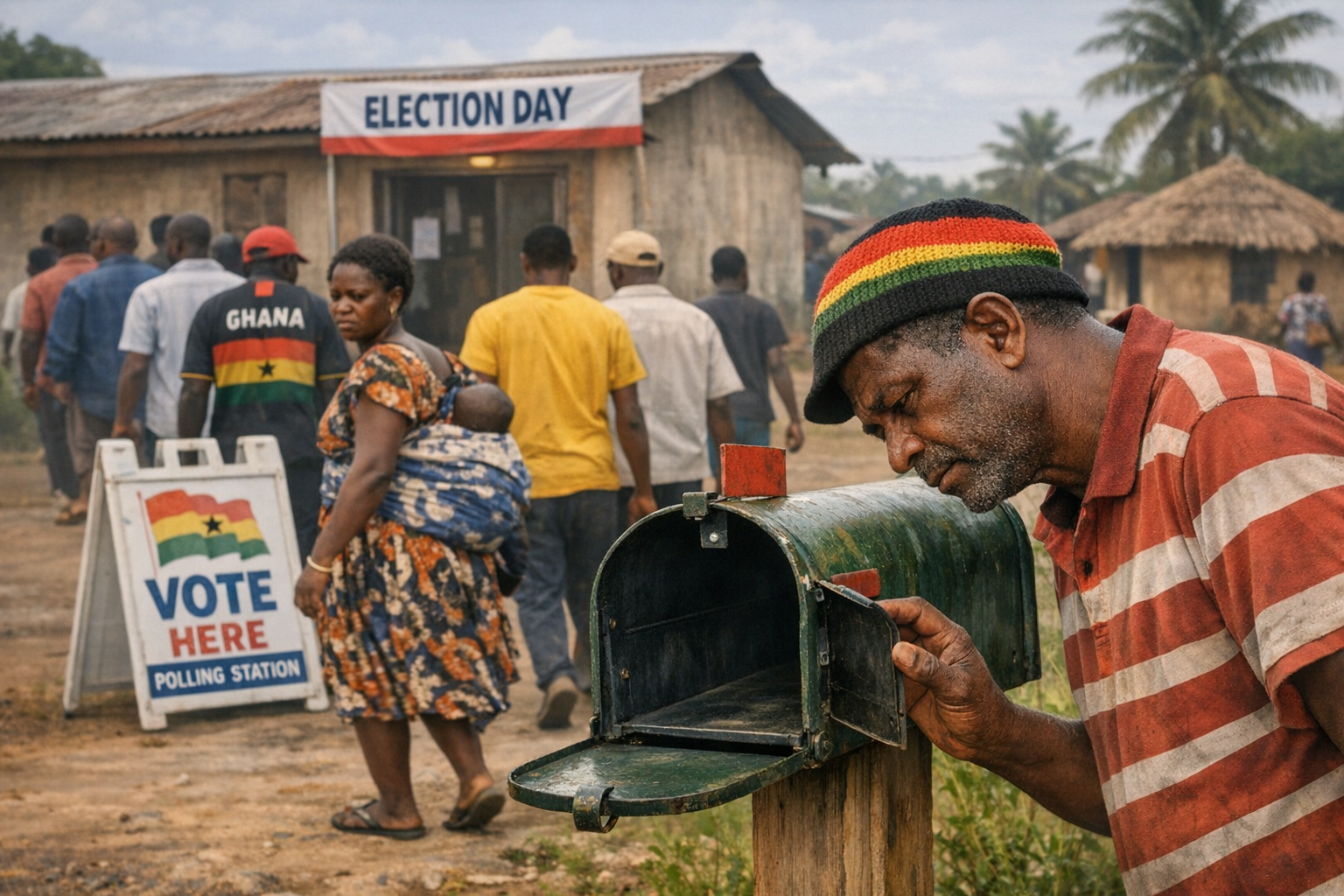
On the morning of March 3, 2026, the polling stations in Ayawaso East opened as planned, with electoral officers prepared, ballot boxes sealed, and ink pads ready. However, for most of the day, voter turnout was extremely low. At the Hajia Ladi Mosque polling centre, one of the constituency’s larger sites with over 800 registered voters, fewer than 100 ballots had been cast by mid-morning (Ghana News Agency, 2026a). This trend was mirrored across the constituency, where observers noted the same striking quiet: empty queues and idle officials, an image that spoke volumes about the day’s low participation.
The declared final results simply confirmed the day’s events. With a mere 17,048 ballots cast out of 49,966 registered voters, the turnout stood at a low 34 percent (The Sikaman Times, 2026). While the outcome was never truly uncertain, with Baba Jamal Ahmed decisively securing 10,884 votes against 4,009 polled by his NPP rival, Baba Ali Yussif (Adom Online, 2026a), the more significant narrative of March 3, 2026, isn’t about the victor. It is fundamentally about those who abstained and crucially, the reasons for their absence.
The first article in this series detailed the mechanisms of vote buying in Ghana’s Fourth Republic, describing the brokers, the cash-filled envelopes, the distribution of goods like gas cylinders and outboard motors, the use of local deities for oath-swearing, and the coercive violence of the foot soldiers who facilitate these transactions. It concluded that vote buying had evolved beyond a sporadic scandal into a fully functioning market, complete with its own forms of currency, enforcement and an exploited youth labor force. The Ayawaso East Bye-election on March 3, 2026, introduces a grave new element to this analysis. This time, the market not only failed to corrupt the election but crucially, failed to activate in significant measure, resulting in a dramatic drop in voter turnout.
Ayawaso East has a strong history of democratic participation, making the March 3 turnout figures particularly noteworthy. Historically, the constituency has not been democratically disengaged, especially during general elections. For instance, voter turnout was 41,045 in the 2012 general election, equating to a 76.69 percent participation rate. Similarly, high engagement continued in subsequent elections, with 37,878 ballots cast in 2016 and 38,549 valid parliamentary votes recorded in the 2020 election, despite the challenges of a global pandemic. These figures confirm that Ayawaso East is a constituency that consistently participates when called upon for general elections.
It is important to note however that Bye-elections have always told a different story here and the 2026 contest sits at the far end of that pattern. Across 113 polling stations, only 17,048 of 49,966 registered voters participated, a turnout of 34 percent, representing a drop of more than 30 percentage points from the constituency’s general election norm (MyJoyOnline, 2026a). As Dr Kwame Asah-Asante noted in his post-election assessment, the figures reflected a worrying national trend of low participation in by-elections that Ghana has consistently failed to address (Adom Online, 2026a). Yes, Baba Jamal won, and the NDC retained its urban stronghold without serious challenge, but a mandate built on the participation of roughly one in three registered voters is not in any meaningful sense, a mandate. It is at best a quorum and Ghana should be profoundly uncomfortable with the difference.
“THEY DIDN’T GIVE US ANYTHING”
The official explanations for the low turnout were not without merit. An NDC branch youth organiser, speaking on the Ghana Yensom Morning Show on Accra 100.5 FM on the morning of the election, attributed the slow early turnout partly to Ramadan, explaining that many Muslim voters who rose at dawn for pre-fast prayers often returned to sleep before heading out later in the day (Modern Ghana, 2026). The election was also held on a Tuesday, placing an undue burden on the informal sector workers, market traders, and commuters of Ayawaso East who must weigh their vote against a day’s lost income. These are legitimate factors and they account for a portion of the gap.
What they do not account for is the explanation that circulated most insistently in the streets and markets of the constituency, where local media interviews with constituents pointed to transactional expectations in electoral participation, with some voters indicating that they had not received any incentives, reflecting a broader sense of disengagement. In the weeks leading up to March 3rd, the customary pre-election system of patronage did not reach voters. Those previously mobilized in election cycles through the distribution of goods such as television sets, students getting laptops and mobile phones and household items noticed the absence of the usual brokers and the failure of the typical envelopes to circulate. Applying the exact transactional principles they had learned from the system over the years, their calculation was simple: without a personal benefit, there was no incentive to participate. Bob-Milliar’s (2024) research on the monetisation of internal party democracy had warned precisely of this outcome that keeping young people financially dependent on patronage networks, rather than building their genuine civic agency, would ultimately corrode the very foundations of participation.
Dr Charles Dwemena, the NPP’s National Treasurer, put a version of this logic plainly in his post-election commentary on Rainbow Radio 87.5 FM: “When things are truly working, nobody will force you to vote. You will wake up early in the morning and walk to the polling station because you can feel the improvement in your pocket” (Rainbow Radio Online, 2026). While his argument was framed economically, its underlying logic extends beyond mere financial considerations. In constituencies such as Ayawaso East, the meaning of electoral participation has fundamentally shifted. It is now widely viewed as a transaction: a service rendered in expectation of compensation. Consequently, when this compensation fails to materialize, the service is withheld. What may initially appear to be mere voter apathy is, upon closer inspection, a more specific and concerning phenomenon: an unspoken, unorganized transactional boycott.
The first article in this series argued that vote buying corrupts democracy by replacing civic logic with transactional logic, by teaching citizens that participation is a commodity to be exchanged rather than a right to be exercised. The March 2026 Ayawaso East Bye-election exposes a new and more serious level of corruption. It signifies a shift from merely focusing on what happens during a corrupt transaction to the grave consequences that arise when such a transaction fails to occur.
The voter who stayed home on March 3 because the envelope did not arrive is not a passive victim of a broken system so much as its most logical and faithful product, someone who has learned exactly what the system set out to teach: that democracy is a market and participation carries a price, and that if the price is not paid, the product need not be delivered. This is the paradox that Ayawaso East lays bare with uncomfortable clarity. Ghana has a vote buying problem, but the remedy to vote buying a citizenry that refuses transactional politics and demands substantive engagement in its place is precisely what years of vote buying have made structurally impossible to produce. As Afrobarometer (2024) documented, trust in state institutions has declined significantly among Ghanaians, with youth reporting the highest levels of political disconnection; March 3 is what that disconnection looks like in practice, when the polling stations open and the people simply do not come.
The security services recruitment crisis, which emerged in the same week, vividly illustrates this transactional nature. The sheer volume of applications; over 506,000 young Ghanaians competing for about 5,000 positions across the Ghana Police, Immigration, Fire, and Prisons Services, was less a typical recruitment drive and more a stark national indicator of desperation given the disproportionately high ratio (YEN.com.gh, 2026a). The widespread anger following an AI-based aptitude test that disqualified hundreds of thousands stemmed from more than just failure. Many test-takers, who had incurred significant, often unaffordable, costs for internet access at cybercafés, felt a political promise had been broken, not that they had simply failed a fair and competitive process (YEN.com.gh, 2026a).
That belief is not irrational, it is in fact structurally well-founded. Afenyo-Markin himself confirmed what many have long suspected: that MPs across both parties routinely receive protocol slots in security service recruitment — a longstanding practice in which ministers ask legislators to submit names of constituents for consideration (GhanaWeb, 2026c). The system has always operated this way; party loyalty has always had its rewards. The foot soldier who campaigned, the youth who turned out on election day, the constituent who delivered their ward — all of them have been educated by decades of political practice to expect something in return. When the aptitude test results came back and the protocol lists fell short of demand, the response was entirely predictable: threats to withhold votes, threats to vote against MPs in the next election, and by March 10, Minority Leader Alexander Afenyo-Markin on the floor of Parliament not to debate policy, but to manage constituent fury. “It is we, the MPs, who are carrying the burden,” he said, appealing for the AI-based system to be reviewed (YEN.com.gh, 2026b). The Majority Chief Whip Rockson-Nelson Dafeamekpor confirmed the same day that MPs across the House were being inundated with complaints, prompting the summoning of the Interior Minister to Parliament (YEN.com.gh, 2026a).
This is not a governance crisis about digital literacy or aptitude test design. It is a democratic crisis about what politics has become. The young Ghanaian who storms a party office demanding recruitment because he voted NDC or NPP, the constituent who threatens to withdraw her vote because the protocol list did not include her son, the MP who stands in Parliament begging for relief from constituency pressure he helped create — they are all participants in the same system, playing by the same rules and arriving at the same destination: a democracy in which citizenship is transactional from top to bottom, and in which the moment the transaction fails, the entire edifice threatens to come apart.
Dr Kwame Asah-Asante observed that the low turnout in Ayawaso East could not be viewed as advantageous to the NDC despite their comfortable margin, warning that Ghana must do more to engage citizens during by-elections (Adom Online, 2026a). That observation is correct, but it understates the scale of what is happening, because what is weakening is not simply enthusiasm for by-elections, it is the foundational principle that representative governance derives its authority from the broad and voluntary participation of the people it claims to represent.
WHEN INTERNAL DEMOCRACY RUNS ON EMPTY
The Bye-election did not begin on March 3. It began on February 7, when NDC delegates gathered for the internal primary that would determine the party’s candidate and that primary was immediately engulfed in allegations of systematic financial inducement — brown envelopes reportedly changing hands, household items distributed to delegates, the NDC’s own Functional Executive Committee calling for annulment of results, and the Majority Caucus in Parliament demanding the primary be cancelled outright (MyJoyOnline, 2026a). Democracy Hub, represented by lawyer Oliver Barker-Vormawor, filed suit on February 16 against the NDC, the Electoral Commission, and the Attorney General, arguing that the primary had been characterised by widespread vote buying and monetisation in violation of Article 55(5) of the 1992 Constitution and Section 9 of the Political Parties Act, 2000 (GhanaWeb, 2026b). On March 2, Justice Kwasi Agyenim-Boateng of the High Court in Accra struck out the case, ruling that Democracy Hub lacked locus standi to pursue the matter (Citi Newsroom, 2026).
The court preserved the election timeline, as it was legally entitled to do, but what it could not do, and perhaps what no court is equipped to do — is address the deeper question of what it means for democratic legitimacy when the process of selecting a candidate is credibly and publicly alleged to be a commercial transaction rather than a democratic act. This is not an indictment of any single party because both of Ghana’s dominant parties have operated within the same transactional system across successive election cycles (Gyampo et al., 2017). The point is systemic: when a party’s internal democracy becomes entirely dependent on the logic it publicly condemns, it forfeits the moral authority to demand civic participation from the electorate it then asks to validate it. You cannot buy your way to a candidacy and then expect the voters to show up for free.
Baba Jamal Ahmed was declared the Member of Parliament for Ayawaso East on the evening of March 3, 2026 and was sworn in on March 10, 2026 (Parliament of Ghana, 2026). He has taken his seat in the legislature, he will cast votes on legislation, and represent a constituency whose majority did not come out to give him that authority. The empty chair at the polling station is not a data point — it is a verdict, rendered not by any court or commission but by ordinary citizens who have been so thoroughly schooled in the transactional nature of their democracy that they have begun, with quiet and devastating logic, to apply its rules consistently. Despite Ghana’s 2019 passage of the Vigilantism and Related Offences Act, the targeted vigilante groups rebranded instead of disbanding (Gyampo et al., 2017). Furthermore, an internal probe into the February 7 primary resulted in the implicated candidate being cleared and ultimately winning (MyJoyOnline, 2026a). A court also dismissed the most significant legal challenge mounted by civil society against the fundamental “moneyocracy” involved in the country’s candidate selection (Citi Newsroom, 2026). Each of these occurrences involved a decision, and every decision has subsequently increased the stakes and costs of future actions.
The voter will not show up at the polling station without an envelope until the polling station offers something more valuable and more reliable than the envelope and that transformation will not be achieved through another piece of legislation, another internal probe, or another round of public condemnation. It will come only when Ghana’s political class is willing to dismantle the structural conditions that make the transactional logic rational: the winner-takes-all political economy that makes losing an election financially ruinous, the youth unemployment that Honwana (2012) described as ‘waithood’ — a suspended state of waiting for economic agency that the formal economy keeps indefinitely deferring and the campaign finance environment that, according to Transparency International Ghana and the Ghana Centre for Democratic Development (2025), has seen the cost of contesting parliamentary elections rise to approximately GHC 4 million, effectively barring everyone except the wealthy from meaningful participation.
The Ayawaso East bye-election of March 3, 2026 will almost certainly be forgotten by the time the next election cycle begins — Baba Jamal won, the NDC held its seat, and the cycle, as it always does, continues. But what the numbers record from that day; a constituency where two in three registered voters did not come, where the patronage machine misfired and democracy misfired with it, where the envelope did not arrive and neither did the voters — is not a footnote in the story of Ghana’s democracy. It is a forecast, and Ghana cannot afford to keep not reading it.
Adom Online. (2026a, March 4). Ayawaso East by-election was free and fair, but low voter turnout worrying — Asah-Asante. https://www.adomonline.com/ayawaso-east-by-election-was-free-and-fair-but-low-voter-turnout-worrying-asah-asante/
Adom Online. (2026b, March 3). First deputy speaker refers Afenyo-Markin to privileges committee over recruitment scam remarks. https://www.adomonline.com/first-deputy-speaker-refers-afenyo-markin-to-privileges-committee-over-recruitment-scam-remarks/
Afrobarometer. (2024). Ghanaians’ trust in institutions wanes amid economic challenges and corruption concerns (Dispatch No. 782). https://www.afrobarometer.org
Bob-Milliar, G. M. (2024). Party foot soldiers and the monetization of internal party democracy in Ghana. African Affairs, 123(490), 87–112.
Citi Newsroom. (2026, March 2). Ayawaso East: Court throws out Democracy Hub case against NDC. https://citinewsroom.com/2026/03/ayawaso-east-court-throws-out-democracy-hub-case-against-ndc/
Ghana News Agency. (2026a, March 3). Ayawaso-East bye-election sees mixed turnout, smooth voting. https://gna.org.gh/2026/03/ayawaso-east-bye-election-sees-mixed-turnout-smooth-voting/
Ghana News Agency. (2026b, March 3). Afenyo-Markin referred to privileges committee over security recruitment claims. https://gna.org.gh/2026/03/afenyo-markin-referred-to-privileges-committee-over-security-recruitment-claims/
GhanaWeb. (2026b, February 16). Democracy Hub seeks court injunction to halt Ayawaso East by-election. https://www.ghanaweb.com/GhanaHomePage/NewsArchive/Democracy-Hub-seeks-court-injunction-to-halt-Ayawaso-East-by-election-2021991
GhanaWeb. (2026c). MPs receive protocol slots in security recruitment – Afenyo-Markin claims. https://www.ghanaweb.com/GhanaHomePage/NewsArchive/MPs-receive-protocol-slots-in-security-recruitment-Afenyo-Markin-claims-1970124
Ghanamma. (2026, March 3). Court throws out Ayawaso East by-election suit. https://www.ghanamma.com/2026/03/03/court-throws-out-ayawaso-east-by-election-suit/
Gyampo, R. E., Asare, B. E., & Kokro, K. (2017). Election 2016 and political vigilantism in Ghana. African Review, 44(2), 186–210.
Honwana, A. (2012). The time of youth: Work, social change, and politics in Africa. Kumarian Press.
Modern Ghana. (2026, March 3). 40,000 head to the polls as Ramadan fasting slows voting in Ayawaso East by-election. https://www.modernghana.com/news/1475626/40000-head-to-the-polls-as-ramadan-fasting-slows.html
MyJoyOnline. (2026a, March 4). Ayawaso East by-election: Low turnout, peaceful polls. https://www.myjoyonline.com/ayawaso-east-by-election-low-turnout-peaceful-polls-photos/
Parliament of Ghana. (2026, March 10). Speaker swears in Baba Jamal as MP for Ayawaso East. https://www.parliament.gh/news?CO=285
Rainbow Radio Online. (2026, March 5). Ayawaso East: Low by-election turnout proves Ghanaians aren’t feeling the economy — NPP’s Dr China. https://rainbowradioonline.com/2026/03/05/162280/
The Sikaman Times. (2026, March 3). Baba Jamal wins Ayawaso East by-election amid low turnout. https://sikamantimes.com/baba-jamal-wins-ayawaso-east-by-election-amid-low-turnout/
Transparency International Ghana, & Ghana Centre for Democratic Development. (2025). TI-Ghana and CDD-Ghana lead the charge for political finance reforms in Ghana.
YEN.com.gh. (2026a, March 10). Interior minister Muntaka Mubarak to address MPs over security service recruitment challenges. https://yen.com.gh/politics/301030-parliament-summons-interior-minister-muntaka-mubarak-security-service-recruitment-challenges/
YEN.com.gh. (2026b, March 10). Minority leader Afenyo-Markin calls for abolition of AI-based security recruitment tests. https://yen.com.gh/politics/301013-minority-leader-afenyo-markin-calls-abolition-ai-security-recruitment-tests/