







West African Security / Counter-Extremism / Ghana Threat Assessment
| 51%+ Sahel share of global terrorism deaths (2024) IEP Global Terrorism Index 2025 | >500 Violent extremist events within 50 km of coastal borders in 2024 Africa Center for Strategic Studies 2025 | USD 3M GCERF investment in Ghana CVE programmes since 2024 GCERF 2025 | ~36% outh unemployment in Ghana’s five northern regions UNDP / Ghana Statistical Service 2024 |
| ABSTRACT This article critically examines the structural, sociological, and geopolitical dynamics that have, thus far, insulated Ghana from the violent extremism devastating the Sahel. While Ghana remains the only country in the Sahel-coastal nexus to have recorded zero domestic terrorist fatalities, a convergence of socioeconomic pressures, security sector deficits, and radicalisation pathways in the north poses escalating risks. The article argues that Ghana’s resilience is contingent, not inherent, and that the window for preventive action is narrowing. Drawing on data from the Global Terrorism Index 2025, the Africa Center for Strategic Studies, GCERF, ACLED, and the Institute for Security Studies (ISS), it advances a framework of proactive, community-embedded counter-extremism as the only credible deterrent strategy. |
1. Introduction: The Proximity Paradox
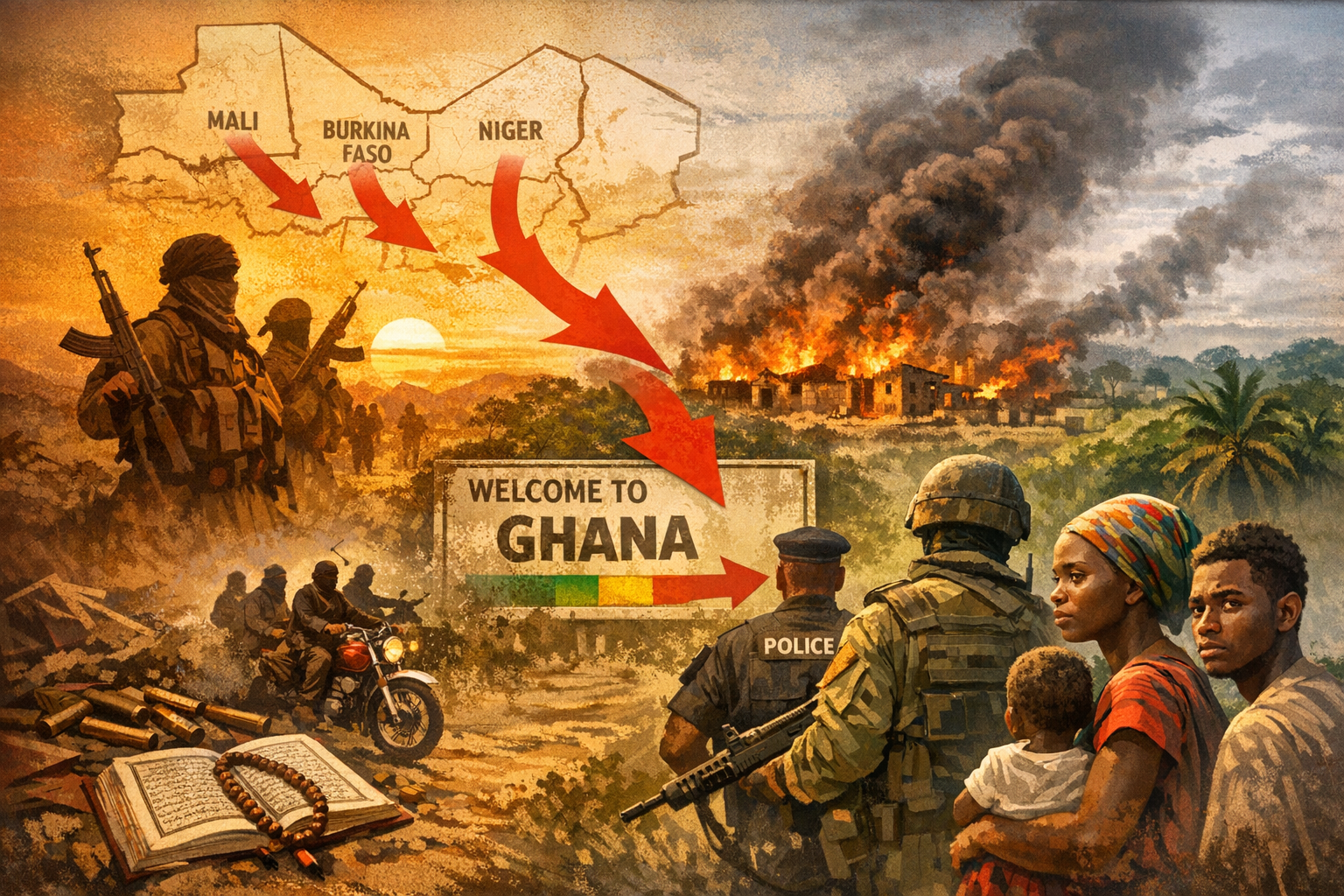
The Sahel has become the world’s most lethal theatre of jihadist violence. According to the Institute for Economics and Peace’s Global Terrorism Index 2025 which analyses incidents recorded during calendar year 2024 the Sahel accounted for more than 51 percent of all global terrorism-related deaths, a figure that UNDP Deputy Resident Representative Shaima Hussein cited directly at Ghana’s National P/CVE Framework review forum in Accra in March 2026 (GNA, 2026). Burkina Faso ranked as the most affected country on earth for the second consecutive year, recording 1,532 fatalities (IEP, 2025). Against this backdrop, Ghana presents a striking paradox: a nation geographically and culturally embedded in the epicentre of this crisis, yet as of April 2026 the only country in the Sahel-coastal nexus to have recorded no domestic terrorist attack fatalities.
This paradox demands interrogation. Is Ghana’s security record a testament to sound governance and effective counter-extremism policy? Or is it a function of geographic depth, statistical chance, and a narrow temporal reprieve that is already closing? The evidence points overwhelmingly to the latter. Ghana’s zero-fatality record masks an expanding web of structural vulnerabilities that, if left unaddressed, render catastrophic security deterioration not merely possible but probable.
2. The Spreading Contagion: Data and Trends
The Africa Center for Strategic Studies (2024) documented a greater than 250 percent increase in violent events linked to militant Islamist groups within 50 kilometres of the borders of Sahel coastal neighbours including Ghana over a two-year period, surpassing 450 recorded incidents (Eizenga and Gnanguenon, 2024). By the close of 2024, the same institution reported that the figure had climbed to over 500 violent extremist events within 50 kilometres of coastal borders, compared to just over 50 such events in 2020 representing a tenfold escalation in four years (Africa Center, 2025). Groups principally active in this corridor include Jamaat Nusrat al-Islam wal Muslimeen (JNIM) and the Islamic State in the Greater Sahara (ISGS), both of which have demonstrated clear strategic intent to expand southward into coastal West Africa.
Togo recorded its worst year for terrorism since the inception of the Global Terrorism Index, reflecting the broader spread of terrorist activity beyond the Sahel’s traditional hotspots (IEP, 2025). These are not peripheral statistics; they represent the advancing perimeter of an insurgency that JNIM has explicitly framed as a Pan-West African liberation struggle (ACCORD, 2023; Chatham House, 2025). Ghana’s northern border communities particularly in the Upper East, Upper West, and Savannah regions are not merely proximate to this perimeter. They are, increasingly, on it.
3. Ghana’s Vulnerability Architecture
Ghana’s exposures operate along three interconnected pathways, each of which mirrors conditions that preceded the security collapse in Mali and Burkina Faso.
3.1 Structural Economic Marginalisation
Youth unemployment in Ghana’s five northern regions averages approximately 36 percent, a figure consistent with the Ghana Statistical Service’s 2024 labour data, which recorded 36.7 percent unemployment among the 20–24 age cohort nationally in the fourth quarter of 2024, with northern regions consistently above that average (GSS, 2024). This was also confirmed by UNDP’s Vulnerability Assessment on Violent Extremism and Radicalisation in Northern Ghana (2024), which identifies youth unemployment as the single most prevalent driver of radicalisation susceptibility in these regions. The disparity is compounded by the lowest rates of school enrolment, the least access to formal financial services, and the greatest concentration of food insecurity in the country. UNDP’s Journey to Extremism in Africa (2023) identifies worsening economic conditions, unemployment, and poverty as primary radicalisation pathways across the continent.
3.2 Zongo Communities and Ideological Penetration
Ghana’s Zongo communities, which are Hausa-speaking, predominantly immigrant settlements spread across major urban and peri-urban centres represent a distinct but frequently mischaracterised vulnerability. The National Commission for Civic Education (NCCE) 2021 report on violent extremism risk in ten border regions found critically low levels of public understanding of radicalisation dynamics within these communities. Their cultural and linguistic ties to Sahel-based groups, perceived political marginalisation, and limited integration into mainstream Ghanaian society create conditions that extremist recruiters have proven adept at exploiting elsewhere (ACCORD, 2023; WACCE, 2022).
3.3 Intercommunal Conflicts as Entry Points
Ghana’s unresolved chieftaincy disputes, farmer-herder conflicts particularly in the northwest, and ethnic tensions in Bawku, Bimbilla, and communities along the Burkina Faso border are not simply local governance challenges. They represent the precise grievance infrastructure that JNIM and ISGS have historically weaponised in Mali and Burkina Faso. The violent extremist playbook in the Sahel did not begin with bombings; it began with the instrumentalisation of local disputes over land, cattle, and traditional authority (AU, 2022; ISS, 2025).
4. The Failed IED Plot and the Warning It Carries
In 2023, Ghana recorded its first evidence of domestic terrorist operational activity: a failed improvised explosive device (IED) plot uncovered and disrupted before detonation. Brigadier General Timothy Tifucro Ba-Taa-Banah, Director of Ghana’s National Counter Terrorism Fusion Centre (NCTFC) at the National Security Council Secretariat, acknowledged this at the opening of a three-day public stakeholder forum in Accra in March 2026. The conference was convened to review the National Framework for Preventing and Countering Violent Extremism and Terrorism. His words were unambiguous: “That we haven’t recorded any casualties on home soil is a product of a fine mix of measures. But it doesn’t mean we are immune, nor does it give us room for complacency. All stakeholders involved in this holistic approach must remain vigilant and proactive” (GNA, 2026).
The Ministry of National Security confirmed as early as 2021 that terrorist groups operating in West Africa had already recruited Ghanaians to support their activities (ACCORD, 2023). Two Ghanaian graduates were confirmed as ISIS recruits as far back as 2015 (UNDP, 2024). The pathway from radicalisation to operational threat is not hypothetical, it has already begun.
Table 1: Regional Security Risk Profile — Ghana and Its Immediate Neighbours
| Country | GTI 2025 Rank | Current Status | Proximity to Ghana |
| Burkina Faso | #1 globally (2024 data) | Active high-intensity conflict | Direct northern border; most critical spillover vector |
| Mali | #4 globally | Active conflict spreading southward | Second-degree via Burkina Faso |
| Togo | Worst year on record per GTI 2025 | Border incursions increasing | Direct eastern border |
| Côte d’Ivoire | Elevated and rising | Active terrorist threat in north | Direct western border |
| Ghana | Monitored; no fatalities recorded | Zero domestic terrorist fatalities to date | — |
Source: Institute for Economics and Peace, Global Terrorism Index 2025; Africa Center for Strategic Studies, ACLED Conflict Watchlist 2025.
5. The 2019 Framework: Adequate for 2026?
Ghana’s National Framework for Preventing and Countering Violent Extremism and Terrorism, developed in 2019, is currently under comprehensive stakeholder review. The March 2026 forum, supported by UNDP with funding from Germany, Australia, and Norway, is examining whether the framework adequately addresses AI-driven disinformation, sophisticated terror financing, and online radicalisation vectors that were nascent or non-existent when the framework was first drafted (GNA, 2026). UNDP Deputy Resident Representative Shaima Hussein captured the urgency at the forum: “In 2014, Burkina Faso had no records of deaths related to terrorism, but 10 years down the line, it is on the top of the index. This stark shift offers a troubling reminder of how quickly security conditions can deteriorate within a single decade.” Ghana’s current trajectory, on present indicators, resembles Burkina Faso’s pre-crisis path.
The Accra Initiative, established in September 2017 by its five founding members: Benin, Burkina Faso, Côte d’Ivoire, Ghana, and Togo has improved intelligence sharing since its inception. Mali and Niger subsequently joined as observers before attaining full membership, while Nigeria has maintained observer status. The Initiative has improved intelligence sharing but suffers from insufficient operationalisation and funding. The Alliance of Sahel States’s withdrawal from ECOWAS in January 2025 has further fragmented the broader cooperative security architecture on which any Accra Initiative effectiveness ultimately depends (Chatham House, 2025).
6. Policy Recommendations
| POLICY IMPERATIVE Ghana cannot afford a reactive counter-terrorism posture. Prevention must become the primary national security investment. The GCERF’s USD 3 million in community resilience programming since 2024 is a meaningful start, but structural interventions at the scale required demand a step-change in political will and financial commitment that no external partner can substitute for. |
The government of Ghana should urgently pursue five priority actions:
(1) Scale GCERF community resilience programmes across all five northern regions with dedicated multi-year budgetary allocations, reducing dependence on international donors.
(2) Accelerate the revised National P/CVE Framework’s implementation, incorporating AI-driven threat monitoring, disinformation tracking, and digital radicalisation early warning systems.
(3) Establish permanent cross-border security protocols with Burkina Faso through AU mediation, focused on JNIM and ISGS movement tracking.
(4) Invest in structured economic development corridors in northern Ghana to address the structural unemployment and marginalisation that makes communities susceptible to recruitment.
(5) Reform the Accra Initiative’s institutional architecture to function independently of the ECOWAS-AES rupture, restoring sub-regional intelligence sharing across the coastal nexus.
References
1. Africa Center for Strategic Studies. (2024). Recalibrating Coastal West Africa’s Response to Violent Extremism. Africa Security Brief No. 43. Washington DC: NDU Press.
2. Africa Center for Strategic Studies. (2025). Africa’s 2024 Security Trends in 10 Graphics. Washington DC: NDU Press.
3. ACCORD. (2023). The Risk of Violent Extremism and Terrorism in the Coastal States of West Africa. Conflict Trends No. 2023/1. Johannesburg: ACCORD.
4. African Union. (2022). The Contagion of Violent Extremism in West African Coastal States. Algiers: ACSRT.
5. Chatham House. (2025, April). Navigating a Path Beyond Regional Division is Essential for West Africa’s Security. London: Chatham House.
6. GCERF. (2025). Ghana Country Strategy. Geneva: Global Community Engagement and Resilience Fund.
7. Ghana News Agency. (2026, March 25). Ghana reviews counter-terrorism framework amid regional extremism threats. Accra: GNA.
8. Ghana News Agency. (2026, March 29). National Security backs stronger anti-terror measures. Accra: GNA.
9. Institute for Economics and Peace. (2025). Global Terrorism Index 2025. Sydney: IEP.
10. ISS Africa. (2025, January). Ghana’s Road to Rebuilding Public Trust Starts with Security Reforms. ISS Today. Pretoria: ISS.
11. KAIPTC. (2025). In the Eye of the Storm: Building Resilient Communities to Resist VEOs in Ghana. Accra: KAIPTC.
12. Security Council Report. (2025, April). West Africa and the Sahel Monthly Forecast. New York: Security Council Report.
13. UNDP. (2023). Journey to Extremism in Africa: Pathways to Recruitment and Disengagement. New York: UNDP.
14. UNDP Ghana. (2024). Vulnerability Assessment on the Threats of Violent Extremism and Radicalisation in Northern Regions of Ghana. Accra: UNDP.
15. WACCE. (2022). The Threat of Violent Extremism to Coastal States: Ghana’s Exposure to Violent Extremism. Accra: WACCE.