








| +150% Surge in China-linked cyber espionage operations globally in 2024 CrowdStrike Global Threat Report 2025 | 30%+ Cybercrime share of all reported crime in W. & E. Africa INTERPOL Africa Cyberthreat Assessment 2025 | USD 3B+ Cumulative cybercrime financial losses in Africa since 2019 INTERPOL Africa Cyberthreat Assessment 2025 | +442% Rise in AI-augmented vishing attacks between H1 and H2 2024 CrowdStrike Global Threat Report 2025 |
| ABSTRACT Africa has transitioned from a peripheral target of global cyber operations to one of their primary frontiers. The continent’s rapid digital transformation, expanding fintech ecosystem, and growing cloud infrastructure adoption have created an asymmetric attack surface exploited systematically by state and non-state actors. China-linked cyber espionage operations surged by 150 percent globally in 2024, with African government institutions specifically targeted by the Sharp Dragon advanced persistent threat (APT) campaign, which exploits Cobalt Strike beacons to establish long-term covert access. INTERPOL’s 2025 Africa Cyberthreat Assessment Report confirms cybercrime now constitutes over 30 percent of all reported crime in Western and Eastern Africa, with cumulative financial losses across the continent exceeding USD 3 billion since 2019. This article examines the espionage typology, assesses Ghana and West Africa’s structural vulnerability, and argues that only a continental cybersecurity doctrine anchored in the AU’s Continental AI Strategy can provide adequate collective defence. |
1. Africa’s Cyber Threat Landscape: From Periphery to Primary Target
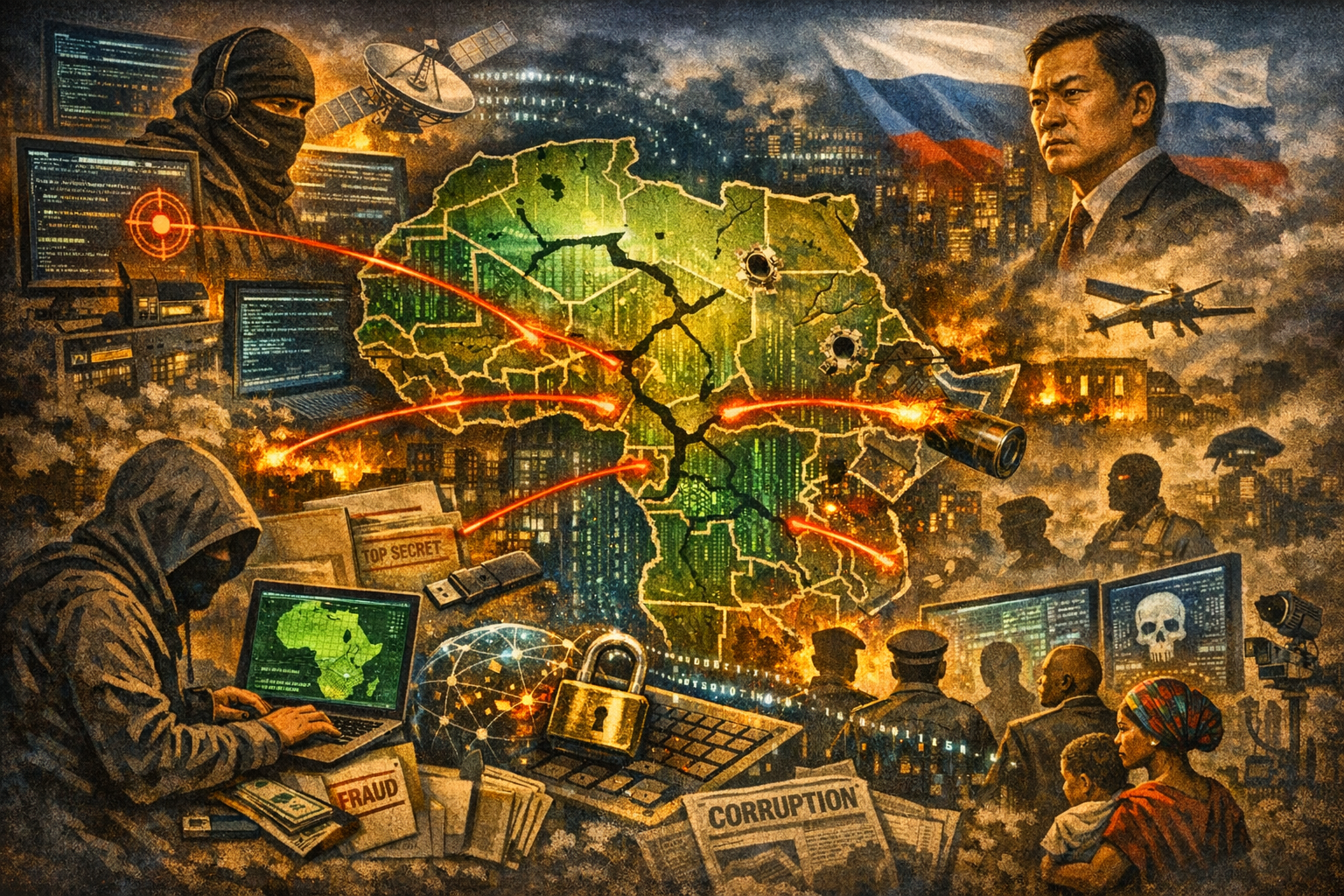
The Microsoft Digital Defence Report 2025 captured a fundamental shift: Africa has moved from occasional targeting to becoming a proving ground for the latest cyber intrusion techniques (Microsoft, 2025). The continent’s growing geostrategic relevance, its position as a theatre of great-power competition, its rapidly expanding digital economy, and its systemic cybersecurity capacity gaps have converged to make it an exceptionally attractive target for state-sponsored espionage, ransomware, disinformation, and infrastructure sabotage.
The World Economic Forum’s Global Cybersecurity Outlook 2026 identifies geopolitical risk as the top factor shaping cyber strategy globally: 64 percent of surveyed organisations report that they incorporate geopolitically motivated cyberattacks such as critical infrastructure disruption and espionage into their risk mitigation planning (WEF, 2026). CrowdStrike’s 2025 Global Threat Report documents a 150 percent surge in China-linked cyber operations in 2024, with attacks on financial services, media, manufacturing, and industrial sectors rising by up to 300 percent (CrowdStrike, 2025). INTERPOL’s Africa Cyberthreat Assessment 2025 (its fourth annual edition) finds that cybercrime accounts for over 30 percent of all reported crime in West and East Africa (INTERPOL, 2025). Since 2019, cyber incidents across Africa have resulted in cumulative financial losses exceeding USD 3 billion, with the finance, healthcare, energy, and government sectors among the hardest hit (INTERPOL, 2025).
2. The Sharp Dragon Campaign: Anatomy of State-Sponsored Intrusion
The Sharp Dragon APT campaign documented by Check Point Research in May 2024 and attributed with high confidence to Chinese state-linked threat actors represents one of the most operationally sophisticated espionage operations yet documented targeting of African government institutions. Originally known as Sharp Panda, the group expanded its operations from Southeast Asia to specifically target governmental organisations in Africa and the Caribbean, exploiting Cobalt Strike beacons to establish persistent covert access within government networks, exfiltrate sensitive data, and conduct long-term intelligence collection (Check Point, 2024; The Hacker News, 2024).
Cobalt Strike, a legitimate penetration-testing framework widely repurposed for malicious intrusion, provides threat actors with rapid reconnaissance capability on newly compromised systems. In the Sharp Dragon context, this translates to a two-stage espionage architecture: initial network penetration for data mapping, followed by targeted extraction of high-value material including diplomatic communications, ministerial correspondence, infrastructure blueprints, and defence procurement data. A related Chinese state-linked group, APT41, launched parallel campaigns targeting Southern Africa, with South Africa recording 17,849 ransomware detections, the highest on the continent according to Trend Micro data cited in the INTERPOL 2025 assessment (ADF Magazine, 2025).
CrowdStrike’s documentation of AI’s role in these campaigns is particularly significant for African targets. Voice phishing (vishing) attacks in which threat actors impersonate IT support staff or executives using AI tools to enhance their credibility increased by 442 percent between the first and second halves of 2024 (CrowdStrike, 2025). The primary mechanism is sophisticated social engineering via telephone calls and remote management tools. This is achieved with AI serving as an amplifying rather than sole enabling factor; a distinction that matters for defenders designing countermeasures.
Table 3: State and Non-State Cyber Threat Actors Targeting Africa (2024–2025)
| Threat Actor | Attribution | Primary Method | Africa Target Profile | Documented Impact |
| Sharp Dragon / Sharp Panda | China (state-linked) | Cobalt Strike beacons, spear-phishing | Government ministries, diplomatic missions | Long-term covert access, data exfiltration |
| APT41 | China (state-linked) | Ransomware, espionage | Southern Africa: finance, defence | 17,849 detections in South Africa (2024) |
| West African criminal syndicates | West Africa (Nigeria-dominant) | BEC, phishing, sextortion | Fintech, banking, individuals | BEC: 21% of successful breach incidents |
Source: INTERPOL Africa Cyberthreat Assessment 2025; CrowdStrike Global Threat Report 2025; Check Point Research 2024; ADF Magazine 2025.
3. West Africa’s Structural Vulnerability
West Africa, including Ghana faces a compound vulnerability: rapid digital transformation occurring faster than cybersecurity capacity can scale to meet it. Ghana’s digital economy encompassing mobile money, digital public services, an expanding fintech sector, and critical infrastructure increasingly dependent on cloud environments presents an asymmetric opportunity for adversarial actors.
Ghana’s undersea cable which are the digital lifeline connecting the country and the broader subregion to the global internet represent a specific and underappreciated vulnerability. The Ghana Maritime Authority has explicitly flagged ‘threats to offshore energy infrastructure and disruptions in maritime communication cables’ as active concerns (ADF Magazine, 2025). Ghana’s Maritime Fusion Centre, currently being established, will manage surveillance of these very assets. A successful cyberattack against cable landing stations or offshore energy management systems would not be merely a technical disruption; it would be a national security event with cascading economic and governance consequences.
4. The AI Disinformation Dimension
Separate from, but intersecting with, state espionage is the threat of AI-driven disinformation at scale. Russia and China have emerged as the primary architects of sophisticated AI disinformation infrastructure targeting Africa, deploying deepfake videos, fabricated media content, synthetic social accounts, and AI-generated political messaging to manipulate electoral processes, inflame sectarian divisions, and destabilise governance. For Ghana, a state that serves as a democratic anchor and active diplomatic mediator in a region of intense geopolitical competition, AI disinformation represents a direct threat to both electoral integrity and diplomatic credibility. Ghana’s counter-terrorism framework review in March 2026 explicitly identified AI-driven disinformation as an emerging threat requiring integration into the national security response architecture (GNA, 2026).
| STRATEGIC RISK: Ghana’s Cyber Posture Against the Threat Environment Ghana has taken commendable steps in digital governance including the Data Protection Act (Act 843), the establishment of the Cyber Security Authority, and participation in AU-led cybersecurity frameworks. However, there is no public evidence of a whole-of-government cybersecurity incident response plan, a national cyber threat intelligence sharing mechanism with the private sector, or dedicated threat-hunting capacity within government networks. The asymmetry between Ghana’s rapid digital expansion and its cybersecurity institutional capacity creates precisely the vulnerability profile that Sharp Dragon and comparable APT campaigns are designed to exploit. |
5. The AU Continental AI Strategy and Collective Defense
The African Union’s Continental AI Strategy represents the most credible institutional foundation for a continental cybersecurity doctrine. As GNET Research (2025) notes, the strategy explicitly emphasises the need for safe and secure AI development across Africa, ensuring that unauthorised actors cannot access AI systems. It also stresses the prevention of AI-enabled disinformation and hate speech. However, the Strategy as currently formulated lacks the operational specificity to address state-sponsored cyber espionage and the AI-augmented attack vectors documented in this article.
A credible continental cybersecurity doctrine would require: a continent-wide threat intelligence sharing platform modelled on the EU’s ENISA framework; mandatory minimum cybersecurity standards for government networks as a condition of AfCFTA participation; a joint African cyber incident response team with rapid deployment capacity; and structured intelligence-sharing protocols with INTERPOL’s African Cyberthreat Assessment unit. Ghana, as the host of the AfCFTA Secretariat, is uniquely positioned to champion this agenda at the continental level and to translate diplomatic standing into binding normative commitments.
6. Policy Recommendations for Ghana
The Government of Ghana should treat cybersecurity as a tier-one national security priority. Five specific recommendations are advanced:
(1) Establish a National Cybersecurity Operations Centre (NCOC) with a dedicated threat-hunting function and 24/7 government network monitoring capability, building on the existing Cyber Security Authority.
(2) Mandate cybersecurity impact assessments for all critical national infrastructure projects, including the Maritime Fusion Centre and undersea cable management systems.
(3) Enact legislation requiring private sector entities operating critical infrastructure to report cyber incidents within 72 hours and share threat indicators with the government.
(4) Engage the AU Commission on operationalising the Continental AI Strategy’s security provisions, positioning Ghana as a continental cybersecurity norm-setter.
(5) Invest urgently in cybersecurity talent development as the shortage of skilled professionals remains the single most critical constraint on African cyber resilience, and no institutional investment makes sense without the human capital to sustain it.
References
1. Africa Defense Forum. (2025). Prolific Chinese Cyber Espionage Group Attacks Southern Africa. ADF Magazine. Washington DC: Africa Center for Strategic Studies.
2. Check Point Research. (2024, May). Sharp Dragon Expands Towards Africa and the Caribbean. Tel Aviv: Check Point Software Technologies.
3. CrowdStrike. (2025). 2025 Global Threat Report. Austin: CrowdStrike Holdings, Inc.
4. GNET Research. (2025). AI and Counter-Terrorism in Africa: Assessing the Role of the AU Continental AI Strategy. London: Global Network on Extremism and Technology.
5. Ghana News Agency. (2026, March 25). Ghana Reviews Counter-Terrorism Framework Amid Regional Extremism Threats. Accra: GNA.
6. INTERPOL. (2025). Africa Cyberthreat Assessment Report 2025: Fourth Edition. Lyon: INTERPOL.
7. Microsoft. (2025). 2025 Microsoft Digital Defence Report. Redmond: Microsoft Corporation.
8. The Hacker News. (2024, May). New Frontiers, Old Tactics: Chinese Espionage Group Targets Africa and Caribbean Governments.
9. World Economic Forum. (2026). Global Cybersecurity Outlook 2026. Geneva: WEF (in collaboration with Accenture).