




• fr Français
  • en English
CISA NEWSLETTER
Advertisement
  • Home
  • Editions
    • April 2026
    • March 2026
    • February 2026
    • January 2026
    • 2025
      • December 2025
      • November 2025
      • October 2025
      • September 2025
      • August 2025
      • July 2025
      • June 2025
      • May 2025
      • April 2025
      • March 2025
      • February 2025
      • January 2025
    • 2024
      • December 2024
      • November 2024
      • October 2024
      • September 2024
      • August 2024
      • July 2024
      • June 2024
      • May 2024
      • April 2024
      • March 2024
      • February 2024
      • January 2024
    • 2023
      • December 2023
  • News
    • All
    • Business
    • Politics
    • Science
    • World
    Okada Operations In Ghana; Economic Necessity Or Security Risk

    Okada Operations In Ghana; Economic Necessity Or Security Risk

    Cedi Appreciation and National Security in Ghana: Currency Stability Amid Persistent Structural Risks

    Cedi Appreciation and National Security in Ghana: Currency Stability Amid Persistent Structural Risks

    The Mirror in the Politician: How Ghanaian Society Breeds the Corruption It Condemns

    The Mirror in the Politician: How Ghanaian Society Breeds the Corruption It Condemns

    Terrorism Financing in The Sahel/West Africa: Mechanisms, Drivers, And Responses

    Terrorism Financing in The Sahel/West Africa: Mechanisms, Drivers, And Responses

    The Silent Threat: Impact of Human and Sex Trafficking on National Security

    The Silent Threat: Impact of Human and Sex Trafficking on National Security

    How JNIM is dominating the terrorism landscape in the Sahel

    How JNIM is dominating the terrorism landscape in the Sahel

    Trending Tags

    • Trump Inauguration
    • United Stated
    • White House
    • Market Stories
    • Election Results
  • Tech
    Securing Africa’s Digital Future: A Call to Action on Cybersecurity.

    Securing Africa’s Digital Future: A Call to Action on Cybersecurity.

    Trending Tags

    • Nintendo Switch
    • CES 2017
    • Playstation 4 Pro
    • Mark Zuckerberg
  • Entertainment
  • Lifestyle
    • All
    • Food
    • Health
    • Travel
    Security Contagion and the Urban Poor: Begging and the Invisible Threat in Accra’s Streets

    Security Contagion and the Urban Poor: Begging and the Invisible Threat in Accra’s Streets

    ECOWAS@50: Ghana as a Stakeholder in West Africa’s Integration Aspiration

    ECOWAS@50: Ghana as a Stakeholder in West Africa’s Integration Aspiration

    The Rise of Substance Abuse Among Ghanaian Youth: A Deep Dive into Music, Media, and Mental Health

    The Rise of Substance Abuse Among Ghanaian Youth: A Deep Dive into Music, Media, and Mental Health

    Impact Of Russia’s War in Ukraine on Africa’s Agriculture and Food Security

    Impact Of Russia’s War in Ukraine on Africa’s Agriculture and Food Security

    Transforming Africa’s Agriculture to Mitigate Food Crisis

    Transforming Africa’s Agriculture to Mitigate Food Crisis

    Framing Food Insecurity as A Security Contagion

    Framing Food Insecurity as A Security Contagion

    Trending Tags

    • Golden Globes
    • Game of Thrones
    • MotoGP 2017
    • eSports
    • Fashion Week
  • Review
    Key Drivers of Voter Choices for Ghana’s 2024 General Elections – A Review

    Key Drivers of Voter Choices for Ghana’s 2024 General Elections – A Review

  • CISA Ghana
No Result
View All Result
  • Home
  • Editions
    • April 2026
    • March 2026
    • February 2026
    • January 2026
    • 2025
      • December 2025
      • November 2025
      • October 2025
      • September 2025
      • August 2025
      • July 2025
      • June 2025
      • May 2025
      • April 2025
      • March 2025
      • February 2025
      • January 2025
    • 2024
      • December 2024
      • November 2024
      • October 2024
      • September 2024
      • August 2024
      • July 2024
      • June 2024
      • May 2024
      • April 2024
      • March 2024
      • February 2024
      • January 2024
    • 2023
      • December 2023
  • News
    • All
    • Business
    • Politics
    • Science
    • World
    Okada Operations In Ghana; Economic Necessity Or Security Risk

    Okada Operations In Ghana; Economic Necessity Or Security Risk

    Cedi Appreciation and National Security in Ghana: Currency Stability Amid Persistent Structural Risks

    Cedi Appreciation and National Security in Ghana: Currency Stability Amid Persistent Structural Risks

    The Mirror in the Politician: How Ghanaian Society Breeds the Corruption It Condemns

    The Mirror in the Politician: How Ghanaian Society Breeds the Corruption It Condemns

    Terrorism Financing in The Sahel/West Africa: Mechanisms, Drivers, And Responses

    Terrorism Financing in The Sahel/West Africa: Mechanisms, Drivers, And Responses

    The Silent Threat: Impact of Human and Sex Trafficking on National Security

    The Silent Threat: Impact of Human and Sex Trafficking on National Security

    How JNIM is dominating the terrorism landscape in the Sahel

    How JNIM is dominating the terrorism landscape in the Sahel

    Trending Tags

    • Trump Inauguration
    • United Stated
    • White House
    • Market Stories
    • Election Results
  • Tech
    Securing Africa’s Digital Future: A Call to Action on Cybersecurity.

    Securing Africa’s Digital Future: A Call to Action on Cybersecurity.

    Trending Tags

    • Nintendo Switch
    • CES 2017
    • Playstation 4 Pro
    • Mark Zuckerberg
  • Entertainment
  • Lifestyle
    • All
    • Food
    • Health
    • Travel
    Security Contagion and the Urban Poor: Begging and the Invisible Threat in Accra’s Streets

    Security Contagion and the Urban Poor: Begging and the Invisible Threat in Accra’s Streets

    ECOWAS@50: Ghana as a Stakeholder in West Africa’s Integration Aspiration

    ECOWAS@50: Ghana as a Stakeholder in West Africa’s Integration Aspiration

    The Rise of Substance Abuse Among Ghanaian Youth: A Deep Dive into Music, Media, and Mental Health

    The Rise of Substance Abuse Among Ghanaian Youth: A Deep Dive into Music, Media, and Mental Health

    Impact Of Russia’s War in Ukraine on Africa’s Agriculture and Food Security

    Impact Of Russia’s War in Ukraine on Africa’s Agriculture and Food Security

    Transforming Africa’s Agriculture to Mitigate Food Crisis

    Transforming Africa’s Agriculture to Mitigate Food Crisis

    Framing Food Insecurity as A Security Contagion

    Framing Food Insecurity as A Security Contagion

    Trending Tags

    • Golden Globes
    • Game of Thrones
    • MotoGP 2017
    • eSports
    • Fashion Week
  • Review
    Key Drivers of Voter Choices for Ghana’s 2024 General Elections – A Review

    Key Drivers of Voter Choices for Ghana’s 2024 General Elections – A Review

  • CISA Ghana
No Result
View All Result
CISA NEWSLETTER
No Result
View All Result
Home ANALYSTS

Borderlands and the Geography of Modern Terrorism

Borderlands and the Geography of Modern Terrorism
Share on FacebookShare on Twitter

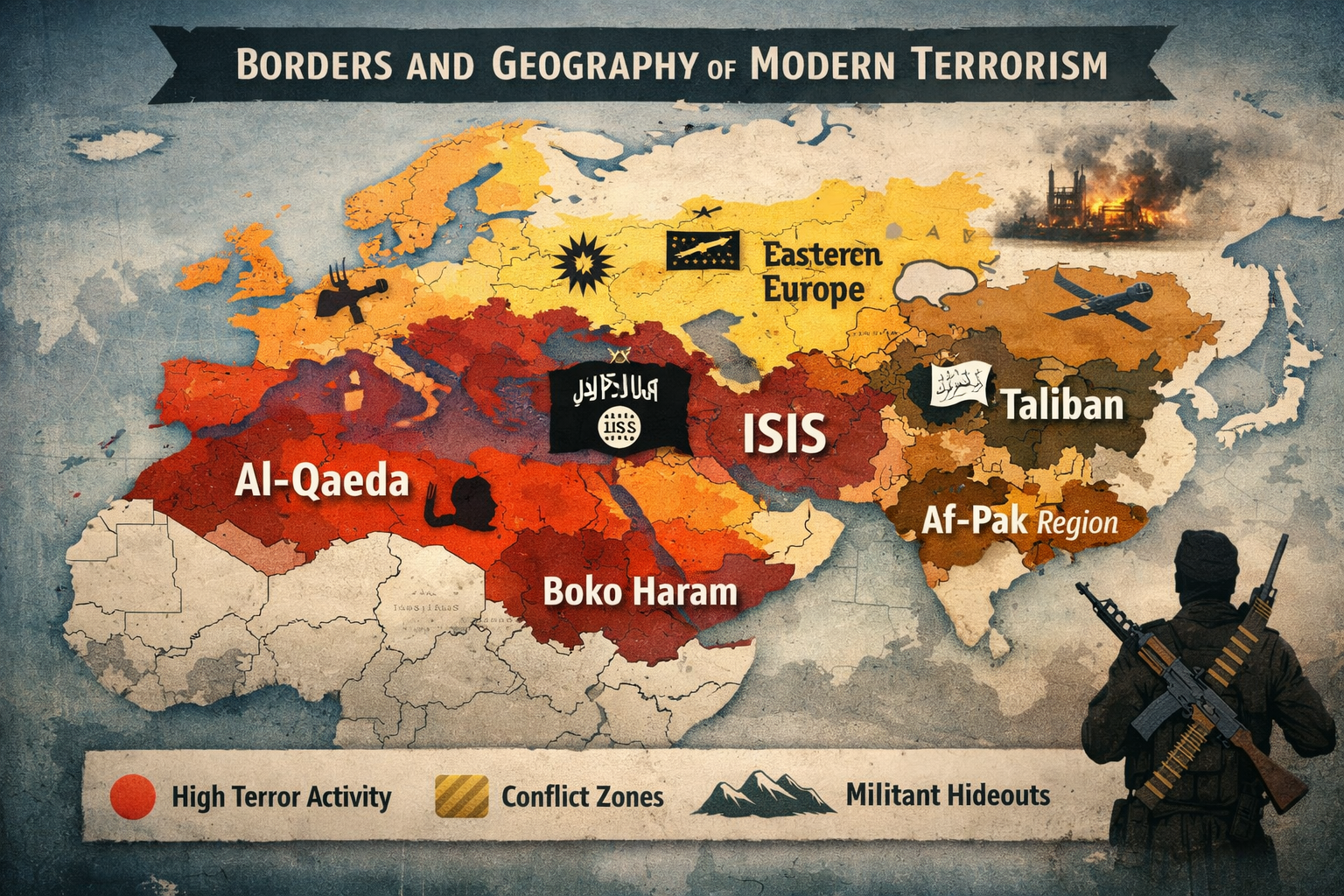
Borderlands have become one of the most critical arenas for understanding modern terrorism.Across the globe, a significant proportion of terrorist activity is concentrated near international boundaries, with over 40 per cent of attacks occurring within 50 kilometres of a border and nearly two-thirds within 100 kilometres (Institute for Economics & Peace, 2025). This pattern is not accidental, according to the Global Terrorism Index 2026. Borders are often drawn through remote, difficult terrain such as mountains, deserts, forests, and wetlands, far from political capitals and administrative centres. These areas tend to suffer from weak governance, limited infrastructure, and minimal state presence, creating what are effectively “authority gaps.”

Such conditions provide fertile ground for terrorist groups. In these peripheral zones, armed actors can recruit from marginalised populations, establish training camps, and exploit limited surveillance. At the same time, national borders impose legal and operational constraints on state security forces, who are generally unable to pursue militants across boundaries without coordination. This asymmetry grants terrorist groups a persistent tactical advantage, allowing them to evade pressure simply by crossing into neighbouring territory (OECD, 2020).

Another defining feature of borderland terrorism is its relationship with broader conflict. Since 2007, the overwhelming majority of terrorism-related deaths have occurred in countries already experiencing armed conflict, with over 76 per cent linked to major conflicts (Institute for Economics & Peace, 2025). In these contexts, terrorism is not an isolated phenomenon but one tactic among many used by insurgent groups, alongside conventional warfare, criminal activity, and governance functions. Border regions amplify these dynamics by enabling mobility, concealment, and access to illicit economies that sustain long-term insurgencies.

Global Patterns: Borderlands as Persistent Hotspots

Several of the world’s most enduring terrorism hotspots are located along international borders. The Colombia–Venezuela frontier, the Afghanistan–Pakistan borderlands, and the Lake Chad Basin all illustrate how porous boundaries and weak coordination between states enable militant groups to thrive. Despite differences in geography and political context, these regions share common characteristics: under-governed spaces, cross-border ethnic or kinship ties, and entrenched illicit economies (UNODC, 2019).

In South Asia, the Afghanistan–Pakistan border has long functioned as a revolving door for militant groups. Insurgents have repeatedly used the mountainous terrain and tribal networks spanning both sides of the frontier to evade military operations, regroup, and launch cross-border attacks. The persistence of these dynamics over decades demonstrates how difficult it is to eliminate insurgencies that are embedded in borderland environments (Giustozzi, 2018).

Similarly, in Latin America, the Colombia–Venezuela border has evolved into a complex zone where terrorism, insurgency, and organised crime intersect. Armed groups exploit the lack of coordinated governance to operate across both countries, using the border as both sanctuary and staging ground. This has allowed them to sustain operations even in the face of sustained military pressure (International Crisis Group, 2020).

The Lake Chad Basin offers another example of how borderlands enable transnational insurgencies. Groups such as Boko Haram and its splinter factions operate fluidly across Nigeria, Niger, Chad, and Cameroon, exploiting weak border controls and fragmented security responses. The region’s challenging terrain—marshes, islands, and dense vegetation—further complicates military operations and allows militants to maintain a persistent presence (African Union, 2022).

The Strategic Logic of Borderland Terrorism

Terrorist groups are not randomly distributed across space; their location choices reflect strategic calculations. Border regions offer an optimal balance between vulnerability and value. While heavily fortified border crossings and major cities may be difficult to attack, areas slightly removed from these points—typically within 10 to 100 kilometres of a border—provide accessible targets with relatively high strategic or symbolic value (Institute for Economics & Peace, 2025).

These zones also tend to host established smuggling routes and informal economies. Illicit trade in arms, fuel, minerals, timber, and narcotics provides a steady revenue stream for armed groups, while the movement of people across porous borders offers cover for fighters. In many cases, these economic networks predate the emergence of terrorist organisations and are simply co-opted or taxed by them (World Bank, 2011).

Another notable trend is that attacks in border regions are less likely to be formally claimed. Groups often avoid claiming responsibility for violence against civilians in areas where they seek local support. Instead, they selectively claim attacks that enhance their reputation, such as those targeting military or government officials. This reflects a broader strategy of balancing coercion with efforts to maintain legitimacy among local populations (Institute for Economics & Peace, 2025).

The Central Sahel: Epicentre of Borderland Terrorism

Nowhere are these dynamics more evident than in the Central Sahel, which has emerged as the global epicentre of terrorism over the past decade. The tri-border region linking Mali, Burkina Faso, and Niger exemplifies how weak state capacity, porous borders, and regional instability can combine to produce a rapidly expanding insurgency.

The origins of the Sahelian crisis lie in the 2012 conflict in Mali, which was itself shaped by cross-border dynamics following the collapse of Libya. Armed groups quickly learned to exploit the region’s vast, sparsely populated borderlands, moving between countries to evade military pressure. As French and United Nations forces intervened, militants adapted by dispersing into neighbouring states and concentrating in border areas where jurisdictional constraints limited pursuit (Thurston, 2020).

Over time, this pattern facilitated the regional spread of terrorism. What began as a localised insurgency in northern Mali evolved into a transnational conflict encompassing large parts of Burkina Faso and Niger. Border regions such as Liptako-Gourma became the core areas of militant activity, characterised by high levels of violence and limited state presence (ACLED, 2024).

A key driver of this expansion has been the lack of effective coordination among Sahelian states. Differences in political priorities, military capabilities, and governance structures have created gaps that armed groups exploit. Even when joint operations are conducted, militants often retreat across borders to regroup, returning once pressure subsides. This cycle has allowed insurgencies to persist and expand despite significant international intervention (OECD, 2020).

Border Communities and Recruitment Dynamics

The social fabric of the Sahel further reinforces these dynamics. Many communities in the region span national borders, particularly among Fulani, Tuareg, and other pastoralist groups. These cross-border ties facilitate recruitment, logistics, and intelligence-sharing for militant organisations (International Crisis Group, 2021).

At the same time, longstanding grievances—such as marginalisation, lack of economic opportunity, and tensions over land use—make these populations vulnerable to recruitment. In some cases, heavy-handed counterterrorism operations have exacerbated the problem, alienating communities and driving them toward armed groups for protection or survival (Human Rights Watch, 2020).

Militant organisations in the Sahel have increasingly adopted strategies aimed at embedding themselves within local societies. Rather than immediately seizing territory, they often begin by building relationships, exploiting grievances, and establishing parallel systems of governance. Border regions serve as ideal areas for this approach, offering both relative security and access to multiple jurisdictions.

Expansion Toward Coastal West Africa

In recent years, the Sahelian insurgency has begun to push southward toward coastal West Africa. Armed groups are using border areas in countries like Benin, Togo, and Côte d’Ivoire as staging grounds for gradual expansion. This shift reflects a strategic adaptation: rather than confronting stronger state structures directly, militants are probing weaker peripheral regions and building footholds incrementally (Institute for Security Studies, 2023).

Protected areas and forest reserves along these borders have become particularly important. These areas provide natural cover for training, planning, and movement, while also lying beyond the effective control of state authorities. From these zones, militants can launch attacks, recruit fighters, and retreat when necessary.

This southward expansion highlights the risk of regional contagion. If left unchecked, the dynamics that have destabilised the Sahel could spread further into West Africa, threatening relatively stable coastal states and disrupting key economic corridors.

Conclusion: Border Security and the Future of Counterterrorism

Borderlands are no longer peripheral to the study of terrorism—they are central to it. The concentration of attacks near international boundaries reflects deeper structural issues: weak governance, limited coordination between states, and the enduring influence of geography on security dynamics.

The experience of the Sahel underscores the urgency of addressing these challenges. Military operations alone are unlikely to succeed if they do not account for the cross-border nature of the threat. Effective counterterrorism in border regions requires sustained cooperation between neighbouring states, investment in governance and development, and strategies that engage local communities rather than alienate them.

Ultimately, the persistence and spread of terrorism in the Sahel and beyond will depend on how effectively states can manage their borderlands—not just as lines on a map, but as complex human, economic, and political spaces where security is negotiated daily.

References

  • ACLED (2024). Armed Conflict Location & Event Data Project: Sahel Trends Report.
  • African Union (2022). Lake Chad Basin Security and Stabilisation Strategy.
  • Giustozzi, A. (2018). The Taliban at War. Oxford University Press.
  • Human Rights Watch (2020). Sahel: Civilian Harm and Armed Islamist Groups.
  • Institute for Economics & Peace (2025). Global Terrorism Index 2025.
  • Institute for Security Studies (2023). Coastal West Africa and Sahel Spillover Risks.
  • International Crisis Group (2020). Gold and Grief in Venezuela’s Violent South.
  • International Crisis Group (2021). The Central Sahel: Scene of New Climate Wars?
  • OECD (2020). States of Fragility Report.
  • Thurston, A. (2020). Jihadists of North Africa and the Sahel. Cambridge University Press.
  • UNODC (2019). Transnational Organized Crime in West Africa.
  • World Bank (2011). World Development Report: Conflict, Security, and Development.
Tags: 20265th Edition 2026May week3
ShareTweet
Previous Post

The End of an Order Africa Never Had

Next Post

Human Ammunition: The rise of weaponized migration in the 21st Century

Next Post
Human Ammunition: The rise of weaponized migration in the 21st Century

Human Ammunition: The rise of weaponized migration in the 21st Century

Leave a Reply Cancel reply

Your email address will not be published. Required fields are marked *

  • Trending
  • Comments
  • Latest
Africa's Natural Resources: Who’s After What And What’s The Continent’s Strategy In The Scramble Game?

Africa’s Natural Resources: Who’s After What And What’s The Continent’s Strategy In The Scramble Game?

March 14, 2026
Effects of overpopulation in class on quality of education

Effects of overpopulation in class on quality of education

March 25, 2024
Slums and Security in Africa: A Growing Threat

Slums and Security in Africa: A Growing Threat

July 25, 2025
The Growing Influence Of AES On African Countries

The Growing Influence Of AES On African Countries

April 1, 2025
Integration of environmental security into Ghana’s National Security Strategy safeguards the future

Integration of environmental security into Ghana’s National Security Strategy safeguards the future

10
Border Security: A Door Left Wide Open

Border Security: A Door Left Wide Open

3
Polls close in Liberia

Liberia: Once a war-torn country, now Africa’s beacon of democracy – Lessons for Africa

1
Alliance Of Sahel States Formation: Objectives & Implications for ECOWAS

Alliance Of Sahel States Formation: Objectives & Implications for ECOWAS

1
Transport Systems, Fuel Prices and Urban Security in Accra- Ghana.

Transport Systems, Fuel Prices and Urban Security in Accra- Ghana.

May 19, 2026
Human Ammunition: The rise of weaponized migration in the 21st Century

Human Ammunition: The rise of weaponized migration in the 21st Century

May 19, 2026
Borderlands and the Geography of Modern Terrorism

Borderlands and the Geography of Modern Terrorism

May 19, 2026
The End of an Order Africa Never Had

The End of an Order Africa Never Had

May 11, 2026

Popular Stories

  • Africa's Natural Resources: Who’s After What And What’s The Continent’s Strategy In The Scramble Game?

    Africa’s Natural Resources: Who’s After What And What’s The Continent’s Strategy In The Scramble Game?

    0 shares
    Share 0 Tweet 0
  • Effects of overpopulation in class on quality of education

    0 shares
    Share 0 Tweet 0
  • Slums and Security in Africa: A Growing Threat

    0 shares
    Share 0 Tweet 0
  • The Growing Influence Of AES On African Countries

    0 shares
    Share 0 Tweet 0
  • The Concept of Beauty in Africa

    0 shares
    Share 0 Tweet 0

CISA Newsletter

Headlining West African News

Follow Us

Browse by Category

  • ANALYSTS
  • Business
  • ECONOMY
  • EDITORIAL
  • Environment
  • Food
  • Health
  • Lifestyle
  • News
  • Politics
  • Review
  • Science
  • Sports
  • Tech
  • Travel
  • Uncategorized
  • World

Recent News

Transport Systems, Fuel Prices and Urban Security in Accra- Ghana.

Transport Systems, Fuel Prices and Urban Security in Accra- Ghana.

May 19, 2026
Human Ammunition: The rise of weaponized migration in the 21st Century

Human Ammunition: The rise of weaponized migration in the 21st Century

May 19, 2026
  • About
  • Advertise
  • Privacy & Policy
  • Contact

© 2023 CISA Ghana Newsletter - Headlines West Africa.

  • fr Français
  • en English
No Result
View All Result
  • Home
  • Editions
    • April 2026
    • March 2026
    • February 2026
    • January 2026
    • 2025
      • December 2025
      • November 2025
      • October 2025
      • September 2025
      • August 2025
      • July 2025
      • June 2025
      • May 2025
      • April 2025
      • March 2025
      • February 2025
      • January 2025
    • 2024
      • December 2024
      • November 2024
      • October 2024
      • September 2024
      • August 2024
      • July 2024
      • June 2024
      • May 2024
      • April 2024
      • March 2024
      • February 2024
      • January 2024
    • 2023
      • December 2023
  • News
  • Tech
  • Entertainment
  • Lifestyle
  • Review
  • CISA Ghana

© 2023 CISA Ghana Newsletter - Headlines West Africa.

  • English
  • Français (French)