







Introduction
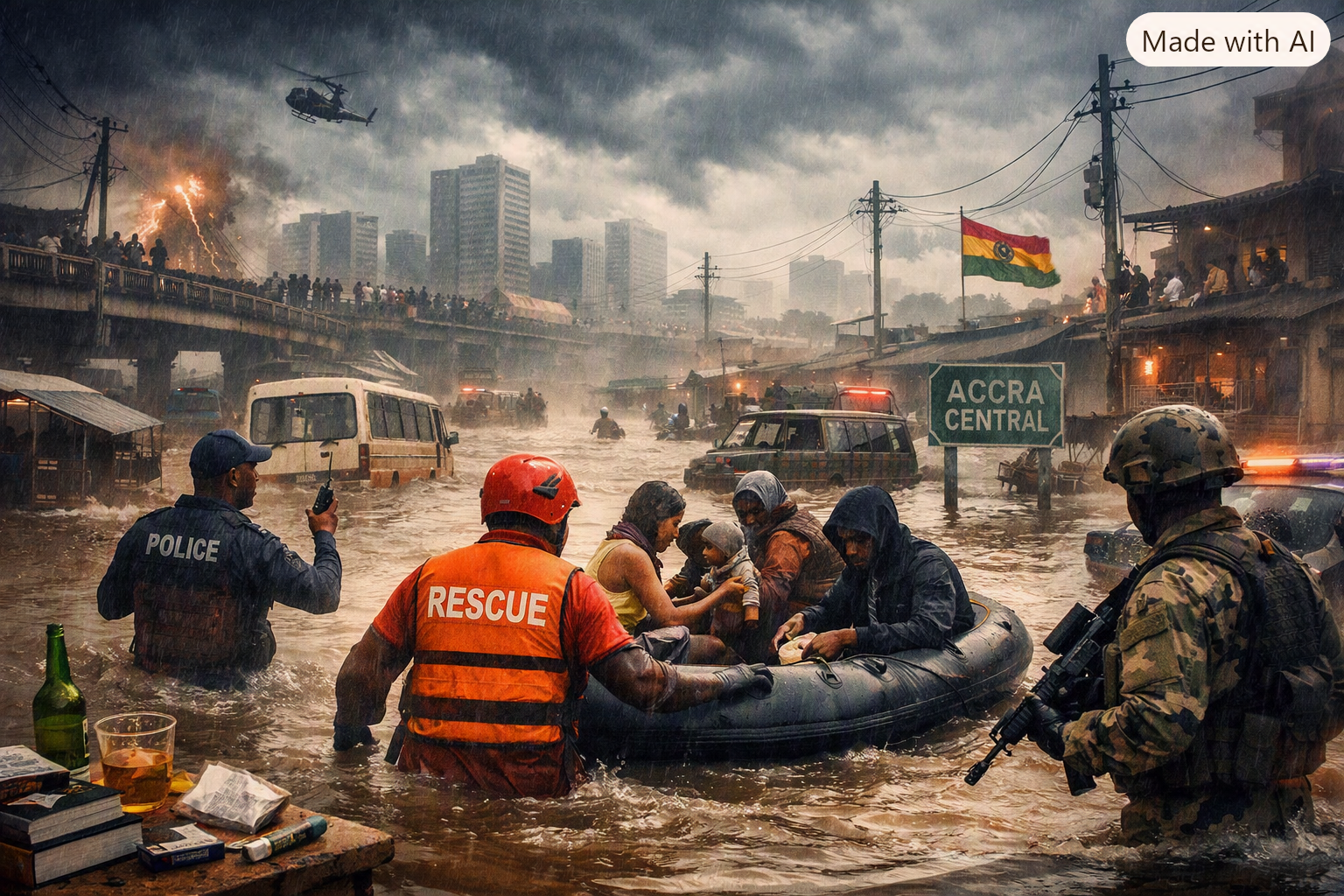
Every June, Accra performs a ritual that has become almost liturgical in its repetition. The rains arrive, the Odaw and its tributaries rise beyond their banks, familiar neighborhoods disappear beneath brown water, and officials describe what has happened as an emergency. The word carries a particular implication. An emergency is sudden, unforeseen, a rupture in an otherwise stable pattern. Accra’s floods are none of these things. They are, instead, the predictable output of a spatial order the city’s own institutions helped create and have declined to correct.
This article treats Accra’s flooding not as an environmental hazard that the state must manage but as evidence of a governance failure that the state has chosen repeatedly not to fix. The distinction matters because it changes where responsibility and remedy are located. A hazard invites better forecasting, faster rescue, more resilient infrastructure. A governance failure invites the political discipline to enforce laws Ghana already has on its books, against interests grown comfortably with their absence. The central claim here is that capital security, understood as protection of the state’s administrative, economic and demographic center from recurring, foreseeable harm, depends far more on strict zoning enforcement than on the reactive disaster machinery that currently absorbs the bulk of public attention when the water rises.
A City That Keeps Learning The Same Lesson
The clearest evidence that Accra’s floods are structural rather than accidental is their repetition across administrations, decades and rainfall patterns. It is tempting to assume the crisis is a symptom of Accra’s more recent, faster growth. The historical record does not support that assumption. Academic reconstructions of Accra’s flood history identify major, damaging events in 1955, 1960, 1963, 1968, 1973, 1986, 1991, 1995, 1997 and 1999, a sequence running directly through the final years of the Provisional National Defence Council and the subsequent National Democratic Congress governments led by Jerry John Rawlings (Amoako & Frimpong Boamah, 2015). The July 1995 flood submerged low-lying districts of the city by morning and pushed the Odaw and Onyasia rivers close to breaking their banks, while the June 1997 floods submerged roads across the metropolis over two days of intermittent rain (ModernGhana, 2026). The Rawlings government was not unaware of the underlying cause. By the late 1990s it had commissioned the Korle Lagoon Ecological Restoration Project, a Ministry of Works and Housing initiative carried out with donor support to dredge the lagoon into which the Odaw empties and ease the passage of floodwater to the sea (Owusu Boadi & Kuitunen, 2002). That the Korle Lagoon and the Odaw basin remain, three decades and several governments later, the epicentre of Accra’s flood crisis suggests the problem was correctly diagnosed a generation ago and that diagnosis was never converted into durable enforcement, regardless of which party has since held office.
The most searing entry in the post-Rawlings record remains the night of 3 June 2015, when floodwaters at Kwame Nkrumah Circle mixed with fuel that had leaked from a filling station where residents had taken shelter from the rain. A spark, its exact origin still disputed between an electrical fault and a discarded cigarette, ignited the mixture and killed more than 150 people in a matter of minutes (Citinewsroom, 2025). President John Mahama declared three days of national mourning, and an investigative committee later recommended dredging the Odaw River and its tributaries and establishing a dedicated enforcement unit for environmental and waste regulations (Citinewsroom, 2025). Ghana now marks 3 June as National Flood Disaster Day in memory of that night.
What makes the 2015 disaster instructive is not its severity alone but what followed it. Barely a year later, on 9 June 2016, a single day’s rainfall of over 180 millimetres flooded the same corridors and killed more than ten people (ModernGhana, 2026). The pattern recurred through 2019, when flooding disrupted major roads and a bridge collapsed, and again in 2023, when the Volta River Authority’s controlled spillage from the Akosombo and Kpong dams compounded flooding already underway in the Greater Accra region. In May 2025, a rainfall event in parts of Greater Accra killed several people and displaced thousands, submerging communities from Weija and Kaneshie to Adentan-Dodowa (Addaney, 2026). Then, in early June 2026, Accra flooded once more. Kwame Nkrumah Circle, Odawna, Adabraka and the approaches to the Tema motorway were underwater within hours of the rains beginning (Addaney, 2026). Weeks later, at the end of June, the city flooded again, this time affecting Weija, parts of Kasoa, Dansoman, Ofankor Barrier and Lakeside, with a body recovered from floodwaters at Tetegu (MyJoyOnline, 2026a).
The scale of the late June 2026 event sets a new benchmark for the crisis. Addressing Parliament on 30 June, the Minister for the Interior, Mohammed Mubarak Muntaka, disclosed that the torrential rains of Monday, 29 June had displaced 7,761 households and affected 38,802 people across 25 communities in eighteen Metropolitan, Municipal and District Assemblies in Greater Accra, with twelve confirmed deaths and seven people still missing as rescue operations continued (Graphic Online, 2026b; Ghana News Agency, 2026). He told Parliament that June 2026 had recorded 593.2 millimetres of rainfall nationally, the highest monthly total in Ghana’s recorded history, surpassing the previous record of 420.6 millimetres set in 2002, while the single day’s total of 169.2 millimetres on 29 June ranked as the fourth-highest daily total recorded since 1995 (Graphic Online, 2026b). A further eighteen people had died in the Central Region over the preceding two weeks, when 58 ageing mud and brick houses collapsed under prolonged rainfall, bringing the combined confirmed death toll across both regions to thirty (Adomonline, 2026; Hotdigitalonline, 2026). President Mahama subsequently authorised the release of GHc350 million from the contingency fund for relief and flood control, and deployed military engineers to support the response (Graphic Online, 2026).
These figures matter for more than their scale. A record rainfall total is, on its own, a meteorological fact that no zoning policy could have prevented. But its translation into 38,802 affected people and thirty deaths, rather than a serious but contained weather event, is a governance fact. The same rainfall falling on a city with intact wetlands and consistently enforced setback rules along its waterways would not have produced flooding on this scale. The Minister’s own account traces the toll to eighteen assemblies overwhelmed at once and to housing stock, some of it a century old, standing where it should not, which is precisely the pattern this article identifies as a capacity failure rather than a weather event.
This is not a city occasionally overwhelmed by unusual weather. It is a city whose vulnerability has become a fixed feature of its geography, one that reappears with each rainy season regardless of which party controls the Osu Castle or which coordinating director sits at the Accra Metropolitan Assembly. A study analysing flood incidence against rainfall data across recent years found no statistical correlation between the intensity of rainfall and the rising frequency of flooding events, a finding that redirects attention away from the weather and toward the built environment that the weather now passes through (Addaney, 2026). Something other than the climate has changed, and that is the capacity of the land itself to absorb water before it reaches the streets.
Where The Water Used To Go
Accra sits on a coastal plain between the Akwapim Ridge and the Atlantic Ocean, a topography that once channelled rainwater through a network of streams, wetlands and lagoons before it reached the sea. The Densu Delta, Sakumo Lagoon and Songor Lagoon in the Greater Accra region functioned as natural reservoirs, absorbing excess rainfall and releasing it gradually rather than allowing it to surge across the landscape at once (Addaney, 2026). The Odaw River basin, which drains much of central Accra, and smaller systems feeding the Korle and Kpeshie lagoons performed a similar function for the urban core. These were not incidental features of the landscape. They were the city’s original drainage infrastructure, built by geology rather than engineering and considerably more effective than anything municipal government has since constructed to replace them.
That infrastructure has been dismantled piece by piece over four decades of urban expansion that consistently outpaced investment in formal drainage (EnviroNews, 2026). Housing estates, commercial developments and roads have spread across the city, replacing permeable land with concrete, asphalt and rooftops that shed rainwater rather than absorbing it. Technical assessments presented by the coordinator of the GARID project have documented extensive clearance of vegetation along the Akuapem Ridge for construction, which has increased erosion and sent large volumes of silt downstream into the city’s already compromised drainage channels (The Sikaman Times, 2026). Significant wetland losses have been recorded in Tetegu, Mallam, Sakumono and the Densu-Weija basin, where land once reserved for water retention has been reclaimed for residential and commercial use. Developers commonly fill wetlands with solid waste and laterite during the dry season before construction begins, a practice that permanently eliminates land the ecosystem depends on to accommodate excess floodwater (The Sikaman Times, 2026).
The Korle stream, which feeds the Kpeshie Lagoon, offers a compact illustration of the broader pattern. Encroachment has narrowed its channel to a fraction of its former width, reducing its capacity to carry stormwater precisely in the section of the city where that capacity is most needed. Multiply this single case across the Odaw basin, the Densu delta and the Sakumo catchment, and the structural picture comes into focus. Accra has not lost its natural flood defenses to some inexorable process of urban growth that no government could have prevented. It has lost them to a specific, traceable pattern of unauthorised development, much of it permitted through what one recent analysis bluntly described as political interference in planning enforcement (Addaney, 2026). The wetlands did not disappear, they were built over, often with the knowledge, and sometimes with the direct participation of the same institutions charged with protecting them.
The Law That Was Never Enforced
It would be convenient and inaccurate to describe Accra’s flooding as a legal vacuum, a problem the state has not yet found the statutory language to address. Ghana’s Land Use and Spatial Planning Act, 2016 (Act 925), together with the Zoning and Land Use Regulations of 2019 and the mandate of the Land Use and Spatial Planning Authority, establishes a comprehensive framework for land use control, including spatial planning committees at every metropolitan, municipal and district assembly, chaired by the assembly’s chief executive (Government of Ghana, 2016; NewsGhana, 2026). Section 94 of the Act governs changes of use or zoning by district assemblies. Section 102 addresses contravention of zoning schemes. Section 160 sets out enforcement procedures, and Section 164 grants planning and building inspectors a right of entry to premises to investigate suspected violations (Ghanajustice, 2020). The architecture for lawful, orderly development exists in considerable detail.
What is missing is not law but its application. The Land Use and Spatial Planning Authority’s own investigations into a spate of building collapses concluded that weak enforcement at the assembly level was the common denominator, noting that where spatial planning committees perform their mandated function properly, unauthorised structures and haphazard development do not appear in the first place (Graphic Online, 2023). The Local Government Service Association of Physical Planners has separately warned that parks, wetlands, school lands and road reservations continue to be converted into private developments, sometimes by metropolitan and municipal assemblies themselves acting without the parliamentary approval that Act 925 requires for the rezoning of public land (Graphic Online, 2026a). In a functioning enforcement regime, such conversions would be a rare aberration, caught and reversed before construction began. In Accra, they have become routine enough to require a formal reminder from planners’ own professional association that the law still applies.
The government’s response, when floods force the issue onto the front page, tends to confirm the diagnosis. Following the flooding of June 2026, authorities announced plans to demolish buildings on six wetlands across Accra that had been encroached upon through unauthorised residential and commercial development, promising stricter enforcement of planning regulations to prevent recurrence (Ghanaian News Canada, 2026). This is the correct instinct, applied far too late and far too narrowly. A state that can identify six wetlands worth demolishing buildings on after a disaster is a state that could, in principle, have identified and protected those same wetlands before construction began. The demolition order is not evidence of new capacity. It is evidence that the capacity existed all along and was simply not exercised until the political cost of inaction exceeded the political cost of confrontation with encroachers, many of whom are neither poor nor powerless.
Why Emergency Response Cannot Substitute For Prevention
Ghana’s institutional response to flooding has, understandably, concentrated resources on the machinery of disaster management. NADMO, supported by the Ghana Armed Forces and other emergency services, has become practised at rescue and evacuation, and its personnel deserve recognition for lives saved during each flood event (Ghanaian News Canada, 2026). But rescue capacity, however well executed, addresses the consequences of flooding rather than its causes, and a state that invests primarily in the former while under-investing in the latter is choosing to manage a crisis indefinitely rather than resolve it.
The Greater Accra Resilient and Integrated Development project illustrates both the scale of what has been attempted and the limits of infrastructure alone as a substitute for enforcement. Approved by the World Bank in 2019 with an initial loan of US$200 million and later expanded with a further US$150 million in 2023, GARID has focused on drainage, solid waste management and flood risk reduction in the Odaw River basin, the city’s most flood-prone corridor, with cumulative disbursement at roughly 36 percent of its total US$350 million credit as of 2025 (African Cities Database, 2026). An independent assessment of the project’s interim impact found no significant effect on flooding conditions in the neighbourhoods it targeted compared with neighbourhoods outside the project area, and recorded a decline in resident satisfaction, a result researchers attributed to construction delays (International Growth Centre, 2025). A 2024 assessment separately found that an enhanced flood-protection system for the Odaw basin, capable of withstanding a one-in-25-year event, would cost approximately US$675 million, more than triple GARID’s original budget (MyJoyOnline, 2026b).
None of this is an argument against infrastructure investment. It is an argument against treating infrastructure as sufficient on its own. Concrete drains, however well engineered, cannot compensate indefinitely for the loss of the natural water retention systems that once did the same work at no construction cost and with no maintenance budget. Every wetland converted to housing is a permanent subtraction from the city’s flood capacity that no amount of downstream engineering can fully replace. A government that spends hundreds of millions of dollars on drainage while permitting continued encroachment on the wetlands feeding that drainage is, in effect running against its own investment. The Ghana Institution of Engineers made a version of this point directly during the June 2026 floods, when its president stated plainly that decades of poor land use planning and unchecked development in wetlands and waterways, not merely inadequate drains, were driving the city’s vulnerability (UNDP Ghana, 2026).
Reading Accra’s Floods As A Capacity Problem
The concept of state capacity is frequently reduced in African policy discourse to a question of resources: does the state have enough revenue, trained personnel and equipment to perform its functions. Accra’s flooding suggests a different and more uncomfortable reading. Ghana has drafted a detailed spatial planning law, established a dedicated land use authority, staffed planning committees in every assembly with inspectors holding statutory rights of entry, and mobilised hundreds of millions of dollars in international financing for flood mitigation. The resources and legal instruments are not in any meaningful sense absent. What is absent is the sustained institutional will to apply them consistently against politically connected interests, across successive administrations, without enforcement lapsing the moment public attention moves elsewhere.
This distinction matters because it changes the nature of the policy problem. A resource deficit is solved with money, comparatively the easier variable to move: a loan can be negotiated, a budget line expanded. A will deficit is solved only by altering the incentives facing officials and political actors who currently profit from looking away, whether through direct participation in unauthorised land transactions, informal payments for overlooked permits, or the electoral calculation that demolishing a constituent’s illegally built house costs more votes than the flood it eventually causes. Ghana’s planning statutes already anticipate this problem in their design, which is precisely why enforcement, not further legislation, is the correct target for reform. Section 94 of Act 925 requires district assemblies to follow a defined process for changing land use or zoning; the Local Government Service Association of Physical Planners’ recent intervention exists because that process is regularly bypassed rather than followed (Graphic Online, 2026a). The gap between statute and practice is a governance failure, and governance failures of this kind are definitionally, questions of state capacity in the fullest sense: the capacity of institutions to act as they say they will act, irrespective of who is watching.
There is also a decentralisation dimension worth noting here, one familiar from other sectors of West African governance. Ghana’s spatial planning framework deliberately places primary enforcement authority at the level of metropolitan, municipal and district assemblies, closer to the communities affected and in principle, better positioned to detect violations early. In practice, this decentralisation has diffused accountability rather than sharpened it. When wetlands are encroached upon in Accra, responsibility is distributed across the Accra Metropolitan Assembly, the Greater Accra Regional Coordinating Council, the Land Use and Spatial Planning Authority, and in cases involving public land Parliament itself, leaving a structure almost designed to obscure who failed to act, and when. Effective capital security requires the opposite: a clear, singular chain of enforcement responsibility that cannot be diluted across jurisdictions each capable of pointing to the others.
Conclusion And Recommendations
Accra’s floods will recur every rainy season for as long as the city’s ecological buffers remain built over and the laws designed to protect them remain selectively enforced. The technical knowledge required to prevent this outcome is not in dispute. Ghana’s engineers, planners and hydrologists have identified the flood zones, mapped the wetland losses and calculated the costs of both action and inaction with considerable precision. What has been missing is not analysis but the political discipline to convert analysis into consistent enforcement, sustained across administrations and immune to the particular political weight of whoever happens to be doing the encroaching. The following recommendations follow directly from that diagnosis.
First, enforcement of Act 925 should be treated as a capital security function reporting through a clear, single line of accountability, rather than a diffuse responsibility shared across assemblies, regional coordinating councils and Parliament in ways that currently allow each to point to the others when violations occur.
Second, Ghana should complete and make publicly accessible a digital, satellite-based map of all gazetted flood zones and wetland buffer areas in Greater Accra, so that violations can be identified in real time rather than discovered after a flood forces investigation.
Third, demolition of unauthorised structures on wetlands and floodplains should proceed as routine enforcement under existing law rather than as an exceptional response announced only after fatalities, since the latter pattern signals to developers that the practical risk of building illegally remains low outside crisis periods.
Fourth, infrastructure financing of the kind mobilised through GARID should be conditioned, explicitly on parallel enforcement benchmarks for wetland protection, so that engineered drainage capacity is not continuously eroded by the ongoing loss of the natural retention systems it supplements.
Finally, Parliament should strengthen the penalties and personal liability attached to public officials who approve or overlook unauthorised development on protected land, since political interference in planning enforcement currently carries little institutional cost, which is the clearest explanation for why a legally sound framework has produced such a legally disordered city.
Accra was not built to drown. It was, for most of its history, drained by a landscape the city has since paved over, filled in and built upon in defiance of laws written specifically to prevent that outcome. The city has simply lost its capacity to absorb its rains, one unauthorised wetland conversion at a time, with the quiet permission of a state that has the tools to say no and has too often chosen not to use them.
References
Addaney, M. (2026, July 3). Accra is not drowning by accident: Why Ghana’s flood crisis demands more than drains. Graphic Online. https://www.graphic.com.gh/features/opinion/accra-is-not-drowning-by-accident-why-ghanas-flood-crisis-demands-more-than-drains.html
Adomonline. (2026, June 30). Central Region floods: 58 houses collapsed, 18 people killed — Interior Minister. https://www.adomonline.com/central-region-floods-58-houses-collapsed-18-people-killed-interior-minister/
African Cities Database. (2026). The Greater Accra Resilient and Integrated Development Project (GARID). https://african-cities-database.org/urc-record-index/GARID/
Amoako, C., & Frimpong Boamah, E. (2015). The three-dimensional causes of flooding in Accra, Ghana. International Journal of Urban Sustainable Development, 7(1), 109-129. https://doi.org/10.1080/19463138.2014.984720
Citinewsroom. (2025, June 3). June 3 disaster: Ghana marks 10 years after deadly flood and fire incident. https://www.citinewsroom.com/2025/06/june-3-disaster-ghana-marks-10-years-since-deadly-flood-and-fire/
EnviroNews. (2026). When Accra flooded: How structural vulnerabilities, climate dynamics turned heavy rain into disaster. https://www.environewsnigeria.com/when-accra-flooded-how-structural-vulnerabilities-climate-dynamics-turned-heavy-rain-into-disaster/
Ghanaian News Canada. (2026). Government to demolish buildings on six Accra wetlands in major flood prevention drive. https://ghanaiannews.ca/government-to-demolish-buildings-on-six-accra-wetlands-in-major-flood-prevention-drive/
Ghana News Agency. (2026, June 30). Greater Accra floods: 38,802 people affected, 7,761 households displaced — Interior Minister. https://gna.org.gh/2026/06/greater-accra-floods-38802-people-affected-7761-households-displaced-interior-minister/
Ghanajustice. (2020). Land Use and Spatial Planning Act, 2016 (Act 925), ss 1-110. https://acts.ghanajustice.com/actsofparliament/land-use-and-spatial-planning-act-2016-act-925-ss-1-110/
Government of Ghana. (2016). Land Use and Spatial Planning Act, 2016 (Act 925). https://faolex.fao.org/docs/pdf/gha180045.pdf
Graphic Online. (2023, June 2). Spate of collapsed buildings: MMDAs must enforce land use laws — Spatial Planning Authority. https://www.graphic.com.gh/news/general-news/spate-of-collapsed-buildings-mmdas-must-enforce-land-use-laws-spatial-planning-authority.html
Graphic Online. (2026a). Public land rezoning requires Parliamentary approval — LoGSAPP. https://www.graphic.com.gh/news/general-news/ghana-news-public-land-rezoning-requires-parliamentary-approval-logsapp.html
Graphic Online. (2026b, June 30). June 2026 records highest rainfall in Ghana’s history; Muntaka tells Parliament President Mahama has authorised release of US$350 million from contingency fund. https://www.graphic.com.gh/news/general-news/june-2026-records-highest-rainfall-in-ghanas-history-muntaka-tells-parliament-president-mahama-has-authorised-release-of-us-350-million-from-contingency-fund.html
Hotdigitalonline. (2026, June 30). Death toll hits 30 in Accra, Central Region floods. https://www.hotdigitalonline.com/health/death-toll-hits-30-in-accra-central-region-floods/
International Growth Centre. (2025, March 24). Interim impacts of an integrated resilient development project: The case of Accra, Ghana. https://www.theigc.org/publications/interim-impacts-integrated-resilient-development-project-case-accra-ghana
ModernGhana. (2026). A city built to drown: The long and painful history of flooding in Accra. https://www.modernghana.com/news/1506795/a-city-built-to-drown-the-long-and-painful-histor.html
MyJoyOnline. (2026a). Accra under water, again: Inside Ghana’s 66-year flooding crisis that nobody has fixed. https://www.myjoyonline.com/accra-under-water-again-inside-ghanas-66-year-flooding-crisis-that-nobody-has-fixed/
MyJoyOnline. (2026b). Before the next rains: Rethinking Accra’s flood crisis. https://www.myjoyonline.com/before-the-next-rains-rethinking-accras-flood-crisis/
NewsGhana. (2026). Ghana’s zoning laws exist but enforcement lags behind growth. https://www.newsghana.com.gh/zoning-must-mean-something-unregulated-commercial-encroachment-into-residential-areas-is-quietly-eroding-safety-property-value-and-peace-of-mind-for-homeowners-across-ghana/
Owusu Boadi, K., & Kuitunen, M. (2002). Urban waste pollution in the Korle Lagoon, Accra, Ghana. The Environmentalist, 22(4), 301-309. https://doi.org/10.1023/A:1020706728569
The Sikaman Times. (2026). Encroachment on wetlands, waterways driving Accra flooding — GARID. https://sikamantimes.com/encroachment-on-wetlands-waterways-driving-accra-flooding-garid/
UNDP Ghana. (2026, June 8). Accra under water again. United Nations Development Programme. https://www.undp.org/ghana/blog/accra-under-water-again