









Introduction
Artificial Intelligence (AI) is no longer a futuristic concept confined to science fiction. It has become one of the defining technologies of the twenty-first century, transforming economies, governments, businesses and everyday life. AI systems now write reports, diagnose diseases, detect fraud, translate languages, generate images, assist legal research, predict consumer behaviour and support decision-making across virtually every sector.
The speed at which AI has evolved has surpassed the ability of many governments to regulate its use. While AI presents unprecedented opportunities for economic growth, innovation and improved public service delivery, it also introduces significant risks. Criminals are exploiting AI to commit sophisticated cybercrimes, fraud and identity theft. Political actors and malicious groups are using AI-generated misinformation and deepfakes to manipulate public opinion, undermine trust in democratic institutions and incite conflict.
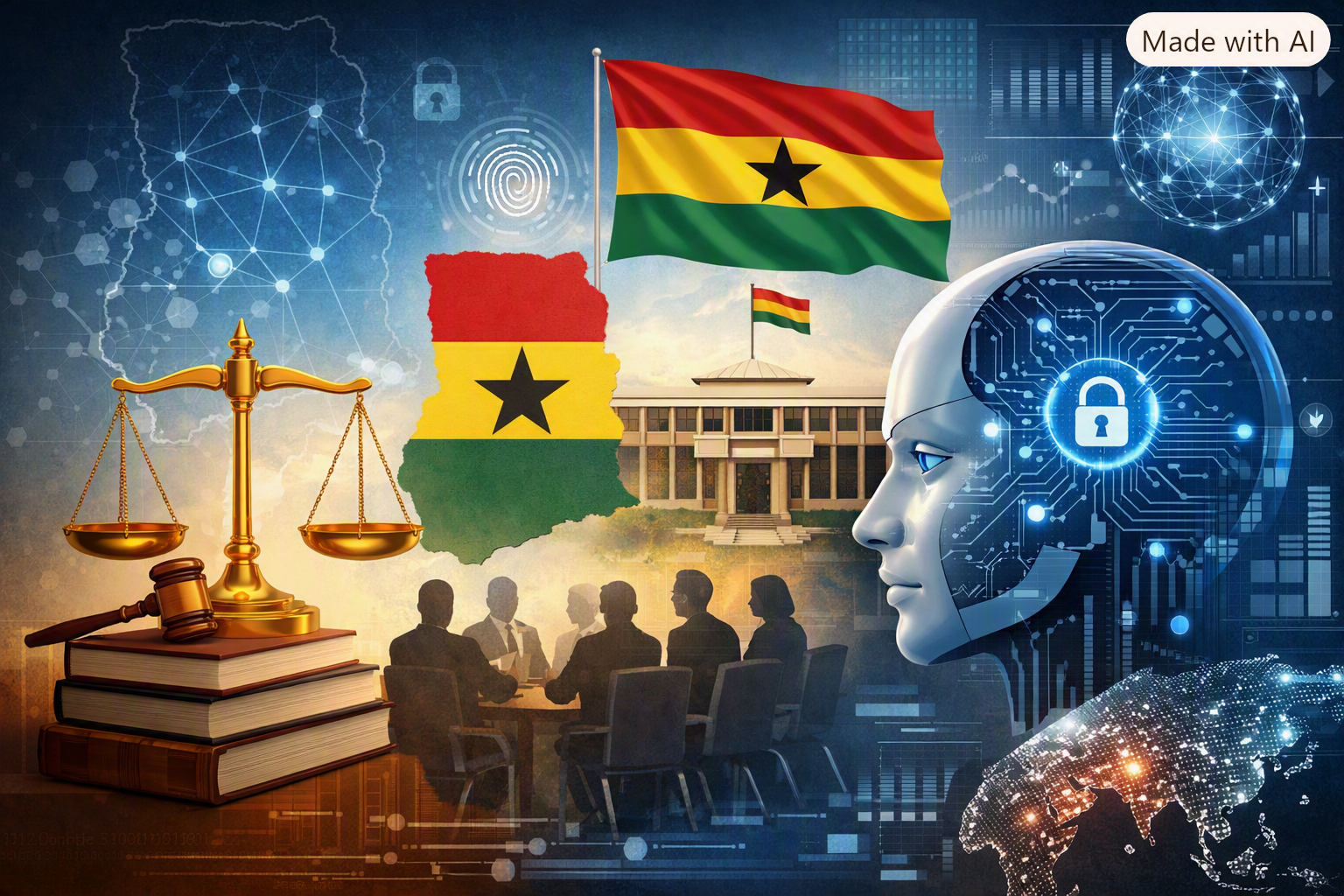
These developments raise an important policy question for Ghana and many African countries: Should AI be left largely unregulated, or should governments establish a legal framework to guide its responsible use? The answer is becoming increasingly clear. Ghana urgently requires a comprehensive Artificial Intelligence law that promotes innovation while protecting citizens, institutions and national security.
AI differs from earlier digital technologies because it increasingly performs tasks requiring judgement, prediction and content creation. Existing Ghanaian legislation—including the Cybersecurity Act, the Data Protection Act and the Electronic Transactions Act—provides an important foundation but was not designed to regulate autonomous decision-making, algorithmic accountability, deepfakes or generative AI. This mismatch illustrates the governance deficit
The Criminal Use of Artificial Intelligence
The use of AI for crime is well established. The same technologies that create economic opportunities also provide criminals with powerful new tools. Cybercriminals are increasingly using AI to automate phishing attacks that are more convincing than traditional scams. AI systems can generate personalised emails that imitate trusted individuals or organisations, making it increasingly difficult for victims to distinguish legitimate communications from fraudulent ones.
Identity theft has become significantly more sophisticated. AI-generated voices can imitate family members, business executives or public officials with remarkable accuracy. Fraudsters now use cloned voices to authorise fraudulent financial transfers or deceive victims into disclosing confidential information.
One of the most disturbing developments is the emergence of deepfakes—AI-generated images, videos and audio recordings that appear authentic but are entirely fabricated. Deepfakes have already been used globally to spread false information, damage reputations, manipulate elections and facilitate extortion.
Artificial Intelligence is also transforming cyber warfare. AI-powered malware can adapt its behaviour to evade traditional cybersecurity systems. Criminal networks increasingly use AI to identify software vulnerabilities automatically and launch attacks at unprecedented speed and scale. This makes effective law enforcement difficult.
Without adequate regulation and investigative capacity, countries risk becoming increasingly vulnerable to AI-enabled criminal activities.
Artificial Intelligence and the Spread of Misinformation
In the area of misinformation, AI poses a great threat. AI can produce misinformation at unprecedented speed and scale. Generative AI can create highly convincing articles, photographs, videos and audio recordings within seconds. While these technologies have legitimate applications in education, marketing and entertainment, they also enable malicious actors to manufacture false narratives capable of influencing public opinion.
Elections have become particularly vulnerable. AI-generated content can falsely portray political leaders making inflammatory statements they never made. Such fabricated material can spread rapidly across social media before authorities have an opportunity to verify its authenticity.
The consequences extend beyond politics. False medical advice generated by AI can undermine public health campaigns. Fabricated financial information can manipulate markets. False reports during emergencies may trigger panic and social unrest.
The challenge is compounded by the speed of digital communication. Social media platforms amplify sensational content regardless of its accuracy, allowing misinformation to reach millions before corrections are issued.
For countries with fragile information ecosystems, AI-generated misinformation represents not merely a technological challenge but a threat to democracy, public trust and national stability.
Why Ghana Needs an Artificial Intelligence Law
Ghana has made significant progress in digital transformation through initiatives such as digital identification, mobile money, electronic government services and expanded internet access. These developments create favourable conditions for AI adoption. However, increasing digitalisation also increases exposure to AI-enabled threats. A national law regulating AI use would provide several important benefits;
First, it would establish clear rules governing the development, deployment and use of AI technologies. Businesses would gain regulatory certainty while citizens would understand their rights and protections.
Second, legislation would strengthen safeguards against AI-enabled fraud, identity theft, deepfakes and cybercrime.
Third, legal requirements for transparency and accountability would improve public trust in AI systems used by government institutions and private organisations.
Fourth, regulation would promote ethical AI by addressing concerns relating to discrimination, bias and unfair algorithmic decision-making.
Finally, a legal framework would support national security by equipping law enforcement agencies with appropriate investigative powers while establishing safeguards against abuse.
International Lessons
The governance architecture for AI is still evolving. This is particularly the reason why Ghana needs to take urgent steps to ensure the development of norms that would guide a rapidly evolving technology use. While the issue is still being discussed, there are some examples that Ghana can learn from.
The European Union Artificial Intelligence Act adopts a risk-based model under which high-risk applications attract stronger regulatory obligations than low-risk systems. UNESCO’s Recommendation on the Ethics of Artificial Intelligence and the OECD AI Principles similarly emphasise transparency, accountability, human oversight and respect for fundamental rights. The African Union Continental AI Strategy recognises that African countries should develop governance approaches reflecting local developmental priorities and institutional realities. Ghana should therefore learn from these initiatives without merely transplanting them.
Towards a Ghanaian Framework
A Ghanaian framework should rest on several principles: proportional regulation; transparency for AI-generated content; human oversight for high-risk systems; protection against algorithmic discrimination; institutional coordination; support for research and innovation; public AI literacy; and regular review as technology evolves. While it is strongly recommended that Ghana should draft and pass an entirely new law to deal with it, the country could also implement this through amendments to existing legislation.
Conclusion
Artificial Intelligence is no longer solely a technological issue; it is a governance issue. The challenge for Ghana is to ensure that innovation advances within a legal and institutional framework that protects citizens, strengthens democratic governance and promotes sustainable development. Rather than waiting for AI-related harms to expose regulatory weaknesses, Ghana should begin a broad national conversation involving Parliament, regulators, academia, industry and civil society. The objective is not to regulate technology for its own sake, but to ensure that governance evolves alongside innovation.
The question is no longer whether Artificial Intelligence should be regulated. Rather, it is how quickly Ghanaian and African governments can establish effective mechanisms that maximise benefits of AI while minimising its dangers. For Ghana, the time has come to develop a comprehensive Artificial Intelligence law that safeguards the public interest, strengthens national security and positions the country to compete responsibly in the digital economy.
Artificial Intelligence will undoubtedly shape the future. Sound legislation will determine whether that future is one of shared prosperity or unmanaged risk.
References
African Union. (2024). Continental Artificial Intelligence Strategy. au.int
European Parliament & Council of the European Union. (2024). Regulation (EU) 2024/1689 laying down harmonised rules on artificial intelligence (Artificial Intelligence Act). EUR-Lex. europa.eu
Organisation for Economic Co-operation and Development. (2019). OECD Principles on Artificial Intelligence. OECD.AI. oecd.ai
PwC. (2017). Sizing the prize: What’s the real value of AI for your business and how can you capitalise? nvidia.com
UNESCO. (2021). Recommendation on the ethics of artificial intelligence. UNESCO Digital Library. unesco.org
United Nations. (2024). Governing AI for humanity: Final report of the High-Level Advisory Body on Artificial Intelligence. un.org
World Economic Forum. (2025). Global risks report 2025. weforum.org