








Consequences for Regional Security
Introduction
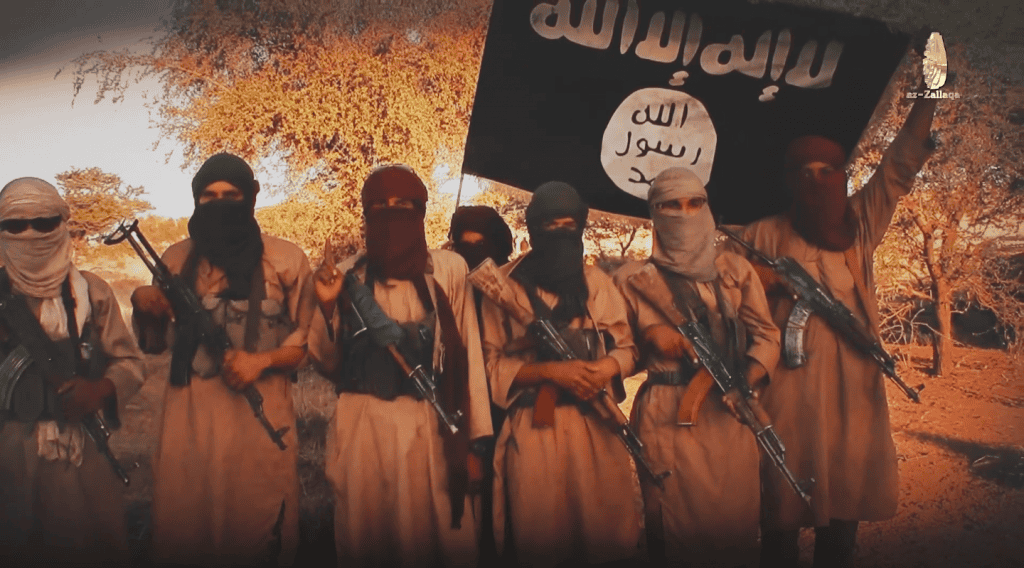
On 25 April 2026, coordinated attacks by Jamaʼat Nasr al-Islam wal Muslimin (JNIM) and the Azawad Liberation Front (FLA) struck Bamako, Kati, Gao, Kidal, Mopti and Sévaré simultaneously the largest offensive in Mali since the 2012 rebellion. Mali’s Defence Minister, General Sadio Camara, was killed in a suicide car-bomb attack on his residence. The country’s intelligence chief sustained multiple gunshot wounds. Kidal fell to the FLA within hours. Russian Africa Corps mercenaries, assigned to defend the town, negotiated a humiliating withdrawal.
The scale, geographic breadth and operational precision of the offensive sent shockwaves across West Africa. Chatham House characterised the attacks as fundamentally challenging “the narrative of regained sovereignty and security projected by the military leaders of Mali and its partners in the Alliance des États du Sahel.” The Africa Center for Strategic Studies observed that the attacks “reflect a deterioration of security requiring a broader coalition of partners to reverse.” This article assesses the April offensive in detail, examines its five principal strategic consequences for regional security, and identifies the implications for Ghana and the coastal West African states.
1. The April 2026 Offensive: What Happened
At approximately 05:20 on Saturday, 25 April 2026, a JNIM suicide car-bomb struck the Kati residence of Mali’s Defence Minister, General Sadio Camara, killing him alongside his second wife and two grandchildren. Within the same hour, gunfire erupted near Bamako’s Modibo Keita International Airport, suspending all commercial flights. Fighters in Malian Army uniforms entered the garrison town of Kati. Simultaneous attacks were reported in Gao, Mopti, Sévaré and Bourem. In the far north, FLA forces rapidly seized most of Kidal, the historic ‘capital’ of Tuareg nationalism.
JNIM publicly claimed responsibility for attacks on the Kati military base, Bamako airport and multiple northern cities. FLA spokesman Mohamed Elmaouloud Ramadane confirmed to the BBC that the assault had been “planned for a long time, in a well-planned manner, in alliance with JNIM.” Mali’s junta leader General Assimi Goïta was evacuated to a secure military camp; on 4 May he issued a decree appointing himself Defence Minister in succession to Camara. Mali’s Military Court opened an investigation into five serving and former soldiers for suspected complicity in the attacks which is an indicator of the intelligence penetration that made the offensive possible.
African Arguments assessed the events as “not an anomaly but the culmination of a long, deteriorating security trajectory” the product of compounding governance failures, the expulsion of multilateral security frameworks, and substitution of sovereign institutional capacity with externally managed mercenary dependency.
2. Five Regional Security Consequences
2.1 The Limits of Mercenary Substitution Are Now Demonstrated
Russia’s Africa Corps, with an estimated presence of at least 400 personnel in Mali, failed to prevent the offensive from targeting the capital. A Malian official told Radio France Internationale that the Kidal governor had warned Russian commanders of the impending attack three days in advance with no adequate response. The humiliating withdrawal of Africa Corps personnel from Kidal under FLA pressure has materially weakened Moscow’s credibility as a security guarantor across the AES states. For the broader region, the lesson is unambiguous: security cannot be outsourced. Externally contracted security arrangements generate dependency without resilience and erode the state-society relationships on which intelligence and community cooperation depend. The Chatham House analysis was explicit: Mali’s experience demonstrates that “security cannot be delivered by military means alone.”
2.2 The Dismantling of Multilateral Frameworks Has Accelerated Instability
Mali’s sequential disengagement from regional security cooperation, the dissolution of the G5 Sahel Joint Force, the expulsion of MINUSMA in 2023, and the AES withdrawal from ECOWAS effective 29 January 2025 stripped the country of intelligence-sharing networks, joint operational capacity and diplomatic support structures. JNIM has since opened new fronts in western and southern Mali, precisely the regions bordering coastal states that had previously been relatively secure. The April 2026 offensive exposed the cumulative cost of that fragmentation. For the region, the inverse lesson is equally clear: The Accra Initiative, established in 2017 by Benin, Burkina Faso, Côte d’Ivoire, Ghana and Togo, remains the most relevant functional security cooperation architecture available to coastal states. Both Chatham House and the Africa Center for Strategic Studies identified expansion of the Accra Initiative as the most promising vehicle for a unified regional counterterrorism response.
2.3 Governance Deficits, Not Military Weakness, Are the Decisive Vulnerability
The Africa Center for Strategic Studies has documented that fatalities linked to militant Islamist groups tripled under Mali’s military junta, despite a hardened security-first posture. JNIM’s capacity to strike Bamako itself reflected the erosion of state-society trust through which intelligence reaches security institutions. The Global Terrorism Index 2026 identifies this dynamic explicitly, noting that Ghana and Côte d’Ivoire have “combined security measures with broader strategies focused on development, infrastructure, and decentralisation” specifically attributing their more contained security position to this integrated approach. Mali’s experience has become the definitive regional case study for what happens when security investment is decoupled from governance investment.
2.4 The Titao Incident Confirms That the Threat Is Already Proximate to Ghana
On 14 February 2026, a JNIM-claimed ambush in Titao, northern Burkina Faso, killed approximately seven Ghanaian tomato traders travelling a routine cross-border commercial route. The incident resulted in the suspension of tomato imports from Burkina Faso, directly disrupting northern Ghana’s supply chains and rural livelihoods. Security analysts assessed it as evidence that JNIM-aligned groups were actively imposing territorial authority over commercial routes connecting Burkina Faso and Ghana. The Dida Forest region of south-western Burkina Faso; a documented JNIM operational area lies approximately 150 kilometres from Ghana’s border. The Africa Center for Strategic Studies has warned that militant establishment in this zone could progressively erode the geographic buffer between JNIM’s operational territory and Ghana’s Upper West and Upper East regions.
2.5 The Intelligence Failure Has Systemic Implications for All Regional States
The April offensive exposed a catastrophic intelligence failure. The Military Court’s investigation into five soldiers for suspected complicity indicates not merely external penetration but possible internal compromise of security institutions. The coordinated multi-city character of the attack requiring sustained planning, materiel pre-positioning and operational security against detection points to significant intelligence gaps at precisely the moment when Mali’s external buffers had been removed. For neighbouring states, this demonstrates that institutional fragmentation across border security agencies produces exploitable seams. The ACSS has recommended that coastal states prioritise unified, real-time cross-agency intelligence coordination as a direct counter to this vulnerability.
3. Implications for Ghana and Coastal West Africa
Ghana has maintained a comparatively strong security position among coastal West African states. Its democratic institutions remain resilient, its security forces have a functional operational record and its comparative social cohesion provides genuine structural advantages. The April 2026 events in Mali, however, sharpen the strategic picture considerably.
U.S. AFRICOM Commander General Michael Langley stated in September 2024 that JNIM and ISSP are actively “metastasizing and moving towards the northern borders of the coastal West Africa states of Côte d’Ivoire, Ghana, Togo, and Benin.” The ACSS has documented that violent incidents within 50 kilometres of coastal West African borders increased by more than 250 percent over the preceding two years, exceeding 450 documented incidents. JNIM leader Hamadoun Kouffa publicly confirmed the group’s intent to expand operations into Ghana, Togo and Benin.
President Mahama’s February 2026 State of the Nation Address confirmed that Ghana’s Northern Border Security Project is advancing as the country’s first line of defence against extremist infiltration, and announced a 12,000-personnel expansion of the Ghana Armed Forces over four years. The Global Terrorism Index 2026 explicitly credits Ghana’s integrated development-security approach as a key factor in its comparatively contained security position. Sustaining and deepening that integration in light of the April 2026 regional escalation is the central strategic task.
4. Policy Considerations
The following considerations build on Ghana’s existing security architecture and the regional lessons of the April 2026 offensive. They are offered as areas for continued attention and deepening, not as assessments of gaps.
- Sustaining the Integrated Security-Development Approach. The Global Terrorism Index 2026 attributes Ghana’s comparatively resilient security position specifically to its combination of security measures with development, infrastructure and decentralisation investment. Sustaining and scaling this approach in northern regions particularly the Upper East, Upper West and North East as regional pressure intensifies would further consolidate Ghana’s comparative advantage.
- Deepening the Accra Initiative’s Operational Capacity. Ghana, as a founding member and the Accra Initiative’s most stable democratic actor, is well-positioned to contribute to the initiative’s continued development. The April 2026 events have prompted ECOWAS to call for a united regional counterterrorism response. Deepening operational cooperation under the Accra Initiative framework including intelligence-sharing protocols and joint border patrol arrangements would strengthen the region’s collective response capacity.
- Protecting Nationally Accountable Security Institutions. Mali’s experience demonstrates the strategic risks of substituting sovereign institutional capacity with externally contracted security arrangements. Ghana’s security architecture, grounded in the Ghana Armed Forces, the Ghana Police Service and the Bureau of National Intelligence, is nationally owned and nationally accountable. Continued investment in the quality, training and institutional integrity of these bodies including through the 12,000-personnel Armed Forces expansion reinforces this structural advantage.
- Advancing Cross-Border Intelligence Integration. The Malian intelligence failure that enabled the April offensive reflects patterns of institutional fragmentation that the ACSS has identified across the region. Ghana’s ongoing inter-agency collaboration among the Police, Armed Forces, Immigration Service, Customs Division and intelligence agencies, as noted in the 2026 SONA, may benefit from further formalisation of real-time cross-agency coordination, particularly in northern border operations.
- Reinforcing Community Trust as a Strategic Asset. Ghana’s democratic legitimacy and state-community relationships in northern regions are among its most durable security advantages. Rights-consistent security operations in border communities, alongside accessible dispute resolution and transparent governance, sustain the trust that enables early-warning intelligence. These dimensions’ complement Ghana’s ongoing military and border security investments.
5. Conclusion
The April 2026 Bamako offensive demonstrated the strategic consequences of compounding governance failures over a decade. Its regional significance extends far beyond Mali’s borders.
For coastal West Africa, the offensive provides the clearest possible demonstration that security cannot be delivered by kinetic means alone, externally dependent on security models that are structurally fragile. Therefore, the deterioration of regional cooperation frameworks carries with it measurable operational costs and reaffirms the urgent need for integrated governance-security-development approach.
| STRATEGIC ASSESSMENT: The April 2026 events are not an isolated national crisis. They are a regional inflection point. The response they demand requires deeper regional cooperation, sustained governance investment and protection of nationally accountable security institutions. This is precisely the architecture that the Accra Initiative framework, Ghana’s Northern Border Security Project, and the integrated development approach the GTI 2026 commends are designed to deliver. |
References
Africa Center for Strategic Studies (ACSS). (2026, May). Attacks in Mali Underscore Worsening Security Trajectory. Washington D.C.: National Defense University. https://africacenter.org/spotlight/attacks-in-mali-underscore-worsening-security-trajectory
Africa Center for Strategic Studies (ACSS). (2026, February). Recalibrating Coastal West Africa’s Response to Violent Extremism. ACSS Security Brief No. 43. https://africacenter.org/publication/asb43en-recalibrating-multitiered-stabilization-strategy-coastal-west-africa-response-violent-extremism
African Arguments. (2026, May). Bamako under Siege: How Coordinated Attacks Exposed the Mali Government’s Fragility and Tested the AES. https://africanarguments.org/2026/05/47654/
Al Jazeera. (2026, April 25). Gunmen stage simultaneous attacks across Mali, army says. https://www.aljazeera.com/news/2026/4/25/mali-army-says-armed-groups-launch-nationwide-attacks-gunfire-near-airport
Al Jazeera. (2026, April 26). Mali rattled by ongoing armed attacks: What to know. https://www.aljazeera.com/news/2026/4/26/mali-rattled-by-ongoing-armed-attacks-what-to-know
Chatham House. (2026, April). Mali attacks show security cannot be delivered by military means alone. https://www.chathamhouse.org/2026/04/mali-attacks-show-security-cannot-be-delivered-military-means-alone
Doke, V. (2026, February 26). From Accra to Titao: Policy and Security Failures in Protecting Ghanaian Cross-Border Traders. Ghana Peace Journal / Adomonline.
Foreign Policy. (2024, September 4). Islamist Extremists Are a Threat to Ghana, Togo, and Benin. https://foreignpolicy.com/2024/09/04/ghana-togo-benin-burkina-faso-jihadists-jnim/
Graphic Online. (2026, February 27). SONA 2026: Mahama announces major security overhaul amid rising threats. https://www.graphic.com.gh/news/general-news/sona-2026-mahama-announces-major-security-overhaul-amid-rising-threats.html
Institute for Economics and Peace. (2026). Global Terrorism Index 2026. Sydney: IEP. https://www.visionofhumanity.org/maps/global-terrorism-index/
McCarthy, J. (2026, May). Mali, Russia and the Security Lessons Ghana Cannot Ignore. NewsGhana / ModernGhana. https://www.newsghana.com.gh/mali-russia-and-the-security-lessons-ghana-cannot-ignore/
Moody, J. (2026). Jihadist Expansion in the Sahel: Risks and Implications for Coastal West Africa. Vision of Humanity / IEP. https://www.visionofhumanity.org/jihadist-expansion-in-the-sahel-and-threats-to-coastal-west-africa/
NPR. (2026, April 25). Armed groups, including jihadists, launch widespread attacks on Mali government. https://www.npr.org/2026/04/25/nx-s1-5799439/mali-hit-by-wave-of-coordinated-attacks-from-armed-groups
Soufan Center. (2024, November 20). IntelBrief: Jihadist Spillover Impact and Deteriorating Security in Coastal West Africa. https://thesoufancenter.org/intelbrief-2024-november-20/
Wikipedia. (2026). 2026 Mali Attacks. https://en.wikipedia.org/wiki/2026_Mali_attacks