







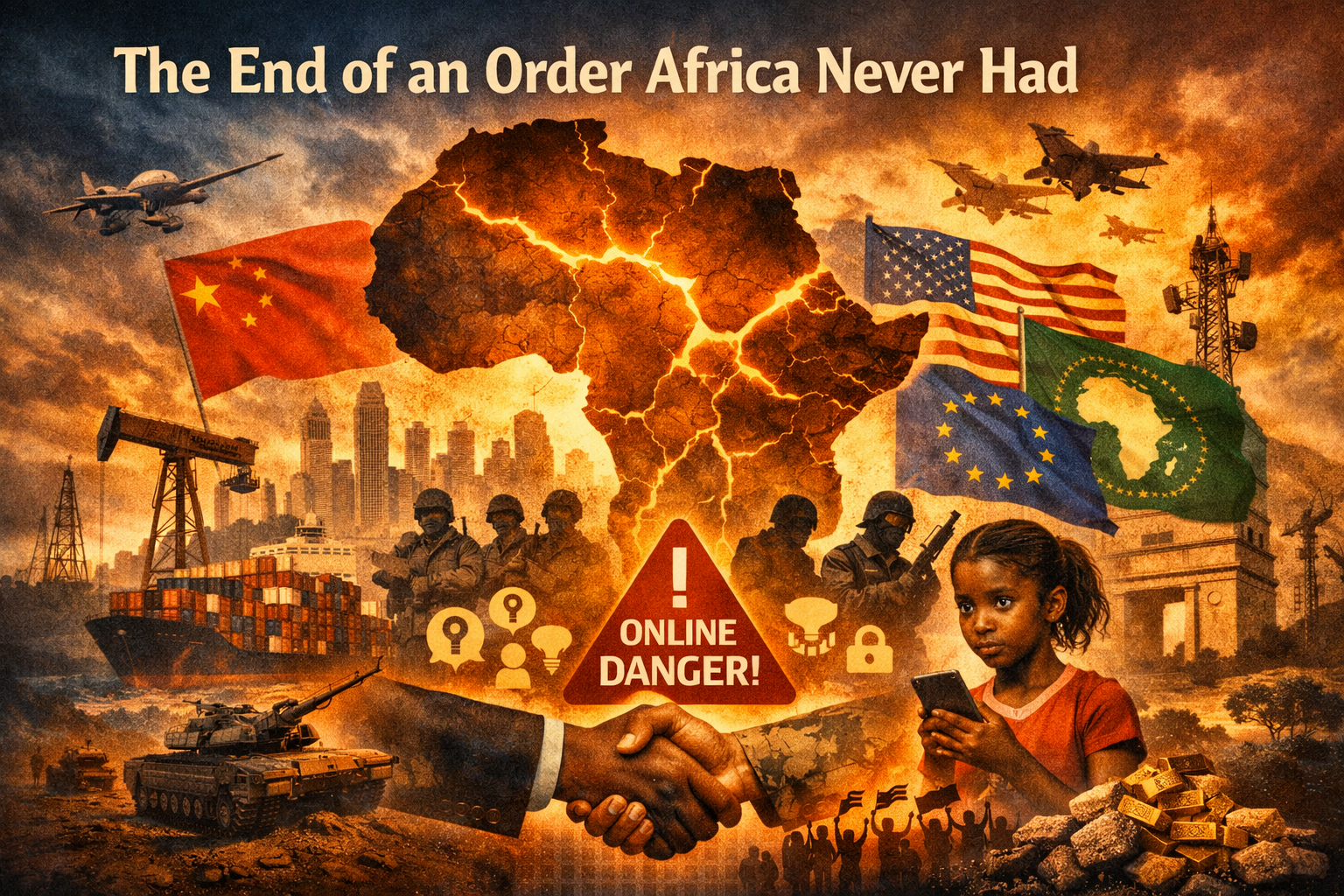
What the Fracturing of the Post-1945 International Liberal Order Reveals for African Security and Autonomy
The post-1945 international order is being described as if it is collapsing. For much of Africa, it is doing something more consequential: it is withdrawing. What is being framed in global policy circles as the breakdown of a shared system was never universally shared to begin with. The rules existed. The institutions functioned. But their protections, flexibilities, and enforcement were unevenly distributed.
The current moment does not mark the sudden destruction of order. It marks the erosion of the claim that the order was ever universal. This distinction matters not only analytically, but strategically. It reframes the issue from global instability to structural exposure, and for African states, exposure is a security concern.
The 2026 report by the Munich Security Conference, titled Under Destruction, captures the anxiety of this transition with unusual clarity. It points to the retreat of the United States from the institutions it once anchored, the fracturing of the multilateral trade system, and the collapse of development and humanitarian financing as evidence of a world in which the post-1945 settlement is being actively dismantled (Bunde et al., 2026). The diagnosis is not wrong. But it is incomplete.
What the report describes as systemic breakdown, much of Africa experiences as the removal of external buffers that long masked internal vulnerability. These are related phenomena, but they are not the same thing. One is a crisis of the powerful losing what they built. The other is a crisis of the less powerful losing what they never fully owned but had learned to depend upon.
A single line buried in the report captures this divergence. In a section on development financing, the report quotes John Dramani Mahama, speaking at the Africa Health Sovereignty Summit in Accra on August 5, 2025, where he had convened African leaders to respond to the steep withdrawal of Western health financing. Mahama described the moment as “a crisis of imagination, a vacuum of solidarity, and a deep failure of shared responsibility” (Mahama, 2025). The report reproduces the words and moves on.
But Mahama was not speaking abstractly. He was describing a structural condition: systems built on external continuity are most visible not when they function, but when that support is withdrawn. Across Africa, health architectures sustained by mechanisms such as PEPFAR and the Global Fund to Fight AIDS, Tuberculosis and Malaria are already under strain as funding commitments fluctuate. The issue is not simply financial. It is structural. And it points toward the deeper question the Munich Security Report never asks: what does the fracturing of this order actually mean for a continent whose relationship to it was never what it was assumed to be?
STRUCTURE WITHOUT SYMMETRY
The post-1945 system presented itself as universal. In practice, it functioned through asymmetry.
Under the World Trade Organisation, liberalisation was promoted globally, yet major economies retained protections in politically sensitive sectors. Agricultural subsidies in advanced economies continued to distort global markets for decades, limiting competitiveness for African producers and entrenching export structures that served the interests of buyers more than sellers (OECD, 2024). The rules existed. The access they provided was not equal.
Through the International Monetary Fund, structural adjustment programmes reshaped African economies across the 1980s and 1990s. Fiscal discipline, privatisation, and reduced public spending were the conditions of access to financing (Herbst, 1993). Macroeconomic indicators improved in many cases. But state capacity in health, education, and agriculture was weakened in the process, and the social costs were absorbed by populations rather than institutions. From a security standpoint this mattered. Reduced investment in social systems increases long-term vulnerability by fuelling inequality, eroding resilience, and, in certain contexts, generating the conditions for instability.
Even accountability mechanisms reflected the same pattern of uneven application. The International Criminal Court was initially embraced across the continent. Several African states were among its earliest and most active supporters, referring cases themselves and championing the principle that no leader should be beyond the reach of international justice. What became contested was not accountability but its distribution. Out of 54 individuals indicted by the court to date, 47 have been African (Amnesty International, 2024). At the African Union summit in Addis Ababa in May 2013, Ethiopia’s Prime Minister Hailemariam Desalegn, then serving as AU chairperson, declared that the process had degenerated into what he called “a race hunting” of Africans (Al Jazeera, 2013). The concern was not whether rules existed. It was whether they applied consistently across different concentrations of power.
The system was not absent. It was uneven, and that unevenness was not incidental to how the order functioned. It was structural.
GHANA AND THE SECURITY COST OF COMPLIANCE
Ghana illustrates how these structural dynamics translate into long-term vulnerability, and why the cost of the old order was never evenly distributed.
In 1983, under Jerry John Rawlings, Ghana implemented IMF-supported reforms under the Economic Recovery Programme. Growth resumed, inflation declined, and Ghana was repeatedly cited by the World Bank as a model of successful adjustment, earning the designation of the Bretton Woods institutions’ “star pupil” in Africa (Mawuko-Yevugah, 2014; Herbst, 1993; Boafo-Arthur, 1999). The macroeconomic results were real. But the gains were uneven.
By the mid-1990s, nearly half the population remained in poverty, and access to healthcare was constrained under the cash-and-carry system, which required payment at the point of treatment (UNDP, 1996). These outcomes reflected a broader trade-off embedded in the design of the programme itself: macroeconomic stabilisation achieved at the expense of social resilience. From a security standpoint this is the critical dimension. States that stabilise fiscally while weakening social systems do not resolve their underlying vulnerabilities. They defer them.
Ghana’s return to IMF support in 2022, following a sovereign debt crisis that brought the cedi into freefall and forced a restructuring of the country’s external obligations, reflects not policy failure in isolation, but structural continuity (Ministry of Finance Ghana, 2024). The conditions that made Ghana vulnerable in 2022 had been accumulating since the logic of external compliance was first embedded in national economic architecture four decades earlier. Ghana did not fail the system. The system reproduced the conditions that sustained vulnerability.
AUTONOMY AND ITS ASYMMETRIES
The response of major powers to the current rupture reveals another dimension of how the order actually functioned, one that is now difficult to ignore.
European states are actively pursuing diversification, expanding trade partnerships across South Asia, Southeast Asia, Latin America, and beyond, and reducing their strategic dependence on a single external anchor. The European Union finalised a landmark trade agreement with India in January 2026, concluded arrangements with Indonesia and Singapore, and completed negotiations with Mercosur after twenty-five years of talks (Euronews, 2025; Geopol Report, 2026). European Commission President Ursula von der Leyen has described this moment as one requiring Europe to build its own partnerships on its own terms, refusing to be a pawn in the competition between major powers (Munich Security Conference, 2026). German Chancellor Friedrich Merz has said the same.
This is a rational response to a world in which a single external partner can no longer be relied upon. But it is also, without apparent awareness, the precise strategy that African states were discouraged from pursuing for decades. When African governments sought to diversify their external partnerships toward China, toward the Gulf, toward other emerging economies, the response from established partners was frequently framed through the language of risk: debt dependency, strategic entanglement, and governance concerns. China-Africa trade exceeded 280 billion dollars in 2023 (UNCTAD, 2024), yet African engagement with Beijing remained more scrutinised than European engagement with the same partner.
The issue is not whether strategic autonomy is viable. It is who has been permitted to exercise it without penalty. Strategic autonomy was never absent from the liberal order. It was selectively legitimised. What the current rupture has done is make that selectivity visible in a way that decades of quieter asymmetry did not.
This is what the Munich Security Report captures only partially. It documents the fracturing of the order with precision. It describes European adaptation with sympathy. But it does not account for the fact that what Europe is now doing openly, building alternative partnerships and refusing structural dependence on a single power, was the behaviour that the order, in its period of coherence, discouraged African states from pursuing. The report mourns a system. It does not examine whose system it was.
FROM DEPENDENCY TO EXPOSURE
What is changing is not the disappearance of order. It is the weakening of the external architecture that allowed dependency to present itself as stability.
For decades, African states operated within a framework in which the policy space was externally conditioned, development financing was donor-dependent, and security operations relied heavily on outside support. These arrangements were not simply imposed. They were, in many cases, chosen, because the bilateral deal with Washington or Paris or the IMF always appeared less costly in the short term than the patient and politically demanding work of building independent capacity. The African Union still depends on external partners for the majority of its peace and security funding (ACCORD, 2025). This is not inevitable. It is the accumulated outcome of sustained structural choices made across decades and across governments.
What is now eroding is the narrative that these arrangements represent the only viable model. Without the external buffers that sustained the appearance of stability, vulnerabilities become more immediate. Fiscal shocks transmit faster into social pressure. Security gaps become harder to offset. Institutional weaknesses that external financing once smoothed over are now more visible and more consequential.
Africa is not entering disorder. It is entering a phase where the underlying structural conditions of the past four decades are no longer obscured by external support. That is a different kind of crisis from the one the Munich report describes. It is also, if African states respond to it seriously, a different kind of opportunity.
CONCLUSION
The Munich Security Conference asks whether the post-1945 order can be rebuilt. That question assumes a level of shared experience that did not exist.
What is fracturing is not simply a system. It is the credibility of that system’s universality. For the states that designed it, governed it, and benefited most reliably from its protections, the fracturing is experienced as loss. For much of Africa, it is experienced differently: as the withdrawal of an arrangement that provided partial shelter at significant cost, and whose terms were never fully reciprocal.
For Africa, this moment is defined not by collapse but by exposure. That exposure carries both risk and possibility. It removes the illusion of stability provided by systems whose continuity depended on decisions made elsewhere. But it also weakens the constraints that sustained dependency as the default arrangement. The structural opening that exists is real. Whether it is used depends entirely on decisions that African states and institutions must make themselves.
The critical question is not whether the old order survives. It is whether African states respond to its exposure by restructuring their position within what comes next, or continue to operate within a framework whose asymmetry has now become impossible to ignore. The terms of the order that replaces this one are not yet written. That is the most consequential fact of the current moment. And unlike the settlement of 1945, this time the question of who writes those terms is genuinely open.
References
ACCORD (African Centre for the Resolution of Conflict). (2025). The African Standby Force’s deployment efficiency in Sudan. https://www.accord.org.za/analysis/the-african-standby-forces-deployment-efficiency-in-sudan/
Al Jazeera. (2013, May 28). African leaders accuse ICC of “race hunt”. https://www.aljazeera.com/news/2013/5/28/african-leaders-accuse-icc-of-race-hunt
Amnesty International. (2024, April). A chance for Africa to counter the pitfalls of international criminal justice. https://www.amnesty.org/en/latest/news/2024/04/a-chance-for-africa-to-counter-the-pitfalls-of-international-criminal-justice/
Boafo-Arthur, K. (1999). Ghana’s politics of international economic relations under the PNDC. African Studies Quarterly, 3(1).
Brookings Institution. (2024, February). The future of African trade in the AfCFTA era. https://www.brookings.edu/articles/the-future-of-african-trade-in-the-afcfta-era/
Bunde, T., Eisentraut, S., et al. (2026). Munich Security Report 2026: Under Destruction. Munich Security Conference. https://securityconference.org/publications/munich-security-report/msr-2026/
Euronews. (2025, December 29). In 2025, global trade cracked as Europe hurt by US tariffs and new China shock. https://www.euronews.com/my-europe/2025/12/29/in-2025-global-trade-cracked-as-europe-hurt-by-us-tariffs-and-new-china-shock
Geopol Report. (2026, February 4). Europe’s pivot away from the US. https://www.geopolreport.com/reports/europes-pivot-away-from-the-us
Herbst, J. (1993). The politics of reform in Ghana, 1982-1991. University of California Press.
Mahama, J. D. (2025, August 5). Opening address at the Africa Health Sovereignty Summit, Accra, Ghana. Reported in AllAfrica and Health Policy Watch.
Mawuko-Yevugah, L. (2014). Reinventing development: Aid reform and technologies of governance in Ghana. Ashgate Publishing.
Ministry of Finance Ghana. (2024, December 4). IMF approves $360 million for Ghana as economic recovery gains momentum. https://mofep.gov.gh/news-and-events/2024-12-04/imf-approves-360-million-for-ghana-as-economic-recovery-gains-momentum
Munich Security Conference. (2026). Munich Security Report 2026: Under Destruction [Quotations from von der Leyen and Merz]. https://securityconference.org/publications/munich-security-report/msr-2026/
OECD. (2024). Agricultural support estimates. https://www.oecd.org/en/topics/agricultural-support.html
UNCTAD. (2024). Economic development in Africa report 2024. https://unctad.org/publication/economic-development-africa-report-2024
United Nations Development Programme. (1996). Human Development Report 1996. Oxford University Press.