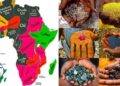









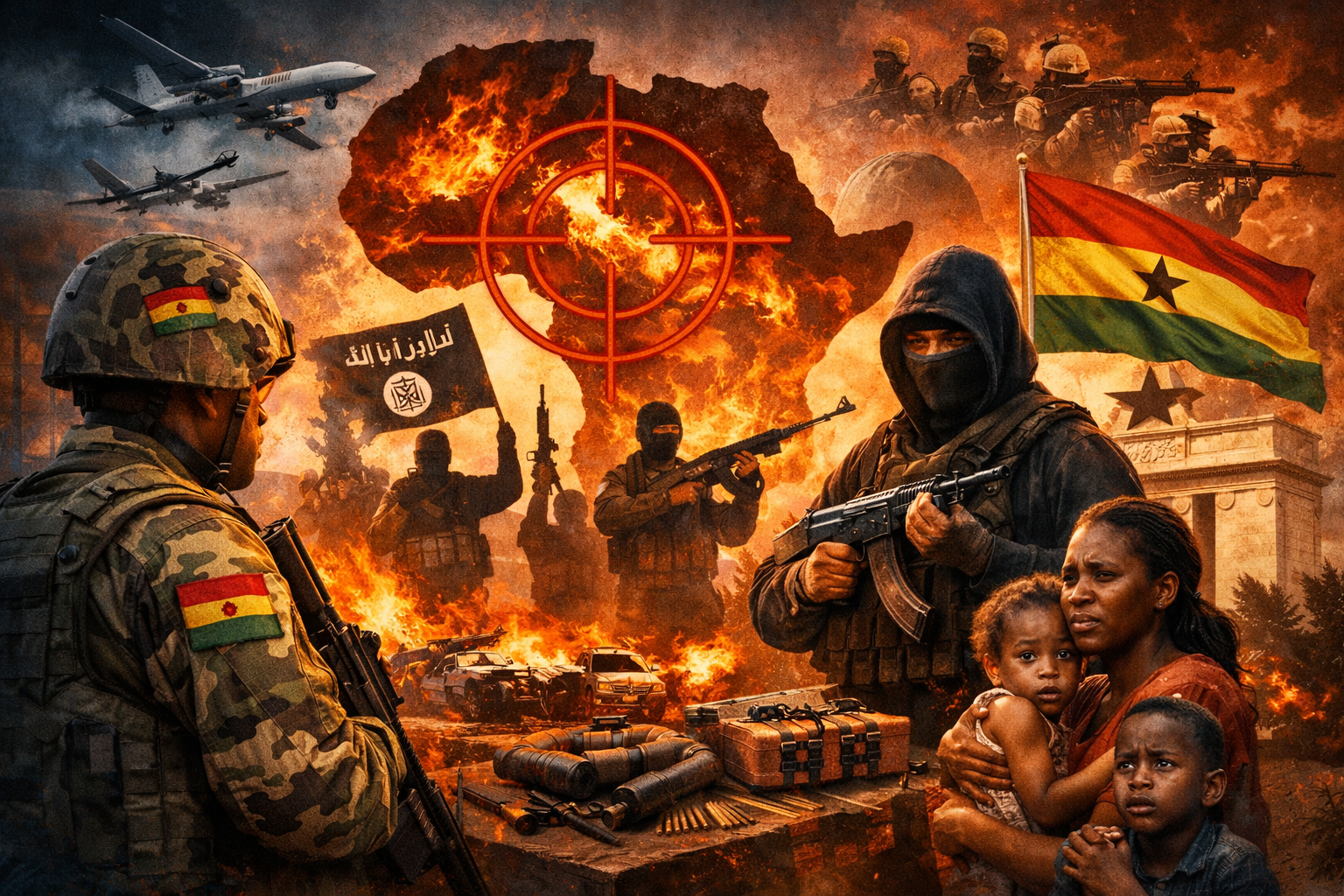
The geography of global terrorism has changed significantly. While global terrorism deaths declined in 2025, the threat has become more concentrated in Africa, particularly in the Sahel. The Global Terrorism Index 2026 reports that the Sahel now accounts for more than half of all terrorism-related deaths worldwide (Institute for Economics & Peace [IEP], 2026).
This shift has direct implications for Ghana. Although the country has not experienced large-scale terrorist attacks comparable to those in Burkina Faso, Mali, Niger, or Nigeria, it would be inaccurate to describe Ghana as untouched. Evidence suggests growing exposure through porous borders, regional instability, and recruitment of citizens into foreign conflicts.
The Sahel as the New Epicentre
The Sahel has emerged as the central theatre of global terrorism. Extremist groups affiliated with al-Qaida and the Islamic State, including Jamaat Nusrat al-Islam wal Muslimeen (JNIM), have expanded their influence across weakly governed areas. These groups exploit border regions, local grievances, and limited state presence.
Despite a reported 28% decline in global terrorism deaths in 2025, violence remains heavily concentrated in fragile African states (IEP, 2026). This concentration highlights a structural shift rather than a temporary fluctuation.
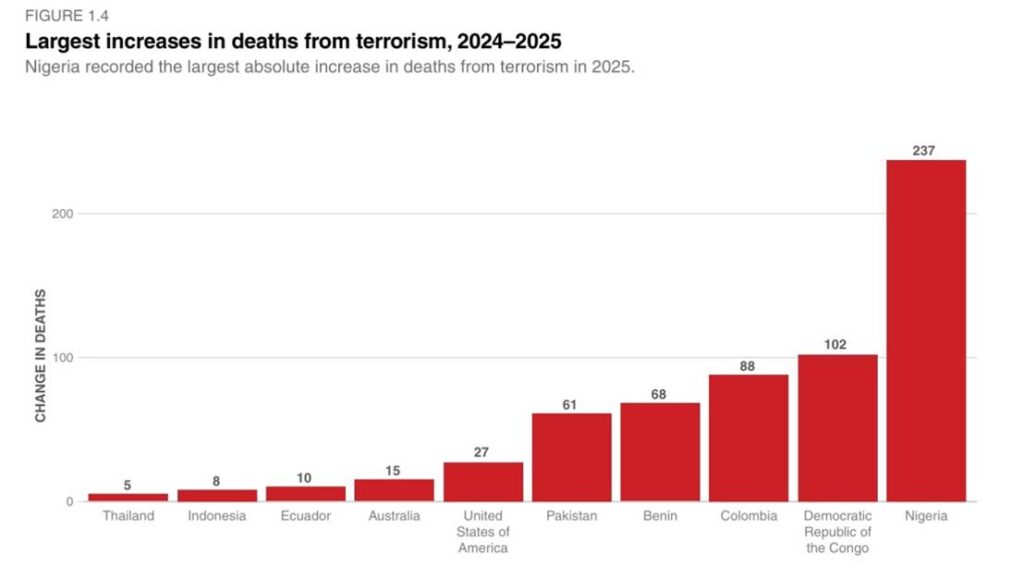
Source: GTI 2026 – Institute of Economics & Peace
Drivers of Extremist Expansion
The expansion of extremist groups in sub-Saharan Africa is driven primarily by governance challenges rather than ideology alone. Factors such as poverty, unemployment, marginalisation, weak institutions, and human rights abuses create fertile ground for recruitment.
According to the United Nations Development Programme (UNDP), 71% of individuals who voluntarily joined extremist groups cited government actions, particularly abuses by security forces, as the tipping point (UNDP, 2017). This finding underscores the importance of balancing security operations with human rights protections.
Ghana Is Not Immune
Ghana is often perceived as insulated from terrorism, but available evidence suggests otherwise. Over the years, there have been several reports which indicate that northern Ghana may have been used intermittently as a logistical or support area by militants operating in neighbouring Burkina Faso. While such claims should be interpreted cautiously, they point to potential vulnerabilities.
More concretely, Ghana has experienced cases of its citizens being recruited into foreign conflicts. In 2026, the Government of Ghana reported that at least 272 Ghanaians had been recruited to fight in the Russia–Ukraine war, with dozens reportedly killed (Pilling, 2026). Although this situation does not constitute terrorism in itself, it demonstrates the existence of recruitment networks capable of mobilising Ghanaians into armed conflicts abroad.
Legal and Policy Gaps
Ghana has established a legal framework to address terrorism through the Anti-Terrorism Act, 2008 (Act 762), which criminalises terrorist acts, financing, recruitment, and support activities (Republic of Ghana, 2008). Additionally, the Foreign Enlistment Act, 1961 (Act 75) regulates the enlistment of Ghanaian citizens into foreign armed forces (Republic of Ghana, 1961).
However, evolving threats expose gaps in these frameworks. Existing laws do not sufficiently address modern recruitment tactics, including online deception, informal agents, and transnational networks. A more comprehensive legal instrument focused specifically on foreign fighters and recruitment into armed conflicts could strengthen Ghana’s preventive capacity.
Policy Recommendations
To respond effectively, Ghana must adopt a proactive and multi-dimensional approach.
- Parliament should consider enacting updated legislation targeting recruitment into foreign conflicts, including terrorism, mercenary activity, and irregular armed groups. Such a law should criminalise recruiters, facilitators, financiers, and digital intermediaries.
- Secondly, Ghana should strengthen border intelligence systems, particularly in northern regions. This includes improving surveillance of informal crossing points, investing in intelligence gathering, and enhancing collaboration with local communities.
- Security operations must prioritise human rights and accountability. Evidence suggests that abuses by security forces can contribute to radicalisation rather than prevent it (UNDP, 2017).
- Fourth, The government of Ghana should deepen regional cooperation through ECOWAS and the Accra Initiative. Coordinated intelligence-sharing and joint operations are essential given the cross-border nature of extremist activity.
The government should increase investment in socio-economic development in northern Ghana. Employment, education, infrastructure, and access to services are critical components of long-term prevention.
Finally, public awareness campaigns should be expanded to educate citizens about recruitment tactics, particularly those targeting youth through promises of employment or migration opportunities.
Conclusion
Africa’s emergence as the epicentre of global terrorism is a significant shift with direct implications for Ghana. While the country has not yet experienced widespread attacks, it faces increasing exposure through regional instability, recruitment networks, and border vulnerabilities.
The key lesson from the Sahel is clear: prevention is more effective than response. Ghana must strengthen its legal frameworks, enhance intelligence systems, promote accountable security practices, and invest in vulnerable communities.
The threat is not only that terrorism may cross into Ghana, but that the conditions enabling it may take root internally. Acting early and decisively is therefore essential.
References
Adegoke, Y. (2024). Northern Ghana emerges as base for Sahelian terrorist organizations. Africa Defense Forum. https://adf-magazine.com
Institute for Economics & Peace. (2026). Global Terrorism Index 2026: Measuring the impact of terrorism. https://www.economicsandpeace.org
Pilling, D. (2026, February 27). Ghanaians recruited to fight in Ukraine war. The Guardian. https://www.theguardian.com
Republic of Ghana. (1961). Foreign Enlistment Act, 1961 (Act 75).
Republic of Ghana. (2008). Anti-Terrorism Act, 2008 (Act 762).
United Nations Development Programme. (2017). Journey to extremism in Africa: Drivers, incentives and the tipping point for recruitment. UNDP. https://www.undp.org