








| >50% ECOWAS territory formerly covered by AES states Georgetown Security Studies Review 2025 | 17% Share of ECOWAS population formerly in AES states Georgetown Security Studies Review 2025 | 31M+ People needing humanitarian assistance in the Sahel OCHA, June 2025 | 1,650 ECOWAS counter-terrorism brigade authorised troop strength ISS Africa / ECOWAS, 2026 |
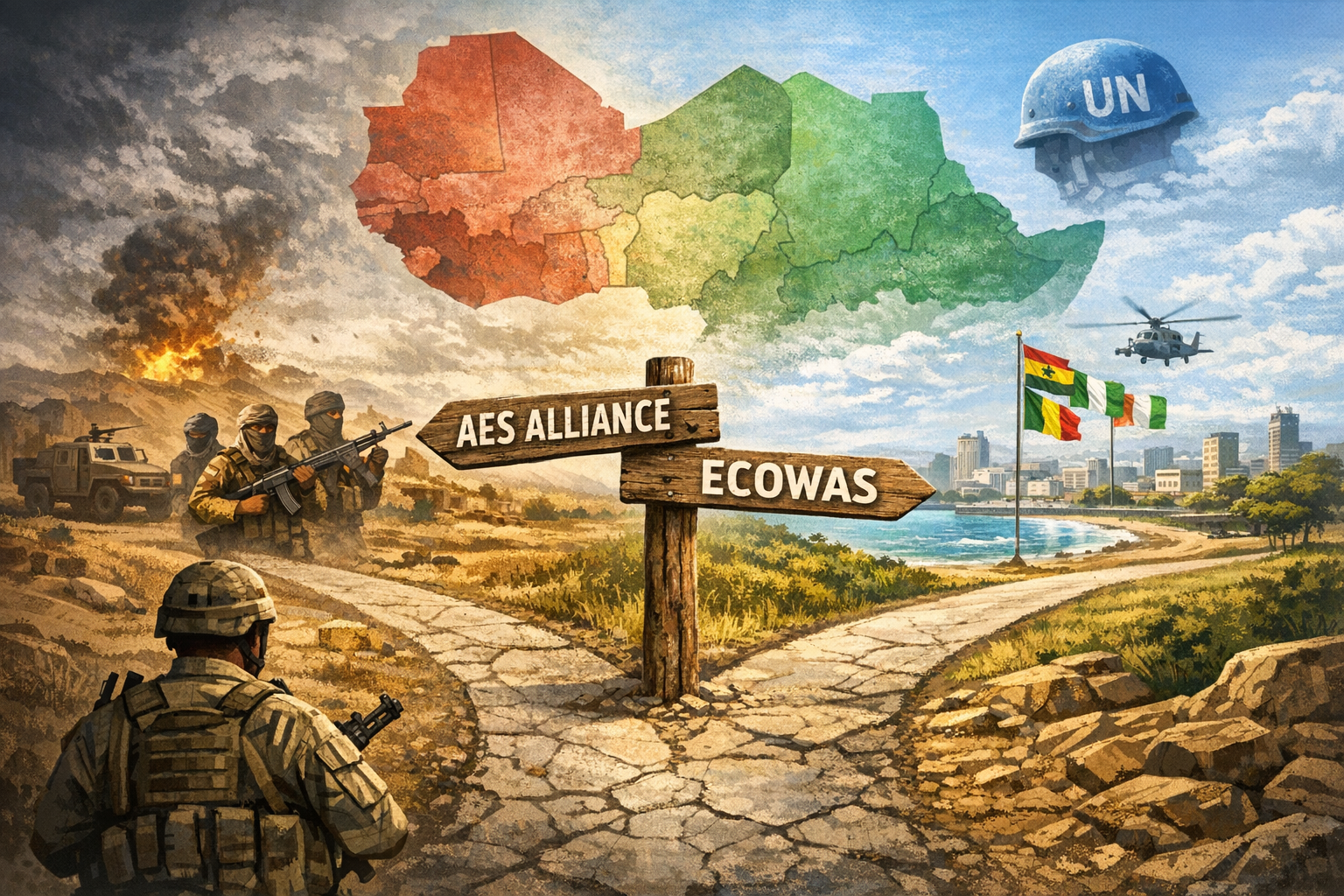
| ABSTRACT On 29 January 2025, the Economic Community of West African States (ECOWAS) suffered its most consequential institutional rupture since its founding in 1975: the formal withdrawal of Burkina Faso, Mali, and Niger constituting over half of ECOWAS territory, 17 percent of its population, and approximately 7.7 percent of its GDP to form the Alliance of Sahel States (AES). This article analyses the security architecture implications of this fracture, evaluates Ghana’s role as a mediating diplomatic actor, and assesses whether informal bilateral and issue-specific cooperation can substitute for the formal multilateral security framework now in fragmentation. The article argues that the ECOWAS-AES split has created a structural security vacuum that existing institutional responses are insufficient to fill, and that Ghana’s diplomatic agency while commendable cannot compensate for a systemic breakdown of collective defence. |
1. The Rupture: Scale and Historical Significance
The formal exit of Burkina Faso, Mali, and Niger from ECOWAS on 29 January 2025 despite a final six-month grace period offered by the bloc in December 2024 represents, in the assessment of Colonel Festus Aboagye (Ret.) at Amani Africa, ‘the most significant crisis in West Africa’s regional integration since the founding of ECOWAS in 1975’ (Amani Africa, 2025). The three countries had first announced their intention to withdraw on 28 January 2024, and despite sustained diplomatic efforts by ECOWAS heads of state including mediation led by Senegalese President Bassirou Diomaye Faye, the exit took effect on schedule. ECOWAS Commission President Omar Touray formally acknowledged the departure, noting that the bloc would ‘keep its doors open’ while establishing transitional arrangements to protect citizens’ rights.
The three AES states now operating as the Confederation of Sahel States since July 2024 collectively controlled more than half of ECOWAS’s total territorial surface area, hosted 17 percent of its population, and represented approximately 7.7 percent of its aggregate GDP (Georgetown Security Studies Review, 2025). For cross-border counterterrorism operations, intelligence sharing, and humanitarian coordination, these figures translate into an irreplaceable operational deficit that ECOWAS’s remaining twelve member states cannot compensate for.
2. The Drivers of Fragmentation
The AES exit cannot be attributed to any single cause. The immediate trigger was ECOWAS’s response to the July 2023 Niger coup threatening military intervention and imposing severe economic sanctions that, according to WANEP (2024), ‘endangered the integration process and gave rise to humanitarian crises.’ But the rupture had deeper structural roots: ECOWAS’s perceived ineffectiveness in addressing Sahelian terrorism over more than a decade, sovereignty anxieties over French and Western influence in ECOWAS decision-making, and the emergence of alternative security partnerships primarily Russia’s Africa Corps deployment that reduced the AES states’ dependence on ECOWAS frameworks (Amani Africa, 2025; Chatham House, 2025).
The AES coup governments enjoyed significant domestic popular legitimacy, rooted in public frustration with previous civilian administrations’ failure to contain jihadist violence. This popular mandate insulated the juntas from ECOWAS’s democratic governance conditionality. The bloc’s zero-tolerance posture on unconstitutional power changes paradoxically accelerated the exit it sought to prevent. ECOWAS’s fundamental error was treating a legitimacy crisis as a sanctions problem, a miscalculation that Chatham House (2025) described as ‘diplomatically maladroit.’
3. Security Implications: The Counterterrorism Void
The most acute consequence of the ECOWAS-AES fracture is the collapse of coordinated counterterrorism architecture at the precise moment when West Africa’s security crisis demands maximum institutional cohesion. The ISS (2026) assessment is direct: ‘A fight against armed groups cannot be effective without cooperation from the three central Sahel countries, which remain the epicentre of terrorism that is spreading to coastal countries.’ The Sahel accounted for 19 percent of all global terrorist attacks and more than 51 percent of global terrorism-related deaths in 2024 (IEP, 2025).
Without the AES states, ECOWAS’s new counter-terrorism brigade authorised at 1,650 troops, dramatically scaled down from the 260,000-strong force originally proposed at the August 2025 African Chiefs of Defence Staff Summit in Abuja faces profound structural limitations (ISS Africa, 2026). While six states; Benin, Côte d’Ivoire, The Gambia, Ghana, Nigeria, and Senegal have committed troop contingents, the brigade must patrol vast border zones without the AES states’ intelligence networks, logistics infrastructure, or territorial access.
Table 2: ECOWAS Security Architecture — Assessment Before and After AES Withdrawal
| Dimension | Pre-January 2025 | Post-AES Withdrawal | Risk Level |
| Intelligence sharing | Functional via Accra Initiative | Disrupted — informal channels only | Critical |
| Cross-border CT operations | Partially coordinated (G5 Sahel) | Fragmented — AES operating independently | Critical |
| Humanitarian coordination | Structured through ECOWAS | Severely underfunded and disconnected | High |
| Trade and movement | Free movement under ECOWAS protocols | Transitional terms pending | High |
| CT brigade financing | 260,000-troop ambition; USD 2.5B/yr | 1,650 troops; ECOWAS community tax financing | Medium-High |
Source: ISS Africa (2026); WANEP (2024); ECOWAS Standby Force documentation (2025–2026).
4. Ghana’s Diplomatic Intervention: Scope and Limits
Ghana, under President John Mahama, has assumed the most active diplomatic posture of any coastal state in attempting to bridge the ECOWAS-AES divide. Ghanaian and Senegalese special envoys have conducted substantive shuttle diplomacy across Accra, Dakar, Niamey, Ouagadougou, and Bamako, pursuing security and trade cooperation through bilateral channels (Crisis Group, 2025). Ghana’s Foreign Minister Samuel Ablakwa, speaking at Chatham House in March 2026, framed the challenge with candour that distinguished Ghana’s approach: ‘We have to admit that there is a genuine concern in francophone Africa that their relations with France will have to be reset. Terrorism taking root is a threat to the entire global community’ (Chatham House, 2026).
Ghana has also pursued bilateral joint security initiatives with Burkina Faso, a pragmatic acknowledgement that shared borders demand operational cooperation regardless of formal institutional standing. Bilateral diplomacy, however energetic, cannot substitute for the institutionalised intelligence-sharing protocols, standing forces, and resource-pooling mechanisms that only a functioning multilateral framework can provide. Ghana is managing the consequences of a system failure, not fixing the system.
5. A Viable Path Forward: The Twin-Track Approach
The International Crisis Group (2025) proposes a framework that merits serious consideration: cooperation between ECOWAS and AES states that does not require formal reintegration, but instead operates through ‘flexible, issue-specific agreements, bilateral ones at first, but with the goal of eventually kindling more expansive understandings.’ This dual-track approach — maintaining ECOWAS governance principles while pragmatically engaging AES states on shared security imperatives represents the most credible near-term path available.
| INSTITUTIONAL RECOMMENDATION: Making the ECOWAS Counter-Terrorism Brigade Work The ECOWAS Chiefs of Staff endorsed a 1,650-strong counter-terrorism brigade in February 2026, a scaled-down but concrete step. Six states have committed troops. The ISS (2026) argues that for this force to be effective, direct communication lines must be restored between ECOWAS and AES general staffs, with the AU serving as a neutral mediator. UN Security Council Resolution 2719 provides a financing mechanism covering 75 percent of AU-mandated peace support operations, a resource ECOWAS must actively leverage. Without AES cooperation, the brigade risks becoming a symbol rather than an operational instrument. |
Ghana’s unique position as ECOWAS’s most active mediator, the AfCFTA Secretariat’s host, and a state with direct border exposure to both Burkina Faso and Togo places it at the intersection of every relevant security, trade, and governance dynamic in West Africa. A robust, adequately resourced Ghanaian foreign and security policy strategy could position Accra as the indispensable convening power for any future ECOWAS-AES rapprochement.
6. Conclusions
The ECOWAS-AES rupture is the single most consequential development in West African security architecture in half a century. Its effects disrupted intelligence sharing, collapsed counterterrorism coordination, hampered humanitarian response, and emboldened jihadist expansion into coastal states are already manifesting across the region. Ghana cannot insulate itself from these consequences through bilateral diplomacy alone. The government must invest in making ECOWAS’s counter-terrorism brigade operationally credible, pursue twin-track engagement with AES states through AU mediation, and champion a regional security financing compact that closes the gap between institutional ambition and funded reality.
References
1. Amani Africa. (2025, January 31). The Withdrawal of AES from ECOWAS: An Opportunity for Re-evaluating Existing Instruments for Regional Integration? Addis Ababa: Amani Africa.
2. Chatham House. (2025, April). Navigating a Path Beyond Regional Division is Essential for West Africa’s Security. London: Chatham House.
3. Chatham House. (2025, December). West Africa Needs Regional Solutions to Combat the Escalating Sahel Security Crisis. London: Chatham House.
4. Chatham House. (2026, March). Nigeria and Ghana Foreign Ministers Discuss Security, AES Countries, Boko Haram and US Operations. London: Chatham House.
5. Georgetown Security Studies Review. (2025). Coalition of Coups: The AES-ECOWAS Split and West Africa’s Security Crisis. Washington DC: GSSR.
6. Institute for Economics and Peace. (2025). Global Terrorism Index 2025. Sydney: IEP.
7. International Crisis Group. (2025). Seven Peace and Security Priorities for Africa in 2026. Africa Report No. 209. Brussels: ICG.
8. ISS Africa. (2026, March). How ECOWAS Can Make Its New Counter-Terrorism Force Effective. ISS Today. Pretoria: ISS.
9. OCHA. (2025, June). 2025 Sahel Humanitarian Needs and Requirements Overview. Dakar: OCHA.
10. Security Council Report. (2025, March 31). West Africa and the Sahel Monthly Forecast. New York: SCR.
11. WANEP. (2024). Security and Economic Implications of the Exit of the AES Countries from ECOWAS. Accra: WANEP.
12. World Politics Review. (2025, April). The ECOWAS-AES Split Is Worsening Security in West Africa.
Comments: why do you suggest civilian and CSO interventions? Is that a worthy suggestion? Perhaps, you should clarify that.