






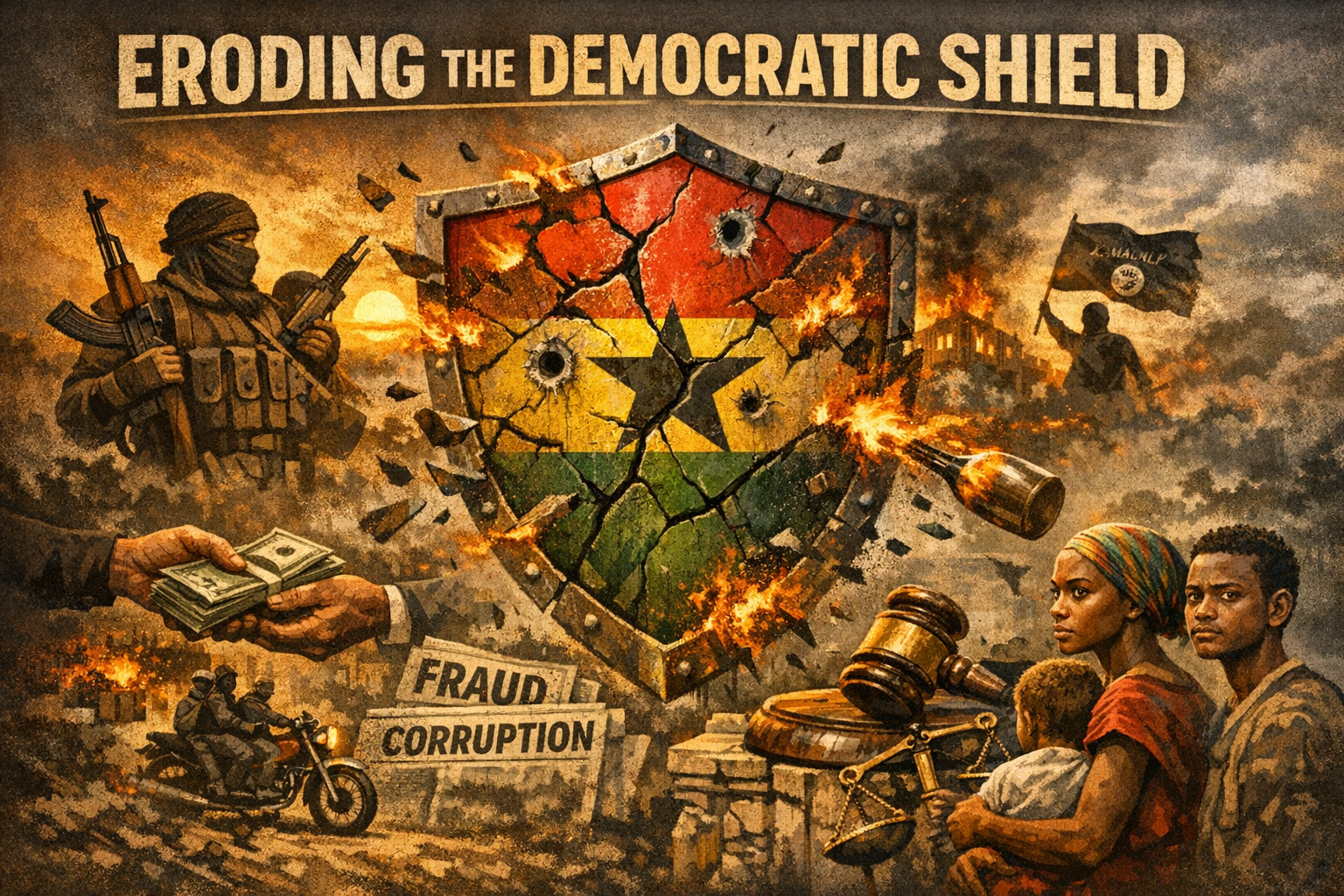
Public Trust Deficits, Security Sector Abuse, And The Radicalisation Risk In Ghana
| −23% Decline in public satisfaction with democracy in Ghana, 2012–2024 Afrobarometer 2024 (Round 10) | 32% Ghanaians who view military rule as a viable alternative (2024) Afrobarometer / BTI 2026 | 2023 Year of first confirmed failed domestic IED plot in Ghana NCTFC / GNA 2026 | 51% Ghanaians endorsing military intervention if elected leaders abuse power (2024) Afrobarometer / CDD-Ghana 2024 |
| ABSTRACT Ghana’s reputation as a beacon of democratic stability in West Africa has long served as its primary strategic asset and its most persuasive deterrent against violent extremism. That reputation is now under measurable strain. This article synthesises findings from the Institute for Security Studies (ISS), the Centre for Strategic and International Studies (CSIS), the Ghana Centre for Democratic Development (CDD-Ghana), and Afrobarometer to document a systemic erosion of public trust in Ghana’s security institutions the police, military, and judiciary driven by documented abuses, the political militarisation of security functions, and deepening governance deficits. The article argues that this trust erosion is not merely a governance inconvenience; it is a national security threat that creates precisely the conditions in which violent extremism flourishes, and that the Mahama administration faces an urgent, time-bound window for security sector reform. |
1. The Democratic Dividend and Its Erosion
For three decades, Ghana’s democratic governance framework anchored in its 1992 Constitution, competitive multiparty elections, and consistent peaceful transfers of power has served as a structural buffer against the instability consuming neighbouring states. Freedom House currently classifies Ghana as one of only two West African countries rated ‘Free,’ and the December 2024 elections, which delivered a peaceful transfer of power to President John Mahama, reaffirmed what Chatham House (2026) described as Ghana’s reputation as a ‘regional democratic anchor.’
Yet beneath this institutional architecture lies a security sector that multiple independent research bodies have found to be in a state of credibility crisis. The ISS (2025) analysis, based on 2024 consultations with civil society and state security actors, concludes directly that ‘Ghana’s reputed stability is at risk from complex security threats and declining public trust in the police, army and judiciary.’ The CSIS (2025) assessment, drawing on field interviews in Accra and Tamale, finds that ‘public trust in the government has eroded because of chieftaincy issues, IMF policies, government corruption, and controversial government spending,’ with communities in northern and urban border areas ‘relying on self-policing due to the inadequate security presence.’
The erosion is quantifiable. Afrobarometer data shows that between 2012 and 2024, public satisfaction with democracy in Ghana declined by 23 percentage points indicating one of the steepest declines recorded among established African democracies (Afrobarometer, 2024). The 2024 round of the survey further found that 32 percent of Ghanaians now view military rule as a viable alternative to democratic governance, and 51 percent expressed willingness to endorse military intervention if elected leaders abuse power, an 11-percentage-point increase from 40 percent in 2022 (Afrobarometer / CDD-Ghana, 2024). Ghana’s Ibrahim Index of African Governance score has stagnated since 2014, with specific declines recorded in security and rule of law. These are not abstract metrics; they are leading indicators of the institutional fragility that precedes the collapse of civilian security legitimacy.
2. A Catalogue of Institutional Failure
The ISS documentation of security sector misconduct covers incidents from 2017 to 2024. Police forces have repeatedly deployed excessive and lethal force against civilians, including students. Peaceful demonstrations have been disrupted and protesters unlawfully detained. During the December 2024 elections widely praised internationally for their peaceful conduct soldiers were accused of shootings at voting stations in Obuasi East, resulting in one confirmed fatality (ISS, 2025).
Military personnel shot and killed protesting youth in Ejura in 2021, an incident that prompted a formal government-commissioned inquiry. Military personnel also brutalised civilians in the Taifa-Ashaiman area in 2023 following the death of a soldier. In 2021, military personnel were implicated in the arrest and torture of children accused of stealing an officer’s laptop an incident that triggered formal legal proceedings against the Ghana Armed Forces. These were not isolated lapses; they form a documented pattern (ISS, 2025).
Military overreach extends beyond episodic abuse. Soldiers have provided VIP protection for government officials, a function constitutionally reserved for the police and have been deployed to secure galamsey concessions, creating documented conflicts of interest that link the armed forces to the illegal mining economy (ISS, 2025; CDD-Ghana, 2024). In January 2021, military personnel entered Parliament during a contentious political standoff over the organisation of the inaugural parliamentary session; an incident described by constitutional scholars as a clear transgression of civil-military boundaries. Ghana’s defence force is also assessed by the ISS as being at high institutional risk for corruption, with the consequent threat to operational integrity during a period of rising regional insecurity.
3. The Security-Radicalisation Nexus
The security implications of this trust erosion extend far beyond policing quality. The relationship between institutional illegitimacy and violent extremist recruitment is empirically well-established. UNDP’s Journey to Extremism in Africa (2023) identifies governance deficits, perceived injustice, and mistrust of state institutions as primary radicalisation pathways across the continent. When communities cannot trust the police to protect them or the courts to deliver justice, they become susceptible to alternative protection providers, and in the West African context, those providers are JNIM and ISGS.
The ISS (2025) consultations found that the ‘fraught relationship’ between civil society, communities, and security institutions ‘limits collaboration on pressing issues like preventing violent extremism.’ In the northwest precisely the region of highest radicalisation susceptibility, citizens are ‘considered especially susceptible to radicalisation,’ with farmer-herder conflicts, land boundary disputes, and chieftaincy tensions creating a grievance landscape that extremist groups have proven, repeatedly, they can exploit. CSIS (2025) found that communities are ‘relying on self-policing’ as a response to inadequate and distrusted formal security presence, the identical precondition that preceded the security collapse in Burkina Faso’s Cascades and Est regions.
| CASE STUDY: The Burkina Faso Scenario — A Mirror for Ghana In 2014, the Global Terrorism Index began recording deteriorating terrorism indicators in Burkina Faso, a country that had seen near-zero terrorism impact in prior years. By 2024, Burkina Faso ranked first globally on the GTI, recording 1,532 fatalities (GTI 2025). In 2025, Pakistan displaced Burkina Faso at the top of the Index though the Sahel, including Burkina Faso, Niger, and Mali, still accounts for more than half of global terrorism deaths (GTI 2026). The pathway was not primarily military; it was institutional: the collapse of public trust in security forces following political upheaval, the perceived abandonment of northern communities by the state, and the vacuum filled by JNIM’s promise of justice and protection. Northern Ghana shares the same structural profile: high poverty, low institutional trust, porous borders, intercommunal conflict, and proximity to active jihadist corridors. The difference, in April 2026, is that Ghana still has time to act. Sources: IEP Global Terrorism Index 2025; IEP Global Terrorism Index 2026. |
4. The Case for Comprehensive Security Sector Reform
The CSIS (2025) and ISS (2025) analyses converge on a reform agenda whose elements are clear and achievable within a single presidential term. First, military roles and deployment protocols in internal security operations must be clearly defined and legally circumscribed. The current practice of deploying soldiers for functions, electoral security, VIP protection, galamsey enforcement, parliamentary impasse management that fall within the police mandate creates structural distortions that damage both institutions. Second, independent oversight mechanisms for security sector conduct must be strengthened, with transparent and publicly communicated accountability processes for documented abuses. Third, the National Security Council’s composition must be reformed to incorporate civilian security experts and civil society representatives. This will end what the ISS describes as the ‘exclusivity’ culture that marginalises community-based actors most essential to prevention work.
Fourth, the Government of Ghana must invest substantially in trust-rebuilding programmes in northern Ghana’s border communities: community policing mechanisms with genuine civilian oversight, district-level community security councils, and sustained dialogue platforms that give communities a meaningful stake in their own security governance. Ghana’s National Security Strategy explicitly identifies ‘the individual Ghanaian citizen and his local community’ as the foundational units of national security. The evidence gathered by ISS and CSIS in 2024 and 2025 suggests the security sector has not yet internalised this principle.
5. Policy Recommendations
The Government of Ghana should treat security sector reform not as an auxiliary governance objective but as the primary national security priority of this term. Five actions are recommended:
(1) Commission and publicly publish an independent audit of all documented security force abuses since 2017, with enforceable accountability mechanisms.
(2) Enact clear legislation defining the circumstances and authorisation process for military deployment in internal security roles.
(3) Establish district-level Community Security Councils in all five northern regions, co-chaired by traditional authorities and civil society representatives, with genuine budgetary authority.
(4) Increase police-to-population ratios in border communities with dedicated national budget allocations not project funding.
(5) Reform recruitment and promotion processes for all security agencies; Afrobarometer data consistently identifies these as primary drivers of institutional delegitimisation.
Comment
Your recommendation 3 requires further discussion. A critical factor in insecurity in large areas across the country is engendered by traditional authorities.
References
1. CDD-Ghana / CSIS. (2025, September). Ghana: Facing Internal and External Threats Without Citizen Support. CSIS Analysis. Washington DC: CSIS.
2. Ghana Centre for Democratic Development. (2024). Security Sector Governance in Ghana: Annual Assessment. Accra: CDD-Ghana.
3. ISS Africa. (2025, January). Ghana’s Road to Rebuilding Public Trust Starts with Security Reforms. ISS Today. Pretoria: ISS.
4. ISS Africa. (2025). Will Ghana’s Mahama Grasp the Nettle of Constitutional Reform? ISS Today. Pretoria: ISS.
5. KAIPTC. (2025). In the Eye of the Storm: Building Resilient Communities to Resist VEOs in Ghana. Accra: KAIPTC.
6. Ghana National Security Strategy. Ministry of Foreign Affairs and Regional Integration. Accra: Government of Ghana.
7. UNDP. (2023). Journey to Extremism in Africa: Pathways to Recruitment and Disengagement. New York: UNDP.
8. Chatham House. (2026, January). Africa in 2026: Global Uncertainty Demands Regional Leadership. London: Chatham House.
9. ACCORD. (2023). The Risk of Violent Extremism and Terrorism in the Coastal States of West Africa. Conflict Trends No. 2023/1. Johannesburg: ACCORD.
10. Institute for Economics and Peace. (2025). Global Terrorism Index 2025. Sydney: IEP.
11. Institute for Economics and Peace. (2026). Global Terrorism Index 2026. Sydney: IEP.
12. Afrobarometer. (2024). African Insights 2024: Democracy at Risk — The People’s Perspective. Accra: Afrobarometer.
13. Afrobarometer / CDD-Ghana. (2024). Summary of Results: Afrobarometer Round 10 Survey in Ghana, 2024. Accra: CDD-Ghana.