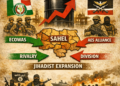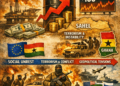







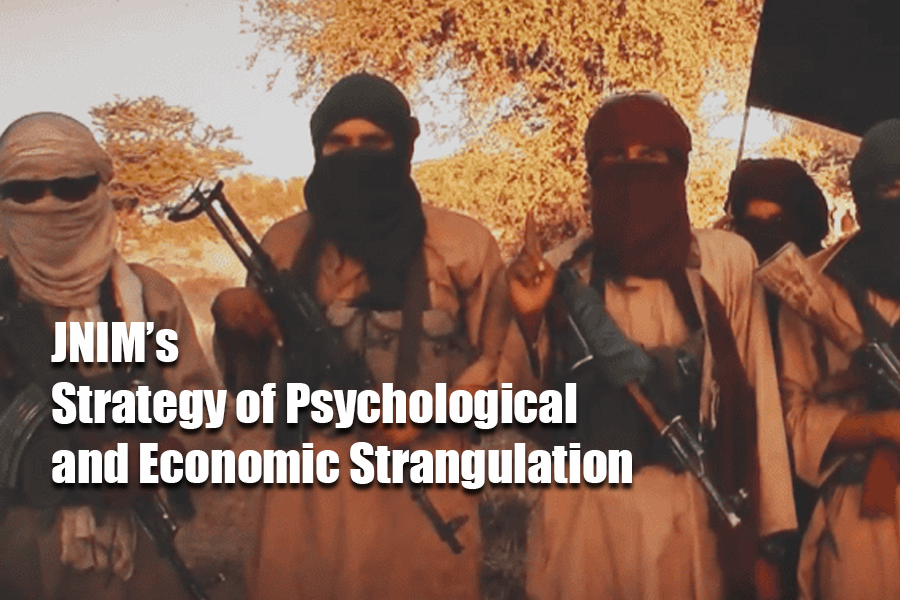
The insurgency in the Sahel, primarily spearheaded by the al-Qaeda-linked Jama’at Nusrat al-Islam wal-Muslimin (JNIM), has entered a deeply unsettling phase. Moving past the costly and often unsustainable strategy of physically seizing and holding remote territories, the group is now deploying a sophisticated form of economic and psychological warfare aimed squarely at undermining the authority of the State and its grip on urban centres (Security Council Report, 2025; Responsible Statecraft, 2025).
This strategic evolution demands immediate, integrated responses from regional authorities, particularly those in coastal West Africa.
The Playbook: Control Without Occupation
The recent fuel blockade imposed on the Malian capital, Bamako, is a perfect case study. JNIM has demonstrated that massive civilian suffering and economic paralysis can be achieved from a distance, without deploying a single fighter into the city. This strategy prioritises leveraging civilian dependency and state fragility (Africa Defense Forum, 2025; MEF Online, 2025):
- Economic Strangulation:
By targeting and interdicting vital supply convoys—like the fuel trucks destined for Bamako from neighbouring coastal states—JNIM showcases the State’s inability to guarantee basic essential services (Security Council Report, 2025; Texas Public Radio, 2025). This engineered scarcity, leading to school and university closures although subsequently reopened, inflicts maximum social and economic pain and is a powerful tool for eroding public confidence (Africa Defense Forum, 2025). They also attack major trade corridors and industrial sites to diminish state revenue while bolstering their own financial base (The Soufan Center, 2025).
- Shadow Governance through Social Dictates:
Alarmingly, JNIM is successfully imposing its will on the private sector and daily life of the ordinary citizenry. The group’s dictates in the transport sector and explicit threats against companies perceived as aiding the military demonstrate an effective form of extra-judicial corporate regulation (Africa Defense Forum, 2025). This establishes a shadow authority that dictates the terms of operation in vast areas, undermining the State’s monopoly on legitimate authority (CSIS, 2021).
- Psychological War – Controlling the Narrative:
JNIM’s rhetoric assures the public that their fight is solely against the State. By controlling the flow of goods and setting the conditions for a return to normalcy, the group seizes the narrative of the urban dweller’s sufferance. This fosters a psychological detachment from the state, as the population perceives the insurgents as the primary influence on their daily reality (Africa Defense Forum, 2025).
Financial Emboldenment: The Interplay on Kidnapping
The successful negotiation of an exorbitant $50 million ransom and a prisoner exchange for three foreigners, including a member of the UAE royal family, represents a major strategic victory and financial boost for JNIM (AL-Monitor, 2025; Stratfor, 2025). This “economic jihad” makes kidnapping a pillar of their strategy (AL-Monitor, 2025).
This liquid capital is critical:
- It will fund expansion, increase recruitment, and allow for the potential acquisition of advanced weaponry, such as commercial drones (AL-Monitor, 2025; Stratfor, 2025).
- It sets a dangerous precedent, making future high-value kidnappings of foreign investors and non-Western nationals (Chinese, Indians, Egyptians) more likely, further crippling Bamako’s economic outlook and investor confidence (AL-Monitor, 2025; Policy Center for the New South, 2020).
The Projected Threat: What Comes Next?
Given this evolving strategy of attrition and economic warfare, the next orders issued by JNIM are likely to be calculated steps to deepen the isolation and chaos of key urban centres:
- Targeting Food Supply Chains:
Expect attacks or blockades on key arteries for essential food imports, driving up food prices and creating a more severe humanitarian crisis (Africa Defense Forum, 2025; AL-Monitor, 2025).
- Imposing Informal Taxes:
Extending their “governance” by issuing decrees demanding “taxes” or “protection fees” from traders and businesses on key trade routes, forcing tacit compliance from the economic sector (Africa Defense Forum, 2025; MEF Online, 2025).
- Critical Infrastructure Sabotage:
Targeted, non-territorial strikes on power grids or telecommunications infrastructure, causing widespread blackouts and communication failures to demonstrate the State’s fragility (UN Security Council, 2017).
Compliance from the public, driven by the basic human need for survival and security, will tragically continue unless the State can effectively reassert its control (Africa Defense Forum, 2025).
Strategic Imperatives for Coastal West Africa
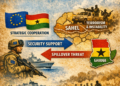
For the coastal states (Côte d’Ivoire, Ghana, Togo, Benin) that face the southward expansion of this threat, the lessons are clear. The preparation must be based on resilience, redundancy, and re-establishing the social contract.
Coastal authorities should focus on the following core areas:
- Re-engineering Economic Resilience:
Establish strategic reserves of critical commodities (fuel, grain) for a minimum of three to six months and diversify import sources (Security Council Report, 2025; Africa Defense Forum, 2025).
- Supply Chain Redundancy:
Map and invest in alternative, quickly securable, and redundant supply routes connecting major ports to capital cities. This requires enhanced cross-border security cooperation (The Soufan Center, 2025).
- Critical Infrastructure Protection (CIP):
Conduct a full Mapping of Critical Infrastructure (CI) (e.g., fuel depots, power stations). Develop risk mitigation procedures and invest in redundant systems (e.g., localized micro-grids, satellite communication backups) to ensure operational continuity in the event of targeted attacks (UN Security Council, 2017; UN-CTED, 2017; OSCE, 2025).
- Building Citizen Resilience:
Launch educational campaigns to counter the insurgents’ psychological operations and teach citizens self-reliance and community resource-sharing during crises. This helps to undermine the insurgents’ ability to control the public narrative (UN-CTED, 2017).
- Protecting the Private Sector:
Establish clear, secure channels of communication and financial/security assistance for key private companies. Removing the incentive for corporate compliance with terrorist dictates is vital (CSIS, 2021).
- Focus on Local Governance:
Address root grievances in all regions. A responsive, effective local government is the most effective counter-narrative to JNIM’s attempts to establish a shadow proto-state (Security Council Report, 2025).
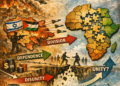
The war against JNIM’s new strategy is less about territory and more about legitimacy. Coastal States must prioritise demonstrating their capacity to protect their people and maintain the social contract, even when under economic and psychological duress from afar.
References
Agence France-Presse (AFP). (2025, November). Royal ransoms, a top money-maker for Mali’s jihadist kidnappers. AL-Monitor. https://www.al-monitor.com/originals/2025/11/royal-ransoms-top-money-maker-malis-jihadist-kidnappers
Africa Defense Forum (ADF). (2025, November). JNIM Blocks Mali’s Fuel Supply, Driving Insecurity. Africa Defense Forum. https://adf-magazine.com/2025/11/jnim-blocks-malis-fuel-supply-driving-insecurity/
Center for Strategic and International Studies (CSIS). (2021, July). Examining Extremism: Jama’at Nasr al-Islam wal Muslimin. CSIS. https://www.csis.org/blogs/examining-extremism/examining-extremism-jamaat-nasr-al-islam-wal-muslimin
MEF Online. (2025, November). Mali’s Fuel Blockade Is a Regional Time Bomb and a Threat to American Interests. Middle East Forum. https://www.meforum.org/mef-online/malis-fuel-blockade-is-a-regional-time-bomb-and-a-threat-to-american-interests
OSCE. (2025, November). Protecting critical infrastructure and vulnerable targets against terrorist attacks. OSCE Secretariat. https://www.osce.org/secretariat/107809
Policy Center for the New South. (2020, October). Kidnapping Remains a Big Deal in the Sahel. Policy Brief. https://www.policycenter.ma/sites/default/files/PB%20-%2020-78%20%28Lyammouri%29%285%29.pdf
Responsible Statecraft. (2025, November). Militants’ blockade of Mali capital is a test for the US. Responsible Statecraft. https://responsiblestatecraft.org/mali-us-jnim/
Security Council Report (SCR). (2025, November). Briefing: Peace Consolidation in West Africa : What’s In Blue. Security Council Report. https://www.securitycouncilreport.org/whatsinblue/2025/11/briefing-peace-consolidation-in-west-africa.php
Stratfor. (2025, October). Mali, UAE: UAE Reportedly Pays €50 Million Ransom to JNIM Jihadists. Stratfor. https://worldview.stratfor.com/situation-report/mali-uae-uae-reportedly-pays-50-million-ransom-jnim-jihadists
Texas Public Radio (TPR). (2025, November). Al Qaeda-affiliated militants cripple fuel supplies to Mali’s capital. Texas Public Radio. https://www.tpr.org/2025-11-21/al-qaeda-affiliated-militants-cripple-fuel-supplies-to-malis-capital
The Soufan Center. (2025, July). JNIM Expands Frontlines with a Coordinated Offensive Across Western Mali. The Soufan Center IntelBrief. https://thesoufancenter.org/intelbrief-2025-july-15/
United Nations Security Council (UNSC). (2017, February). Resolution 2341 (2017) on the protection of critical infrastructure from terrorist attacks. France ONU. https://onu.delegfrance.org/IMG/pdf/100217_protection_of_critical_infrastructure.pdf
UN Counter-Terrorism Committee Executive Directorate (UN-CTED). (2017, March). Physical Protection of Critical Infrastructure Against Terrorist Attacks. United Nations. https://www.un.org/securitycouncil/ctc/sites/www.un.org.securitycouncil.ctc/files/files/documents/2021/Jan/cted-trends-report-march-2017-final.pdf