








Introduction
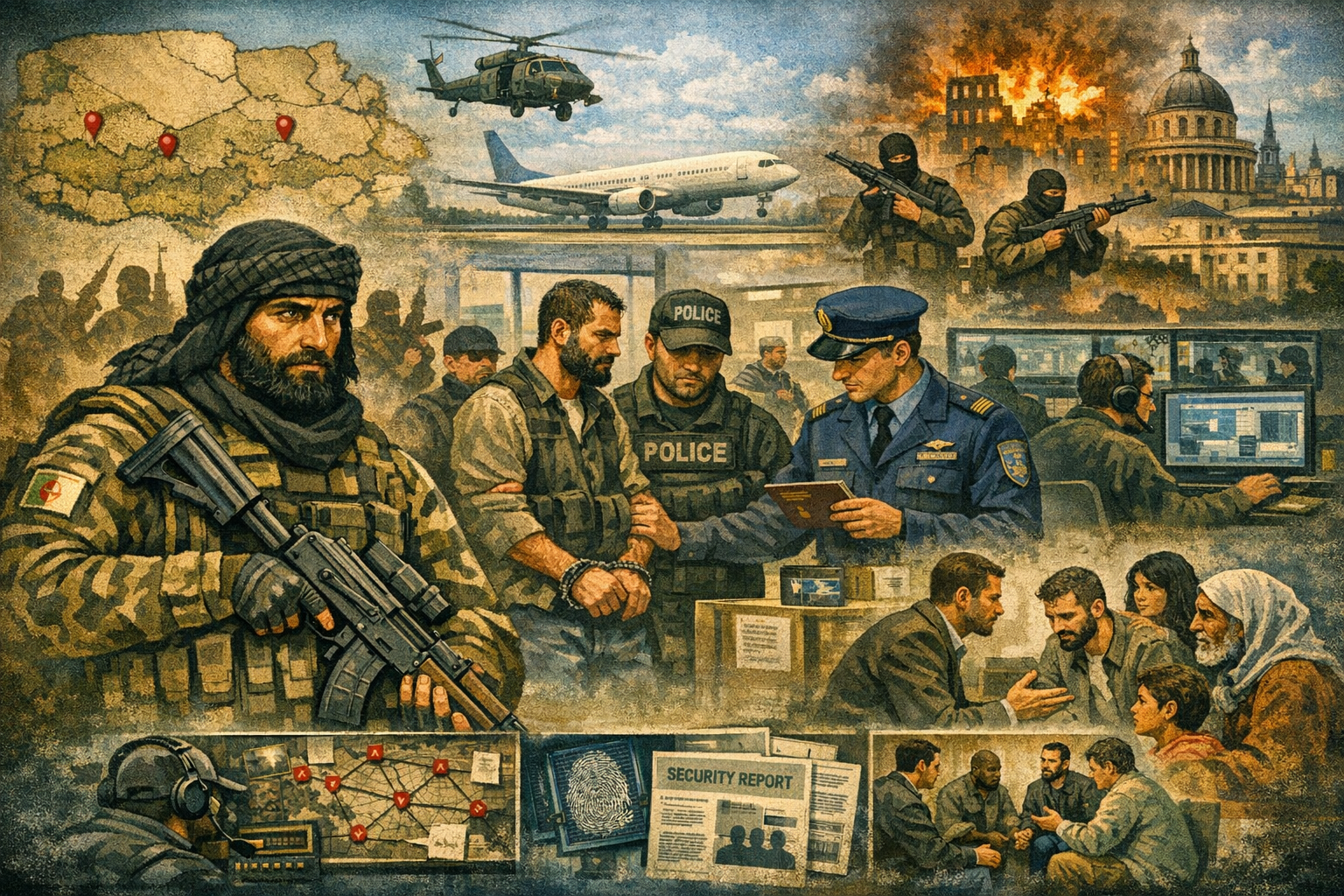
In the complex and ever-shifting landscape of modern warfare, few phenomena are as consistently destabilising—and as frequently misunderstood—as the “foreign fighter.” To effectively analyse the security challenges of tomorrow, we must first establish a precise understanding of the actors involved today.
At its core, a foreign fighter is an individual who leaves their country of origin or primary residence to join a non-state armed group in a foreign conflict. However, public discourse and media reporting frequently conflate this highly specific profile with other distinct actors on the battlefield. To accurately assess the threat, we must draw clear analytical boundaries:
- Foreign Fighters vs. Mercenaries: The critical distinction lies in motivation. Under international law, a mercenary is recruited specifically to fight for substantial private financial gain. Foreign fighters, conversely, are driven by ideology, religion, political beliefs, or a sense of transnational grievance. They are fundamentally volunteers, often receiving little to no pay.
- Foreign Fighters vs. State Military Volunteers: Individuals who travel abroad to join the official, recognised armed forces of another sovereign state are classified as lawful combatants under state command. A true foreign fighter operates outside the bounds of state authority, joining insurgencies, rebel factions, or designated terrorist organisations.
- Foreign Fighters vs. Foreign Military Personnel: These are active-duty soldiers officially deployed by their home government. Foreign fighters act entirely independently of, and frequently in direct defiance of, their home government’s foreign policy.
Understanding these distinctions is vital because the foreign fighter is not a modern anomaly; it is a recurring historical variable. In the 1930s, for example, over 32,000 individuals from nearly 50 countries travelled to join the International Brigades during the Spanish Civil War. However, the paradigm shifted dramatically in the late 20th century. The ideological driver evolved from secular political movements to transnational extremism, fundamentally altering the lethality and longevity of the threat.
When a conflict ends, these fighters do not simply vanish. They return home or migrate to new fragile regions, carrying with them battle-hardened skills, extremist networks, and an aura of misplaced heroism. To understand the magnitude of the threat we face today, we must look at how this modern cycle of mobilisation evolved and how nations can fortify themselves against the return of these combatants.
The Evolution of the Vanguard: From the Sahel to Syria
History provides a stark warning about the long-term impact of foreign fighters. In the 1980s, thousands of volunteers travelled to Afghanistan to fight the Soviets. When that war ended, the “Afghan Arabs”—including a highly trained contingent of Algerians—returned to North Africa. Their return met with a critical fractured political environment, serving as a catalyst, plunged Algeria into a brutal civil war and eventually birthing Al-Qaeda in the Islamic Maghreb (AQIM). The violent ripples of that 1980s mobilisation are still felt today across West Africa and the Sahel, forming the strategic DNA of modern terror coalitions, that is JNIM.
In the 2010s, the civil wars in Syria and Iraq triggered a mobilisation that dwarfed the Afghan jihad. Estimates indicate that over 40,000 foreign fighters from over 100 countries travelled to the region during the peak years of the crisis. Two demographics would be of particular interest to highlight:
- The Maghrebian Contingent: Countries like Tunisia and Morocco saw thousands of their youth depart, with Tunisia alone estimated to have contributed approximately 6,000 fighters. Driven by post-Arab Spring disillusionment, high unemployment, and sophisticated local recruitment pipelines, these young men and women sought purpose in a utopian, extremist narrative.
- European Citizens: Approximately 5,000 foreign fighters travelled from Western Europe. Many were second- or third-generation immigrants struggling with identity crises and social marginalisation, making them highly susceptible to peer-to-peer radicalisation and the promise of redemption.
Today, as territorial caliphates have collapsed, the surviving fighters are entering the “returnee” phase. They pose a profound organic threat: transferring advanced tactical skills to local militant groups, and acting as “super-nodes” capable of linking hyper-local grievances to global terrorist logistics. Even more alarming is the potential for hostile state actors to weaponize these returnees, utilising them as proxy forces for unconventional warfare to destabilise their home nations from the inside out.
Policy Recommendations: Breaking the Cycle
Managing the returnee threat requires a pivot from reactive policing to proactive, comprehensive statecraft. We recommend the following three-pillar approach:
1. Establish Extraterritorial Legal Frameworks: Many nations do not have the legal architecture to prosecute crimes committed by their citizens in foreign warzones. A domestic terror law often falls short when the violence occurred thousands of miles away.
- Legislative Updates: Governments must urgently update penal codes to explicitly criminalise traveling to join designated terrorist organisations and receiving military training from non-state actors abroad.
- Battlefield Evidence Integration: Judicial systems must develop protocols to accept and verify “battlefield evidence.” This includes biometric data collected by allied militaries, captured enemy communications, and rigorously vetted open-source intelligence (OSINT), allowing prosecutors to secure convictions that keep high-risk super-nodes off the streets.
2. Deepen Strategic Intelligence Cooperation (The Maghreb Focus) As nations like Morocco and Tunisia navigate the complex process of taking custody of their nationals who fought in Syria, they are gathering invaluable, primary-source intelligence. Global security depends on regional cooperation.
- Intelligence Sharing Pacts: Partner nations should formalize intelligence-sharing agreements with these Maghrebian states.
- Decoding Recruitment and Networks: Through joint debriefings, allied intelligence services can dissect the underlying, highly localized recruitment drives that mobilize youth. Returnees are vital sources for mapping the current command structures, illicit financial pipelines, and operational methodologies of global terrorist groups as they adapt to a post-Syria landscape.
3. Implement Strategic Rehabilitation and Collective Resilience Incarceration alone cannot dismantle an ideology. A sustainable security arrangement must incorporate psychological and social dimensions.
- Weaponizing the Counter-Narrative: Disillusioned returnees—those who witnessed the hypocrisy and brutality of extremist groups firsthand—should be carefully managed and utilised as powerful voices against future recruitment. Their authenticity shatters the romanticised propaganda spread by terrorist recruiters.
- Building Community Resilience: Governments must invest in educational campaigns that expose extremist ideologies and manipulative recruitment tactics to the general population. By making citizens aware of these groups’ existence and operations, the state empowers the public to protect themselves from manipulation.
- Establishing Early Warning Systems: By training families, teachers, and local leaders, nations can build a collective intelligence network capable of identifying the early behavioural signs of radicalisation. This ensures detection happens exactly where it starts—progressing from the home, to the community, and up to the school level—long before a citizen decides to cross a border.
Conclusion
The phenomenon of the foreign fighter is a complex, adaptive threat that exploits the seams between local grievances and global conflicts. As the veterans of the Syrian war return to their countries of origin, the international community cannot afford to be caught unprepared. By modernising legal frameworks, sharing vital intelligence gathered from regional partners, and fostering deep-rooted community resilience, nations can neutralise these vectors of instability and prevent the conflicts of yesterday from igniting the insurgencies of tomorrow.
Reference
Bakowski P., Puccio L. (2016), European Parliamentary Research Service (EPRS), https://www.europarl.europa.eu/EPRS/EPRS-Briefing-579080-Foreign-fighters-rev-FINAL.pdf
Corradi E. Joining the fight: the Italian foreign fighters contingent of the Kurdish People’s Protection Units. Italian Political Science Review/Rivista Italiana di Scienza Politica. 2023;53(2):201-219. http://doi:10.1017/ipo.2022.31
Loft P., Sturge G., & Kirk-Wade E. (2023), The Syrian Civil War: Timeline and Statistics, House of Commons Library, https://commonslibrary.parliament.uk/research-briefings/cbp-9381/
Martin G. (Ed.) (2011). Afghan Arabs The SAGE encyclopedia of terrorism (2 ed., pp. 11-12). SAGE Publications, Inc., https://doi.org/10.4135/9781412980173.n10
Mohn E. (2022), International Brigades EBSCO. https://www.ebsco.com/research-starters/history/international-brigades
United Nations (2017), Greater Cooperation Needed to Tackle Danger Posed by Returning Foreign Fighters, Head of Counter‑Terrorism Office Tells Security Council, United Nations, https://press.un.org/en/2017/sc13097.doc.htm
Wikipedia, Foreign fighters in the Syrian civil war, Wikipedia, https://en.wikipedia.org/wiki/Foreign_fighters_in_the_Syrian_civil_war