








Introduction
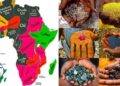
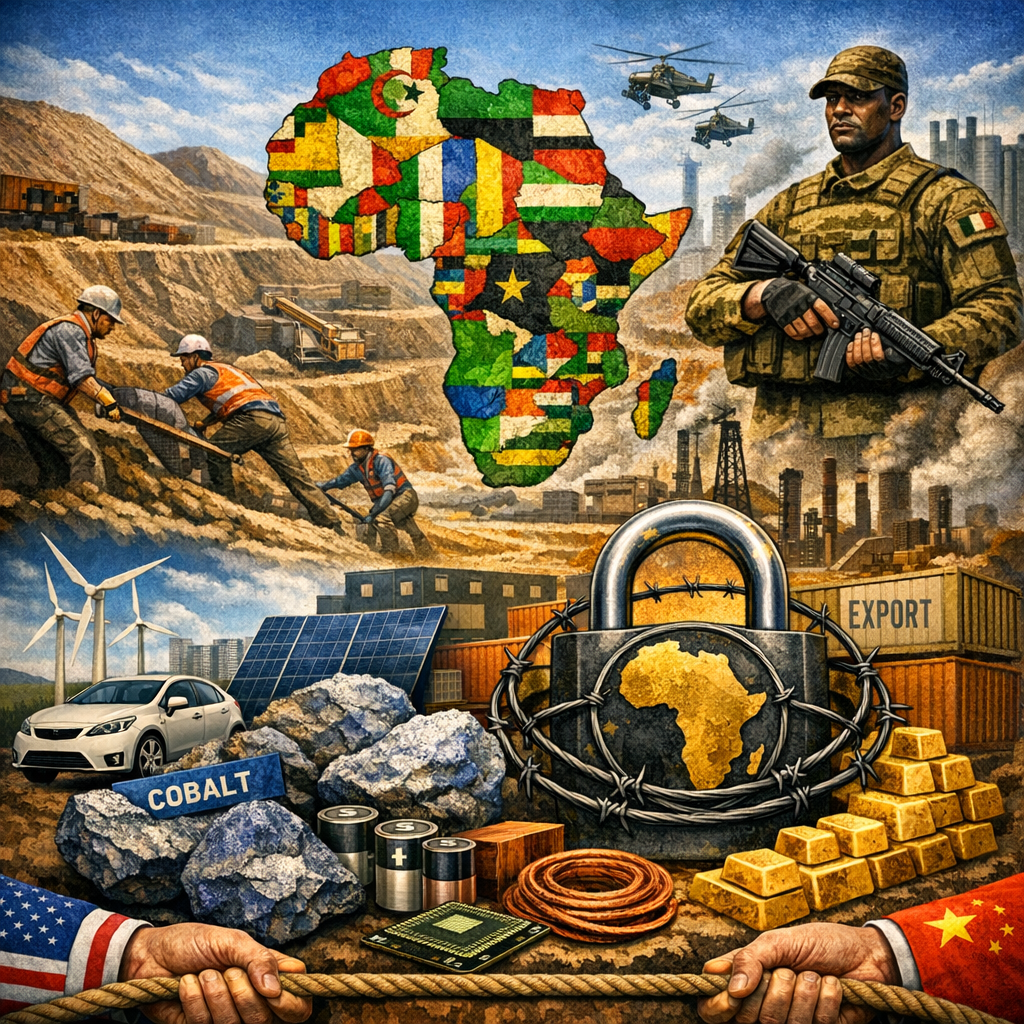
The global energy transition and the proliferation of digital technologies have triggered an unprecedented scramble for critical minerals. Lithium, cobalt, coltan, nickel, graphite, and rare earth elements once of limited strategic interest are now the enabling materials of the twenty-first century economy. These minerals are essential for electric vehicle batteries, AI chips, wind turbines, smartphones, and advanced military systems. The world’s known reserves of these materials are disproportionately concentrated in Africa, which holds approximately 30 percent of global critical mineral reserves (Pan African Visions, 2026). Yet Africa captures only 10 percent of the economic value generated from these exports (ibid.), a gap that reflects historical extraction patterns and structural inequalities that are now becoming flashpoints for conflict, geopolitical competition, and organised crime.
This article examines the security dimensions of Africa’s critical minerals endowment and how resource competition is generating new vectors of conflict. Additionally, it examines how organised crime and armed groups are positioning themselves within mineral supply chains. More importantly, it explores the governance frameworks required to ensure that the transition from the oil economy to the minerals economy does not repeat the devastation of the resource curse.
The Demand, Supply and Competition
The scale of global demand growth for critical minerals is staggering. In 2023, global trade in raw and semi-processed minerals reached approximately $2.5 trillion, more than 10 percent of global trade (UN Security Council, 2026). By 2030, demand could triple; by 2040, quadruple (ibid.). This demand is driven by structural forces: by 2025, over 20 million electric vehicles were sold worldwide indicating more than one in four of all new cars purchased globally with each battery requiring kilogrammes of lithium, cobalt, nickel, and manganese (Chatham House, 2026).
China currently dominates the global processing architecture, controlling approximately 60 percent of lithium and cobalt refining, 85 percent of rare earth processing, and an estimated 87 percent of global rare earth mineral refining (Africa Center for Strategic Studies, 2025). In response, the United States and European Union have launched competing strategic initiatives. The US National Security Strategy, released in November 2025, explicitly designated securing critical mineral supply chains a matter of national security, including an executive order on critical mineral imports signed by President Trump in January 2026. It has also launched Project Vault, a Strategic Critical Minerals Reserve in February 2026 (Security Council Report, 2026). The EU has identified 60 Strategic Projects targeting lithium, graphite, cobalt, nickel and rare earths, with 13 external projects in partner countries (ODI, 2026).
Africa is the principal theatre of this contest. The DRC alone produces more than 70 percent of global cobalt (UN Security Council, 2026). An estimated 30 percent of all sub-Saharan Africa’s reserves of minerals critical to the energy transition lie within the continent’s borders (Chatham House, 2026). As a result, Africa has become, in the words of the US Foreign Policy Research Institute, “a battleground for resource competition with China” (FPRI, 2026).
Africa holds 30% of global critical mineral reserves yet captures only 10% of the value generated from those exports. Closing this value-capture gap is simultaneously an economic imperative and a security necessity.
Minerals, Armed Conflict and Organised Crime
The nexus between critical minerals and insecurity is not hypothetical. The 2025 Global Organised Crime Index found that 73 countries, representing nearly 40 percent globally, experienced significant to severe levels of criminality relating to non-renewable resources (Global Initiative, 2026). There is a strong negative correlation between high natural resource crime scores on the Organised Crime Index and low scores on the Global Peace Index. Where minerals are found, violence and crime tend to follow (ibid.).
In the Democratic Republic of Congo (DRC) the situation is vivid and immediate. In April 2024, the M23 armed rebel group seized control of Rubaya, a mining site in North Kivu province that supplies approximately 15 percent of global tantalum production (Global Initiative, 2026). UN reports confirm that M23 has been smuggling tantalum into Rwanda, where international concentrate traders continue to purchase it despite the conflict context (ibid.). The DRC has offered Rubaya as part of strategic asset negotiations with the United States, even as the site remains under rebel control underscoring how resource competition at the global level translates directly into conflict dynamics on the ground.
In the Sahel, the geometry is equally stark. In January 2026, the Islamic State West Africa Province (ISWAP) conducted an assault on Niamey’s international airport that coincided with a scheduled uranium transport targeting a stockpile valued at over $220 million, causing an immediate spike in uranium futures (Security Council Report, 2026). Critics have consistently argued that securing mineral access, not achieving peace, is the principal objective of Russia’s Africa Corps presence across the Sahel states (African Security Analysis, 2025). Meanwhile, organised criminal networks are increasingly positioning themselves within mineral supply chains exploiting weak border controls, corrupt procurement systems, and the informality of artisanal mining sectors.
Resource Nationalism: Africa’s Response
African governments are not passive recipients of this competition. A wave of resource nationalism asserting state ownership and local value-addition requirements has swept the continent. Zimbabwe imposed export restrictions on raw lithium in 2022, sustained through 2025 and into 2026, to incentivise domestic processing (theowp.org, 2026). Mali struck a deal with Ganfeng Lithium under its 2023 mining code guaranteeing the government a 30 percent stake in the project, with local investors receiving an additional 5 percent (Chatham House, 2026). In 2025, the DRC created a Strategic Investment Fund to manage revenues from its mineral endowment, following the model of Nigeria’s sovereign wealth fund established in 2011 (Chatham House, 2026).
These are encouraging signals, but structural obstacles remain formidable. As the Africa Center for Strategic Studies has documented, policies requiring local mineral processing frequently outpace domestic industrial capacity (Africa Center, 2025). Zimbabwe’s case is instructive: even after export restriction policies were enacted, Chinese companies found ways to export lithium concentrate rather than refined product, circumventing the intent of the regulation (ibid.). The gap between policy aspiration and industrial reality is itself a governance vulnerability that organised crime can exploit.
Policy Recommendations
Three directions of action are necessary. First, African states must invest in regional processing infrastructure rather than attempting to build competing national-level capacity. Zambia and the DRC’s joint battery production venture, and the proposed model of routing raw lithium from Zambia to South Africa for refinement, illustrate the logic of regional value-addition strategies (theowp.org, 2026). ECOWAS and the African Union must provide the institutional scaffolding for these arrangements.
Second, international supply chain governance must be strengthened. The Security Council’s Panel of Experts mechanism which has documented M23’s mineral smuggling operations requires sustained political support and adequate funding. Due diligence standards under the OECD’s Guidelines for Responsible Mineral Supply Chains must be applied with consistency and rigour by importing nations, not selectively deployed when geopolitical interest demands.
Third, the intersection of organised crime and mineral extraction requires dedicated security attention. The proposed operationalisation of the AUC’s African Minerals Governance Framework, combined with stronger customs and border management across mineral-producing corridors, represents a minimum necessary step. Without it, the clean energy transition risks funding the very insecurity it is meant, in part, to transcend.
Conclusion
The race for critical minerals is not merely an economic story. It is a security story one involving armed groups, foreign powers, organised crime networks, and structurally vulnerable states. Africa’s mineral endowment is a genuine asset, offering, as the World Bank has noted, a “generational opportunity” for economic development (UN Security Council, 2026). But without the governance architecture to manage it responsibly, it risks becoming the latest iteration of the resource curse with consequences that security practitioners will spend decades managing.
References
1. Africa Center for Strategic Studies (2025). Africa’s Critical Minerals at a Critical Juncture. Africa Center, Washington D.C.
2. Chatham House (2026, March). Critical Mineral-Rich Africa Can Look After Itself. The World Today, Chatham House, London.
3. FPRI (2026, February). A Conundrum: Strategic Minerals and a Peripheral Africa. Foreign Policy Research Institute, Philadelphia.
4. Global Initiative Against Transnational Organized Crime (2026, February). Beyond Security: Critical Mineral Supply Chains and the 2026 Mining Indaba. GI-TOC, Geneva.
5. ODI (2026). Critical Minerals Geopolitics in 2026: Risks, Supply Chains and Global Power Shifts. Overseas Development Institute, London.
6. Pan African Visions (2026, March). The Hormuz Crisis and Africa’s Critical Minerals Moment.
7. Security Council Report (2026, March). Briefing on Energy, Critical Minerals and Security. What’s in Blue. Security Council Report, New York.
8. UN Security Council (2026). Critical Minerals Create Generational Opportunity for Development. Meeting Coverage SC/16310. UN Press, New York.
9. theowp.org (2026, March). Africa’s Critical Minerals Boom: Opportunity or Another Resource Trap? The Owl Post.