








Introduction
The youth of Ghana are ensnared in a tightening trap of societal expectations and economic instability. In 2024, the unemployment rate for individuals between the ages of 15 and 24 skyrocketed to over 32%, while it was roughly 22.5% for those between the ages of 15 and 35 (GSS, 2025; myjoyonline.com). These figures do not reflect a temporary blip, but a persistent structural challenge in the labour market. Inflation, cost-of-living and unemployment pressures have compounded the stress on young people striving to secure meaningful livelihood. The repercussions go beyond job resumes and pocketbooks. Research shows a growing mental-health crisis among Ghanaian youth: depression, anxiety and substance-use which are increasingly common and are driven by financial hardship, disrupted education, and uncertain futures (Research and Grant Institute of Ghana). The stakes increase much more when security-related issues are taken into account. A recent tragedy at a recruitment event in Accra, where six young people died in a stampede during a military recruitment drive illustrates how desperation, high unemployment and inadequate infrastructure can converge into public-safety hazards (citinewsroom.com, ghanaweb.com).
This article makes the case that Ghana’s youth’s economic and psychological suffering is a security problem as well as a social policy issue. The likelihood of social disturbance, unrest, and destabilization increases as expectations stagnate and discontent rises. Understanding the youth’s position at this crossroads is thus critical not only for their future, but for the future of the nation.
The youth
For many young Ghanaians, finishing school or earning a diploma once symbolized a pathway to independence and stability. Currently, however, this pathway seems increasingly obstructed, leaving many graduates with certificates and no clear route to meaningful employment. The economic strain is made worse by under-employment and informal work, alongside a labor market that struggles to accommodate new workforce entrants (theghanareport.com). According to the Ghana Statistical Service, the rate of NEETs (Not in Employment, Education or Training) has risen to 25.8% for those aged 15-24 and 22.4% for those aged 15-35 (GSS, 2025). These trends undermine the aspirations of youth, resulting in delays in home ownership and marriages, and restricting the ability to construct a stable future. Consequently, rather than progressing, many young individuals find themselves in a position of mere survival.
This tailspin of ambition has significant psychological effects. A study by Amissah and Nyarko (2017) on youth in Greater Accra revealed higher levels of depression, hopelessness, and suicidal thoughts among unemployed individuals aged 18–35 compared to those employed. The duration of unemployment was a strong predictor of mental health decline. Additionally, a wider study showed that moderate to severe psychological distress was strongly linked to unemployment, with severe distress increasing the likelihood of being unemployed for men by over 12 times. This compounds the link between economic stalling and mental strain, which creates a vicious cycle that diminishes young people’s employment prospects. This goes on to affect individuals while having social repercussions as deferred youth dreams lead to psychological issues that hinder community engagement and social capital (William et al., 2024). The sense of isolation and uncertainty among youth raises concerns about social stability and generational hope, ultimately putting the nation at risk.
Incidents as warning signs
The altercation at the Aayalolo Bus Terminal and the recent tragedies at El-Wak Stadium are symptoms of a larger crisis demonstrating how systemic governance problems combined with youth economic despair can escalate into major security risks.
On November 10, 2025, tensions escalated at the Kinbu terminal of the Aayalolo Bus Rapid Transit (BRT) system in Accra. According to reports, a group purportedly connected to political figures and the Accra Metropolitan Assembly (AMA) seized control of several areas of the terminal, turning them into parking lots and areas for offloading cargo (ghanaweb.com, modernghana.com). When National Security personnel attempted to intervene, the occupiers resisted. Their rallying cry? “We are party boys and we need to eat.” The phrase captures both economic desperation (“we need to eat”) and a political dimension (“party boys”), suggesting that their actions are not just about survival but about staking a claim on power and resources. The takeover has since led to issues of public-safety and operations including cargo trucks crowding in, drug users and petty crime infiltrating, and a breakdown of sanitation and order. Meanwhile, transport services are being disrupted, affecting thousands who depend on Aayalolo buses in Accra (ghanaweb.com, modernghana.com). The incident is troubling. First, when public transportation infrastructure is taken over and exploited profitably without responsibility, it indicates a breakdown in regulation and governance. Second, the youth’s audacity and disillusionment in taking over indicates a generation prepared to confront authority head-on with its audacious proclamation of opposition to state power. This shows that economic desperation is no longer contained to personal frustration, it spills over into political conflict.
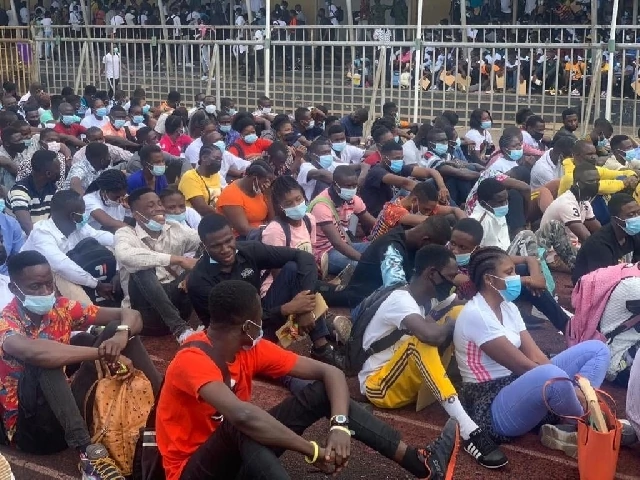
On the other hand, during a recruitment exercise for the Ghana Armed Forces on November 12, 2025, a sizable group of young Ghanaians flocked to El-Wak Stadium in Accra. Tragically, a stampede resulted in the deaths of six persons and several others injured (pulse.com.gh). According to the Ghana Armed Forces, the crush was triggered when “an unexpected surge of applicants breached security protocols” as they tried to enter the gates. The Ghana Armed Forces confirmed that 28 people were rushed to the 37 Military Hospital; six were pronounced dead, five were in intensive care, and others remained in critical condition (apnews.com, ghanaweekend.com). Overcrowding and poor crowd control seem to have played central roles, according to eyewitnesses and official statements. This surge occurred during an extended recruitment window where the deadline had been moved back by a week due to technical problems with the online portal (pulse.com.gh). There were two risks involved; the physical risk of unregulated mass gatherings increasing the potential for disaster and the socio-political risk where the youth see the military as the only viable job, skewing and distort recruitment, straining security institutions, and fostering disillusionment if expectations are not met. Why does this matter for the youth-security link? It is because the event highlights just how precarious things are for unemployed young people. Many are lined up to join the military, not necessarily out of patriotic zeal, but in search of stable employment in a very uncertain economy. Such recruitment events often attract young people precisely because other job opportunities are so limited if not non-existent.
The combined effect of young people’s desperation and lax institutional constraints brings to the fore wider consequences for national security, causing instability. As demonstrated by the circumstances in El-Wak, economic uncertainty that motivates young people without jobs to enlist in the military may put a strain on security forces and politicize the recruitment process, potentially creating dangerous conditions. The takeover of the Aayalolo terminal sets a dangerous precedent for other industries by demonstrating how politically connected informal groups can take advantage of openings. A lack of accountability and persistent governance shortcomings can alienate young people, eroding their faith in state institutions and raising the possibility of radical or disruptive outbursts.
Security Implications
The economic struggles of Ghana’s youth significantly impact national security. What may seem as purely social or economic issues are increasingly entangled with risks of radicalization, political instability, and institutional breakdown. Here are some ways youth economic insecurity translates into security threats.
Extremist recruitment in Ghana’s northern regions is primarily driven by youth unemployment, leading to feelings of exclusion and hopelessness among young people. The proximity to unstable Sahelian zones increases vulnerability, as extremist groups may exploit these conditions through social media and community ties (ghana.un.org). The UNDP emphasizes the need for targeted interventions such as youth empowerment and livelihood programs to mitigate the risks of radicalization.
Political instability and electoral violence are often increased by the involvement of unemployed or underemployed youth during elections. Research from UNDP indicates that these youth may be mobilized by political actors, leading to violent outcomes such as thuggery and vandalism. A sense of economic exclusion and institutional distrust among disillusioned youth can be exploited, rendering them susceptible to manipulation by groups aiming to disrupt political processes. Additionally, weak institutional responses and governance issues further increase the likelihood of aggressive political engagement from disenfranchised youth (theghanareport.com).
Long-term national security risks are transparent by the youth bulge, where large, economically marginalized youth populations described as a “security time bomb” can lead to social unrest and recruitment into violent groups (Scheible, 2024). In a study from Ghana’s Effutu Municipality, youth unemployment is associated with threats to human security, with issues of safety and social inclusion (Amoah, 2022). Civic leaders warn that this unemployment poses a national security threat, potentially resulting in political vigilantism and instability if not addressed.
Conclusion
As economic and social pressures increase for Ghanaian and West African youth, action must be taken to prevent these frustrations from becoming long-term security threats. This action should be practical, youth-centered, and future-focused.
To start, economic empowerment must be intentional, not symbolic. This means scaling up apprenticeships, digital-skills programs, technical training, and community-based entrepreneurship support. When young people see viable career paths, desperation gives way to motivation.
Additionally, governance and security institutions must rebuild trust with young people through transparency, fair recruitment processes, and meaningful participation. Youth should be partners in national development, not passive observers or political foot soldiers.
Furthermore, mental-health support must become mainstream. Depression, anxiety, and hopelessness are no longer hidden issues; they shape behaviour, choices, and resilience. Religious institutions such as churches and mosques, youth centers, and workplaces should become safe spaces where seeking help is normal, affordable, and accessible.
Then, youth engagement must be reimagined. From community leadership to technology innovation, the next generation who are capable must be given real seats at the table, not just as beneficiaries, but as co-architects of Ghana’s future.
To conclude, this moment calls for collective responsibility. The government must create fair opportunities and protect public spaces; institutions must rebuild trust; and society must treat youth concerns as urgent national priorities. At the same time, young people must continue to raise their voices, seek skills, support one another, and hold on to hope even in uncertain times.
The path forward is not easy, but it is possible. With the right investments, compassion, and leadership, Ghana can achieve progress. The youth are not a risk to manage, they are a resource to empower. Acting now ensures that this generation becomes the foundation of a safer, stronger, and more stable nation.
References
’We need to eat’ – Alleged party boys ’fight’ National Security at Aayalolo bus terminal. ghanaweb.com.https://www.ghanaweb.com/GhanaHomePage/NewsArchive/We-need-to-eat-Alleged-party-boys-fights-National-Security-at-Aayalolo-bus-terminal-2008899
Aayalolo Boss averts sit-down strike after drivers alleged assault by AMA boss’ entourage. modernghana.com.https://www.modernghana.com/news/1447872/aayalolo-boss-averts-sit-down-strike-after-drivers.html
Amissah, C. M., & Nyarko, K. (2017). Psychological effects of youth unemployment in Ghana. Journal of Social Sciences, 13(1), 64-77.
Amoah, C. I. (2022). Youth unemployment and human security in Ghana A study of the Effutu Municipality (Doctoral dissertation, University of Education, Winneba).
Aryee, H. Ghana’s unemployment rate drops slightly, youth joblessness remains high – GSS. myjoyonline.com.https://www.myjoyonline.com/ghanas-unemployment-rate-drops-slightly-youth-joblessness-remains-high-gss/
Canavan, M. E., Sipsma, H. L., Adhvaryu, A., Ofori-Atta, A., Jack, H., Udry, C., … & Bradley, E. H. (2013). Psychological distress in Ghana: associations with employment and lost productivity. International Journal of Mental Health Systems, 7(1), 9.
GHANA ANNUAL HOUSEHOLD INCOME AND EXPENDITURE SURVEY Quarterly Labour Statistics . https://statsghana.gov.gh/gssmain/fileUpload/pressrelease/Labour%20Statistics%20Bulletin%20(2025%20July%20Edition).pdf
https://apnews.com/article/ghana-stampede-military-recruitment-ffea0f78cdbc5f9e82dfb980b25f1a92
Nyagamago, M. GAF confirms 6 potential recruits dead in stampede at El-Wak Stadium during military recruitment. pulse.com.gh. https://www.pulse.com.gh/articles/news/gaf-confirms-6-potential-recruits-dead-in-stampede-at-el-wak-stadium-during-military-recruitment-2025111211334599545
Quaicoe, S. Military recruitment tragedy: 6 Dead, 5 in ICU, 12 in critical condition -GAF. ghanaweekend.com.. https://ghanaweekend.com/2025/11/12/six-dead-five-in-icu-12-in-critical-conditions-ghana-armed-forces-confirms/
William, D. ., Panin Kwame Baah, O. ., Eddy Mary, T. ., Selasi, A. ., & Emmanuel, B. . (2024). Investigating the Role of Unemployment on Relationship Breakdown Among the Unemployed Ghanaian Youth. International Journal of Social Science, Education, Communication and Economics, 3(5), 1367–1376. https://doi.org/10.54443/sj.v3i5.422
Youth Mental Health in Ghana . regig.org. November 13, 2025. https://regig.org/youth-mental-health-in-ghana-2/