








On 28 February 2026, the United States and Israel launched coordinated military strikes against Iran, killing Supreme Leader Ali Khamenei and senior officials of the Islamic Revolutionary Guard Corps (Al Jazeera, 2026a), and set in motion a regional escalation whose economic consequences reached African shores faster than most governments had time to prepare. Tehran responded by launching hundreds of ballistic missiles against United States military installations across Qatar, Bahrain, the United Arab Emirates, and Kuwait, targeting airports and hotels suspected of hosting American forces and causing civilian casualties that transformed Gulf states — long among the world’s most stable destinations for trade, investment, and tourism — into active conflict zones (Al Jazeera, 2026a). Crude oil prices surged toward $120 per barrel (IRU, 2026); tanker traffic through the Strait of Hormuz, responsible for approximately one-fifth of the world’s seaborne oil supply annually (U.S. Energy Information Administration, 2025), collapsed to just 21 transiting vessels in the first three weeks of the conflict compared to more than 100 ships daily before the strikes (CNBC, 2026a); and European natural gas prices nearly doubled as Qatari LNG production ground to a halt (Euronews, 2026; Economics Observatory, 2026). Major shipping lines including Maersk, CMA CGM, and Hapag-Lloyd suspended Gulf operations entirely, forcing re-routing around Africa’s Cape of Good Hope and adding days and costs to global supply chains that the world economy was ill-positioned to absorb (NBC News, 2026).
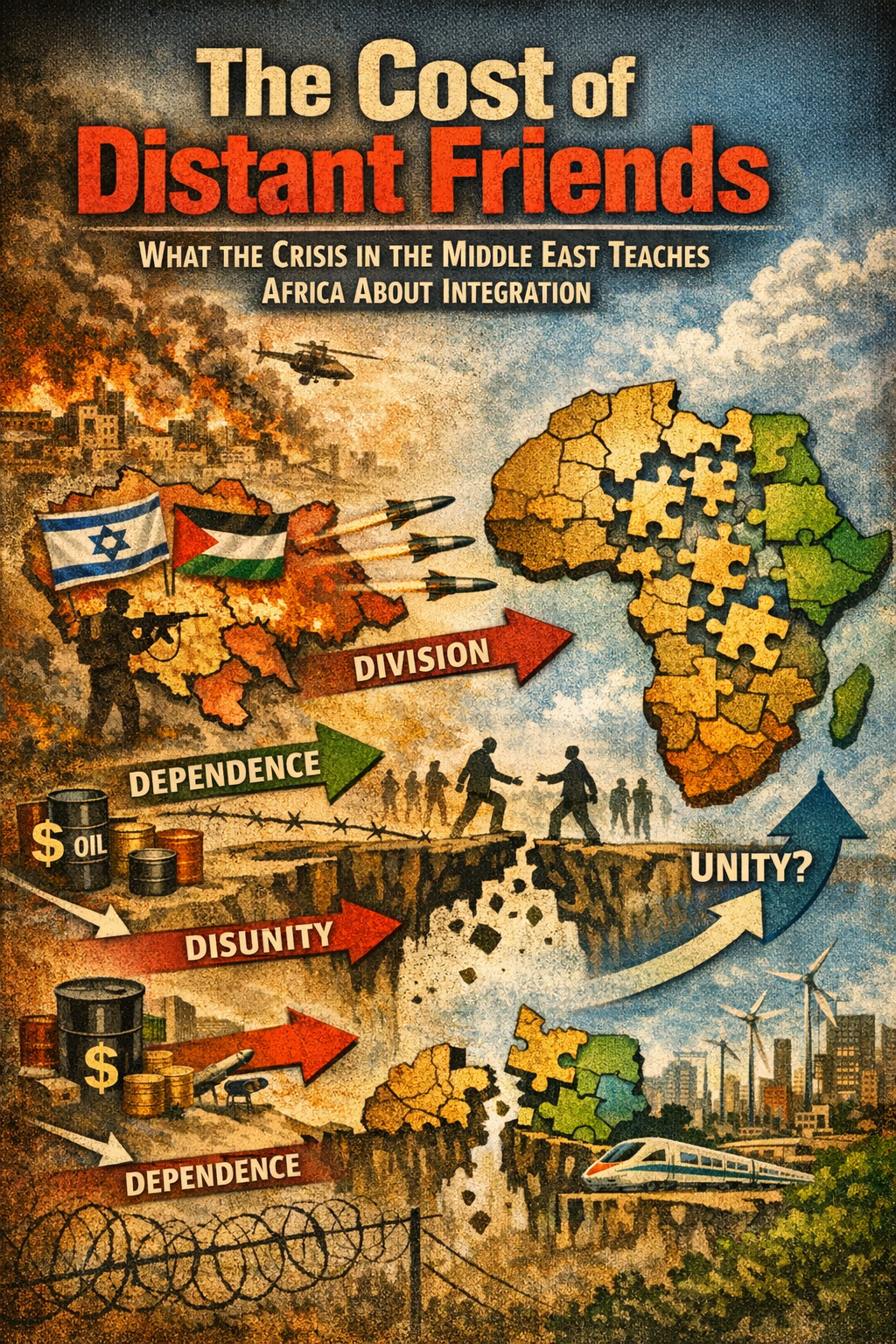
What makes this cascade of consequences analytically significant for Africa is not merely its severity but the particular dynamic it exposed. The Gulf states had not chosen this conflict; they had not been consulted before the strikes were launched, and had not been warned that the American military infrastructure they hosted such as the Central Command’s forward headquarters in Qatar, the Fifth Fleet in Bahrain was about to make them targets of Iranian retaliation. They found themselves absorbing the full costs of a war whose initiation belonged entirely to others, a situation that the Al Jazeera Centre for Studies described as a practical demonstration of how a single strategic waterway, when disrupted, can destabilise the global economy far beyond what security planners had modelled (Al Jazeera Centre for Studies, 2026). Africa, a continent that hosts the military installations of at least 13 foreign powers (The Conversation, 2024), is not watching a distant cautionary tale. It is watching a preview.
THE CHANGING NATURE OF EXTERNAL SECURITY DEPENDENCE
To understand why the Gulf crisis carries the lessons it does for Africa, one must first understand why states that appeared so thoroughly protected proved so devastatingly vulnerable to a conflict they did not start. The conventional theory of military alliance rests on the assumption that the strategic interests of the protecting power and the protected state are sufficiently aligned to ensure that the ally’s military decisions will not impose severe costs on the host. For decades, Gulf states had no reason to question this assumption, because the arrangement had functioned as designed: Iranian aggression was constrained, in part, by the credible threat of American response. What the architecture was never designed to handle was American offensive action, taken on American and Israeli strategic calculations, executed from the territory of states whose governments had no decisive voice in the decision.
The February 2026 crisis demonstrated that protection and liability, within the architecture of external security dependence, are not opposites they are, especially when the protecting power exercises its own offensive judgment, the same thing. Wealth, as the Gulf states discovered, does not substitute for strategic autonomy; and a bilateral security arrangement, however deep and institutionalised, does not guarantee that the host state’s interests will prevail when they diverge from the patron’s, because the power asymmetry that defines such arrangements is precisely what determines whose preferences are adjusted when a genuine conflict arises (Al Jazeera Centre for Studies, 2026).
THE AFRICAN REFLECTION: BASES, FRAGMENTATION, AND THE ILLUSION OF SOVEREIGNTY
Africa’s relationship with external military presences is structurally analogous to the Gulf’s, and in several respects more exposed. The United States operates Camp Lemonnier in Djibouti alongside a network of cooperative security locations distributed across the continent (CSIS, 2018); France, despite its expulsions from Mali, Burkina Faso, Niger, and Chad following the military coups of 2021 to 2024, retains a significant presence in Djibouti, Côte d’Ivoire, Gabon and Senegal (Anadolu Agency, 2024); China maintains its first overseas military base in Djibouti and Russia has extended its footprint across the Sahel through the Africa Corps. The continent is not a passive stage on which great power competition plays out at a safe distance, it is in fact the terrain on which that competition is increasingly conducted, with African populations bearing costs they had no hand in generating.
The first consequence of this configuration is proxy vulnerability: African states that host foreign military infrastructure become potential targets in conflicts between those powers and their adversaries, over which the host state has no meaningful decision-making authority. The logic that rendered Gulf airports, seaports, and military installations targets of Iranian retaliation in February 2026 because they were nodes of American power projection applies equally to any African state whose territory serves a comparable function in a rival great power relationship. The host becomes implicated not because of its own foreign policy choices but because of the choices of its guests.
The second consequence is the steady erosion of diplomatic agency. States that depend on external powers for their security find themselves constrained in their ability to take positions that conflict with the interests of those powers, not through explicit coercion but through the implicit calculus of a dependency they understand cannot be jeopardised without cost. The African Union’s calls for reform of the international financial architecture, for equitable climate financing, for genuine debt relief – all of these have been advanced from a position of structural dependence that reduces their negotiating weight in exact proportion to how deeply individual member states remain reliant on external actors for their own security.
The third consequence is the most self-reinforcing: the perpetuation of continental defence fragmentation. African states that have externalised their security have by extension, reduced the political urgency of investing in collective security capacity, because the bilateral deal with Washington or Paris always appears cheaper in the short term than the patient and institutionally demanding work of building regional security architecture from within. The Gulf crisis is a pointed reminder of the long-term price of that calculation and the Sahel as well has been offering the same reminder, at a slower tempo for the better part of a decade.
THE AFCFTA IMPERATIVE: INTEGRATION AS SECURITY ARCHITECTURE
The case for accelerating AfCFTA implementation has typically been made in development terms — in the observation that intra-African trade reached $220.3 billion in 2024 yet still accounts for only around 15 per cent of the continent’s total merchandise trade, compared to 60 per cent in Asia and 70 per cent in Europe (Ecofin Agency, 2025; Brookings Institution, 2024), and in the projection that full implementation could add $141 billion to Africa’s GDP and increase intra-African trade by 45 per cent by 2045 (UNECA, 2025). These figures are compelling, and the development case they support is not in dispute. What the Gulf crisis adds to this argument is a security dimension that development economists have rarely emphasised: that the AfCFTA is not only a commercial framework but a strategic security architecture, and that the pace of its implementation is, in the context of the current global moment, a security question as much as an economic one.
Africa possesses the world’s largest renewable energy potential, yet in 2023 attracted only 2.3 per cent of global renewable energy investment (UNCTAD, 2024), a disproportion that ensures the continent remains exposed to price shocks generated by conflicts in distant waterways over which it exercises no influence. A functionally integrated continental energy market, built on the regulatory harmonisation and cross-border infrastructure investment that AfCFTA implementation makes possible is the structural answer to that exposure, because a continent that draws on its own abundant energy resources is not held hostage to the strategic geography of the Persian Gulf.
The fiscal argument is equally direct. The economic disruption transmitted from the Gulf to African states arrives through multiple channels at once: in rising fuel import costs, in declining remittances from African workers employed in Gulf economies, and in reduced export revenues from states whose trading partners are themselves absorbing shocks that compress demand. Each of these transmission channels narrows in proportion to how deeply a state is integrated into regional markets, because economies with diversified, regional trading relationships are structurally less exposed to any single external disruption than those whose trade remains concentrated in a small number of distant partners.
REVITALISING AFRICA’S COLLECTIVE SECURITY CAPACITY
Economic integration and collective security capacity are not substitutes for one another, rather they are complementary foundations for genuine strategic autonomy, and the Gulf crisis illustrates why the absence of either leaves the other exposed. Africa’s Peace and Security Architecture — the AU Peace and Security Council, the African Standby Force, the Continental Early Warning System represents a framework of considerable ambition whose operational performance has, across two decades, fallen well short of its design. The African Standby Force was declared fully operational in 2015; as of 2025, the African Union remains dependent on external donors for approximately 75 per cent of its peace and security budget (ACCORD, 2025), and the AU Continental Logistics Base in Douala continues to operate below capacity because recruitment is conditioned on funding that member states have consistently failed to provide (Amani Africa, 2023). This is not a technical shortfall. It is a political choice and is one whose consequences are becoming harder to defer.
The argument for closing this gap rests not on the claim that Africa faces an imminent military threat comparable to the one now destabilising the Persian Gulf, but on the recognition that the credibility of collective security arrangements is itself a component of strategic autonomy — that states capable of providing for their own collective security can, over time, decline the bilateral arrangements that embed their territory within the strategic liability of others, while states that cannot provide that capacity will continue to find themselves hosting consequences they did not choose. Regional intelligence sharing, continental early warning, and the political will to sustain unified positions under the pressure that great powers routinely apply to fracture African solidarity are not secondary priorities, they are parallel necessities that must develop alongside economic integration if the continent’s strategic autonomy is to become real rather than rhetorical.
PERMANENT NEIGHBOURS, TRANSIENT ALLIES
The Sahel has already offered Africa this lesson at considerable human cost, though its full implications have yet to be absorbed into continental strategic thinking. France’s military presence in Mali, Burkina Faso, Niger, and Chad was sustained for years under the banner of counterterrorism partnership, and was understood by host governments as a form of security they lacked the independent capacity to provide. What those governments eventually concluded, expressed through coups and expulsions between 2021 and 2024 (Anadolu Agency, 2024) was that the French presence had come to serve French strategic interests more reliably than it served African security, and that the sovereignty it constrained was too high a price for the protection it provided. The lesson is not that external partners are always harmful; it is that external partners are always external, present when their own interests require their presence and liable to prioritise those interests when they conflict with the host’s, because the power asymmetry within such relationships ensures that it is the weaker party’s preferences that are adjusted.
The Gulf states are learning this same lesson now, under more acute economic circumstances, and the symmetry between their experience and the Sahel’s is instructive — it suggests that the dynamic is not regional or incidental but structural and predictable. There is a principle that African strategic discourse has not yet fully operationalised: that neighbours are permanent while allies are transient, that the geographic and economic complementarities between African states are features of the continental landscape that no change in government or great power alignment can dissolve, and that the AfCFTA exists precisely to convert those permanent complementarities into the functioning economic relationships that would give African states the collective weight they currently lack. That work cannot be done by any external partner; it can only be done by Africans, and it cannot be deferred indefinitely without compounding cost.
THE COST OF WAITING
Africa has held summits on integration and adopted frameworks for collective security with a regularity that has come, in the discourse of continental governance, to substitute for the harder work of implementing what has been agreed. The AfCFTA has been signed but its implementation has proceeded at a pace that the current moment renders inadequate; the African Standby Force has been mandated but its operationalisation has been deferred through successive budget cycles; and the Peace and Security Architecture exists on paper with a comprehensiveness that stands in contrast to how little of it functions in practice when tested against competing national interests. This gap between ambition and execution is not merely a governance shortcoming, it is, under the conditions the Gulf crisis has made visible, a security failure whose costs have historically been diffuse enough to ignore but are becoming too large and too frequent to defer.
The rising fuel costs that African governments are managing, the disrupted remittances that African households are absorbing, and the diplomatic pressures bearing down on African states whose territory hosts foreign military infrastructure in the context of a conflict they played no part in — these are not the consequences of a war Africa chose. They are the consequences of structural vulnerabilities that Africa has not yet chosen to address with the seriousness they require, and the significance of the current moment is that it has made those vulnerabilities visible and legible in a way that years of quieter accumulation had not.
Every year in which AfCFTA implementation is deferred, in which the African Standby Force remains under-resourced, in which African states continue to substitute bilateral arrangements with transient allies for the harder project of building continental solidarity from within, is a year in which the next crisis will find the continent in the same position it occupied on 28 February 2026, absorbing the consequences of decisions made elsewhere, with no collective architecture adequate enough to manage them, and no credible answer to the question of why, having seen this before, it was permitted to happen again. The choice to build that architecture belongs to African leaders. The cost of not making it belongs, as it always has, to everyone else.
References
- ACCORD (African Centre for the Resolution of Conflict). (2025). The African Standby Force’s deployment efficiency in Sudan. https://www.accord.org.za/analysis/the-african-standby-forces-deployment-efficiency-in-sudan/
- Al Jazeera. (2026a). US and Israel attack Iran: What we know so far. https://www.aljazeera.com/news/2026/2/28/us-and-israel-attack-iran-what-we-know-so-far
- Al Jazeera Centre for Studies. (2026). The Strait of Hormuz: Global economic shock and the limits of military power. https://studies.aljazeera.net/en/analyses/strait-hormuz-global-economic-shock-and-limits-military-power
- Amani Africa. (2023). Briefing on status of implementation of the Common African Defence and Security Policy and the operationalization of the African Standby Force. https://amaniafrica-et.org/briefing-on-status-of-implementation-of-the-common-african-defence-and-security-policy-and-the-operationalization-of-the-african-standby-force-asf/
- Anadolu Agency. (2024). Factbox: Ouster from Africa — What is left of France’s military presence on the continent? https://www.aa.com.tr/en/world/factbox-ouster-from-africa-what-is-left-of-france-s-military-presence-on-the-continent/3447004
- Brookings Institution. (2024, February). The future of African trade in the AfCFTA era. https://www.brookings.edu/articles/the-future-of-african-trade-in-the-afcfta-era/
- CNBC. (2026a, March 18). Traffic is trickling through Strait of Hormuz: Who’s moving and who’s stranded. https://www.cnbc.com/2026/03/18/hormuz-bottleneck-vessel-tanker-tracker-shipping-strait-of-hormuz.html
- Ecofin Agency. (2025, June). Africa’s trade grows 13.9% in 2024, driven by AfCFTA progress. https://www.ecofinagency.com/finance/2706-47457-africa-s-trade-grows-13-9-in-2024-driven-by-afcfta-progress
- Economics Observatory. (2026, March). How might the Middle East conflict shape Europe’s inflation outlook? https://www.economicsobservatory.com/how-might-the-middle-east-conflict-shape-europes-inflation-outlook
- Euronews. (2026, March 3). Gas prices nearly double as Europe braces for Iran war energy shocks. https://www.euronews.com/business/2026/03/03/gas-prices-nearly-double-as-europe-braces-for-iran-war-energy-shocks
- International Road Transport Union (IRU). (2026, March 13). War in Iran: Fuel prices remain high and volatile. https://www.iru.org/news-resources/newsroom/war-iran-fuel-prices-remain-high-and-volatile
- NBC News. (2026). Shipping slows to a crawl through Strait of Hormuz, threatening to snarl international trade. https://www.nbcnews.com/business/economy/shipping-slows-crawl-strait-hormuz-threatening-snarl-international-tra-rcna261797
- Center for Strategic and International Studies (CSIS). (2018). The evolution of U.S. defense posture in North and West Africa. https://www.csis.org/analysis/evolution-us-defense-posture-north-and-west-africa?utm_source=chatgpt.com
- The Conversation. (2024, September 4). Why foreign countries are scrambling to set up bases in Africa. https://theconversation.com/why-foreign-countries-are-scrambling-to-set-up-bases-in-africa-146032
- United Nations Conference on Trade and Development (UNCTAD). (2024). Economic development in Africa report 2024. https://unctad.org/publication/economic-development-africa-report-2024
- United Nations Conference on Trade and Development (UNCTAD). (2026). Strait of Hormuz disruptions: Implications for global trade and development. https://unctad.org/publication/strait-hormuz-disruptions-implications-global-trade-and-development
- United Nations Economic Commission for Africa (UNECA). (2025). ERA 2025: With effective implementation, the AfCFTA can open alternative markets to sectors affected by the global tariff wars. https://www.uneca.org/stories/era-2025-with-effective-implementation,-the-afcfta-can-open-alternative-markets-to-sectors
- U.S. Energy Information Administration (EIA). (2025, June). Amid regional conflict, the Strait of Hormuz remains critical oil chokepoint. https://www.eia.gov/todayinenergy/detail.php?id=65504