




• fr Français
  • en English
CISA NEWSLETTER
Advertisement
  • February 2026
  • Editions
    • 2025
      • December 2025
      • November 2025
      • October 2025
      • September 2025
      • August 2025
      • July 2025
      • June 2025
      • May 2025
      • April 2025
      • March 2025
      • February 2025
      • January 2025
    • 2024
      • December 2024
      • November 2024
      • October 2024
      • September 2024
      • August 2024
      • July 2024
      • June 2024
      • May 2024
      • April 2024
      • March 2024
      • February 2024
      • January 2024
    • 2023
      • December 2023
  • News
    • All
    • Business
    • Politics
    • Science
    • World
    Okada Operations In Ghana; Economic Necessity Or Security Risk

    Okada Operations In Ghana; Economic Necessity Or Security Risk

    Cedi Appreciation and National Security in Ghana: Currency Stability Amid Persistent Structural Risks

    Cedi Appreciation and National Security in Ghana: Currency Stability Amid Persistent Structural Risks

    The Mirror in the Politician: How Ghanaian Society Breeds the Corruption It Condemns

    The Mirror in the Politician: How Ghanaian Society Breeds the Corruption It Condemns

    Terrorism Financing in The Sahel/West Africa: Mechanisms, Drivers, And Responses

    Terrorism Financing in The Sahel/West Africa: Mechanisms, Drivers, And Responses

    The Silent Threat: Impact of Human and Sex Trafficking on National Security

    The Silent Threat: Impact of Human and Sex Trafficking on National Security

    How JNIM is dominating the terrorism landscape in the Sahel

    How JNIM is dominating the terrorism landscape in the Sahel

    Trending Tags

    • Trump Inauguration
    • United Stated
    • White House
    • Market Stories
    • Election Results
  • Tech
    Securing Africa’s Digital Future: A Call to Action on Cybersecurity.

    Securing Africa’s Digital Future: A Call to Action on Cybersecurity.

    Trending Tags

    • Nintendo Switch
    • CES 2017
    • Playstation 4 Pro
    • Mark Zuckerberg
  • Entertainment
  • Lifestyle
    • All
    • Food
    • Health
    • Travel
    Security Contagion and the Urban Poor: Begging and the Invisible Threat in Accra’s Streets

    Security Contagion and the Urban Poor: Begging and the Invisible Threat in Accra’s Streets

    ECOWAS@50: Ghana as a Stakeholder in West Africa’s Integration Aspiration

    ECOWAS@50: Ghana as a Stakeholder in West Africa’s Integration Aspiration

    The Rise of Substance Abuse Among Ghanaian Youth: A Deep Dive into Music, Media, and Mental Health

    The Rise of Substance Abuse Among Ghanaian Youth: A Deep Dive into Music, Media, and Mental Health

    Impact Of Russia’s War in Ukraine on Africa’s Agriculture and Food Security

    Impact Of Russia’s War in Ukraine on Africa’s Agriculture and Food Security

    Transforming Africa’s Agriculture to Mitigate Food Crisis

    Transforming Africa’s Agriculture to Mitigate Food Crisis

    Framing Food Insecurity as A Security Contagion

    Framing Food Insecurity as A Security Contagion

    Trending Tags

    • Golden Globes
    • Game of Thrones
    • MotoGP 2017
    • eSports
    • Fashion Week
  • Review
    Key Drivers of Voter Choices for Ghana’s 2024 General Elections – A Review

    Key Drivers of Voter Choices for Ghana’s 2024 General Elections – A Review

  • CISA Ghana
  • January 2026
No Result
View All Result
  • February 2026
  • Editions
    • 2025
      • December 2025
      • November 2025
      • October 2025
      • September 2025
      • August 2025
      • July 2025
      • June 2025
      • May 2025
      • April 2025
      • March 2025
      • February 2025
      • January 2025
    • 2024
      • December 2024
      • November 2024
      • October 2024
      • September 2024
      • August 2024
      • July 2024
      • June 2024
      • May 2024
      • April 2024
      • March 2024
      • February 2024
      • January 2024
    • 2023
      • December 2023
  • News
    • All
    • Business
    • Politics
    • Science
    • World
    Okada Operations In Ghana; Economic Necessity Or Security Risk

    Okada Operations In Ghana; Economic Necessity Or Security Risk

    Cedi Appreciation and National Security in Ghana: Currency Stability Amid Persistent Structural Risks

    Cedi Appreciation and National Security in Ghana: Currency Stability Amid Persistent Structural Risks

    The Mirror in the Politician: How Ghanaian Society Breeds the Corruption It Condemns

    The Mirror in the Politician: How Ghanaian Society Breeds the Corruption It Condemns

    Terrorism Financing in The Sahel/West Africa: Mechanisms, Drivers, And Responses

    Terrorism Financing in The Sahel/West Africa: Mechanisms, Drivers, And Responses

    The Silent Threat: Impact of Human and Sex Trafficking on National Security

    The Silent Threat: Impact of Human and Sex Trafficking on National Security

    How JNIM is dominating the terrorism landscape in the Sahel

    How JNIM is dominating the terrorism landscape in the Sahel

    Trending Tags

    • Trump Inauguration
    • United Stated
    • White House
    • Market Stories
    • Election Results
  • Tech
    Securing Africa’s Digital Future: A Call to Action on Cybersecurity.

    Securing Africa’s Digital Future: A Call to Action on Cybersecurity.

    Trending Tags

    • Nintendo Switch
    • CES 2017
    • Playstation 4 Pro
    • Mark Zuckerberg
  • Entertainment
  • Lifestyle
    • All
    • Food
    • Health
    • Travel
    Security Contagion and the Urban Poor: Begging and the Invisible Threat in Accra’s Streets

    Security Contagion and the Urban Poor: Begging and the Invisible Threat in Accra’s Streets

    ECOWAS@50: Ghana as a Stakeholder in West Africa’s Integration Aspiration

    ECOWAS@50: Ghana as a Stakeholder in West Africa’s Integration Aspiration

    The Rise of Substance Abuse Among Ghanaian Youth: A Deep Dive into Music, Media, and Mental Health

    The Rise of Substance Abuse Among Ghanaian Youth: A Deep Dive into Music, Media, and Mental Health

    Impact Of Russia’s War in Ukraine on Africa’s Agriculture and Food Security

    Impact Of Russia’s War in Ukraine on Africa’s Agriculture and Food Security

    Transforming Africa’s Agriculture to Mitigate Food Crisis

    Transforming Africa’s Agriculture to Mitigate Food Crisis

    Framing Food Insecurity as A Security Contagion

    Framing Food Insecurity as A Security Contagion

    Trending Tags

    • Golden Globes
    • Game of Thrones
    • MotoGP 2017
    • eSports
    • Fashion Week
  • Review
    Key Drivers of Voter Choices for Ghana’s 2024 General Elections – A Review

    Key Drivers of Voter Choices for Ghana’s 2024 General Elections – A Review

  • CISA Ghana
  • January 2026
No Result
View All Result
CISA NEWSLETTER
No Result
View All Result
Home ANALYSTS

Precarious Mobility and Proxy War: African Migration in the Shadow of Russia’s Militarisation Strategy

Precarious Mobility and Proxy War: African Migration in the Shadow of Russia’s Militarisation Strategy
Share on FacebookShare on Twitter

Introduction

Africa’s demographic dynamism characterised by a rapidly expanding youth population coexists with limited formal employment opportunities and uneven industrial transformation. This contradiction generates intense pressure toward outward mobility. For many young people, migration represents not only economic survival but social adulthood, dignity and hope. The circulation of celebratory migration imagery across social media platforms especially on TikTok like young Africans rejoicing over newly acquired visas, documenting their first encounters with snow, or publicly thanking God for what they perceive as life-changing opportunities reveals the emotional and symbolic power that mobility now holds within many African societies.

In Ghana, the name “borga” reveals that travel is not merely an economic movement. It is perceived and narrated as redemption, dignity and social transformation. Favorable exchange rates further intensify this perception, since even modest foreign earnings abroad can translate into significant status and material support for families at home. Within this affective landscape, departure becomes morally valorised, and remaining in Africa risks being interpreted as stagnation. It is precisely within this symbolic economy of hope that external recruitment narratives gain traction, especially in contexts where numerous travelling and tour companies, alongside informal travel agents promising employment, training, or relocation abroad, already operate and normalise the expectation of departure as a pathway to transformation. Within such environments, the boundary between civilian mobility and militarised opportunity becomes increasingly porous, allowing geopolitical actors to embed security recruitment within familiar migration pathways and aspirational discourses of departure.

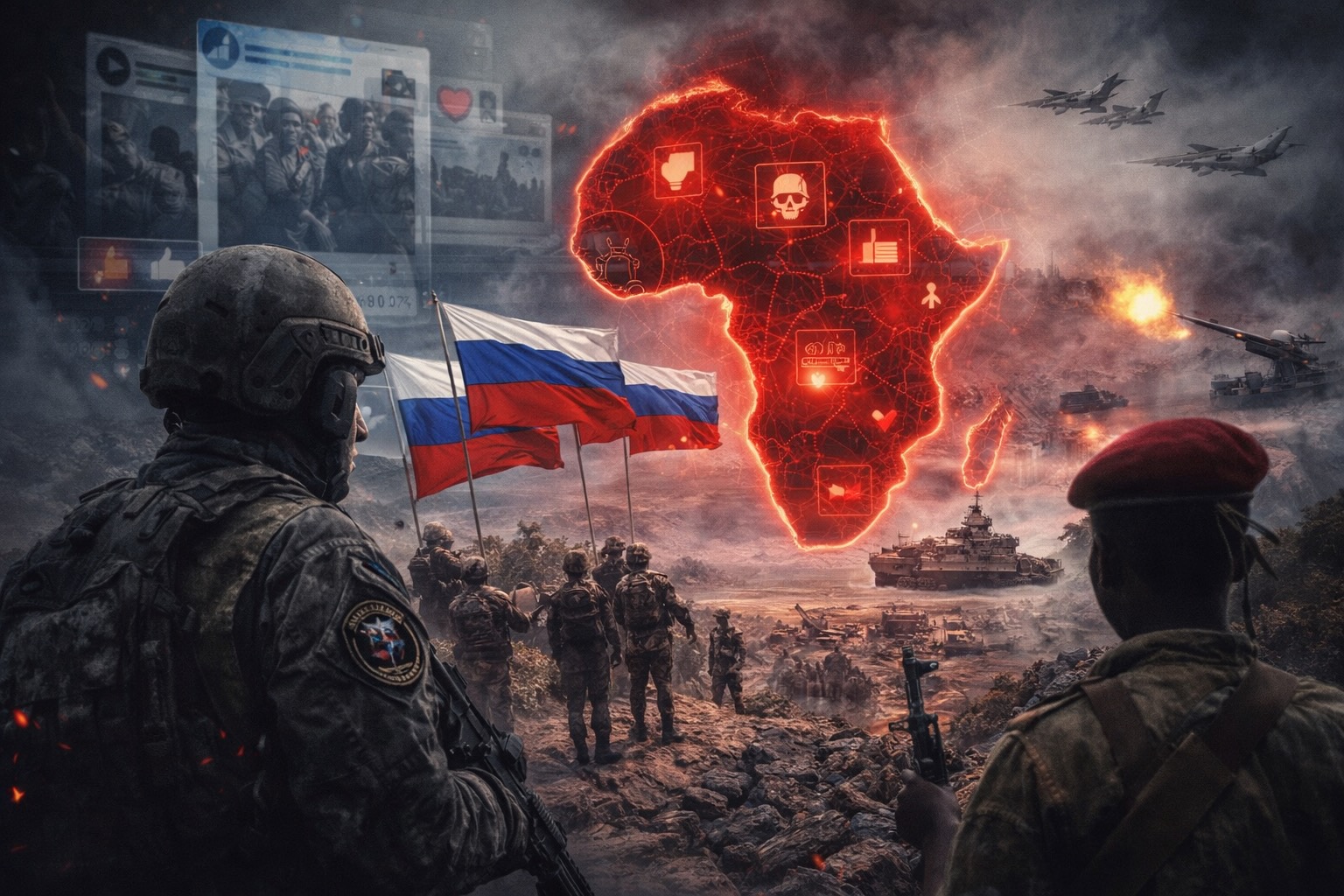
Across the contemporary landscape of global conflict, migration and militarisation are becoming increasingly intertwined. Nowhere is this convergence more visible than in the emerging pattern of African youth recruitment into foreign security structures linked to Russia’s war effort in Ukraine. Mounting battlefield losses and prolonged attrition have generated acute manpower pressures for Moscow, encouraging the search for recruits beyond its own population. In response, networks connected to the Federal Security Service and affiliated shell companies have reportedly expanded outreach across multiple African states, including Kenya, Ghana, Egypt, and Cameroon. This article argues that such recruitment is not an isolated wartime improvisation but part of a deeper structural relationship between global inequality, migration precarity and contemporary proxy warfare. Africa becomes a target not because of inherent instability, but because historical underdevelopment, youth unemployment, and constrained mobility produce conditions in which the promise of work, training, or international passage can be weaponised. The militarisation of migration thus reflects a broader transformation in geopolitical power: the battlefield now extends into labor markets, visa regimes, and the aspirations of unemployed youth.

Migration as a Tool of Contemporary Warfare

Historically, imperial powers extracted raw materials and agricultural surplus from colonised territories. In the twenty-first century, extraction increasingly targets mobility itself. Human movement, once framed primarily as a humanitarian or economic issue now functions as an instrument within geopolitical strategy. By transforming migrants into soldiers, guards, or logistical workers, states externalise the human costs of war while sustaining military campaigns that might otherwise become politically untenable. Russia’s evolving recruitment practices reflect this shift from territorial conquest toward networked warfare. Casualties on the Ukrainian front create continuous demand for replacement personnel, yet large-scale domestic mobilisation risks internal dissent. Foreign recruitment mitigates this tension. African bodies become buffers within a distant conflict, absorbing risk while remaining socially invisible inside Russia’s political sphere. This dynamic mirrors older patterns of imperial warfare in which colonised populations fought battles far from home like the Gold Coast soldiers fighting alongside the British in World War 2. However,  the difference lies in method rather than logic: instead of formal empire, recruitment now flows through private contractors, intelligence-linked firms and ambiguous labor agreements. Militarised migration therefore represents a neo-imperial formation adapted to a legally sovereign but economically unequal world.

Information, Deception, and the Political Economy of Hope

Recruitment into distant conflicts does not usually begin with force but with a carefully crafted story. Across social media feeds, in conversations with local brokers and through the quiet persuasion of community networks, the promise of work abroad is carefully narrated. The pay is described in glowing terms , making it appealing as currencies depreciate in most African countries. The dangers fade into silence, with  contracts claiming options that provide a return home if there is dissatisfaction. For many young people who already carry the dream of life beyond their borders which are nurtured by images of successful diasporas on social media and testimonies of transformation, these promises feel believable. This hope softens their doubt and creates a hyperreality where trust grows when questions should remain. In this gentle shaping of expectation, information itself becomes a subtle weapon, turning aspiration into agreement long before any journey begins. Yet the reality that follows is often far less luminous. Arrival in a foreign land can bring isolation instead of opportunity, strange languages, watchful control, uncertain legal status and few paths of return. The distance from home weakens resistance, while the absence of strong protection between sending and receiving states allows exploitation to remain hidden beneath the appearance of choice. What looks like voluntary movement slowly reveals quiet forms of coercion. Beneath this process lies a deeper truth about the global order: hope has become a resource that can be extracted. The dreams of youth, shaped by inequality and carried through digital connection, are drawn into systems far removed from the futures they imagined. In 2024, for example, fourteen young men from Ghana found themselves on the frontlines of the war between Russia and Ukraine after being lured abroad with promises of security work and farming jobs. Far from the futures they had imagined, they became trapped in a conflict not their own, their hopes replaced by fear and uncertainty. Back home, families waited in anguish, calling on the state to intervene and bring their children safely home, an appeal that revealed, in painfully human terms, how easily dreams of migration can be redirected into the violence of distant wars.

Why Africa, Why Now? And consequences for sovereignty

The timing of intensified recruitment is inseparable from battlefield realities in Ukraine. Prolonged conflict, high attrition, and the slow pace of territorial change generate chronic manpower shortages. Additionally, geopolitical isolation constrains Russia’s access to traditional foreign fighters. Africa, where diplomatic, military, and media relationships have expanded in recent years offers an alternative reservoir of labor less constrained by public scrutiny. Moreover, the symbolic politics of anti-Western solidarity can obscure exploitative dynamics. Recruitment framed as partnership or shared struggle resonates within postcolonial narratives of resistance to Western dominance. Yet this rhetoric masks asymmetry: African recruits assume lethal risk in a war whose strategic objectives are externally defined. The language of solidarity thus coexists with the reality of substitution.

Militarised migration carries implications extending beyond individual tragedy. The loss of young workers undermines domestic development, while returning veterans, traumatised or militarily trained may reshape local security environments. Diplomatic tensions can also emerge when citizens become trapped in foreign conflicts. More fundamentally, such recruitment challenges the meaning of sovereignty. When external wars can draw manpower from economically vulnerable populations abroad, the boundary between domestic social crisis and international conflict dissolves. Youth unemployment becomes indirectly linked to distant battlefields. Development failure transforms into security exposure.

Conclusion

The recruitment of African youth into Russia’s wartime structures represents more than opportunistic labor sourcing; it signals a profound mutation in the relationship between migration and war. In an era where open imperial conquest is politically costly, power operates through mobility, deception, and inequality. Africa becomes a target not because of weakness alone, but because global structures continue to concentrate opportunity elsewhere while dispersing risk onto those with the fewest alternatives. Understanding this phenomenon requires moving beyond narratives of individual choice toward recognition of systemic coercion embedded in the world economy. Until pathways for dignified employment, safe migration, and accountable governance expand across the continent, militarised recruitment will remain an available strategy for distant powers facing the human costs of their own conflicts. The struggle against such exploitation is therefore inseparable from the broader quest for economic justice and genuine sovereignty in Africa’s future.

Tags: 20263rd Edition 2026Mar week3
ShareTweet
Previous Post

Foreign Wars, Ghanaian Fighters: Why a Foreign Fighters Act Is Now Urgent

Next Post

Sovereignty at the Frontier: Mitigating the Unconscious Drift Toward Diplomatic Advocacy

Next Post
Sovereignty at the Frontier: Mitigating the Unconscious Drift Toward Diplomatic Advocacy

Sovereignty at the Frontier: Mitigating the Unconscious Drift Toward Diplomatic Advocacy

Leave a Reply Cancel reply

Your email address will not be published. Required fields are marked *

  • Trending
  • Comments
  • Latest
Africa's Natural Resources: Who’s After What And What’s The Continent’s Strategy In The Scramble Game?

Africa’s Natural Resources: Who’s After What And What’s The Continent’s Strategy In The Scramble Game?

March 14, 2026
Effects of overpopulation in class on quality of education

Effects of overpopulation in class on quality of education

March 25, 2024
The Growing Influence Of AES On African Countries

The Growing Influence Of AES On African Countries

April 1, 2025
Slums and Security in Africa: A Growing Threat

Slums and Security in Africa: A Growing Threat

July 25, 2025
Integration of environmental security into Ghana’s National Security Strategy safeguards the future

Integration of environmental security into Ghana’s National Security Strategy safeguards the future

10
Border Security: A Door Left Wide Open

Border Security: A Door Left Wide Open

3
Polls close in Liberia

Liberia: Once a war-torn country, now Africa’s beacon of democracy – Lessons for Africa

1
Alliance Of Sahel States Formation: Objectives & Implications for ECOWAS

Alliance Of Sahel States Formation: Objectives & Implications for ECOWAS

1
The Expendable Vanguard: Recalibrating the African Geopolitical Response to Global Military Recruitment

The Expendable Vanguard: Recalibrating the African Geopolitical Response to Global Military Recruitment

March 16, 2026
Sovereignty at the Frontier: Mitigating the Unconscious Drift Toward Diplomatic Advocacy

Sovereignty at the Frontier: Mitigating the Unconscious Drift Toward Diplomatic Advocacy

March 16, 2026
Precarious Mobility and Proxy War: African Migration in the Shadow of Russia’s Militarisation Strategy

Precarious Mobility and Proxy War: African Migration in the Shadow of Russia’s Militarisation Strategy

March 16, 2026
Foreign Fighters and Security Contagion: Implications for Ghana

Foreign Wars, Ghanaian Fighters: Why a Foreign Fighters Act Is Now Urgent

March 16, 2026

Popular Stories

  • Africa's Natural Resources: Who’s After What And What’s The Continent’s Strategy In The Scramble Game?

    Africa’s Natural Resources: Who’s After What And What’s The Continent’s Strategy In The Scramble Game?

    0 shares
    Share 0 Tweet 0
  • Effects of overpopulation in class on quality of education

    0 shares
    Share 0 Tweet 0
  • The Growing Influence Of AES On African Countries

    0 shares
    Share 0 Tweet 0
  • Slums and Security in Africa: A Growing Threat

    0 shares
    Share 0 Tweet 0
  • The Concept of Beauty in Africa

    0 shares
    Share 0 Tweet 0

CISA Newsletter

Headlining West African News

Follow Us

Browse by Category

  • ANALYSTS
  • Business
  • ECONOMY
  • EDITORIAL
  • Environment
  • Food
  • Health
  • Lifestyle
  • News
  • Politics
  • Review
  • Science
  • Sports
  • Tech
  • Travel
  • Uncategorized
  • World

Recent News

The Expendable Vanguard: Recalibrating the African Geopolitical Response to Global Military Recruitment

The Expendable Vanguard: Recalibrating the African Geopolitical Response to Global Military Recruitment

March 16, 2026
Sovereignty at the Frontier: Mitigating the Unconscious Drift Toward Diplomatic Advocacy

Sovereignty at the Frontier: Mitigating the Unconscious Drift Toward Diplomatic Advocacy

March 16, 2026
  • About
  • Advertise
  • Privacy & Policy
  • Contact

© 2023 CISA Ghana Newsletter - Headlines West Africa.

  • fr Français
  • en English
No Result
View All Result
  • February 2026
  • Editions
    • 2025
      • December 2025
      • November 2025
      • October 2025
      • September 2025
      • August 2025
      • July 2025
      • June 2025
      • May 2025
      • April 2025
      • March 2025
      • February 2025
      • January 2025
    • 2024
      • December 2024
      • November 2024
      • October 2024
      • September 2024
      • August 2024
      • July 2024
      • June 2024
      • May 2024
      • April 2024
      • March 2024
      • February 2024
      • January 2024
    • 2023
      • December 2023
  • News
  • Tech
  • Entertainment
  • Lifestyle
  • Review
  • CISA Ghana

© 2023 CISA Ghana Newsletter - Headlines West Africa.

  • English
  • Français (French)