









Introduction
Over the past decade, the Sahel region has witnessed an unprecedented proliferation of military interventions, regional security frameworks, and international partnerships, all ostensibly aimed at stabilising fragile states and containing insurgent threats. Yet, rather than receding, jihadist activity has intensified, spreading across borders, deepening its territorial reach, and embedding itself within local socio-political dynamics. For example, in Mali, they are expanding towards the capital, Bamako. This contradiction suggests that the drivers of insecurity in the Sahel extend beyond conventional explanations centered on weak state capacity or insufficient military resources.
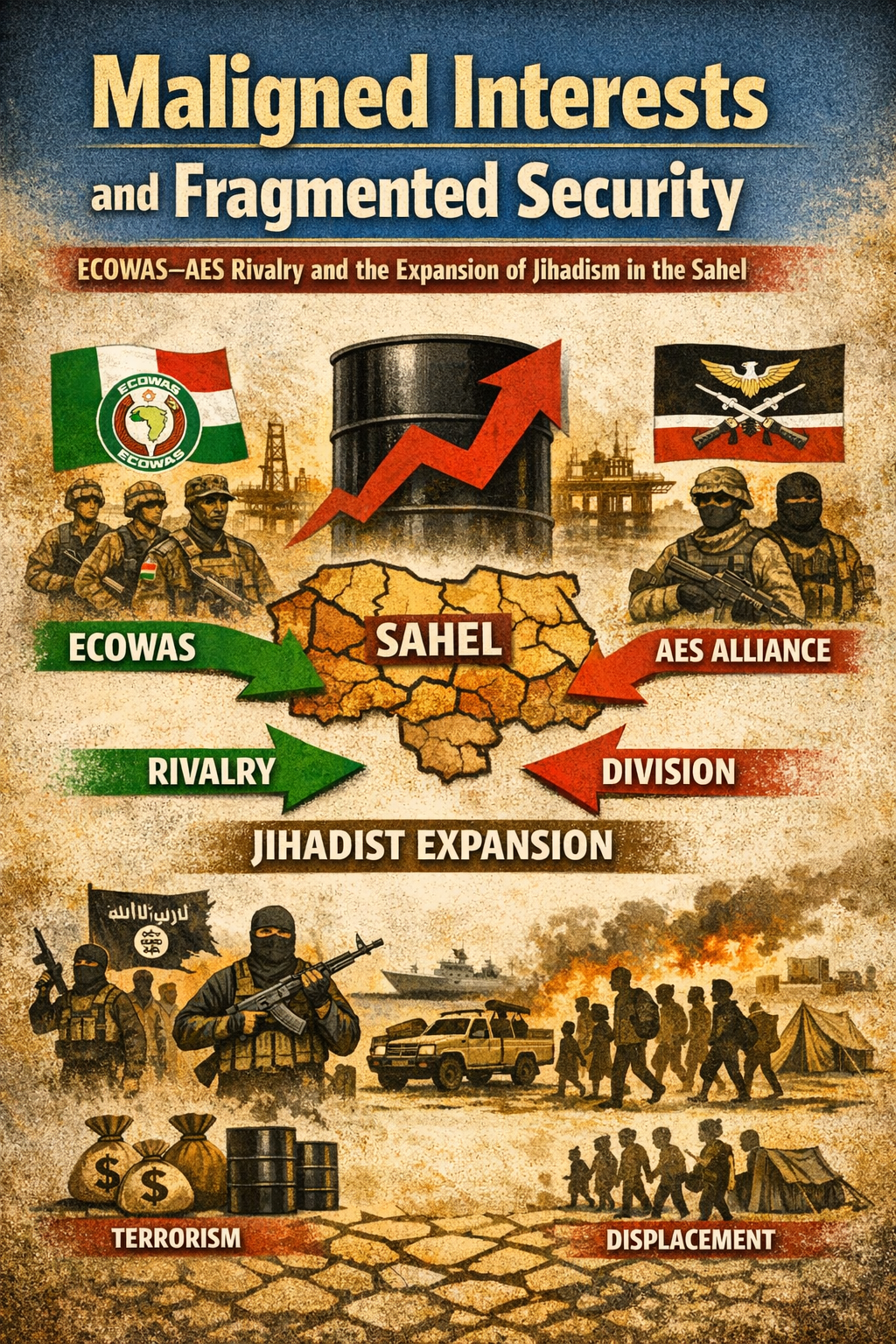
This article argues that the expansion of jihadism is partly rooted in the interaction of competing regional strategies, specifically the growing rivalry between the Economic Community of West African States (ECOWAS) and the Alliance of Sahel States (AES). While both entities pursue objectives that are, not in isolation, rational and normatively defensible, their interaction produces unintended consequences that undermine collective security. This phenomenon is conceptualised here as maligned interests, a condition in which the pursuit of legitimate goals generates outcomes that are collectively counterproductive. Maligned interests differ from simple misalignment in that actors pursue internally coherent and rational strategies, yet the interaction of these strategies systematically produces collectively harmful outcomes.
To deepen this analysis, the article employs the Prisoner’s Dilemma as a theoretical lens. By framing the ECOWAS–AES relationship as a strategic interaction characterised by incentives to defect rather than cooperate, the article demonstrates how mutual distrust and competing priorities produce a stable but undesirable equilibrium, one that fragments security governance and creates opportunities for jihadist expansion. In this configuration, jihadist groups are not primary actors within the strategic game but emerge as unintended beneficiaries of its outcome.
Maligned Interests and the Structure of Regional Security
The concept of maligned interests provides a critical entry point into understanding the paradox of intensifying insecurity amid sustained intervention. It challenges the assumption that insecurity necessarily results from irrationality, incompetence, or lack of political will. Instead, it directs attention to the relational dynamics between actors, emphasising how the alignment or misalignment of interests shapes outcomes (Murningham, 2018; Romain, 2015). This framework builds on, but extends beyond, traditional notions of the security dilemma. While the classical security dilemma explains how defensive measures by one state can be perceived as threats by another, leading to escalation, the Sahelian case reflects a more complex, multi-actor dynamic (Glaser, 1997; Tang, 2009). In the Sahelian context, both ECOWAS and AES operate within coherent strategic frameworks. ECOWAS, as a long-standing regional organisation, derives its legitimacy from its commitment to democratic governance, constitutional order, and regional stability (Bolaji, 2015; Edodi & Ahimbisibwe, 2024). Its responses to political crises, including sanctions and threats of intervention, are grounded in a normative framework that seeks to deter unconstitutional changes of government and preserve institutional continuity. By contrast, AES represents a reconfiguration of regional politics rooted in the assertion of sovereignty and regime survival. Comprising Mali, Burkina Faso, and Niger, the alliance emerged in the wake of military coups and subsequent tensions with ECOWAS. Its leaders frame their position as a rejection of external interference and an affirmation of national autonomy, particularly in matters of security. Within this framework, cooperation with external or regional actors is often viewed through the lens of political vulnerability rather than collective benefit.
These two orientations, normative enforcement on the one hand and sovereign assertion on the other are not inherently incompatible. However, in practice, they become mutually reinforcing sources of fragmentation. Each actor interprets the actions of the other not as complementary but as threatening, thereby narrowing the space for cooperation. The resulting dynamic is not one of direct confrontation, but of strategic divergence, in which coordination erodes and parallel systems of governance emerge. The formation of AES marks a critical juncture in the evolution of West African regionalism. The withdrawal or disengagement of its member states from ECOWAS mechanisms represents more than a temporary diplomatic dispute; it signals a deeper reconfiguration of the regional order. Institutions that once facilitated cooperation, such as the G5 Sahel, created on 16th February 2014, have been weakened, while new forms of alignment have emerged outside established frameworks.
This fragmentation has profound implications for security governance. Counterinsurgency in the Sahel is inherently transnational, requiring coordination across borders, shared intelligence, and synchronised military operations. The erosion of these mechanisms disrupts the capacity of states to respond effectively to mobile and adaptive insurgent groups. At the same time, the emergence of parallel alliances introduces competing priorities and strategies, further complicating efforts to establish a coherent regional response. The political rupture between ECOWAS and AES thus creates a structural environment in which insecurity is not merely a byproduct of weak institutions, but a consequence of institutional disintegration and strategic misalignment.
The Prisoner’s Dilemma and the Logic of Strategic Defection
The dynamics described above can be analytically captured through the framework of the Prisoner’s Dilemma. Introduced by Merrill Flood and Melvin Dresher in 1950 and later formalised and popularised by Albert W. Tucker, the model describes a strategic situation in which two rational actors, acting in their own self-interest, may arrive at an outcome that is suboptimal for both. The central insight of the Prisoner’s Dilemma lies in the tension between individual rationality and collective welfare: although cooperation yields the best joint outcome, the structure of incentives encourages each actor to defect, anticipating that the other may do the same. In its classical formulation, two prisoners are interrogated separately and must independently decide whether to cooperate with each other by remaining silent or defect by betraying the other. Mutual cooperation leads to relatively lenient outcomes for both, while unilateral defection rewards the defector and punishes the cooperator. However, because neither actor can trust the other to cooperate, both choose to defect, resulting in a worse outcome than if they had cooperated. This paradox illustrates how mutual distrust and strategic uncertainty can systematically undermine cooperation, even when it is clearly beneficial.
Applied to the ECOWAS–AES relationship, this framework illuminates the logic underlying their interaction. Cooperation would involve maintaining open channels of communication, coordinating security operations, and prioritising collective responses to jihadist threats. Such an approach would enhance the effectiveness of counterinsurgency efforts and reduce the operational space available to insurgent groups. However, cooperation carries perceived risks for both actors. For ECOWAS, engaging with AES without enforcing its normative framework may undermine its credibility and weaken its ability to deter future coups. For AES, cooperation with ECOWAS may be interpreted domestically as capitulation to external pressure, thereby threatening regime stability. In this context, defection becomes the safer strategy.
ECOWAS defects through the imposition of sanctions, diplomatic isolation, and the assertion of its normative authority. AES, in turn, defects by withdrawing from regional mechanisms, rejecting external oversight, and pursuing alternative security arrangements. These decisions are individually rational, given the constraints and priorities facing each actor. Yet, when both sides defect, the outcome is a fragmented security environment in which cooperation collapses.This equilibrium of mutual defection is not accidental: it is structurally embedded in the interaction. The absence of trust, combined with the high perceived cost of unilateral cooperation, makes defection the dominant strategy. Over time, repeated interactions reinforce this pattern, transforming it into a stable but undesirable equilibrium.
Jihadist Expansion as an Outcome of Strategic Interaction
A key contribution of this analysis lies in shifting the focus from jihadist groups as primary drivers of insecurity to their role as opportunistic actors within a fragmented system. Organizations such as Jama’at Nasr al-Islam wal Muslimin and Islamic State in the Greater Sahara do not directly shape the strategic interaction between ECOWAS and AES. Instead, they exploit the conditions produced by it. The breakdown of coordination creates gaps in surveillance and response, allowing these groups to move across borders with reduced resistance. The diversion of resources toward political and diplomatic conflicts limits the capacity of states to sustain counterinsurgency operations. At the same time, competing narratives of legitimacy erode public trust in state institutions, creating openings for insurgent groups to position themselves as alternative sources of authority.
This dynamic is further exacerbated by the emphasis on militarised responses in the absence of effective governance. In many parts of the Sahel, state presence is limited, inconsistent, or perceived as predatory. Jihadist groups capitalise on these conditions by embedding themselves within local communities, providing forms of order, dispute resolution, or economic opportunity that the state fails to deliver. The involvement of external actors, including the Wagner Group, adds another layer of complexity. While such actors may enhance short-term military capacity, they often operate outside established frameworks of accountability and coordination, reinforcing the fragmentation that benefits insurgent groups.
The ECOWAS–AES interaction is not a one-time event but an ongoing process characterised by repeated engagements. In such an iterated context, the persistence of defection becomes self-reinforcing. Each instance of defection validates the expectations of the other actor, deepening mistrust and reducing the likelihood of future cooperation. This creates a feedback loop in which fragmentation produces insecurity, and insecurity, in turn, reinforces fragmentation. The longer this dynamic persists, the more difficult it becomes to reverse. Cooperation requires not only a shift in strategy but also a transformation in perceptions, expectations, and institutional arrangements. From this perspective, the expansion of jihadism is not simply a failure of counterterrorism, but a manifestation of a broader crisis of regional governance. It reflects the inability of key actors to align their strategies in a manner that addresses shared threats.
Rethinking Regional Security in the Sahel
Understanding the Sahelian crisis through the lens of maligned interests and the Prisoner’s Dilemma highlights the limitations of approaches that focus solely on military solutions or external intervention. It underscores the importance of coordination, trust-building, and institutional integration in addressing transnational threats. The expansion of jihadism in the Sahel cannot be adequately explained by reference to state weakness or insurgent strategy alone. It must be understood as an outcome of strategic interaction within a fragmented regional system. The rivalry between ECOWAS and AES illustrates how rational actors, pursuing legitimate objectives, can generate collectively harmful outcomes when their interests are misaligned. Rebuilding cooperation between ECOWAS and AES is undoubtedly challenging, given the political and ideological differences that divide them. However, even limited forms of engagement such as technical cooperation on intelligence sharing or border management could mitigate the effects of fragmentation. More broadly, there is a need to decouple counterterrorism from broader political disputes, ensuring that security cooperation is not held hostage to competing agendas. At the same time, addressing the structural drivers of insurgency requires a shift toward governance-centered approaches that prioritise service delivery, inclusion, and community engagement. Without such efforts, military gains are likely to remain temporary, and the underlying conditions that sustain jihadist expansion will persist. The persistence of jihadist expansion in the Sahel is not merely a failure of capacity, but a failure of coordination. Until regional actors resolve the structural incentives that sustain defection, insecurity will remain a predictable outcome of rational strategy.
Reference
Bolaji, K.A. (2015). Regional Organizations and Democratization in Africa: The ECOWAS Experience. In: Adejumobi, S. (eds) Democratic Renewal in Africa. Palgrave Macmillan, New York. https://doi.org/10.1057/9781137484345_8
Edodi, S., & Ahimbisibwe, F. (2024). Challenges of deepening political commitment and long-term legitimacy in West African integration and the future of ECOWAS. Cogent Social Sciences, 10(1). https://doi.org/10.1080/23311886.2024.2420465
Romain P. L. (2015). Conflicts of interest in research: looking out for number one means keeping the primary interest front and center. Current reviews in musculoskeletal medicine, 8(2), 122–127. https://doi.org/10.1007/s12178-015-9270-2
Murnigham, J.K. (2018). Game Theory. In: Augier, M., Teece, D.J. (eds) The Palgrave Encyclopedia of Strategic Management. Palgrave Macmillan, London. https://doi.org/10.1057/978-1-137-00772-8_416
Glaser, C. L. (1997). The Security Dilemma Revisited. World Politics, 50(1), 171–201. http://www.jstor.org/stable/25054031
Tang, S. (2009). The Security Dilemma: A Conceptual Analysis. Security Studies, 18(3), 587–623. https://doi.org/10.1080/09636410903133050