







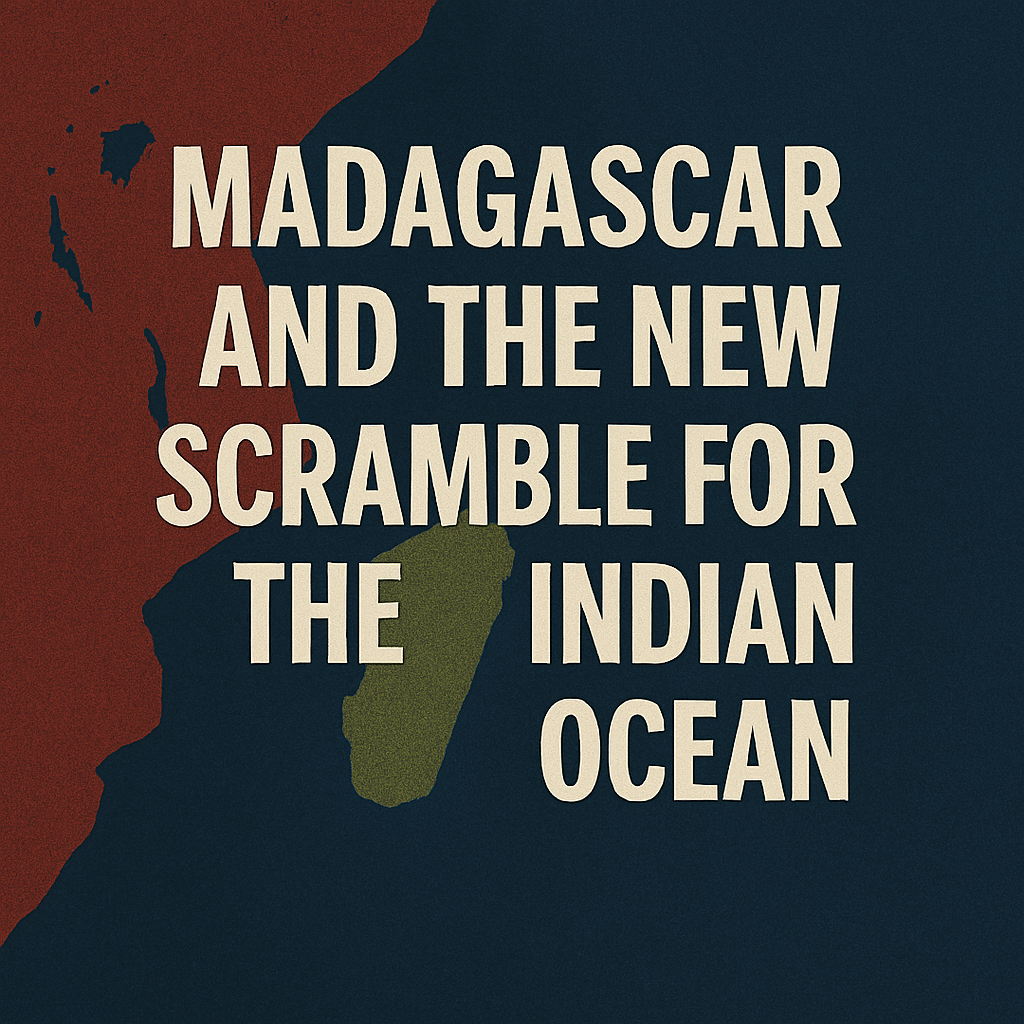
Madagascar’s sudden political rupture—marked by mass protests, a military mutiny, and the overthrow of former president Andry Rajoelina aboard a French military aircraft—has transformed the island into one of the most contested geopolitical spaces of the Indian Ocean. Far from a purely domestic upheaval, the crisis exposes how Madagascar sits at the intersection of maritime strategy, critical mineral supply chains, and Africa’s accelerating rejection of Western tutelage (Jeune Afrique, 2025; International Crisis Group, 2025).
As global powers reposition amid disruptions to Red Sea shipping and the erosion of French influence across Africa, Madagascar’s strategic value has never been higher. What is unfolding on the “Great Island” is not simply a power vacuum, but a multi-layered scramble involving France, China, India, the United States, Japan, and Russia—each pursuing distinct but overlapping interests within an increasingly multipolar Indian Ocean order (Kaplan, 2023; UNCTAD, 2024).
Strategic geography: Why Madagascar matters
Madagascar’s importance is first and foremost geographical. The CIA identifies it as the “largest, most populous, and most strategically situated” state in the southwestern Indian Ocean, commanding sea lanes linking Asia, Africa, Europe, and the Americas (CIA, 2024). The Mozambique Channel—flanked by Madagascar and Mozambique—has gained renewed importance as global trade is rerouted around the Cape of Good Hope following repeated disruptions to Red Sea shipping linked to Yemen’s Ansarallah-aligned forces (Lloyd’s List, 2024).
Shipping traffic along the Cape Route surged by over 200 percent between late 2023 and 2024, dramatically increasing the strategic value of chokepoints previously considered secondary (UNCTAD, 2024). Control, access, or surveillance of these waters now offers major leverage over global trade flows, energy shipments, and naval mobility, elevating Madagascar from peripheral island to strategic hinge (Kaplan, 2023).
France’s imperial afterlife and strategic retreat
France’s relationship with Madagascar is rooted in late-19th-century imperial competition with Britain. Although Madagascar formally gained independence in 1960, Paris retained control of the Scattered Islands (Les îles Éparses), granting itself expansive exclusive economic zones in the Mozambique Channel. Antananarivo has long contested this arrangement under international law, viewing it as an unfinished act of decolonization (Aldrich & Connell, 2023).
Repeated attempts by Malagasy leaders to distance themselves from Paris have historically ended in crisis. Didier Ratsiraka fled to France after the 2002 protests; Andry Rajoelina first rose to power in 2009 following a military mutiny, only to be removed, rehabilitated, and ultimately ousted again in 2025. His exile to France mirrors the fate of numerous Western-aligned leaders across Africa, reinforcing perceptions of a collapsing Françafrique system (Charbonneau, 2024; Jeune Afrique, 2025).
France’s broader retreat from the continent—including expulsions from Mali, Burkina Faso, Niger, and the Central African Republic—magnifies this loss. Madagascar is not merely another former colony; it anchors maritime zones Paris historically sought to control to secure Indian Ocean trade routes. The United Kingdom’s 2024 agreement to return the Chagos Islands to Mauritius further isolates France as the last major power resisting decolonization in the region (UK Foreign Office, 2024).
India and China: Strategic patience versus structural power
Into this vacuum step India and China, both of which view the Indian Ocean as existential to their economic and security futures. India depends on the Indian Ocean for roughly ninety percent of its trade and has quietly expanded its regional footprint for nearly two decades (Indian Ministry of Defence, 2023).
As documented by The Cradle and corroborated by Indian defence sources, New Delhi established a listening post in northern Madagascar in 2007 and formalized defence cooperation through a 2018 agreement. This presence complements Indian facilities across Mauritius, the Maldives, Oman, and the Seychelles, forming an arc of maritime awareness designed to counterbalance Chinese naval expansion (Brewster, 2024).
China’s approach is broader and more structural. The Indian Ocean serves as the maritime spine of the Belt and Road Initiative, carrying nearly eighty percent of China’s oil imports (Rolland, 2023). Beijing has entrenched itself through port investments, including Tamatave, and has reportedly explored access to Diego Suarez, a former French naval base (AidData, 2024).
In November 2025, Chinese Ambassador Ji Ping met Madagascar’s Mines Minister to expand cooperation in geological mapping and mining investment, signaling Beijing’s intent to secure graphite, nickel, cobalt, and rare earth elements—minerals central to China’s industrial and energy transition strategy (Xinhua, 2025; World Bank, 2024).
The mineral dimension: Resources as the real prize
Madagascar’s mineral wealth is vast but underdeveloped. It is the second-largest producer of graphite in Africa and hosts significant deposits of nickel, cobalt, ilmenite, chromite, and rare earth elements (USGS, 2024). By the early 2000s, the island was producing roughly half of the world’s sapphires, alongside gold and industrial minerals (World Bank, 2023).
Despite this abundance, mining accounted for only about five percent of GDP in 2023, constrained by infrastructure deficits, governance challenges, and social resistance (African Development Bank, 2024). This gap between potential and production is precisely what attracts external powers seeking long-term supply security.
American firm Energy Fuels is advancing the Toliara mineral sands project, while Harena Resources controls the Ampasindava site. China has engaged mining conglomerate Tsingshan to explore coal, iron, and nickel opportunities. Control over Madagascar’s resources is therefore not merely economic but strategic, shaping future supply chains for defence, energy, and technology (IEA, 2024).
Washington, Tokyo, and Moscow: Late movers and hedgers
The United States has been slower to engage, constrained by distance and competing priorities in Europe and West Asia. Aid suspensions following Madagascar’s 2009 coup strained relations, though Washington has recently expanded diplomatic and security engagement through AFRICOM, recognizing the island’s relevance to critical mineral diversification and maritime security (US Department of Defence, 2024).
Japan plays an inconspicuous but significant role. Through the Tokyo International Conference on African Development (TICAD), Tokyo has invested heavily in infrastructure, including the expansion of Madagascar’s main port scheduled for completion in 2026. The Ambatovy nickel-cobalt project—the largest foreign investment in the country’s history—anchors Japan’s long-term economic stake and its “Free and Open Indo-Pacific” vision (JICA, 2024).
Russia’s involvement is more aggressive. Moscow supported candidates in Madagascar’s 2018 election and has expanded naval engagement across the Indian Ocean. In late 2025, a Russian delegation linked to the Africa Corps reportedly delivered weapons to Antananarivo, testing the new leadership’s openness to security cooperation (Jeune Afrique, 2025; ISS, 2025). Yet Madagascar’s leadership appears cautious, balancing Moscow against Paris, Beijing, and Washington to avoid overdependence.
Conclusion: A hinge of the new Indian Ocean order
Madagascar’s revolt is not merely a domestic reckoning with corruption and inequality; it is a geopolitical hinge moment. As colonial-era arrangements unravel and new trade routes reshape global commerce, the island stands at the crossroads of maritime power, mineral security, and post-imperial identity (Kaplan, 2023; UNCTAD, 2024).
For global powers, Madagascar offers access to chokepoints, resources, and influence. For Madagascar, the challenge is converting that attention into sovereignty rather than subordination. If the current moment holds, the Great Island may not only reclaim its contested territories and resources but also redefine its role in a rapidly transforming Indian Ocean order—one shaped not by imperial inheritance, but by contested multipolar realities.
References
African Development Bank Group. (2024). African economic outlook 2024: Mobilising Africa’s domestic resources. AfDB.
AidData. (2024). Banking on the Belt and Road: China’s global infrastructure footprint, 2013–2023. William & Mary Global Research Institute.
Aldrich, R., & Connell, J. (2023). France’s overseas empire and the politics of decolonisation. Routledge.
Brewster, D. (2024). India’s expanding strategic presence in the western Indian Ocean. Journal of the Indian Ocean Region, 20(1), 1–18. https://doi.org/10.1080/19480881.2024.XXXXXX
Central Intelligence Agency. (2024). The World Factbook: Madagascar. CIA.
Charbonneau, B. (2024). The end of Françafrique? Military disengagement and post-colonial power in Africa. Third World Quarterly, 45(3), 421–438. https://doi.org/10.1080/01436597.2023.XXXXXX
Indian Ministry of Defence. (2023). Ensuring security and growth for all in the region (SAGAR): Maritime strategy update. Government of India.
Institute for Security Studies. (2025). Russia’s renewed security footprint in the Indian Ocean region. ISS Policy Brief, No. 192.
International Crisis Group. (2025). Madagascar’s political rupture and regional implications. ICG Africa Briefing No. 187.
International Energy Agency. (2024). Critical minerals market review 2024. IEA.
Japan International Cooperation Agency. (2024). TICAD and Japan–Africa infrastructure cooperation. JICA.
Jeune Afrique. (2025). Madagascar: Crise politique, recomposition militaire et rivalités étrangères. Jeune Afrique, January–February 2025.
Kaplan, R. D. (2023). The looming maritime century: How the Indian Ocean is shaping the 21st century. Random House.
Lloyd’s List. (2024). Cape of Good Hope shipping surge reshapes global trade routes. Lloyd’s List Intelligence.
Rolland, N. (2023). China’s Eurasian century? Political and strategic implications of the Belt and Road Initiative. National Bureau of Asian Research.
UK Foreign, Commonwealth & Development Office. (2024). UK–Mauritius agreement on the Chagos Archipelago. FCDO Policy Paper.
United Nations Conference on Trade and Development. (2024). Review of maritime transport 2024. UNCTAD.
United States Department of Defense. (2024). Indo-Pacific strategy and western Indian Ocean engagement. DoD.
United States Geological Survey. (2024). Mineral commodity summaries: Madagascar. USGS.
World Bank. (2023). Madagascar economic update: Harnessing natural resources for inclusive growth. World Bank.
World Bank. (2024). Minerals for climate action: The role of developing economies. World Bank.
Xinhua News Agency. (2025). China and Madagascar deepen cooperation on mining and geological surveys. Xinhua, November 2025.