








Introduction
Over the past three Global Terrorism Index (GTI) reports produced by the Institute for Economics & Peace, the trajectory of terrorism has evolved from resurgence to gradual decline. The GTI 2024 (covering 2023 data) indicated a renewed increase in terrorism-related deaths, largely driven by intensifying violence in the Sahel region. This marked a reversal of earlier global improvements. In GTI 2025 (2024 data), the situation stabilised somewhat, with mixed trends across regions—declines in some areas offset by worsening conditions in fragile states. By GTI 2026 (2025 data), a more significant improvement was recorded, with terrorism-related deaths falling by 28 per cent to 5,582 and attacks declining by 22 per cent to 2,944, representing the lowest levels since 2007 (Institute for Economics & Peace, 2026). This progression suggests that while counterterrorism efforts may be yielding results, the improvements remain uneven and fragile.
Geographic Concentration: Intensification in Fewer States
A key trend across the three reports is the increasing geographic concentration of terrorism. In GTI 2024, terrorism was relatively widespread, affecting a broad range of countries, although early signs of concentration in the Sahel were emerging. By GTI 2025, the pattern had begun to shift, with fewer countries accounting for a larger share of global terrorism deaths. This trend became more pronounced in GTI 2026, where nearly 70 per cent of all deaths occurred in just five countries, and only 36 countries recorded terrorism-related fatalities (Institute for Economics & Peace, 2026). This indicates a transition from a globally diffused threat to one that is highly concentrated in a small number of conflict-affected states.
The Sahel’s Evolution: From Rising Hotspot to Entrenched Epicentre
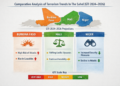
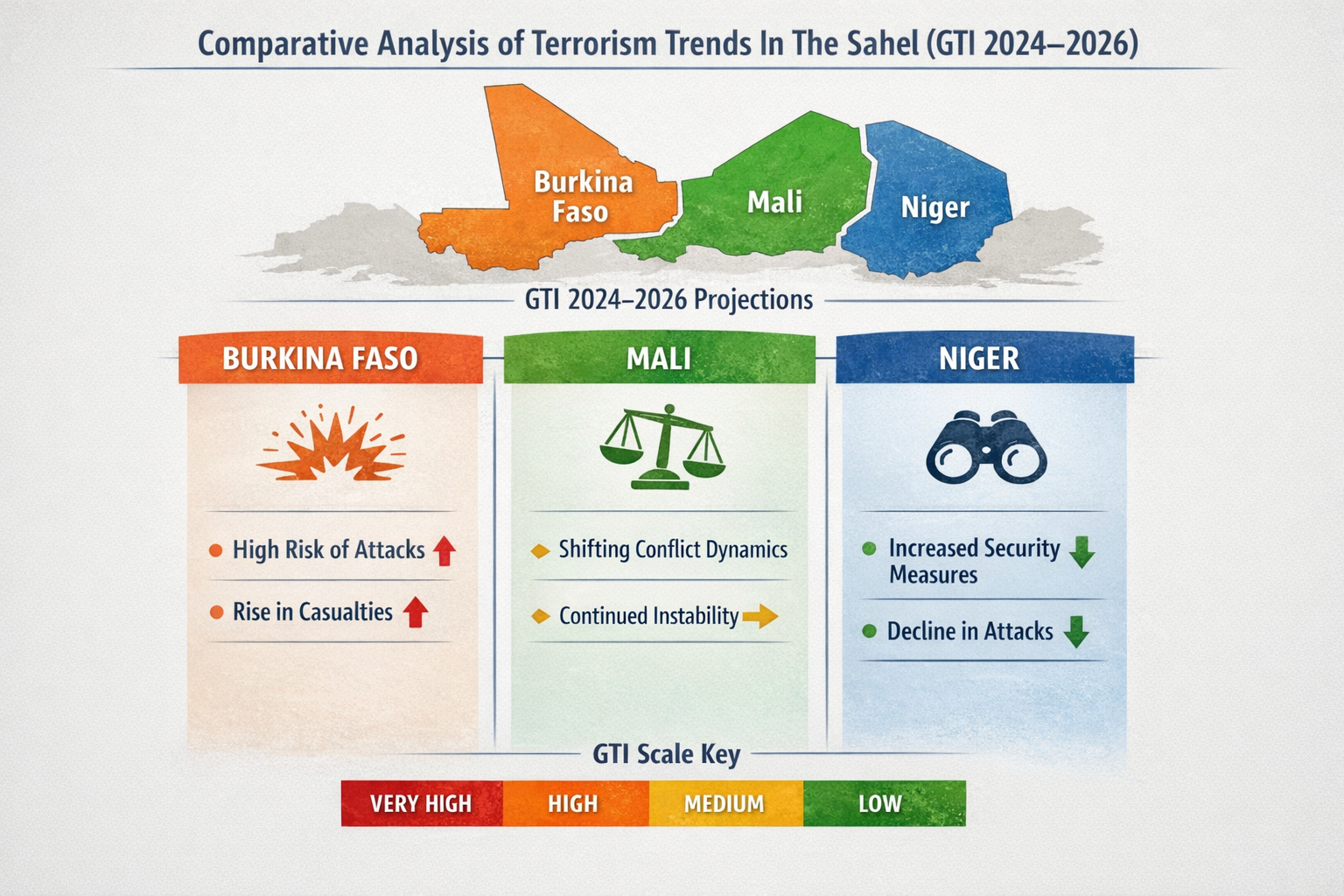
The Sahel region has undergone the most dramatic transformation over the three-year period. In GTI 2024, it was identified as the fastest-growing region for terrorism, with a sharp rise in attacks and fatalities. By GTI 2025, the Sahel had firmly established itself as the global epicentre of terrorism, surpassing regions such as the Middle East. In GTI 2026, the region continued to dominate global terrorism trends, accounting for over half of all terrorism-related deaths despite a modest decline in fatalities (Institute for Economics & Peace, 2026). This indicates that while the intensity of violence may fluctuate, the underlying conditions sustaining terrorism in the Sahel remain deeply entrenched.
Country-Level Dynamics: Shifting Patterns of Impact
At the country level, the rankings of the most affected states have shifted significantly. In GTI 2024, Burkina Faso was identified as the country most impacted by terrorism, reflecting the rapid escalation of violence in the Sahel. This position largely persisted into GTI 2025, with Niger and Mali also experiencing substantial increases in terrorism-related activity. However, GTI 2026 marked a notable shift, with Pakistan emerging as the most affected country for the first time in over a decade, driven by increased activity from Tehrik-i-Taliban Pakistan. Meanwhile, Burkina Faso experienced a decline in violence but remained among the most affected, and Nigeria recorded a resurgence in attacks and fatalities. The Democratic Republic of the Congo also entered the top ten, highlighting the expanding threat in Central Africa (Institute for Economics & Peace, 2026).
Terrorist Groups: Continuity and Adaptation
The three reports reveal both continuity and adaptation among terrorist organisations. Across all years, the Islamic State remained the world’s deadliest terrorist group, while Jama’at Nusrat al-Islam wal-Muslimin (JNIM) expanded its influence in the Sahel and al-Shabaab continued to dominate in Somalia. By GTI 2026, however, there was increasing evidence of fragmentation and rivalry among extremist groups, particularly in Nigeria, where competition between Islamic State West Africa Province (ISWAP) and Boko Haram intensified violence. This suggests that terrorist organisations are not only persisting but also adapting their strategies to local conditions, becoming more embedded in regional conflicts and community-level grievances.
Changing Nature of Attacks: Strategic Localisation
Another important shift concerns the nature and location of terrorist attacks. In GTI 2024, attacks were distributed across both urban and rural areas, often involving high-casualty tactics. By GTI 2025, there was a noticeable shift towards rural insurgency-style operations, including ambushes and raids. This trend became even more pronounced in GTI 2026, where over 76 per cent of attacks occurred within 100 kilometres of international borders, particularly in regions such as the Central Sahel and the Lake Chad Basin (Institute for Economics & Peace, 2026). This reflects a broader transformation in terrorism, from symbolic acts of violence to strategies focused on territorial control and the domination of local populations.
Persistent Drivers of Terrorism
Despite fluctuations in the number of attacks and fatalities, the underlying drivers of terrorism have remained consistent across the three reports. Weak governance, political instability, economic deprivation, human rights abuses, and declining international cooperation continue to create conditions conducive to the spread of extremist violence. While GTI 2024 and GTI 2025 highlighted the intensification of these factors, GTI 2026 suggests that they remain largely unchanged, even as overall violence declines (Institute for Economics & Peace, 2026). This underscores the structural nature of the terrorism challenge, particularly in sub-Saharan Africa.
The International Dimension: Declining Cooperation
The role of international cooperation has also evolved over the three-year period. Earlier reports (GTI 2024 and GTI 2025) reflected significant involvement by international actors, particularly in the Sahel. However, by GTI 2026, there was a noticeable decline in external engagement, partly due to political developments such as military coups in the region. The withdrawal of Western forces and reduced coordination have weakened collective counterterrorism efforts, shifting the burden increasingly onto regional actors (Institute for Economics & Peace, 2026). This reduction in international support may have long-term implications for security in already fragile states.
Conclusion: From Expansion to Fragile Containment
The comparative analysis of GTI 2024–2026 reveals a transition from expansion to fragile containment of terrorism. While the overall number of attacks and deaths has declined, the threat has become more concentrated, structurally embedded, and regionally complex. The Sahel remains the epicentre of global terrorism, and the persistence of underlying drivers such as weak governance and economic hardship suggests that recent gains may not be sustainable. Without sustained investment in governance, development, and international cooperation, there is a significant risk that terrorism could resurge in the coming years (Institute for Economics & Peace, 2024; 2025; 2026).
References
Institute for Economics & Peace. (2024). Global Terrorism Index 2024: Measuring the impact of terrorism. Sydney: Institute for Economics & Peace.
Institute for Economics & Peace. (2025). Global Terrorism Index 2025: Measuring the impact of terrorism. Sydney: Institute for Economics & Peace.
Institute for Economics & Peace. (2026). Global Terrorism Index 2026: Measuring the impact of terrorism. Sydney: Institute for Economics & Peace.