





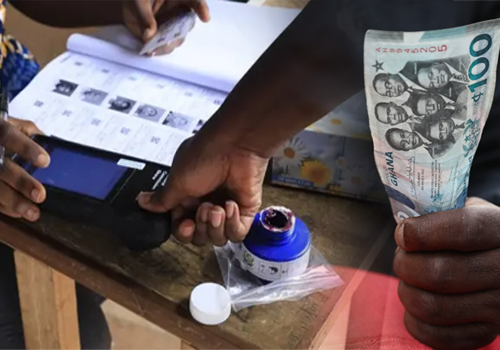
On Saturday, February 7, 2026, as delegates filed into the Ayawaso East National Democratic Congress (NDC) primary, allegations surfaced that some of them had arrived with more than just a political preference. Brown envelopes had reportedly been circulating. Household items had changed hands. A candidate was implicated. An internal probe was launched, the candidate was cleared, and then — as happens so often in Ghana’s political landscape — the country moved on. But the Ayawaso East incident is not a footnote. It is a mirror. It reflects, with uncomfortable clarity, the deep structural rot that has taken hold in the machinery of Ghana’s democracy: a rot so embedded that it now persists even within the internal processes meant to determine who represents the people before a single public vote has been cast.
Ghana’s Fourth Republic is often held up as a democratic success story in a region where governance systems frequently buckle under their own weight. The peaceful transitions of power, the functioning electoral commission, the vibrant civil society sector — these achievements are real. But achievements on paper do not tell the full story. What is happening beneath the surface is a systematic replacement of civic participation with transactional logic, in which the distribution of private goods has become more persuasive than the articulation of public policy. Vote buying has matured from a rare and scandalous act into a fully functioning market, one with its own brokers, currencies, enforcement mechanisms, and most disturbingly, its own youth labour force. The consequences are not only electoral. They are economic, social, and increasingly violent.
The Structural Foundations of Electoral Clientelism
To understand why vote buying persists in Ghana, one must first understand why it is so rational. The political culture of the Fourth Republic is anchored in a winner-takes-all logic that makes the cost of losing elections professionally and financially devastating for politicians. Cabinet appointments, government contracts, constituency development funds, public procurement decisions — all of these flow overwhelmingly toward the party in power. Losing is not merely an electoral setback; it is economic ruin. This calculus drives politicians to spend at almost any cost, turning parliamentary campaigns into extraordinarily expensive enterprises. Research from Transparency International Ghana and the Ghana Centre for Democratic Development (2025) estimated that it costs GHC 4 million (approximately $693,000) to contest parliamentary primaries and elections — a sum so staggering that it effectively bars women, young people, and anyone outside elite financial networks from meaningful political participation. The same organisations found that between 2012 and 2016, campaign costs rose by 59 percent.
The money to fund these campaigns rarely comes without strings. Politicians who secure large donations from business interests are expected to return the favour through procurement awards, regulatory concessions, or the channelling of state contracts to loyal patrons. This cycle corrupts governance from the inside. Infrastructure projects are awarded on the basis of political allegiance rather than technical merit. Public funds are diverted to settle electoral debts. The result is a fiscal landscape permanently warped by political incentives, producing the kind of reckless public spending that brought Ghana to its knees in 2022 and necessitated a $3 billion International Monetary Fund bailout (IMF, 2023). That crisis was not simply an accident of global commodity prices. It was, in substantial part, the predictable consequence of a political system that had long treated the public purse as a campaign resource.
The Mechanics of the Market: How Votes Are Bought and Sold
The transactions of vote buying in Ghana are considerably more sophisticated than simple cash handouts. At the grassroots level, local brokers — men and women who know their communities intimately, who understand what each household needs and what each voter fears — serve as indispensable intermediaries between political patrons and the electorate. They translate political money into targeted goods that speak directly to lived conditions of deprivation. For fishermen struggling to keep their livelihoods afloat, outboard motors appear. For families cooking on open fires, gas cylinders materialise. For households in need of basic repairs, roofing sheets arrive. For students — whose economic desperation can be leveraged with particular ease — laptops and mobile phones are distributed with the implicit understanding that political loyalty is the currency of exchange.
To enforce these transactions across a sometimes sceptical electorate, politicians have developed mechanisms that go well beyond trust. The practice of staged payments is common: a portion of the promised gift is delivered before the election, with the remainder handed over only after the candidate wins in that specific polling area. Some voters are required to photograph their completed ballots with mobile phones as evidence of compliance. Others are made to swear oaths before traditional religious authorities, invoking the binding power of local deities to guarantee that their end of the bargain is kept. These are not the improvised tactics of desperate campaigners. They are the institutionalised instruments of a mature clientelist system — one that has learned, through years of refinement, how to convert human vulnerability into political capital.
The Youth Factor: Trapped Between Desperation and Complicity
Ghana’s young people occupy a deeply contradictory position within this system. They are simultaneously its primary victims and among its most active perpetrators. First-time voters are targeted with particular precision, precisely because they have not yet formed the partisan loyalties that make older voters harder to shift, and because they are, in many cases, experiencing economic precarity in its most acute form. They enter a labour market that offers few formal opportunities, navigate the aftermath of education without viable prospects, and inhabit what scholar Alcinda Honwana (2012) has called ‘waithood’ — a suspended state of waiting for employment, for economic agency, for an adulthood that the formal economy keeps indefinitely deferring. In that condition of waiting, the offer of immediate cash or a gas cylinder is not a bribe that can be easily refused. It is, for many, the most concrete economic transaction the state has ever offered them.
But the role of young people in Ghana’s vote buying ecosystem extends far beyond passive receipt of gifts. Many are actively recruited as ‘foot soldiers’ — the grassroots operatives who distribute gifts on behalf of politicians, mobilise communities, monitor which voters have taken money from rival candidates, and apply social pressure to ensure that private promises are honoured in the polling station. Bob-Milliar’s (2024) research has documented with precision how the monetisation of internal party democracy relies on precisely this class of young political operatives, keeping them financially dependent on patronage networks rather than building the skills, confidence, and independence that genuine political participation requires. The politician who pays a foot soldier on election day is not investing in youth empowerment. He is investing in continued dependency — and in the perpetuation of the very system that makes youth dependency possible.
From Foot Soldiers to Vigilantes: When Vote Buying Kills
The most lethal expression of this dynamic is the recruitment of young men into political vigilante groups — the so-called ‘macho men’ who provide ‘security’ at political events, intimidate opponents, and use the threat or fact of violence to enforce electoral transactions. Ghana passed the Vigilantism and Related Offences Act in 2019 (Act 999) specifically to address this problem, and the legislation was widely welcomed. It has not worked. What the law succeeded in doing was prompting a rebranding exercise: the Azorka Boys became ‘community development’; the Delta Force and Invisible Forces became ‘Party Operations’; other groups simply became ‘Party Security’ or ‘youth wings.’ The faces remained the same. The violence did too.
The 2024 general election left no ambiguity about the human cost. In the Tolon Constituency of the Northern Region, 31-year-old Haruna Shaibu, a steel bender, was shot and killed at the Nyankpala lorry station (CDD-Ghana, 2024). In the Offinso North Constituency of the Ashanti Region, two people lost their lives when a group stormed a warehouse to steal fertiliser that had been designated as campaign largesse for voters (Ghana News Agency, 2024). Even after the election had concluded, items meant for Persons with Disabilities (PWDs) were looted in Ayawaso North in the Greater Accra Region, because the expectation of political ‘goodies’ had by then become a post-election norm, as entrenched as the election itself. Historical violence in the Talensi Constituency of the Upper East Region and Ayawaso West Wuogon in Greater Accra tells the same story across different election cycles (Gyampo et al., 2017). Electoral violence in Ghana is not a failure of isolated bad actors. It is a structural feature of a system in which vote buying requires enforcement, and enforcement requires young men willing to deploy their bodies as instruments of political coercion.
The Erosion of Trust and the Collapse of the Social Contract
The long-term damage of vote buying is not merely fiscal, though the fiscal damage is severe. When citizens and politicians alike operate on the mutual understanding that electoral outcomes are purchased rather than earned, the social contract that underpins democratic governance begins to dissolve. Why would a voter hold a government accountable for service delivery when the only transaction they have ever had with that government was a gas cylinder before polling day? Why would a politician invest in genuine policy development when votes can be secured more cheaply and efficiently through patronage? The result is a self-reinforcing cycle of cynicism — voters who expect nothing from government except what can be extracted at election time, and politicians who deliver nothing except what is necessary to win the next round.
Afrobarometer (2024) data documents this deterioration in sharp relief. Trust in state institutions has declined significantly among Ghanaians, with youth reporting the highest levels of political disconnection. More citizens than at any previous recorded point in the Fourth Republic describe political parties as self-interested rather than nationally oriented. This is not apathy. It is the rational response of a citizenry that has been educated, through repeated experience, that democratic engagement is transactional at its core. Young Ghanaians are being trained in a school of politics that defines citizenship not as collective participation in governance but as individual extraction from a system that offers nothing else. The consequences of that training — the normalisation of corruption, the atrophying of civic identity, the substitution of patronage for rights — will outlast any single election cycle, accruing compound interest with every passing year.
Beyond the Auction: What Genuine Reform Requires
Ghana has passed laws. It has held inquiries. It has issued condemnations. None of these, taken on their own, have broken the cycle — because the cycle is not primarily a legal problem. It is a structural one. Legal reforms that leave intact the economic conditions that make vote buying rational, the political incentives that make it necessary, and the youth unemployment that makes it attractive will always fall short of the change required. What is needed instead is a multi-layered reckoning with each of these conditions simultaneously, pursued with the consistency and political courage that Ghana’s reform efforts have historically lacked.
Strengthening the Office of the Special Prosecutor and guaranteeing its genuine independence from political interference is a necessary first step. Enforcing existing campaign finance legislation with the rigour it was designed to command is another. But institutional measures must be accompanied by economic investments that give young Ghanaians a credible alternative to political patronage — expanded apprenticeship programmes, accessible small business credit, a deliberate push to grow the formal economy into the communities where vote buying thrives because it is the only reliable income available. The foot soldier will not leave the streets of Ghana’s elections until there is somewhere better to go.
The Ayawaso East primary of 7th February 2026 will likely be forgotten. The candidate was cleared; the cycle continues. But Ghana cannot afford to keep forgetting. Every election season in which vote buying goes unreformed is a season in which the next generation of citizens is taught that democracy is an auction house, that youth is a resource to be exploited, and that the future belongs not to those who serve the public, but to those who can best afford to buy it. The choice to break that cycle belongs equally to politicians and to citizens — and the cost of choosing wrongly continues to compound with every election that passes without meaningful change.
References
- Afrobarometer. (2024). Ghanaians’ trust in institutions wanes amid economic challenges and corruption concerns (Dispatch No. 782). https://www.afrobarometer.org
- Bob-Milliar, G. M. (2024). Party foot soldiers and the monetization of internal party democracy in Ghana. African Affairs, 123(490), 87–112. https://doi.org/10.1093/afraf/adad023
- Ghana Centre for Democratic Development. (2024, December 19). Six people killed during election 2024 – CDD report. Ghana News Agency. https://gna.org.gh/2024/12/six-people-killed-during-election-2024-cdd-report/
- Ghana News Agency. (2024, December 19). Six people killed during election 2024 – CDD report. https://gna.org.gh/2024/12/six-people-killed-during-election-2024-cdd-report/
- Gyampo, R. E., Asare, B. E., & Kokro, K. (2017). Election 2016 and political vigilantism in Ghana. African Review, 44(2), 186–210.
- Honwana, A. (2012). The time of youth: Work, social change, and politics in Africa. Kumarian Press.
- International Monetary Fund. (2023, May 17). IMF Executive Board approves SDR 2.242 billion extended credit facility arrangement for Ghana [Press Release]. https://www.imf.org /en/News/Articles/2023/05/17/pr23159-ghana-imf-executive-board-approves-extended-credit-facility-arrangement
- Transparency International Ghana & Ghana Centre for Democratic Development. (2025, June 29). TI-Ghana and CDD-Ghana lead the charge for political finance reforms in Ghana [Press Release].