








In contemporary development language, few words travel as smoothly across boardrooms, policy documents, donor reports, and academic conferences as resilience. It appears in climate negotiations under the auspices of the United Nations, in financing frameworks promoted by the World Bank, and in regional strategies endorsed by the African Union. Cities are urged to become resilient as boldly declared by SDG 11: smart and resilient cities (United Nations, 2015). Food systems must become resilient as communities facing drought, conflict, or economic volatility are told to build resilience (Ben Hassen et al., 2025; Huang et al., 2025).
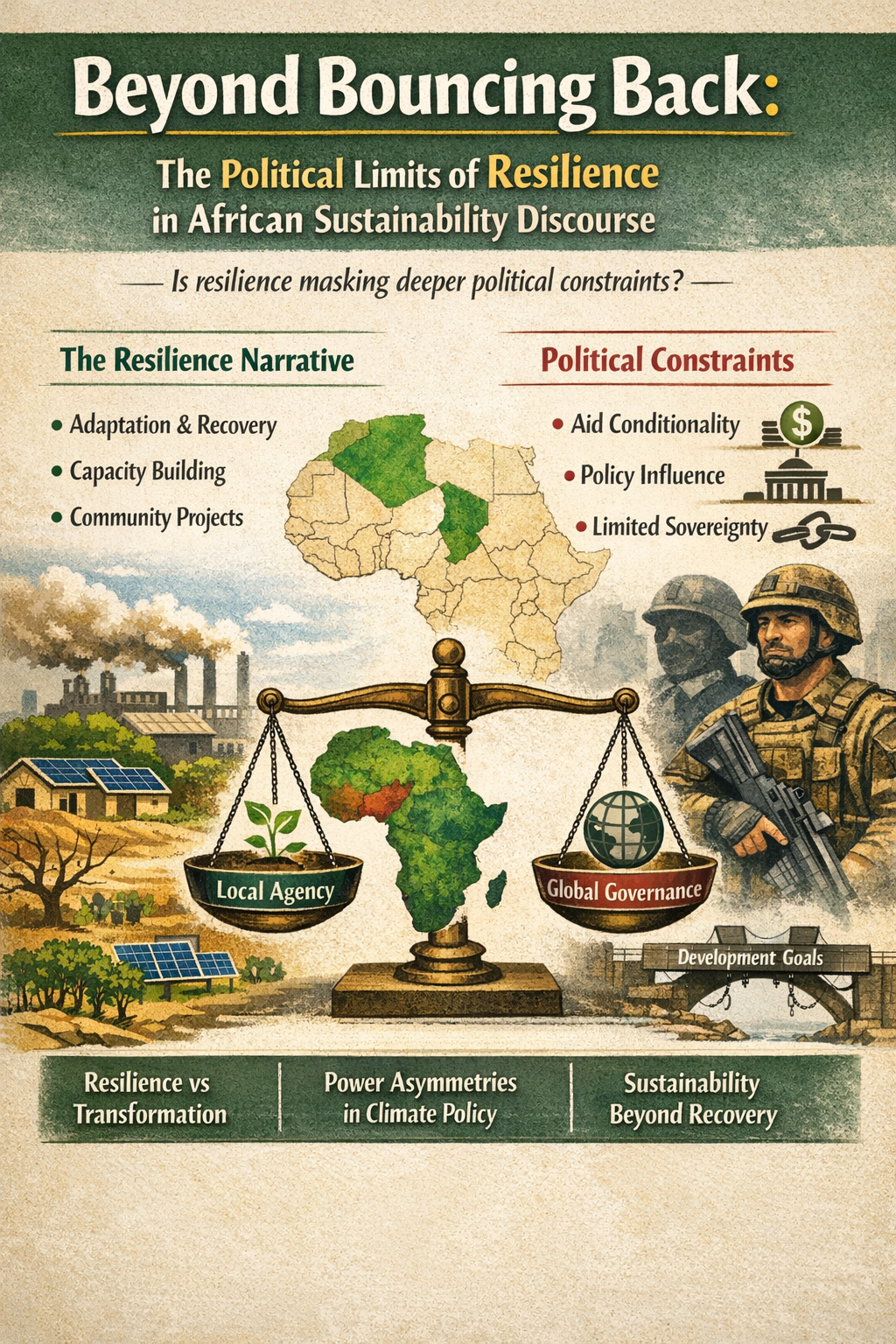
The term carries a moral force and who could oppose resilience? The concept conjures images of strength, adaptation as well as survival against adversity (Denckla et al., 2020; Pearson et al., 2025). Resilience implies human agency amid the state of vulnerability (Métais et al., 2022; Proag, 2014). In a continent disproportionately exposed to climate shocks, commodity volatility, debt pressures as well as demographic change, resilience appears not only sensible but necessary. Yet beneath its reassuring tone lies a troubling question: when resilience becomes the dominant framework for sustainability in Africa, what political work does it perform? And whose interests does it ultimately serve? Resilience basically means to bounce back or to return to a prior state after disruption (Southwick et al., 2014). This elastic metaphor presumes that the pre-shock condition is worth restoring and also assumes that continuity, rather than transformation, is the desired outcome. In contexts where baseline conditions are already characterised by infrastructural deficits, precarious livelihoods, unequal land tenure and historical extraction, the idea of “bouncing back” begins to look less like empowerment and more like containment.
Resilience discourse rose to prominence in the wake of intensifying climate awareness and disaster risk governance, crystallised in global agreements such as the Paris Agreement and the Sendai Framework for Disaster Risk Reduction (Carrasco et al., 2024; Miri et al., 2024). These frameworks rightly emphasise adaptation in a complex and warming world. For African states, where climate impacts are immediate and uneven, adaptation is not optional. However, the migration of resilience from ecological science into political economy has been neither neutral nor innocent. In its policy usage, resilience subtly shifts the locus of responsibility. Instead of centering on the historical emitters, unequal trade systems, debt structures or extractive corporate practices, resilience places emphasis on the capacity of communities to cope. As a result, the question becomes how farmers can adjust to erratic rainfall, how informal settlements can absorb flooding, how households can diversify incomes to withstand economic shocks. The structural drivers underlying this perception make people vulnerable and expose them to these hazards.
This is not accidental as resilience appears to be politically convenient. What it does is to avoid naming perpetrators and translate injustice into technical challenges. It fits comfortably within existing development finance architectures. Institutions such as the International Monetary Fund and the African Development Bank can fund resilience-building initiatives without confronting more contentious questions of redistribution, debt cancellation, or reparative climate finance. Resilience can be measured, audited, and reported within project cycles. Structural transformation cannot. There is, moreover, a subtle moral economy embedded in resilience rhetoric. African communities are frequently celebrated as inherently resilient, capable of enduring shocks with creativity and communal solidarity. While often intended as praise, this narrative risks romanticising hardship where endurance becomes expectation. Survival becomes virtue and the capacity to cope is elevated above the right not to be perpetually destabilised.
The political theorist Michel Foucault once described how modern power operates not only through repression but through the shaping of subjectivities, through encouraging individuals to regulate themselves according to particular norms (Foucault, 1980). Resilience can function in precisely this way. Citizens are encouraged to internalise risk management as a personal and communal responsibility. Households must insure themselves against crop failure; communities must develop early warning systems and urban residents must adapt to service gaps (see Batkai et al., 2023; Fisher et al., 2021; Güngör & Elburz, 2024).The state, meanwhile, can retreat into facilitation rather than provision. In this configuration, resilience aligns neatly with neoliberal governance where risk is individualised and markets are positioned as solutions. Insurance products, climate-smart technologies and public-private infrastructure partnerships proliferate (see Kaikai, 2017).
Vulnerability becomes an opportunity for investment and resilience becomes a market category. However, resilience does not distribute burdens evenly. The farmer in northern Ghana who replants after repeated droughts, the informal trader in Lagos navigating currency shocks and the coastal resident in Mozambique rebuilding after cyclones are not abstract figures. They are people absorbing systemic failures. Each “bounce back” depletes savings, erodes health, disrupts education and narrows future choices. What policy language describes as adaptive capacity may, in lived experience, feel like cumulative exhaustion. The danger is that resilience normalises chronic crisis. If drought is expected, if flooding is cyclical, if food price spikes are routine, then the objective becomes management rather than prevention. Instead of asking why African economies remain structurally dependent on volatile commodity exports, policy asks how to cushion the next price shock. Instead of interrogating land speculation and exclusionary urban planning, policy funds flood-resistant housing retrofits in informal settlements. Instead of confronting the global asymmetries that leave African countries contributing minimally to emissions yet suffering disproportionately from climate impacts, discourse emphasises local adaptation strategies.
This is where misaligned interests surface most clearly. For international financiers, resilience projects are attractive because they are incremental and scalable. For researchers, there is a lot of funding available to support climate resilience research. For national political elites, resilience narratives project strength without demanding uncomfortable reforms. For private actors, resilience opens a new sector, from climate analytics to microinsurance. For vulnerable populations, however, resilience often means adjusting to constraints not of their making. None of this is to argue that adaptation is unnecessary. On the contrary, adaptation is urgent but adaptation without accountability risks entrenching injustice. When resilience becomes the ceiling rather than the floor of ambition, sustainability is reduced to survival. A more transformative sustainability agenda would begin elsewhere. It would foreground questions of power: who controls land, credit, and infrastructure? It would interrogate trade regimes that disadvantage African producers. It would confront debt burdens that crowd out social spending. It would treat climate finance not as charity but as obligation. It would reimagine urban development not as reactive upgrading but as proactive redistribution. Such an agenda moves beyond bouncing back toward restructuring forward. It refuses to accept that returning to precarity is success. It insists that sustainability must mean altering the conditions that generate vulnerability in the first place.
The language we choose matters because it shapes the horizons of possibility. If Africa is continually framed as resilient, it risks being imagined as a continent forever recovering, perpetually adaptive, perpetually absorbing shocks generated elsewhere. The celebration of resilience can become a subtle containment strategy, ensuring that global systems remain intact while local populations adjust endlessly. At some point, the question must shift from how communities can bounce back to why they are repeatedly knocked down, from how to endure volatility to how to reduce it, from how to survive inequity, to how to dismantle it. Resilience, in its richest sense, should include the capacity to transform unjust systems. Anything less, risks turning a language of empowerment into a vocabulary of endurance; and endurance, stretched across generations, is not sustainability. It is fatigue disguised as strength.
References
Batkai, M., Hugé, J., Huitema, D., Semeijn, J., Lambrechts, W., & Stoorvogel, J. (2023). Social learning as a catalyst for building resilience among smallholder farmers: Exploring its role in promoting transformations. NJAS: Impact in Agricultural and Life Sciences, 95(1). https://doi.org/10.1080/27685241.2023.2278906
Ben Hassen T, El Bilali H, Daher B & Burkart S (2025) Editorial: Sustainable and resilient food systems in times of crises. Front. Nutr. 12:1564950. doi: 10.3389/fnut.2025.1564950
Carrasco, S., Ochiai, C., & Tang, L. M. (2024). Social Capital and Community Resilience in the wake of disasters, conflicts and displacements. International Journal of Disaster Risk Reduction, 115, 105049. https://doi.org/10.1016/j.ijdrr.2024.105049
Denckla, C. A., Cicchetti, D., Kubzansky, L. D., Seedat, S., Teicher, M. H., Williams, D. R., & Koenen, K. C. (2020). Psychological resilience: an update on definitions, a critical appraisal, and research recommendations. European journal of psychotraumatology, 11(1), 1822064. https://doi.org/10.1080/20008198.2020.1822064
Fisher, R., Petit, F., Porod, C. (2021). Early Warning Systems to Strengthen the Resilience of Communities to Extreme Events. In: Eslamian, S., Eslamian, F. (eds) Handbook of Disaster Risk Reduction for Resilience. Springer, Cham. https://doi.org/10.1007/978-3-030-61278-8_11
Foucault, M. (1980). Power/Knowledge: Selected Interviews and Other Writings, 1972-79, (Ed. Colin Gordon). New York: Pantheon.
Güngör, M., & Elburz, Z. (2024). Beyond boundaries: What makes a community resilient? A Systematic Review. International Journal of Disaster Risk Reduction, 108, 104552. https://doi.org/10.1016/j.ijdrr.2024.104552
Huang, I. Y., Forero, O. A., Wagner-Medina, E. V., Florez Diaz, H., Tremma, O., Fargetton, X., & Lowenberg-DeBoer, J. (2025). Resilience of food supply systems to sudden shocks: A global review and narrative synthesis. Global Food Security, 44, 100842. https://doi.org/10.1016/j.gfs.2025.100842
Kaika, M. (2017). “Don’t call me Resilient Again! The New Urban Agenda as Immunology … or what happens when communities refuse to be vaccinated with ‘smart cities’ and indicators. Environment and Urbanization, 29(1), 89-102; DOI 110.1177/0956247816684763.
Métais, C., Burel, N., Gillham, J. E., Tarquinio, C., & Martin-Krumm, C. (2022). Integrative Review of the Recent Literature on Human Resilience: From Concepts, Theories, and Discussions Towards a Complex Understanding. Europe’s journal of psychology, 18(1), 98–119. https://doi.org/10.5964/ejop.2251
Miri, J., Atighechian, G., Seyedin, H., & Raeisi, A. R. (2024). Components and entities of post-disaster damage and loss assessment program in healthcare sector: a scoping review. BMC Public Health, 24(1), 2417.
Pearson, E., Sharp, L., & Hampton, L. (2025). Resilience in context: a synthesis of theories and practices for educational psychologists. Educational Psychology in Practice, 41(4), 439–456. https://doi.org/10.1080/02667363.2025.2518990
Proag, V. (2014). The Concept of Vulnerability and Resilience. Procedia Economics and Finance, 18, 369-376. https://doi.org/10.1016/s2212-5671(14)00952-6
Southwick, S. M., Bonanno, G. A., Masten, A. S., Panter-Brick, C., & Yehuda, R. (2014). Resilience definitions, theory, and challenges: interdisciplinary perspectives. European journal of psychotraumatology, 5, 10.3402/ejpt.v5.25338. https://doi.org/10.3402/ejpt.v5.25338
United Nations (2015) Transforming Our World. The 2030 Agenda for Sustainable Development. https://sustainabledevelopment.un.org/post2015/transformingourworld/publication