








Introduction
Global climate governance is anchored in landmark agreements such as the Paris Agreement, the Kyoto Protocol, and the UN Framework Convention on Climate Change (UNFCCC). The Paris Agreement, adopted in 2015 and entering into force in 2016, commits parties to limit global temperature rise to “well below 2°C” and pursue efforts to cap it at 1.5°C above pre-industrial levels (UNFCCC, 2015). According to the Intergovernmental Panel on Climate Change (IPCC), limiting warming to 1.5°C requires global greenhouse gas emissions to decline by roughly 43–45% by 2030 relative to 2019 levels and reach net zero by mid-century (IPCC, 2023).
While these frameworks are grounded in climate science, their socioeconomic implications are uneven. Africa contributes approximately 3–4% of global greenhouse gas emissions (UNEP, 2025), yet faces disproportionate vulnerability to climate impacts. The continent’s climate commitments, therefore, intersect directly with its urgent development agenda.
Historical Responsibility and Unequal Burden
Industrialised economies built prosperity through fossil-fuel-intensive development. Today, the largest emitters include China, United States, India, the European Union, Russia, and Indonesia. The G20 economies account for approximately 77% of global emissions (UNEP Emissions Gap Report, 2025).
The UNFCCC embeds the principle of “common but differentiated responsibilities” (UNFCCC, 1992), acknowledging historical disparities in emissions. Yet in practice, uniform mitigation expectations risk narrowing policy space for low-emitting developing regions. Africa’s minimal historical contribution contrasts sharply with its exposure to severe climate impacts, intensifying debates about equity and climate justice.
Restricted industrialisation pathways
Industrialisation has historically depended on abundant, low-cost fossil fuels. Western nations utilised coal and oil to expand manufacturing, infrastructure, and urbanisation before transitioning toward cleaner energy systems. African countries are now urged to bypass this carbon-intensive phase at a time that they are now making abundant discoveries of these resources.
Countries such as Nigeria and South Africa face competing pressures: expanding electricity access and industrial capacity while meeting emissions targets under their Nationally Determined Contributions (NDCs). Research by Akeredolu (2024) indicates that GDP per capita is negatively associated with climate ambition in sub-Saharan Africa, suggesting that economic development priorities often outweigh aggressive mitigation commitments.
The energy sector accounts for nearly three-quarters of global emissions (IPCC, 2023), but energy poverty remains widespread across Africa. For many states, fossil fuels remain the cheapest and most immediately deployable option for baseload power generation. Yet, climate governance policies demand that Africa forgo all the potential benefits fossil fuels bring and gravitate toward cleaner sources of energy.
Climate Finance: Promise and Shortfall
The Green Climate Fund (GCF) was established to channel financial support from developed to developing countries for mitigation and adaptation. The Paris Agreement reaffirmed the obligation of developed countries to provide financial assistance (UNFCCC, 2015).
However, climate finance flows have consistently fallen short of estimated needs. The United Nations Economic Commission for Africa (UNECA, 2023) reports significant adaptation financing gaps across the continent. Moreover, a large proportion of climate finance is delivered as loans rather than grants, exacerbating debt burdens in countries already experiencing fiscal distress.
The result is a “double burden”: African countries must invest heavily in adaptation to protect vulnerable populations while simultaneously financing a green transition.
Adaptation versus Mitigation: Divergent Priorities
While industrialized countries prioritise mitigation, African nations prioritize adaptation. Agriculture accounts for a significant share of employment across the continent and is highly climate-sensitive. According to UNECA (2023), climate impacts could reduce African GDP by 10–15% by 2050 if adaptation efforts are insufficient.
Droughts, floods, and extreme weather events already disrupt livelihoods. Investments in irrigation systems, climate-resilient infrastructure, and early warning systems are urgent. This divergence in priorities often complicates international negotiations, where mitigation metrics dominate assessment frameworks.
Green Protectionism and Emerging Trade Barriers
Climate policy increasingly shapes global trade rules. Carbon pricing instruments—such as emissions trading systems and carbon border adjustments—aim to prevent carbon leakage. However, mechanisms under development within the European Union may disproportionately affect exporters from carbon-intensive economies (European Commission, 2023).
Simultaneously, industrialized nations are investing heavily in domestic green industries. The Inflation Reduction Act allocates hundreds of billions of dollars toward renewable energy manufacturing, electric vehicles, and clean technology supply chains (U.S. Government, 2022).
While such policies accelerate decarbonisation domestically, they also strengthen technological dominance and reshape global supply chains in favour of advanced economies.
Technological Control and the New Resource Race
Africa holds substantial reserves of critical minerals essential for renewable technologies—cobalt, lithium, manganese, and rare earth elements. Yet manufacturing and value addition remain concentrated in industrialised economies.
According to the International Energy Agency (IEA, 2023), demand for critical minerals is projected to multiply significantly under net-zero scenarios. Without policies to foster local processing and manufacturing, Africa risks remaining primarily a raw-material exporter in the green economy.
Governance, Capacity, and Political Realities
Institutional capacity influences climate ambition. Democratic systems in developing contexts often prioritize immediate economic and social stability over long-term mitigation targets. Akeredolu (2024) finds that economic capacity, rather than regime type or fossil fuel consumption, is the strongest determinant of climate ambition in sub-Saharan Africa.
Strengthening governance, enhancing transparency, and integrating climate policy into development planning remain crucial steps for aligning mitigation goals with domestic priorities.
Climate Justice or Strategic Self-Interest?
The expansion of net-zero commitments—107 countries representing approximately 82% of global emissions as of mid-2024 (UN, 2024)—reflects growing political consensus. Yet UNEP’s Emissions Gap Report (2025) warns that current NDCs would reduce emissions by only around 12% by 2035 relative to 2019 levels—far short of the 55% reduction required to maintain a 1.5°C pathway.
This gap underscores a tension: while climate urgency is real, implementation often reflects national economic strategies. Advanced economies are positioned to dominate green technology markets and carbon finance mechanisms. Critics argue that elements of global climate governance may align with strategic economic interests alongside environmental objectives.
Opportunity Amid Constraint
Despite these structural inequalities, climate policy offers transformative potential. Africa possesses vast renewable energy resources, particularly solar and wind. With adequate financing, technology transfer, and industrial policy support, the continent could leapfrog carbon-intensive infrastructure and build resilient energy systems.
The Paris Agreement explicitly calls for technology development and transfer and capacity-building support (UNFCCC, 2015). Realizing these provisions will determine whether climate governance facilitates inclusive growth or entrenches dependency.
Conclusion: Development, Dignity, and Equity
Climate action is indispensable. However, equity must remain central to its implementation. As emphasised by UN Secretary-General António Guterres, climate justice requires solidarity, especially with vulnerable regions.
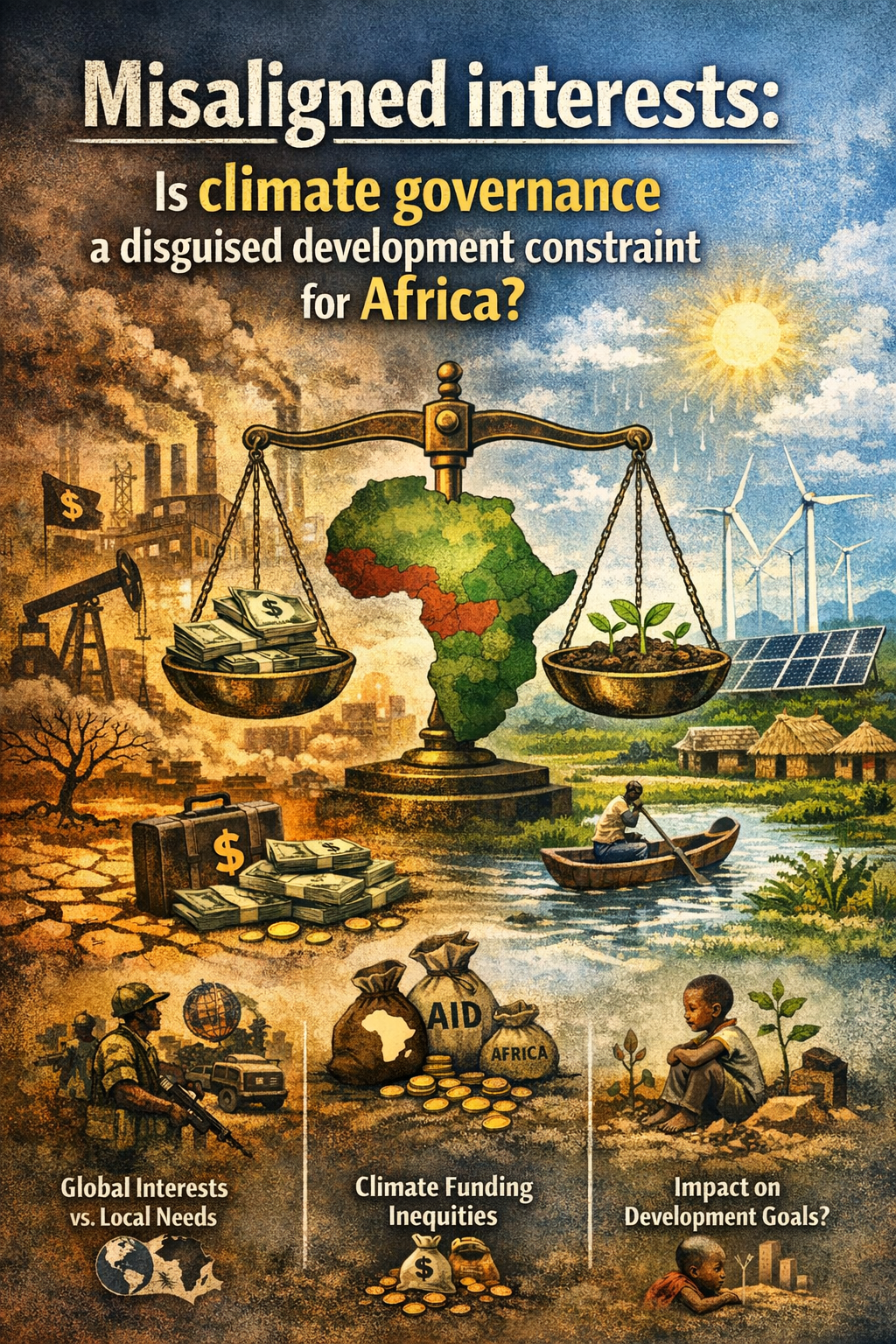
For Africa, the challenge is not rejecting climate responsibility but ensuring that mitigation commitments do not foreclose development pathways. A just transition demands meaningful financial support, fair trade rules, technology access, and recognition of historical responsibility. Without these, global climate policy risks reinforcing structural inequalities under the banner of sustainability.
References:
Akeredolu, O. (2024). Climate ambition and economic determinants in sub-Saharan Africa. University of Oxford / The Conversation.
European Commission. (2023). Carbon Border Adjustment Mechanism (CBAM) policy framework.
IEA (2023). Critical Minerals Market Review. International Energy Agency.
IPCC (2023). Sixth Assessment Report Synthesis Report. Intergovernmental Panel on Climate Change.
UN (2024). Net Zero Coalition Data.
UNEP (2025). Emissions Gap Report 2025.
UNFCCC (1992). United Nations Framework Convention on Climate Change.
UNFCCC (2015). Paris Agreement.
UNECA (2023). Economic Report on Africa and Climate Finance Gap Assessment.
U.S. Government (2022). Inflation Reduction Act.