









Introduction
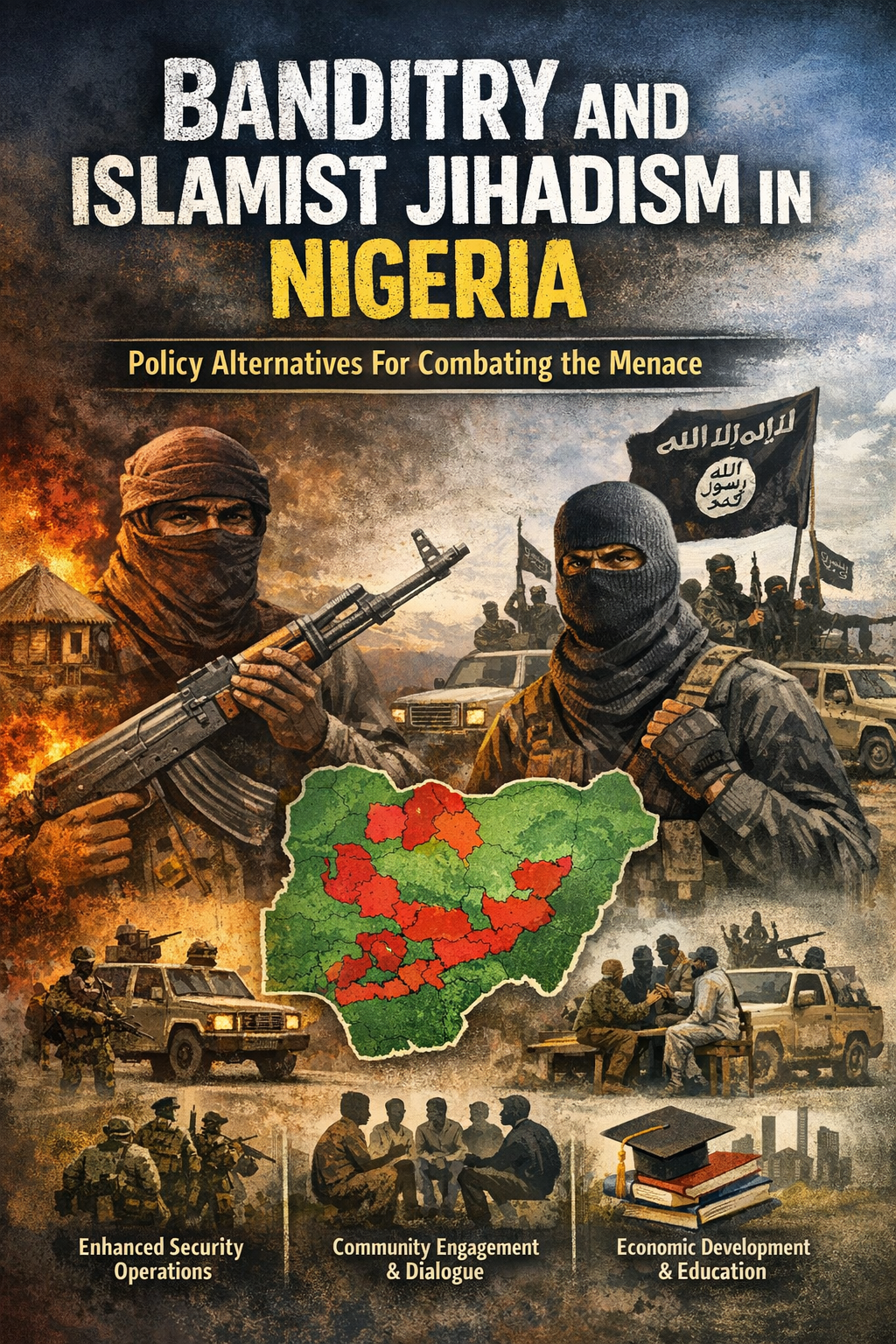
Nigeria faces one of the most complex security crises in contemporary Africa. Multiple non-state armed actors operate across different regions, contributing to widespread violence, displacement, and socioeconomic disruption. Two of the most prominent threats are rural banditry in the northwest and Islamist jihadist insurgency in the northeast. Although often discussed separately in policy and media discourse, these phenomena increasingly overlap in geography, tactics, and impact.
Banditry in Nigeria refers primarily to organized criminal gangs engaged in kidnapping for ransom, cattle rustling, village raids, and extortion. These groups operate largely in Zamfara, Katsina, Sokoto, Kaduna, and Niger states and have intensified their attacks since the mid-2010s (HistoricalNigeria.com, 2025). In contrast, Islamist jihadist groups such as Boko Haram and its splinter faction, the Islamic State West Africa Province (ISWAP), emerged in northeastern Nigeria with the stated objective of establishing governance based on their interpretation of Islamic law (Counter Extremism Project [CEP], n.d.).
While bandits are typically characterized as economically motivated criminals and jihadists as ideologically driven insurgents, the distinction is not always clear-cut. Reports suggest instances of cooperation, tactical alliances, and even ideological cross-fertilization between these groups. At the same time, competition over territory and resources can produce friction and clashes.
This article examines the similarities and differences between banditry and Islamist jihadism in Nigeria. It addresses four core questions: (1) How are bandits and jihadists similar? (2) How do they differ? (3) Do they have distinct motivations? (4) Do they cooperate or clash? The analysis situates both phenomena within Nigeria’s broader context of weak governance, rural marginalization and protracted conflict.
Historical Context of Violence in Nigeria
Banditry: Historical Roots and Contemporary Evolution
Banditry in Nigeria has historical precedents. Precolonial raiding economies in parts of northern Nigeria involved armed groups attacking rival communities for livestock, captives, and resources. During colonial rule, forms of highway robbery and rural criminality persisted, though often suppressed by centralized authority. In the post-independence period, banditry evolved alongside communal conflicts, particularly farmer–herder disputes over land and grazing routes (Historical Nigeria, 2025).
The modern wave of banditry intensified in the 2010s. Factors contributing to its rise include climate change–induced desertification, population pressure, proliferation of small arms, porous borders, and the collapse of effective rural governance structures. As cattle rustling and reprisal violence escalated, criminal gangs consolidated into loosely networked armed groups capable of attacking entire villages and abducting large numbers of civilians for ransom.
Kidnapping for ransom became a particularly lucrative enterprise. Mass abductions of schoolchildren and travelers on highways demonstrated both the organizational capacity and opportunistic nature of these groups. Unlike insurgent organizations with political manifestos, bandit groups rarely articulate ideological demands; their actions are typically transactional and profit-oriented.
Islamist Jihadism: Boko Haram and ISWAP
Islamist jihadism in Nigeria is primarily associated with Boko Haram, officially known as Jama’atu Ahlis Sunna Lidda’awati wal-Jihad. Founded in the early 2000s in northeastern Nigeria, Boko Haram radicalized following state repression and launched a full-scale insurgency in 2009. The group’s name is commonly translated as “Western education is forbidden,” reflecting its rejection of secular governance and Western influence (CEP, 2025).
Boko Haram’s insurgency has resulted in tens of thousands of deaths and millions displaced. In 2015, a faction pledged allegiance to the Islamic State, becoming ISWAP. The split created two rival jihadist factions with differing strategies but shared ideological foundations. Both seek to undermine the Nigerian state and establish governance according to their interpretation of Islamic law.
Unlike bandits, jihadist groups maintain identifiable leadership structures, ideological narratives, and propaganda mechanisms. They conduct suicide bombings, complex assaults on military installations, and targeted killings designed to challenge state authority and assert territorial control.
Motivations and Objectives
- Economic Motivations of Bandit Groups
The primary motivation of bandit groups is economic gain. Kidnapping for ransom provides substantial financial returns. Cattle rustling and extortion further supplement income. These activities thrive in areas where state presence is weak and communities lack adequate protection.
Bandits’ grievances often stem from local conflicts, particularly between herding and farming communities. However, while grievances may explain recruitment and initial mobilization, the persistence of banditry is largely sustained by profit incentives. Bandit leaders frequently negotiate ransom payments and may release hostages once financial demands are met, underscoring the transactional nature of their operations.
Importantly, bandits do not typically seek to overthrow the Nigerian state or establish alternative governance based on a coherent ideology. Their violence is instrumental rather than transformative.
- Ideological and Political Motivations of Jihadists
In contrast, jihadist groups articulate clear ideological objectives. Boko Haram and ISWAP frame their struggle as a religious obligation to purify society and establish Islamic governance. They reject Nigeria’s secular constitution and target institutions associated with the state, Western education, and Christian communities (CEP, 2025).
Although jihadist groups also engage in criminal activities such as kidnapping and extortion to finance operations, these are subordinate to ideological goals. For example, attacks on schools or churches often serve symbolic purposes consistent with their ideological narrative.
Thus, while both bandits and jihadists may engage in similar criminal acts, the underlying motivations differ. Bandits pursue economic survival and enrichment; jihadists pursue ideological transformation of society and governance.
- Organizational Structure and Strategy
Bandit groups are typically decentralized and fluid. Leadership structures exist but are often localized. Alliances form and dissolve based on convenience. This flexibility allows bandits to evade security operations and shift across state boundaries.
Jihadist groups, by contrast, maintain more structured hierarchies. Boko Haram and ISWAP have identifiable leaders, chains of command, and organized recruitment systems. ISWAP, in particular, has demonstrated governance capacity in territories it controls, including taxation and dispute resolution mechanisms.
Strategically, bandits favor opportunistic attacks on soft civilian targets. Jihadists conduct more coordinated and ideologically framed attacks, including assaults on military convoys and symbolic infrastructure.
Similarities Between Bandits and Jihadists
Despite clear differences, several similarities exist:
- Exploitation of Weak Governance: Both thrive in areas where the state is absent or ineffective. Rural marginalization and limited security presence provide operational space.
- Use of Kidnapping: Both engage in kidnapping, though motivations may differ. Jihadists sometimes use abductions for propaganda or prisoner exchanges; bandits prioritize ransom payments.
- Community Impact: Both create humanitarian crises characterized by displacement, food insecurity, and economic disruption.
- Access to Arms Networks: Both rely on illicit arms markets and porous borders in the Sahel region.
- Recruitment Among Marginalized Youth: Economic deprivation and lack of opportunities make young men vulnerable to recruitment by both types of groups.
These similarities contribute to blurred perceptions among affected communities, who may experience both actors as sources of insecurity regardless of their ideological distinctions.
Cooperation and Convergence
Emerging research suggests instances of pragmatic cooperation between bandit groups and jihadist factions. In some cases, jihadist groups have reportedly supplied weapons or training to bandits in exchange for logistical support or safe passage. Bandits operating in northwestern Nigeria have at times adopted jihadist rhetoric, though often superficially.
This convergence may be driven by mutual benefit. Jihadists expanding westward can leverage bandits’ local networks, while bandits gain access to advanced weaponry and training. Such alliances tend to be transactional rather than ideological.
However, convergence does not imply complete merger. Many bandits remain primarily criminal actors with limited commitment to jihadist ideology. Analysts caution against conflating banditry entirely with jihadism, as doing so risks misdiagnosing the problem and applying inappropriate counterterrorism frameworks to what may be primarily criminal enterprises.
Competition and Clashes
While cooperation occurs, competition and clashes also arise. Territorial control is central to both economic and ideological dominance. Where jihadist factions attempt to impose religious codes or governance structures, bandits motivated by profit may resist constraints on their autonomy.
Differences in discipline and command structures can also create friction. Jihadist groups often enforce stricter codes of conduct, whereas bandits may prioritize immediate financial returns without long-term strategic considerations.
Thus, interactions between the two phenomena are dynamic: cooperative in some contexts, competitive in others.
Policy Implications
The convergence of banditry and jihadism complicates Nigeria’s security response. Treating banditry solely as terrorism risks overlooking socioeconomic drivers and community-level grievances. Conversely, treating jihadist insurgency merely as criminality underestimates its ideological and political dimensions.
Effective responses require:
- Strengthening rural governance and security presence.
- Addressing economic marginalization and youth unemployment.
- Disrupting illicit arms flows.
- Enhancing intelligence coordination across regions.
- Distinguishing between ideologically committed jihadists and economically motivated bandits in deradicalization and reintegration programs.
A nuanced approach that recognizes both overlap and distinction is essential.
Conclusion
Banditry and Islamist jihadism represent two distinct but intersecting forms of violence in Nigeria. Bandits are primarily economically motivated criminal actors operating in decentralized networks. Jihadists are ideologically driven insurgents seeking political and religious transformation. While their motivations differ fundamentally, similarities in tactics, recruitment environments, and geographic operation create opportunities for convergence.
Evidence suggests that bandits and jihadists may cooperate pragmatically, particularly where mutual benefits exist. At the same time, competition over territory and resources can generate clashes. Understanding these dynamics is critical for designing targeted security and development interventions.
Nigeria’s security crisis cannot be resolved through military force alone. Addressing structural drivers of violence, poverty, governance deficits, environmental stress, and social fragmentation is necessary to reduce the appeal of both criminal banditry and extremist insurgency. Differentiating between the two while acknowledging their interaction offers the most promising path toward sustainable peace.
References
Counter Extremism Project. (2025). Nigeria: Extremism and terrorism. https://www.counterextremism.com/countries/nigeria-extremism-and-terrorism
HistoricalNigeria.com. (2025, October 7). Kidnapping and banditry in Nigeria’s history. https://historicalnigeria.com/kidnapping-and-banditry-in-nigerias-history/