








Introduction: Coups, Counterterrorism, and the Politics of Blame
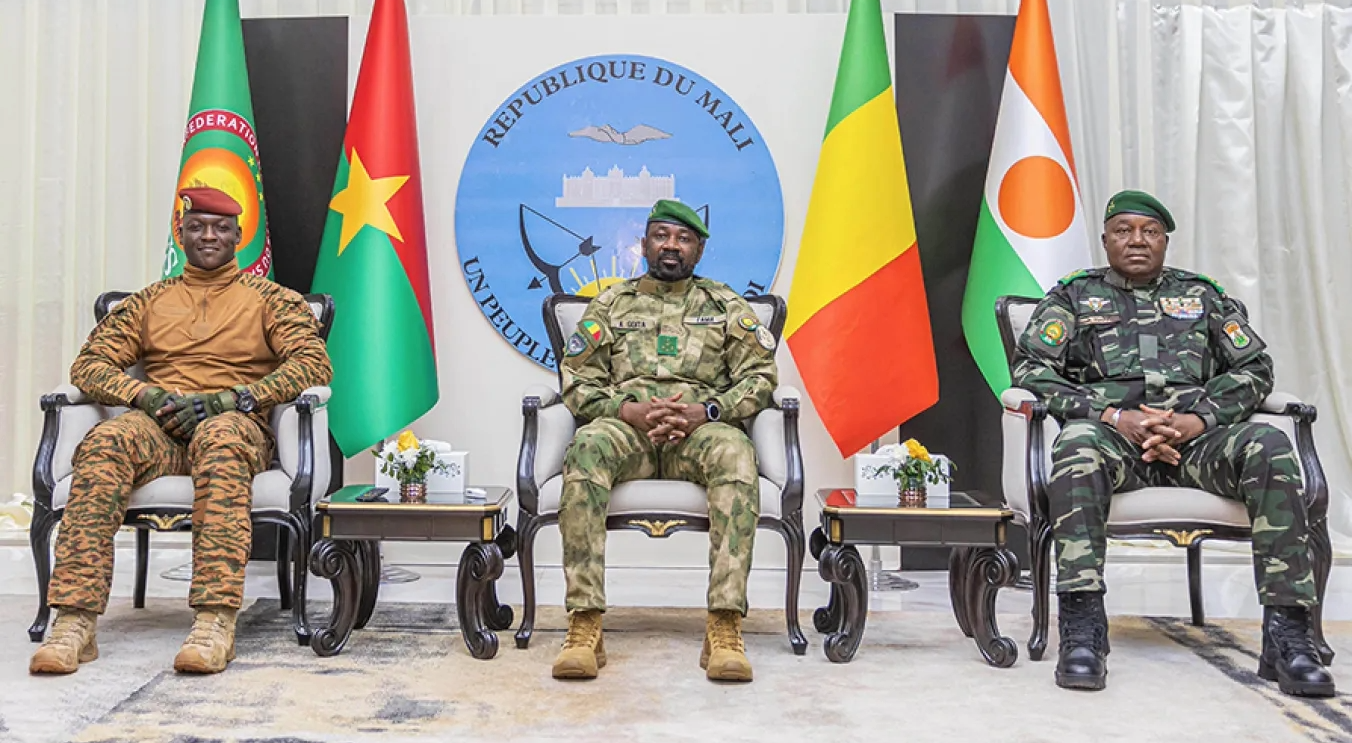
Across much of contemporary Africa, security governance has become entangled in a wider struggle over sovereignty, legitimacy and external influence. From the Sahel to parts of Central and East Africa, a growing number of states now stand at the intersection of internal crisis, contested authority and intensifying geopolitical competition. In several of these contexts, military interventions into politics have been justified by a recurring and powerful narrative: that civilian governments, often operating within Western-backed security architectures have failed to contain insurgency, terrorism, and organised violence, thereby forfeiting their claim to effective rule. Between 2021 and 2023, the Sahel witnessed a decisive militarisation of politics. In Mali, Burkina Faso and Niger, juntas defined their seizures of power as corrective interventions necessitated by mounting jihadist attacks, territorial losses and eroding public trust in civilian leadership. Western partners, particularly France and the broader counterterrorism architecture built around Operation Barkhane were said to be ineffective, self-interested and disconnected from local realities. ECOWAS, in turn, was portrayed not as a guarantor of regional stability but as an external enforcer of unconstitutional norms at odds with “popular sovereignty.”
This narrative resulted in the formation of the Alliance of Sahelian States (AES) in September 2023 and the formal withdrawal of its members from ECOWAS in January 2024. Symbolically, the AES represents a rejection of post–Cold War security orthodoxy in West Africa. Strategically, however, it has fragmented regional cooperation at a moment when transnational insurgencies demand precisely the opposite. As a result, this article offers a critical assessment of the evolving security landscape in Mali, Burkina Faso and Niger by comparing pre- and post-coup periods using a symmetrical temporal framework with data from ACLED, GTI & Sphere+. By examining trends in incident volume, fatalities, typologies of violence, and actor dynamics up to 31 August 2025 (see table 1), it interrogates a central question confronting the Sahel: have shifting alliances resolved the region’s security crisis, or merely reproduced it under a different geopolitical banner?
Table 1: Periods analysed
| Country | Pre-coup period | Post-coup period |
| Mali | 17th Feb. 2017 to 24th May, 2021 | 24th May, 2017 to 31st Aug. 2025 |
| Burkina Faso | 29 Oct. 2019 to 30th Sep. 2022 | 30 Sep. 2022 to 31st August, 2025 |
| Niger | 21st June 2021 to 26th July 2023 | 26th July 2023 to 31st August 2025 |
Source: CISA (2025)
Mali: Militarisation without Stabilisation
In Mali, the post-coup period has been marked by a sharp escalation in both insurgent and state-led violence, underscoring the limits of the junta’s security reorientation. Attacks increased by 80.9 percent, confirming their continued centrality to insurgent strategy, while armed clashes rose by 41.3 percent. However, the declining proportional share of clashes suggests a shift away from sustained battlefield engagements toward more fragmented, opportunistic and asymmetrical violence. This evolution reflects insurgent adaptability rather than battlefield defeat. The dramatic rise in looting and property destruction, nearly quadrupling post-coup, signals a deepening collapse of everyday security and livelihoods in contested rural zones. Such patterns are emblematic of environments where state authority is not merely challenged but intermittently absent. Abductions more than doubled, reinforcing the strategic use of civilian coercion to control territory, extract resources, and undermine state legitimacy. At the same time, the Malian state has embraced an increasingly kinetic posture. Air and drone strikes surged by nearly 400 percent, a clear indication of a counterterrorism doctrine reliant on force projection rather than governance consolidation. While these tactics may offer tactical advantages, their expansion has coincided with, rather than curtailed, insurgent activity.
Actor dynamics further illuminate this paradox. JNIM emerged as the dominant beneficiary of the post-coup environment, with incidents increasing by 186.4 percent and its share of total activity rising significantly. Rather than being weakened by intensified military operations, the group appears to have exploited the security vacuum and civilian grievances generated by militarised governance. The Malian military’s own activity increased by over 300 percent, now accounting for nearly a third of all incidents, an extraordinary figure that highlights the degree to which violence has become state-driven as well as insurgent-led. Meanwhile, the expansion of IS-affiliated activity, alongside the resurgence of Dozo militias and Dan Na Ambassagou, points to a growing fragmentation of the security landscape. The proliferation of communal and state-aligned militias suggests that insecurity is no longer monopolised by jihadist groups but has become embedded in local social conflicts, further complicating prospects for stabilisation.
Burkina Faso: Expansion of the Battlefield
Burkina Faso presents an even starker illustration of militarisation without security dividends. Armed clashes nearly doubled post-coup, reflecting a dramatic expansion of active frontlines across the country. Attacks and looting rose sharply, reinforcing the centrality of insurgent economic warfare and the persistent absence of effective state control in rural and peri-urban areas. Abductions surged by nearly 90 percent, consolidating civilian targeting as a core insurgent tactic. This pattern underscores the failure of intensified military operations to shield non-combatants and instead reveals how civilians have become the primary terrain on which the conflict is fought. As in Mali, the Burkinabè state has responded with increased aerial warfare, with air and drone strikes almost doubling. Yet this escalation has unfolded alongside, rather than against, the consolidation of jihadist groups. JNIM retained its majority operational share, accounting for over 60 percent of all incidents, while ISGS expanded its footprint in the east and tri-border zones. These trends suggest that insurgent groups have adapted effectively to the junta’s security posture, dispersing forces and exploiting overstretched state capacity.
The growing reliance on Volunteers for the Defence of the Homeland (VDPs), whose activity more than doubled, reflects a broader strategy of outsourcing security to civilian auxiliaries. While framed as community empowerment, this approach risks deepening cycles of communal violence and blurring the line between protection and predation. The sustained activity of Katiba Macina further highlights the persistence of locally embedded insurgent networks that cannot be dismantled through military force alone.
Niger: Containment, Not Resolution
Niger stands apart within the AES due to an overall decline in incident volume post-coup. However, this apparent improvement warrants careful interpretation. Violence against civilians remains the dominant category, accounting for nearly 40 percent of incidents, indicating that insecurity continues to be borne disproportionately by non-combatants. The reduction in battles and armed clashes, alongside a decline in strategic developments, points to a quieter but not necessarily more stable operational environment. The increase in the use of improvised explosive devices (IEDs) and mine usage suggests a tactical pivot toward remote warfare, often associated with insurgent regrouping rather than defeat. Declines in looting and abductions may reflect territorial reorganisation rather than lasting pacification.
Actor trends reinforce this caution. While ISGS and JNIM activity declined in absolute terms, ISGS increased its proportional share of incidents, signalling continued relevance in key theatres. Boko Haram maintains a marginal but persistent presence, while the absence of significant state-aligned or communal militia mobilisation distinguishes Niger from its AES counterparts. This relative restraint may explain Niger’s lower incident counts but also highlights the fragility of its security equilibrium.
Western Failure, Eastern Illusions and the cost of fragmentation
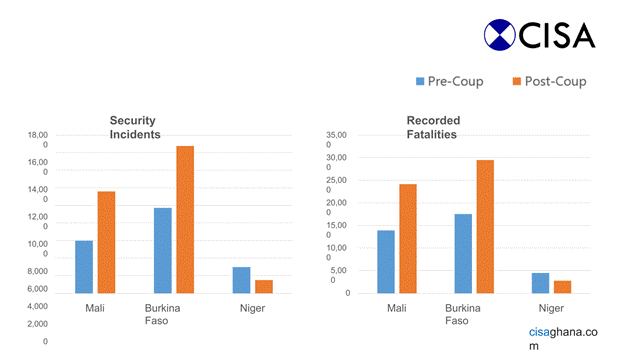
It is tempting particularly in popular and nationalist discourse to frame the Sahel’s crisis as a binary choice between Western failure and Eastern salvation. This framing is analytically shallow and politically dangerous. Western interventions, anchored in counterterrorism doctrines that privileged kinetic operations over state-building and social legitimacy, undeniably failed to deliver security. They often reinforced dependency, empowered unaccountable elites and treated symptoms rather than structural drivers of violence. Yet the pivot to Russia and associated security actors has not altered these dynamics. While rhetorically framed as partnerships of equals, Eastern engagements have largely reproduced a militarised, state-centric approach to insecurity rooted in exploitations. The sharp rise in air and drone strikes (+391.16% in Mali and 92.60% in Burkina Faso) coupled with declining civic space and suppressed protest activity, suggests that security is being pursued through coercion rather than consent. The proverb that “a tree that will bear good fruit is seen at germination” is instructive here: early indicators matter. Thus far, the germination phase of the Sahel’s new security partnerships offers little evidence of a more inclusive or sustainable peace trajectory as it has worsened the insecurity incidents and recorded fatalities over the period analysed (see figure 1).
Source: CISA (2025).
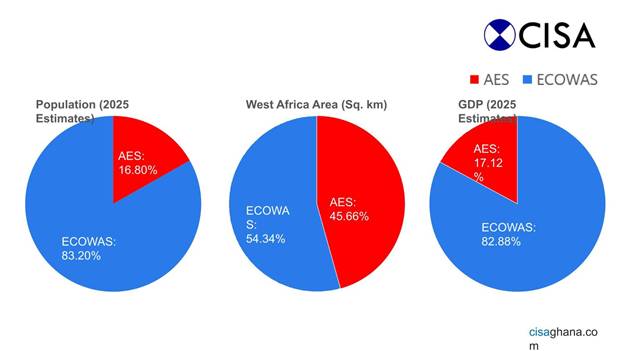
The ECOWAS–AES rupture has created a strategic vacuum in West Africa. Although AES states account for a modest share of regional GDP, they encompass nearly half of ECOWAS landmass and form the frontline against jihadist expansion (see figure 2).As a result, their withdrawal has weakened collective defence mechanisms, disrupted intelligence sharing, and undermined coordinated border management. Insurgents, by contrast, remain highly integrated across borders, exploiting precisely the fragmentation that now characterises regional governance. The irony is stark: while juntas invoke sovereignty to justify isolation, insecurity in the Sahel is fundamentally transnational. No single bloc whether aligned with Western or Eastern powers can address it alone.
Source: CISA (2025).
Conclusion
These trends challenge the central premise of the Sahel’s post-coup realignment: that replacing Western partners with Eastern ones would deliver security gains. The evidence suggests otherwise. While Western interventions demonstrably failed, their displacement has not produced a qualitatively different security outcome. Instead, militarisation has deepened, civilian harm has intensified and insurgent groups have adapted with alarming speed. The Sahel’s crisis is therefore not a question of choosing the “right” external partner, but of confronting misaligned interests, whether Western or Eastern, that prioritise military optics over political legitimacy, and sovereignty rhetoric over regional solidarity. Without renewed cooperation between the AES and ECOWAS and without a shift toward governance-centred security rooted in development and social inclusion, the Sahel risks remaining trapped in a cycle of violence where alliances change but insecurity endures. Rebuilding the broken relationship between the AES and ECOWAS is therefore not a diplomatic luxury but a strategic necessity. A renewed regional compact, one that centres African agency, prioritises civilian protection, and integrates security with development offers the most credible path forward. Unity does not mean uniformity, but it does require recognising that fragmented responses only deepen collective vulnerability. In the end, the Sahel’s crisis is less about choosing between West and East and more about confronting misaligned interests wherever they arise. Without regional solidarity and a people-centred approach to security, the cycle of coups, interventions and escalating violence will persist bearing bitter fruit long after the promises of sovereignty have faded.