







In the 1950s and 1960s, problem solving was framed as a straightforward process that required experts to identify the problem, analyse the problem, gather data and implement the best solutions that emerged from the data gathering and analysis (Allmendiger, 2007). These problems are described as tame problems as they can be clearly defined, solved technically and approached within a stable institutional framework (Kostić, 2024). However, there were some problems/challenges that did not bow to this procedural planning process due to their complexity and dynamic nature. The concept of a wicked problem was therefore introduced by Horst Rittel and Melvin Webber in 1993. It became essential for understanding deeply embedded societal challenges that resist straightforward solutions, acting like a Chinese bamboo that bounces back when hit with a rainstorm. Wicked problems are characterised by their complexity, interdependence and evolving nature (Hipolito & Khanduja, 2024). These problems lack clear definitions, are shaped by multiple stakeholders with conflicting interests and present no definitive or universal solutions. Attempts to address wicked problems often produce new challenges which further complicate the problem landscape. The cyclical and unpredictable nature distinguishes wicked problems from tame ones.
In this article, CISA analysts position illegal small-scale mining in Ghana (popularly known as galamsey) as a paradigmatic wicked problem. While it is often portrayed in public discourse as a matter of law enforcement or environmental protection, its true nature is far more complex and shaped by multiple stakeholders with conflicting interests. These include miners and their sponsors who are benefiting financially from it so they do not want it to be banned, the general public led by Civil Society Organisations (CSOs) who are calling for it to be banned and the government of the day which is in a dilemma. As a result, galamsey exists at the intersection of economic desperation, governance weaknesses, political interference, global commodity pressures, rural marginalisation, and environmental vulnerability. The purpose of this article is to critically examine the multidimensional ways in which galamsey functions as a wicked problem, unravel its deeper connections to ecological collapse, food and water insecurity, public health crises, and socio-economic inequalities, and propose pathways toward sustainable and systemic solutions. In doing so, the article argues that the persistence of galamsey is not merely a failure of enforcement but symptomatic of broader structural and developmental challenges confronting the Ghanaian state.
2.Galamsey as a Wicked, not a Tame, Problem
To understand galamsey as a wicked problem,one must first appreciate the inadequacy of simplistic technocratic approaches. A tame problem such as repairing a footbridge that connects communities or regulating traffic flow has clear boundaries, predictable outcomes, and solutions that can be repeated with consistent success. Galamsey, however, evades such linear responses because it is entwined with socio-economic survival strategies, political clientelism, land tenure complexities, global gold markets, and local power dynamics. It does not present itself as a single problem but as a collection of mutually reinforcing challenges. Since 2017, every attempt to address galamsey reveals its fluidity. For instance, when security forces are deployed to clamp down on miners, operations simply shift to more remote locations. When the government suspends or revokes mining licenses, illegal miners form new networks, often backed by influential actors who benefit from the trade. When alternative livelihoods are introduced, they are overshadowed by the immediate financial rewards of illegal mining. Even attempts at formalising small-scale mining are undermined by the limited capacity of regulatory agencies to monitor compliance, as well as the pervasive corruption that allows illegal operations to thrive under the veil of legitimacy.
More importantly, galamsey is embedded in a wider socio-economic reality characterised by rural poverty, youth unemployment, and declining agricultural productivity (Ayambire et al., 2024, Obodai et al., 2024). In many mining communities, illegal mining is not perceived as criminal activity but as a rational response to structural neglect and limited economic opportunities (Akponzele et al., 2025). This perception makes enforcement alone insufficient because it fails to address the social foundations that render galamsey attractive (Aziabah & Ayelazuno, 2024). The conflict of interests among stakeholders: miners seeking livelihoods, chiefs seeking royalties, politicians seeking votes and corporations seeking concessions creates a policy environment where no single intervention is universally accepted or sustainably enforceable (Taabazuing et al., 2012). This is the essence of a wicked problem: multifaceted, contested, and resistant to one-dimensional remedies.
3. Galamsey as a Symptom of Broader Systemic Problems
3.1 Environmental Collapse, Planetary Boundaries, and Climate Change
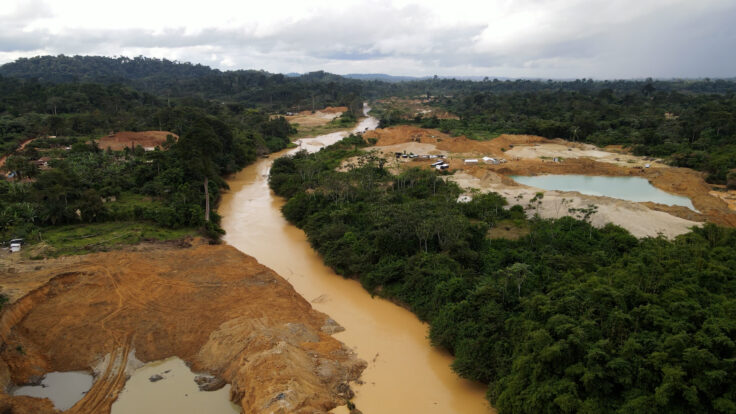
One of the most devastating dimensions of galamsey lies in its assault on Ghana’s ecological systems. Illegal mining, driven largely by the unregulated use of excavators, has accelerated deforestation, biodiversity loss, and soil degradation at unprecedented levels (Yiridomoh, 2021). These excavators tear apart forest landscapes, destroy riverbanks, and leave behind vast expanses of scarred land that struggle to regenerate. Such destruction undermines essential ecological processes, including carbon sequestration, hydrological balance, and soil nutrient cycles (Abugre et al., 2025). The result is a compounded pressure on planetary boundaries related to land-system change, biosphere integrity, and freshwater use. The ecological impacts are not isolated; they send shock waves through entire ecosystems. Forests that once served as habitats for diverse plant and animal species are being destroyed. Many of these organisms play critical roles in soil fertility, pest control, pollination, and climate regulation. As a result, their disappearance destabilises ecological balances, contributing to the extinction of species whose value to human survival is immeasurable. Cocoa farms, in particular, have suffered catastrophic destruction. These farms not only support Ghana’s economy but also function as agro-ecological systems that provide refuge for critical microorganisms and insects. According to Wilberforce & Nunoo (2024), more than 19,000 hectares of farmland have been destroyed in key cocoa-growing regions such as the Western and Ashanti Regions, a loss that carries implications not only for ecosystems but for national economic stability and global cocoa supply chains. Climate change further amplifies the complexity of the situation because deforestation and soil degradation caused by galamsey reduces carbon sinks, escalates greenhouse gas emissions, and weakens the resilience of ecosystems to climate stresses. The cumulative effect is a feedback loop in which environmental degradation exacerbates climate vulnerabilities, while these vulnerabilities, in turn, push more rural populations toward galamsey as agriculture becomes less reliable.
3.2 Food and Water Security and the Growing Threat of Toxic Contamination
Food security, defined as a condition in which all people at all times have physical, social, and economic access to safe and nutritious food, is directly threatened by galamsey activities (Acheampong et al., 2022). Ghana’s major food-producing regions including Ashanti, Western North, Eastern, and Savannah are ironically the same areas most devastated by illegal mining. As agricultural lands are transformed into mining pits, the availability of arable land declines, reducing food production and affecting livelihoods (Ansah & Smardon, 2015). Obodai et al. (2024), employing the Food Insecurity Experience Scale (FIES) in Amansie West, found deeply troubling statistics where about 50.1 percent of respondents experienced moderate food insecurity, while 13.3 percent faced severe food insecurity, figures that significantly surpass the national averages. These outcomes indicate that a substantial portion of the population goes at least a day without adequate food, and women, especially those with limited dietary diversity, bear the heaviest burden. The study highlights the intricate relationship between illegal mining, smallholder farming, and individual well-being. While mining may produce short-term economic stimulation, it fundamentally undermines the stability and resilience of food systems.
Beyond declining production, food contamination has emerged as a new frontier of harm. A growing body of evidence reveals that common foods such as kontomire, coconut, mangoes, tomatoes, and peppers harvested in galamsey-affected areas contain dangerous levels of mercury, lead and cyanide. These toxins accumulate in human bodies, posing severe health risks that include neurological damage, kidney failure, miscarriages, hormonal disorders, and cancer (Collins, 2022; Laoye et al., 2025). The contamination of food therefore transforms galamsey from an economic or environmental issue into a public health emergency that threatens national nutrition and human capital. Exposure to mercury and other toxic chemicals used in gold extraction is linked to severe birth defects, neurological disorders, and developmental delays. Children born in galamsey-affected communities face elevated risks of deformities that may affect mobility, cognition, or sensory functions (Arhin et al., 2025). While disability must never be equated with inability, these conditions create significant challenges for affected individuals and impose long-term socio-economic costs on families, communities, and the nation at large. A country whose future generations suffer preventable health burdens jeopardises its development trajectory and compromises the human capital necessary for national progress.
Water insecurity is another critical dimension of the galamsey crisis. Major rivers such as the Pra, Offin, Ankobra, and Birim have been transformed into murky, heavily polluted channels filled with mercury, arsenic, cyanide, and suspended solids. Communities that depend on these rivers for drinking, farming, and fishing face dire consequences. The Ghana Water Company Limited frequently struggles to treat water from these rivers for urban consumption, incurring higher operational costs and sometimes shutting down treatment plants altogether. The destruction of riverine ecosystems also devastates aquatic biodiversity, disrupts fisheries, and undermines traditional economies. Water insecurity does not occur in isolation as it feeds into food insecurity, health risks, and socio-economic decline (Vuong et al., 2022). When communities lack safe water, agriculture becomes less viable, sanitation deteriorates and waterborne diseases become rampant (Emran et al., 2024; Koren et al., 2021). This interconnectedness reinforces the wickedness of the galamsey problem: each impact strengthens another, creating a cascading cycle of vulnerability.
4 Dealing with the Wicked Problem of Galamsey: Towards a Sustainable Way Forward
Addressing the wicked problem of galamsey requires first acknowledging that it cannot and must not be reduced to a political talking point or an electoral strategy. One of the most offensive dynamics sustaining the crisis is the manner in which political actors have instrumentalised illegal mining for partisan gain. In the past three election seasons (2016, 2020, 2024), galamsey became a tool for mobilising votes, appeasing local elites and securing financial support. Numerous investigative reports and discussions point to the entrenched role of political figures, sometimes serving as financiers, “chairmen,” or silent partners in perpetuating illegal mining networks. In such a context, the fight against galamsey becomes compromised from the very start where institutions tasked with enforcing mining laws are weakened, state officials become conflicted and illegal miners gain a sense of impunity with many posting online videos particularly on TikTok justifying their actions.
Political will, therefore, is not merely desirable; it is indispensable. No number of task forces, committees, military operations, or public campaigns will have meaningful impact unless the political class and the institutions it controls commits wholeheartedly to dismantling the networks of power and profit underpinning illegal mining. The challenge here recalls Walter Rodney’s seminal argument in How Europe Underdeveloped Africa, which showed how external exploitation shaped the continent’s development trajectory. In Ghana’s case, however, the tragedy is not simply external but internal: the greed, complicity and hypocrisy embedded in the political culture of the Fourth Republic have undermined the promise of Nkrumah’s nation-building agenda. The post-independence project envisioned by Nkrumah rooted in disciplined resource management, collective progress, and industrial transformation has been compromised by cycles of rent-seeking, patronage politics, and an erosion of public accountability.
Galamsey reflects not only institutional failure but also a moral crisis at the heart of governance. When leaders who publicly condemn illegal mining privately benefit from it, society receives contradictory signals about what is permitted and what is punishable. Such hypocrisy emboldens illegal miners, weakens enforcement agencies, and fuels public distrust. In this sense, the wickedness of the problem lies not only in its socio-economic complexity but also in the political contradictions that allow it to persist. Wicked problems demand unwavering political will because partial commitment or selective enforcement only multiplies the problem’s complexity. Future generations, inheriting polluted rivers, toxic soils, depleted forests, and weakened institutions, will rightly hold today’s leaders accountable for consuming national resources with reckless greed while destroying opportunities that could have enabled their prosperity.
Given the deeply entangled nature of galamsey, effective responses must be equally multifaceted and systemic:
- There should be robust governance reforms to enhance regulatory oversight and insulate mining governance from political interference.
- Transparent mineral licensing systems, digitised land administration records, anti-corruption reforms, and strong community-based monitoring frameworks must replace opaque and politically manipulated processes.
- Ecological restoration is equally critical, requiring long-term investments in reforestation, river rehabilitation as well as soil regeneration.
- Public health interventions must focus on monitoring mercury exposure, supporting affected children, and equipping rural health facilities with diagnostic and treatment capabilities.
- Alternative livelihoods must provide incomes that are competitive and sustainable, supported by market access, financing, and infrastructure.
In conclusion, dealing with galamsey demands an approach that combines enforcement with social protection, environmental science with community wisdom, and economic transformation with political accountability. It requires political leadership prepared to confront not only illegal miners but also the powerful elites who benefit from and protect the industry. Solutions must be long-term, adaptive, and collaborative, recognising that no single institution or intervention can comprehensively resolve such a deeply rooted challenge. Through sustained political courage, inclusive governance and holistic planning, the destructive trajectory of galamsey can be slowed and eventually reversed creating a future where ecological integrity, public health, and equitable development are restored for generations to come.
Reference
Abugre, S., Asigbaase, M., Kumi, S., Nkoah, G., & Asare, A. (2025). Mining in Ghanaian Forest Reserves: Impacts on Forest Cover, Biodiversity and Carbon Stocks. https://doi.org/10.21203/rs.3.rs-6259522/v1
Acheampong, P. P., Obeng, E. A., Opoku, M., Brobbey, L., & Sakyiamah, B. (2022). Does food security exist among farm households? Evidence from Ghana. Agriculture & Food Security, 11(1). https://doi.org/10.1186/s40066-022-00362-9
Akponzele, R., Essilfie, P., Agyei, C., Avudzegah, R., & Adongo, J. A. (2025). The Vicious Cycle: Illegal Mining, Climate Vulnerability and Institutional Failure in Ghana. International Journal of Environment and Climate Change, 15(10), 595-606. https://doi.org/10.9734/ijecc/2025/v15i105085
Allmendinger, P. (2017). Planning Theory. Bloomsbury Publishing.
Ansah, F. O., & Smardon, R. C. (2015). Mining and agriculture in Ghana: A contested terrain. International Journal of Environment and Sustainable Development, 14(4), 371. https://doi.org/10.1504/ijesd.2015.072087
Arhin, S. K., Barnes, P., Arhin, I. K., & Owusu-Nyarko, B. (2025). Effect of ‘Galamsey’ on Human Fertility: A Systematic Review. Health science reports, 8(3), e70602. https://doi.org/10.1002/hsr2.70602
Ayambire, R. A., Nunbogu, A. M., Cobbinah, P. B., Kansanga, M. M., Pittman, J., & Dogoli, M. A. (2024). Constructing alternative interpretation: Embeddedness of illegality in small-scale mining. The Extractive Industries and Society, 17, 101430. https://doi.org/10.1016/j.exis.2024.101430
Aziabah, M. A., & Ayelazuno, J. A. (2024). The failure of the militarised fight against ‘Galamsey’ in Ghana: A critical overview of the class and political dynamics. Journal of Planning and Land Management, 3(2), 38-51. https://doi.org/10.36005/jplm.v3i2.78
Collin, M. S., Venkatraman, S. K., Vijayakumar, N., Kanimozhi, V., Arbaaz, S. M., Stacey, R. G. S., Anusha, J., Choudhary, R., Lvov, V., Tovar, G. I., Senatov, F., Koppala, S., & Swamiappan, S. (2022). Bioaccumulation of lead (Pb) and its effects on human: A review. Journal of Hazardous Materials Advances, 7, 100094. https://doi.org/10.1016/j.hazadv.2022.100094
Hipolito, I., & Khanduja, A. (2024). The Wicked and the Complex: A New Paradigm for Societal Problem-Solving. https://doi.org/10.20944/preprints202407.1438.v2
Kostić, A. (2024). Tame, Wicked, and Aporetic Problems in Design. She Ji: The Journal of Design, Economics, and Innovation, 10(2), 242-260. https://doi.org/10.1016/j.sheji.2024.07.003
Laoye, B., Olagbemide, P., Ogunnusi, T., & Akpor, O. (2025). Heavy Metal Contamination: Sources, Health Impacts, and Sustainable Mitigation Strategies with Insights from Nigerian Case Studies. F1000Research, 14, 134. https://doi.org/10.12688/f1000research.160148.4
Obodai, J., Bhagwat, S., & Mohan, G. (2024). The interface of environment and human wellbeing: Exploring the impacts of gold mining on food security in Ghana. Resources Policy, 91, 104863. https://doi.org/10.1016/j.resourpol.2024.104863
Rittel, H. W. J., & Webber, M. M. (1973). Dilemmas in a general theory of planning. Policy Sciences, 4(2), 155-169. https://doi.org/10.1007/bf01405730
Taabazuing, J., Luginaah, I., Djietror, G., & Otiso, K. M. (2012). Mining, conflicts and livelihood struggles in a dysfunctional policy environment: The case of Wassa West District, Ghana. African Geographical Review, 31(1), 33-49. https://doi.org/10.1080/19376812.2012.690089
Vuong, T. N., Dang, C. V., Toze, S., Jagals, P., Gallegos, D., & Gatton, M. L. (2022). Household water and food insecurity negatively impacts self-reported physical and mental health in the Vietnamese Mekong Delta. PloS one, 17(5), e0267344. https://doi.org/10.1371/journal.pone.0267344
Wilberforce , M., & Nunoo, F. (2024). Galamsey: Ghana. www.bbc.com. November 17, 2025. https://www.bbc.com/news/articles/cn9dn8xq92jo
Yiridomoh, G. Y. (2021). “Illegal” Gold Mining Operations in Ghana: Implication for Climate-Smart Agriculture in Northwestern Ghana. Frontiers in Sustainable Food Systems, 5. https://doi.org/10.3389/fsufs.2021.745317